

Park Ji-sung's Reform Committee Proposes Expanding Football Association Electorate to 2 Ten-Thousand Voters: Why the Presidential Election Is Changing
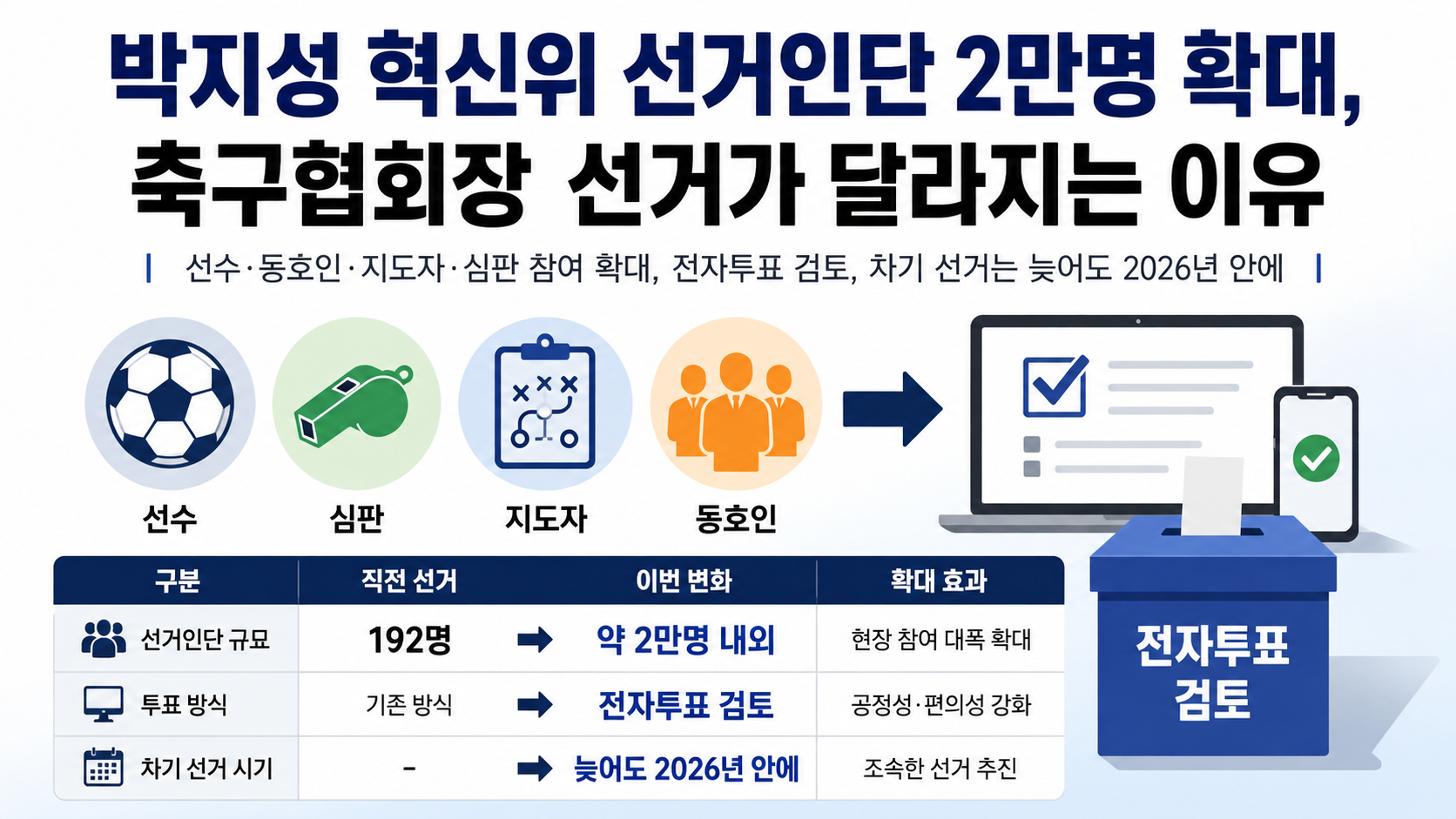
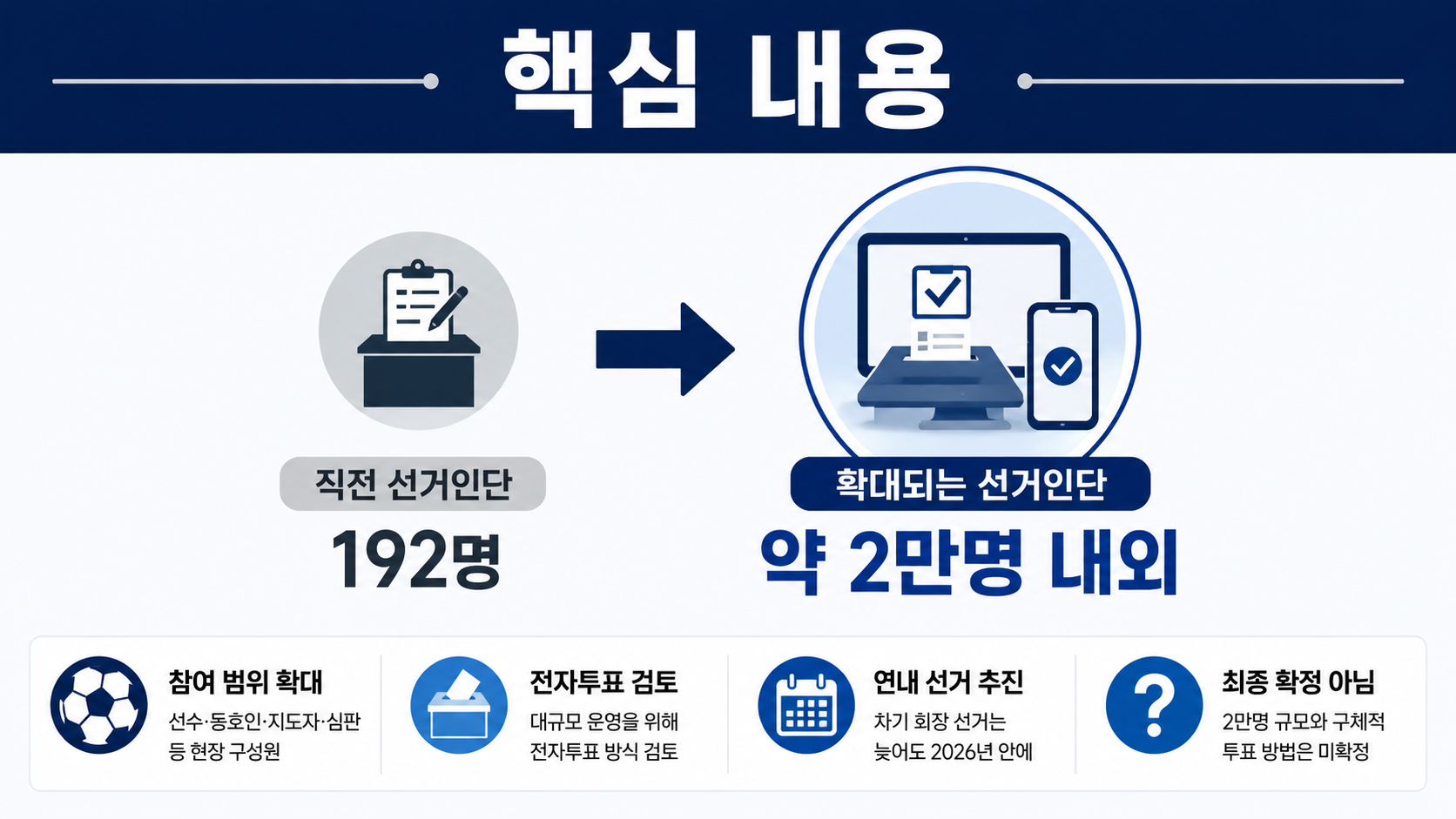
The electorate that chooses the president of the Korea Football Association (KFA) is moving toward a major expansion, from 192 voters in the previous election to approximately 2 ten-thousand voters. The K-Football Reform Committee aims to substantially increase participation among players, amateur football participants, coaches, referees, and other members of the football community. It is also considering electronic voting to manage an electorate of this size. The next presidential election is expected to take place no later than 2026, but neither the 2 ten-thousand-voter figure nor the specific voting procedures have been finalized.
What became clearer at the K-Football Reform Committee's 6th meeting, held on August 11, was more than simply the principle of increasing the number of voters. The committee discussed the implementation stage, under which the KFA would revise its articles of association and related regulations based on the committee's recommendations to prepare for an actual election, while the government and the Korean Sport & Olympic Committee would provide the necessary administrative and financial support.
Why Is the Electorate Expanding From 192 to Approximately 2 Ten-Thousand Voters?
The biggest change is the expansion of the range of football community members who can participate in choosing the association's president. The electorate for the 55th KFA presidential election, held on February 2025, consisted of 192 voters. The reform committee's current proposal, however, calls for approximately 2 ten-thousand voters.
The scale of the change becomes much clearer when expressed numerically.
Author's calculation:
20,000 ÷ 192 = approximately 104.2 times
Therefore, if the electorate is ultimately established at around 2 ten-thousand voters, it would be approximately 104 times larger than in the previous election. In terms of additional voters, the increase would be approximately 1 ten-thousand 9,808 people.
However, the 2 ten-thousand-voter figure should not be interpreted as a finalized total. According to the reform committee's estimates based on registration figures from 2025, professional players, amateur football participants, and coaches were each estimated at approximately 4–6 thousand people, alongside approximately 3 thousand registered referees and 1 thousand other members. Because duplicate registrations must be removed, the final number of eligible voters may change.
The central objective is not to reach exactly 2 ten-thousand voters. Rather, it is to move toward a system that grants voting rights to a much broader range of football community members who meet the eligibility requirements.
Does This Mean 2 Ten-Thousand Football Fans Will Vote Directly?
No. The proposal does not involve randomly recruiting 2 ten-thousand ordinary football fans and allowing them to vote.
The reform committee's publicly outlined plan would establish an electorate primarily consisting of professional players, registered amateur players, coaches, registered referees, and other qualified members of the football community operating within the KFA's organizational system. Based on registration figures from 2025, these groups together would total approximately 2 ten-thousand people.
This would represent a substantial structural change compared with the previous election.
In the 55th presidential election, the 192-member electorate consisted of ex officio delegates, including representatives of provincial and metropolitan football associations, national federations, and K League clubs, as well as players, coaches, and referees selected by lottery. A total of 183 people actually voted in that election.
The central feature of the proposed system is a major expansion of participation among football community members who satisfy defined eligibility requirements, rather than limiting participation to a relatively small number of selected representatives.
Therefore, interpreting the proposal as meaning that all 2 ten-thousand voters would be ordinary fans, or that every South Korean citizen would be entitled to vote for the KFA president, would be inconsistent with what is currently under discussion.
Will Electronic Voting Actually Be Introduced?
Electronic or online voting is a strong possibility, but as of August 11, the final voting system cannot be considered confirmed.
Election administration would inevitably need to change when the electorate expands from 192 to approximately 2 ten-thousand voters. Bringing tens of thousands of voters scattered across the country to a single location or multiple physical polling stations would create substantial time and cost burdens.
During a briefing on August 11, co-chair Park Ji-sung also explained that conducting an election using the existing method would be difficult with an electorate approaching 2 ten-thousand people. He indicated that practical reviews would be conducted, including consideration of electronic and online voting methods.
The reform committee's earlier recommendations on expanding the electorate, released on August 4, also identified the introduction of an electronic voting system and the protection of secret ballots as major priorities.
Ultimately, the important question is not simply whether voters will be able to cast ballots using their mobile phones. Detailed operating standards appropriate for a large-scale election must also be established, including voter identity verification, prevention of duplicate voting, protection of ballot secrecy, system security, and management of voting records.
Therefore, the most accurate interpretation at this stage is that electronic voting has been proposed as a direction for reform, but the final system and detailed procedures will be determined through subsequent implementation work.
When Will the Next Korea Football Association Presidential Election Take Place?
The goal announced by the reform committee on August 11 is to hold the next KFA presidential election no later than 2026. However, no specific voting date was officially confirmed that day.
The election cannot be held immediately because the reform involves more than simply changing the number of eligible voters.
To incorporate the committee's recommendations into the actual election system, the KFA must revise its articles of association and election-related regulations. The Korean Sport & Olympic Committee's rules governing member sports organizations are also connected to the expansion of the electorate. An electoral register must then be prepared.
The process can be summarized as follows.
1. The reform committee presents its recommendations and proposed direction for expanding the electorate
2. The KFA revises its articles of association and election-related regulations
3. Voting eligibility requirements and standards for compiling the electoral register are finalized
4. The actual voting method, including electronic voting, is determined
5. The election schedule and candidate registration procedures are finalized
6. The next presidential election is held
Therefore, announcing plans for an electorate of 2 ten-thousand voters does not mean that the election is ready to begin immediately.
The most specific timeline currently available is the goal of holding the election within the year. The actual election date will depend on the progress of regulatory revisions and practical preparations.
Could Expanding the Electorate From 192 to 2 Ten-Thousand Voters Really Change the Election Result?
Expanding the electorate alone does not establish that any particular candidate will gain an advantage or that the election outcome will change. However, the structure of the election itself could change significantly.
In the previous 55th election, 183 of the 192 eligible voters cast ballots, and then-candidate Chung Mong-gyu received 156 votes. At the time, the president was selected by a relatively small electorate.
If the electorate expands to approximately 2 ten-thousand voters, the range of voters that candidates must appeal to will change.
In addition to professional football officials and representatives of provincial and metropolitan organizations, professional players, grassroots football participants, coaches, and referees could account for a much larger share of the electorate. Predicting the overall outcome based on the preferences of a few groups could also become more difficult than before.
However, increasing the number of voters does not automatically guarantee fairness.
Questions must also be resolved concerning who receives voting rights, how individuals holding multiple qualifications are treated, the reference date used to finalize the electoral register, and how the secrecy and reliability of electronic voting will be protected.
For this reason, when evaluating the proposed reform, the criteria used to determine who makes up the 2 ten-thousand-voter electorate are more important than simply noting that the number has increased from 192 to 2 ten-thousand.
What Has Not Yet Been Finalized?
As of August 11, much of the overall direction and several numerical estimates have been presented, but further work is still required to finalize the detailed system.
First, the approximate 2 ten-thousand-voter figure is an estimate based on registration data from 2025. The actual number may change once overlapping qualifications are reconciled.
Although the direction toward electronic voting has become clearer, the actual system and identity verification methods have not yet been publicly finalized.
The same applies to the election date. The reform committee has indicated that the election should take place no later than the end of this year, but the specific date will depend on subsequent procedures.
Separately, the KFA's past controversy involving sexual entertainment provided to foreign referees, which also attracted attention at the meeting on August 11, is a different matter from the proposed electoral reforms. Co-chair Park Ji-sung made clear that the issue was not one for the reform committee to address directly, while also emphasizing the need to restore trust in South Korean football.
The fact that both matters were reported on the same day does not mean that the 2 ten-thousand-voter system was created because of the sexual entertainment controversy. Discussions about expanding the electorate had already progressed through earlier reform committee meetings, and recommendations for an electorate of approximately 2 ten-thousand voters had already been made public on August 4.
The Most Important Developments to Watch Next
The next key development is not the figure of 2 ten-thousand voters itself, but how the recommendations are formally incorporated into the KFA's actual election regulations.
In particular, once voting eligibility requirements and procedures for handling overlapping qualifications are published, it will become clear who can actually vote. Once the electronic voting method is finalized, it will also become possible to understand how an election involving approximately 2 ten-thousand voters will operate in practice.
Finally, an official election announcement will be needed to confirm the candidate registration schedule and actual voting date.
Based on the developments so far, the overall direction is clear. The current framework is to expand the electorate from 192 voters in the previous election to approximately 2 ten-thousand voters, substantially increase participation among players, amateur football participants, coaches, referees, and other members of the football community, consider electronic voting to accommodate the larger electorate, and hold the next KFA presidential election within 2026.
However, 2 ten-thousand voters cannot yet be regarded as the final confirmed electorate size, and the electronic voting system and exact election date remain subject to further procedures. Going forward, it will be more important to watch how the amendments to the articles of association, voting eligibility requirements, electronic voting procedures, and final election date are confirmed than simply whether the proposed electorate grows further.
---
※ This article is provided for reference purposes to help readers understand market trends and does not constitute an investment recommendation regarding any particular stock or asset. Readers are responsible for their own final decisions and investment risks.