

Why Do the Economic Effects of the Livelihood Recovery Consumption Vouchers Differ Between 43.3% and 30.9%? Differences in Calculation Methods Between KIPF and the Bank of Korea
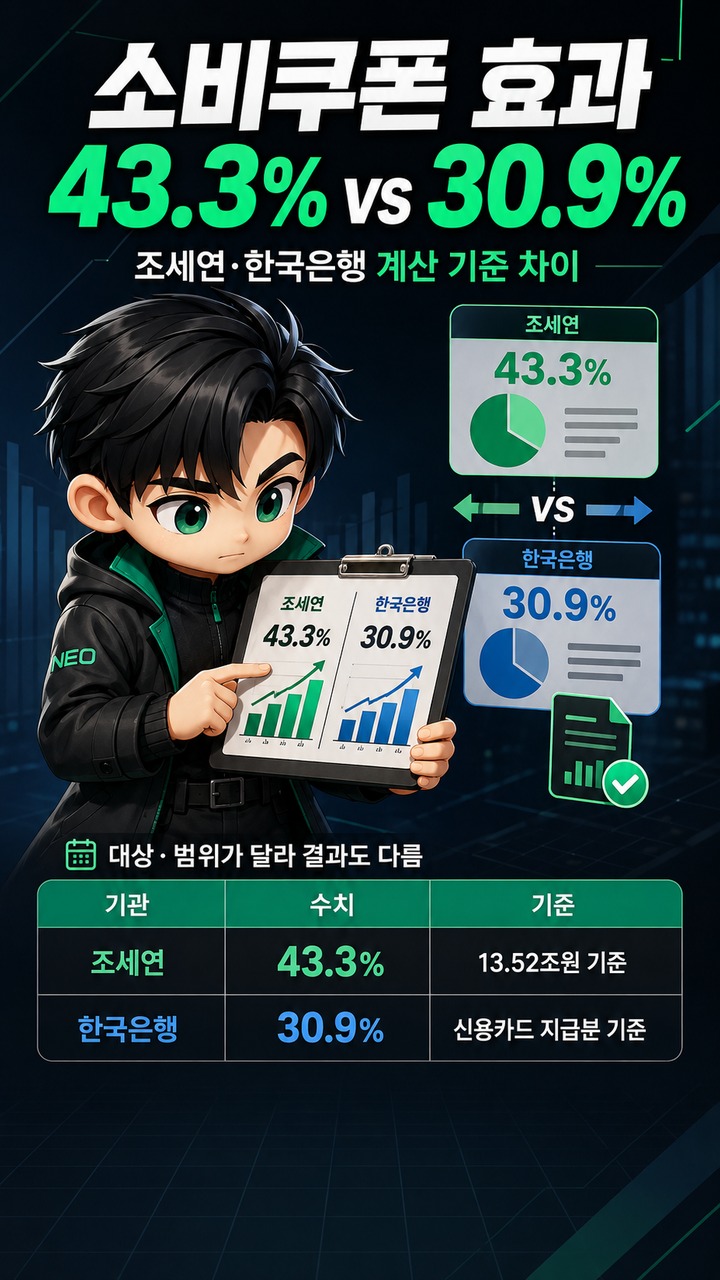
The difference between 43.3% and 30.9% in estimates of the Livelihood Recovery Consumption Voucher program's effects does not mean that either figure is incorrect. The Korea Institute of Public Finance (KIPF) and the Bank of Korea reached different results because they analyzed different populations and scopes and used different methods to calculate the effects. In particular, 43.3% represents the increase in small-business net sales relative to the total voucher distribution of KRW 13,520,000,000,000.00, while the Bank of Korea's 30.9% represents the estimated additional sales at eligible businesses based on approximately KRW 9,100,000,000,000.0 distributed through credit cards.
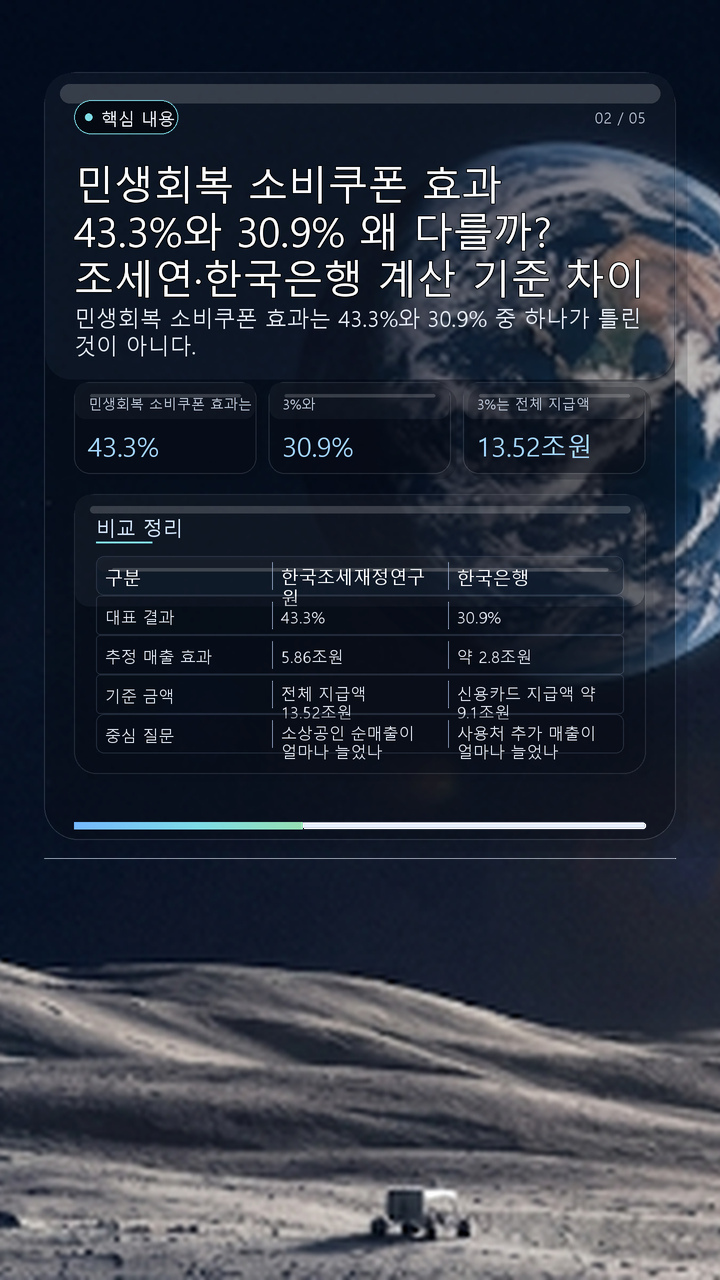
When looking up data on the consumption voucher program's effects in 2026, two sets of figures appear: KRW 5,860,000,000,000.00 and 43.3%, and KRW 2,800,000,000,000.0 and 30.9%. Although both studies examined the Livelihood Recovery Consumption Voucher program implemented in 2025, understanding why their results differ requires examining their calculation methods.
43.3% Represents a KRW 5,860,000,000,000.00 Increase in Net Sales Out of KRW 13,520,000,000,000.00
According to the findings of a commissioned study by the Korea Institute of Public Finance, released by the Ministry of the Interior and Safety on 2026-05-11, the distribution of KRW 13,520,000,000,000.00 in consumption vouchers was estimated to have increased small-business net sales by KRW 5,860,000,000,000.00.
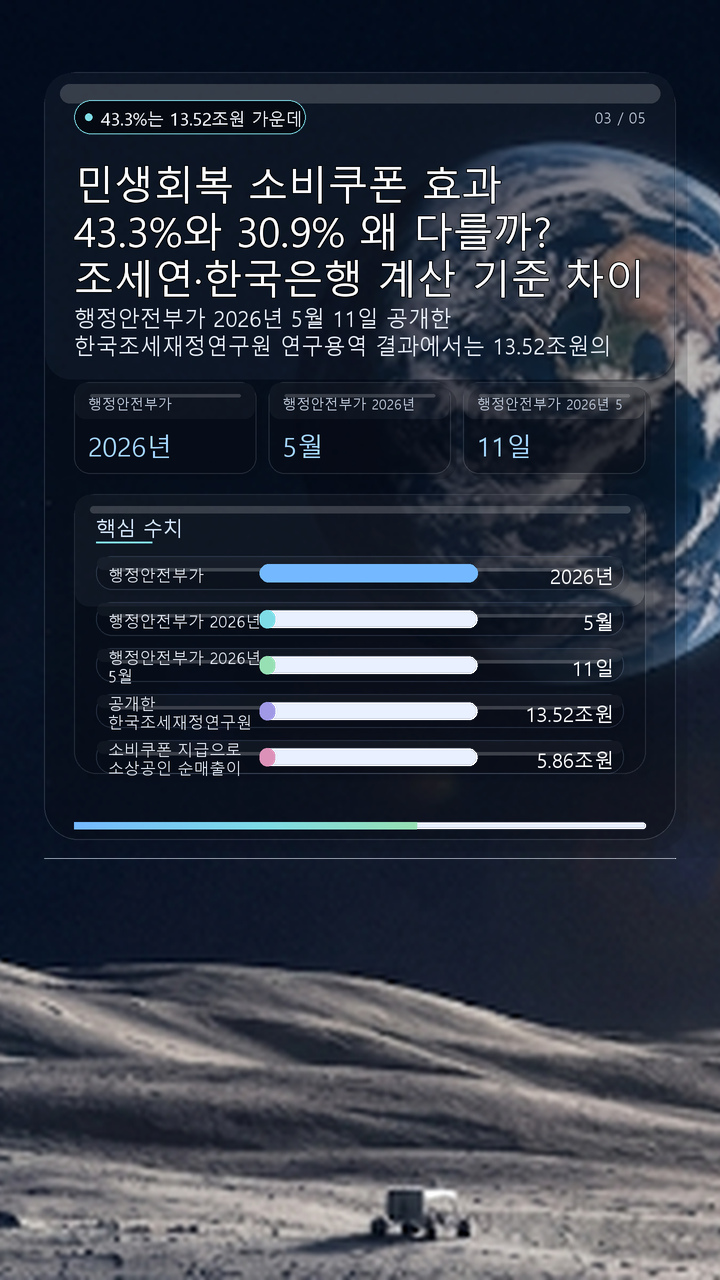
The calculation is as follows.
KRW 5,860,000,000,000.00 ÷ KRW 13,520,000,000,000.00 × 100 ≈ 43.3%
In other words, the estimated increase in small-business net sales was equivalent to 43.3% of the total amount distributed through the voucher program. The Ministry of the Interior and Safety explained that the study used payment data from 6 major credit card companies, covering 74.23% of total credit card transaction value.
43.3% should not be interpreted as meaning that 'if the government distributes KRW 1,000,000, a particular store will necessarily earn an additional KRW 433,000.' It is an estimate of the overall policy effect, based on data from multiple regions and industries and compared with what would have happened without the policy.
Why Did the Bank of Korea Calculate 30.9% and KRW 2,800,000,000,000.0?
On 2026-06-10, the Bank of Korea published a separate report titled 'Assessment of the Economic Effects of the Livelihood Recovery Consumption Vouchers.' It estimated that average monthly sales at an individual business accepting the vouchers increased by 2.91% more than at businesses that did not accept them. Aggregating this effect nationwide, it calculated additional sales of approximately KRW 2,800,000,000,000.0.
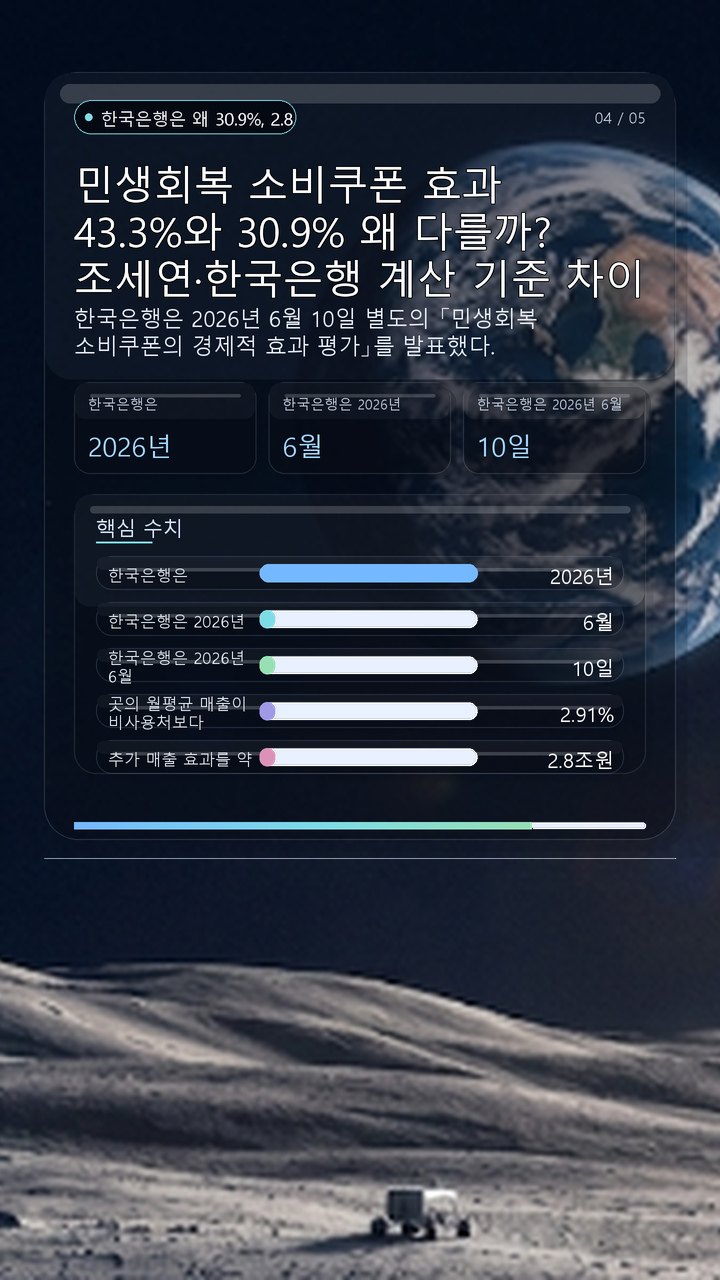
The crucial difference is the denominator.
The Bank of Korea's sales-effect calculation was based not on the total voucher distribution of KRW 13,520,000,000,000.00, but on approximately KRW 9,100,000,000,000.0 distributed through credit cards. Local gift certificates and prepaid cards were excluded from this sales analysis.
KRW 2,800,000,000,000.0 ÷ KRW 9,100,000,000,000.0 × 100 ≈ 30.8%
When rounded, this matches the 30.9% reported by the Bank of Korea. The central bank also noted that alternative analytical methods could produce estimates of additional sales ranging from 1.4 trillion to KRW 3,600,000,000,000.0, corresponding to a range of 16.1 to 39.8%.
Why 43.3% and 30.9% Should Not Be Compared Directly
At first glance, the difference is 12.4% percentage points.
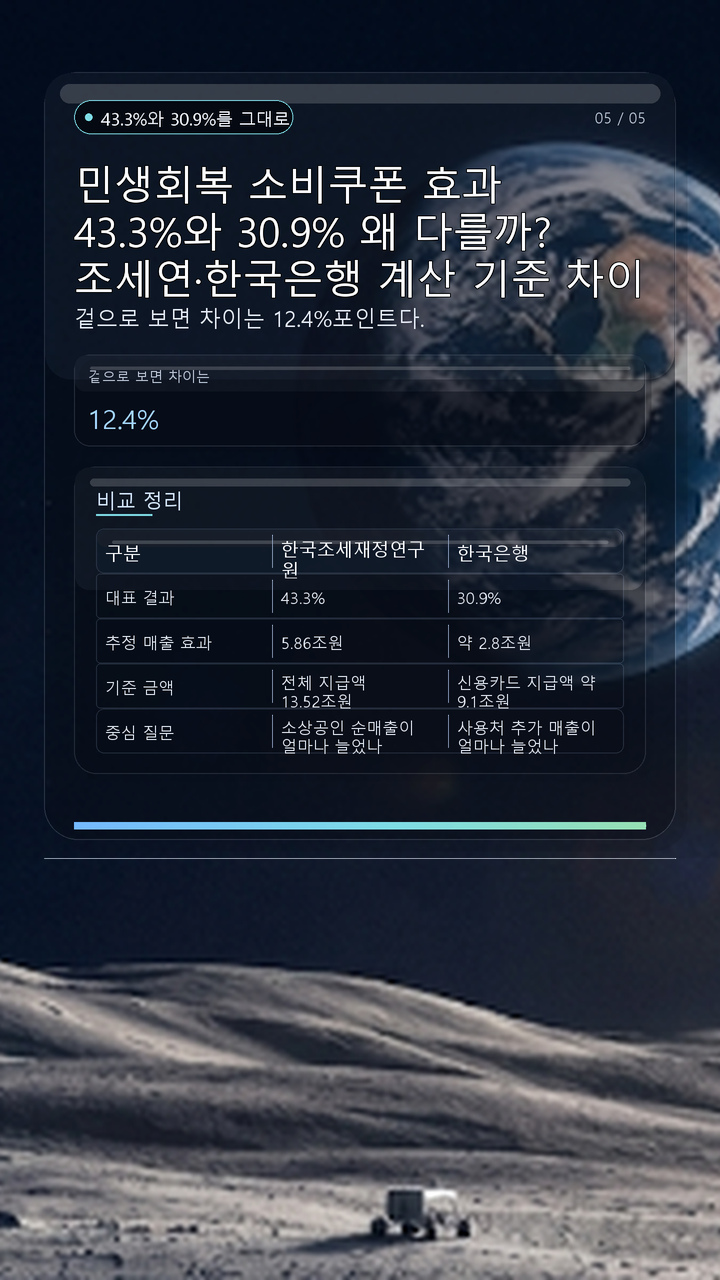
43.3% - 30.9% = 12.4%p
The estimated amounts, KRW 5,860,000,000,000.00 and KRW 2,800,000,000,000.0, also differ by KRW 3,060,000,000,000.00. However, it would be inaccurate to interpret this difference as meaning that 'one study estimated the voucher program's effects to be KRW 3,060,000,000,000.00 greater than the other.'
The Bank of Korea focused on businesses eligible to accept the vouchers, comparing their actual sales with the sales expected in the absence of the program to estimate the direct sales effect at participating businesses. By contrast, researchers explained that the Korea Institute of Public Finance study used an approach designed to capture broader spillover effects on small-business sales across local economies. The two studies therefore differed in analytical scope. The composition of the credit card companies included in their datasets also differed somewhat.
| Category | Korea Institute of Public Finance | Bank of Korea |
|---|---|---|
| Headline result | 43.3% | 30.9% |
| Estimated sales effect | KRW 5,860,000,000,000.00 | Approximately KRW 2,800,000,000,000.0 |
| Reference amount | Total voucher distribution of KRW 13,520,000,000,000.00 | Approximately KRW 9,100,000,000,000.0 distributed through credit cards |
| Main question | How much did small-business net sales increase? | How much additional revenue did voucher-accepting businesses generate? |
Therefore, the two figures are not directly comparable results calculated using the same denominator and analytical scope.
34.7% Also Appears, but It Measures Something Different
Another figure, 34.7%, also appears in reports about the consumption voucher program. It can easily be confused with 43.3% and 30.9%, but it answers a different question.
In the Korea Institute of Public Finance study released by the Ministry of the Interior and Safety, 34.7% represents the proportion of the voucher distribution that translated into additional consumer spending, measured from the consumer perspective. It is not the same indicator as 43.3%, which measures the effect on small-business net sales.
The key is to identify what each figure measures before interpreting it.
43.3% = Increase in small-business net sales; 30.9% = Additional sales at eligible businesses estimated by the Bank of Korea based on credit-card-distributed vouchers; 34.7% = Additional consumption effect from the consumer perspective
Ranking these three figures solely by their size can easily lead to a misleading interpretation of the policy's effectiveness.
Which Figure Should Be Used to Evaluate the Consumption Voucher Program's Effects?
The appropriate indicator depends on the purpose of the analysis.
To understand how much the voucher program affected small-business sales across local economies, the Korea Institute of Public Finance's findings of KRW 5,860,000,000,000.00 and 43.3% provide a useful reference. To examine the direct additional sales generated by businesses eligible to accept the vouchers within a narrower scope, it is appropriate to consider the Bank of Korea's estimates of approximately KRW 2,800,000,000,000.0 and 30.9% alongside them.
The two studies also identified common findings. Both observed an increase in sales following voucher use, with relatively stronger effects in regions outside the Seoul metropolitan area than within it. The Bank of Korea found that the effects were concentrated in the initial period following distribution and lasted for a relatively short time.
Ultimately, the question 'What percentage effect did the Livelihood Recovery Consumption Voucher program have?' cannot be answered accurately by citing a single figure without explaining what was measured, which payment methods were included, and the scope of the analysis. The difference between 43.3% and 30.9% is not a simple reporting error involving the same statistic. It reflects the different analytical designs used by the two institutions.
※ This article is provided for informational purposes to help readers understand market trends and does not constitute investment advice or a recommendation to buy any particular stock or asset. Readers are responsible for their own final investment decisions.