

U.S. Stock Trailing Stop 5%: If You're Already in Profit, How Far Below the High Will Your Shares Be Sold?
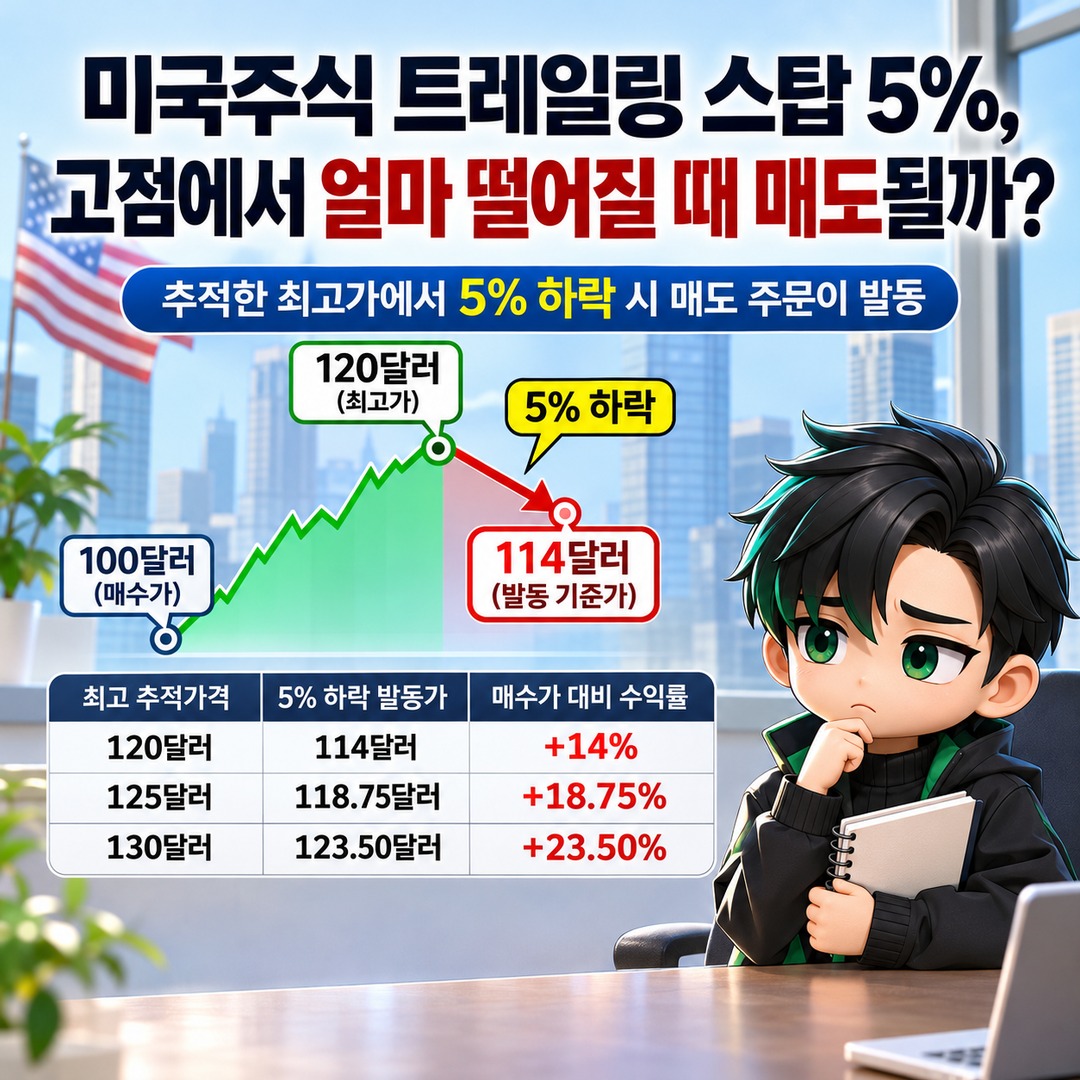
When you set a sell trailing stop of 5% for a U.S. stock, the sell order is triggered when the price falls by 5% from the highest reference price tracked after the order becomes active. If the stock rises from USD 100 to USD 120, the trigger price is USD 114. However, there is no guarantee that the shares will actually be sold at USD 114.
Based on 2026-11-01, a review of investor guidance from the U.S. Securities and Exchange Commission (SEC) and order explanations from U.S. brokerage Charles Schwab reveals two key distinctions that matter most when using trailing stops.
First, 5% is the percentage decline from the highest reference price tracked after the order becomes active, not the percentage loss relative to your purchase price.
Second, the price that triggers a sell order and the actual execution price can be different.
Understanding this distinction makes it possible to estimate how much profit you might retain when setting a trailing stop on a U.S. stock that is already generating a return.
If You Bought a Stock at USD 100 and It Is Now at USD 120, the 5% Trailing Stop Is USD 114
If you purchased a U.S. stock at USD 100 and its current reference price is USD 120, the initial trigger price will be USD 114 if you set a sell trailing stop of 5% at that point. The trigger price rises as the stock climbs further, but it does not move downward when the stock price falls.
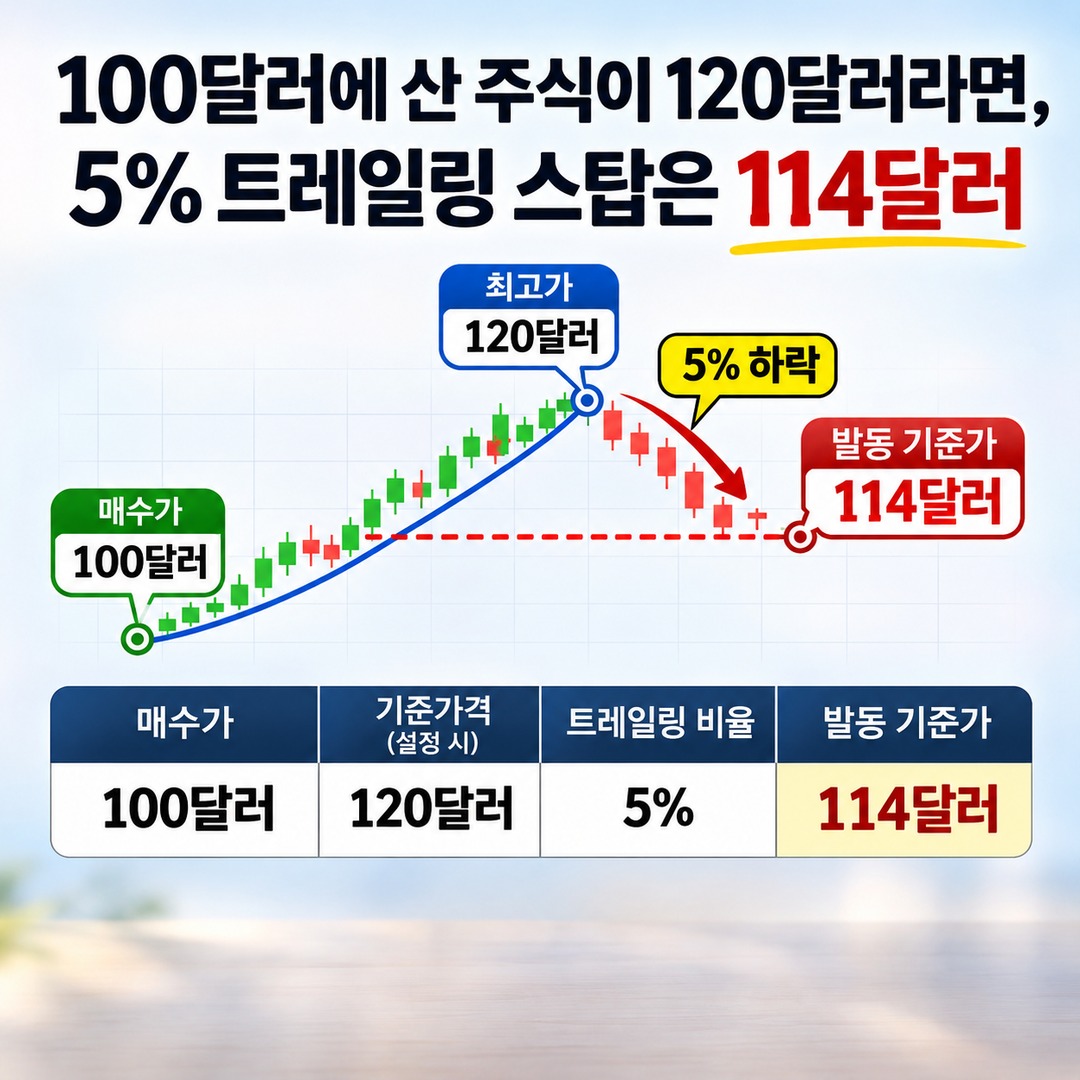
The calculation is as follows.
Trailing stop trigger price = Highest price tracked after order activation × (1 − 0.05)
As a hypothetical example, suppose an investor purchases 10 shares of a U.S. stock at USD 100 per share and sets a trailing stop of 5% when the stock price reaches USD 120.
Purchase price# USD 100
Reference price when the order is placed# USD 120
Trailing percentage# 5%
Initial sell trigger price# USD 114
USD 120 × 0.95 = USD 114
If the reference price never rises above USD 120 after the order becomes active and instead declines, the sell order is triggered as soon as the price reaches USD 114.
Assuming the shares are actually executed at USD 114, the investor makes a profit of USD 14 per share compared with the purchase price of USD 100. For 10 shares, that amounts to USD 140, representing a return of 14% relative to the purchase price.
These figures are the author's calculations and exclude commissions, taxes, and exchange rate fluctuations. Actual profits will vary if the execution price differs.
If the Stock Rises Further to USD 130, the Sell Trigger Price Also Increases to USD 123.50
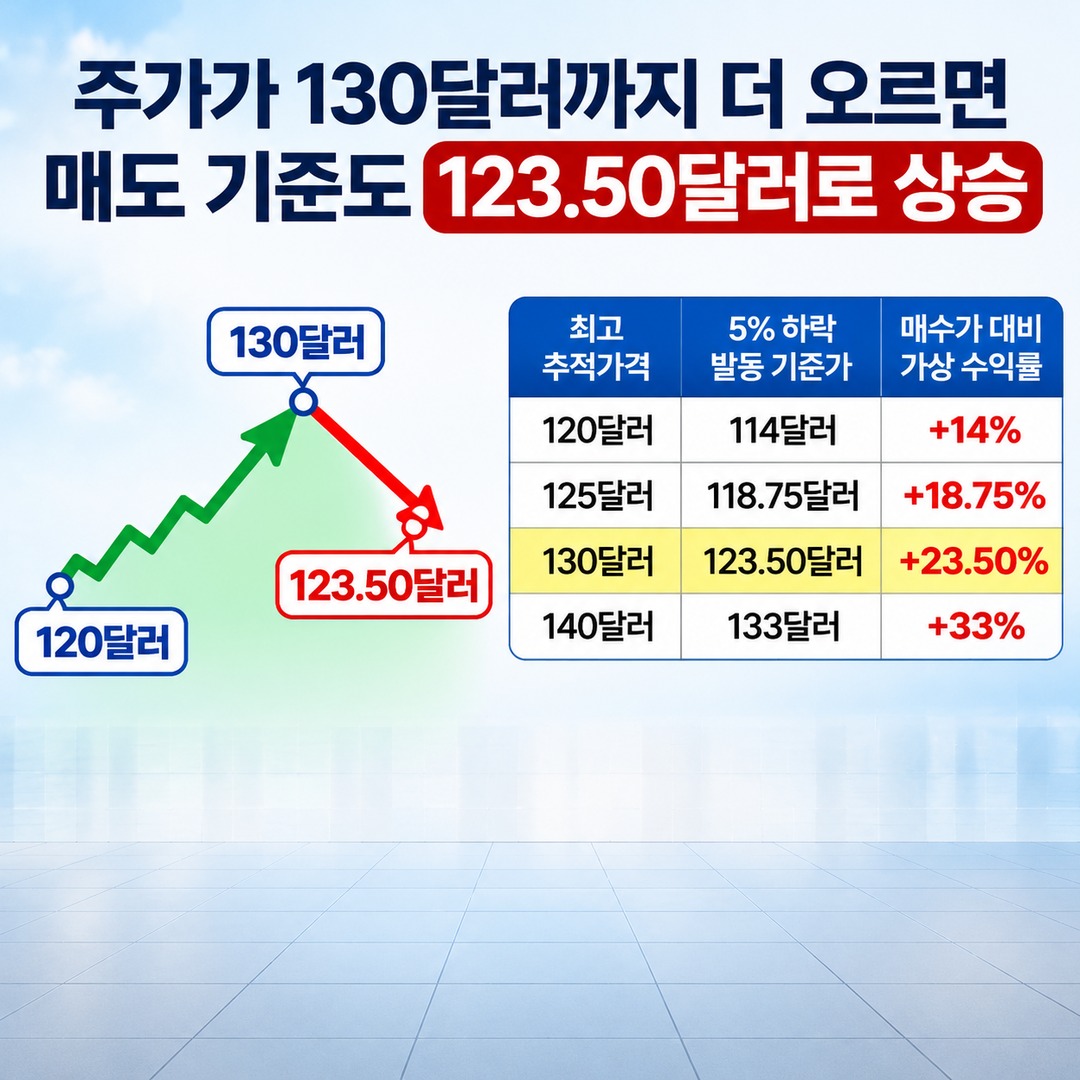
A trailing stop automatically adjusts its trigger price when the stock moves in a favorable direction. If the order is initially placed at USD 120 and the reference price subsequently rises to USD 130, the 5% decline threshold increases to USD 123.50.
The following table shows hypothetical calculations assuming that the reference price rises and then falls while the order remains untriggered.
| Highest price tracked after placing the order | Trigger price after a 5% decline | Hypothetical return relative to the USD 100 purchase price |
|---|---|---|
| USD 120 | USD 114 | +14% |
| USD 125 | USD 118.75 | +18.75% |
| USD 130 | USD 123.50 | +23.50% |
| USD 140 | USD 133 | +33% |
Author's calculations. The return in each row assumes that the order is executed at exactly the trigger price. Actual returns are not guaranteed. Hypothetical price movement: The price rises to USD 130 after the order is placed at USD 120.
Hypothetical stock price movementConceptual trigger price lineThis is a conceptual illustration for explanatory purposes, not actual market prices or brokerage order records. The scale is not precisely proportional. The important point is that even if the stock falls from USD 130 to USD 127, the sell trigger price does not move back down.
After the reference price rises to USD 130, a subsequent decline to USD 123.50 triggers the sell order.
Charles Schwab's explanation of trailing stop orders also describes a sell trailing stop as following the reference price upward while maintaining the existing trigger price during a decline.
However, the specific price used for tracking, such as the latest execution price or the bid price, may differ between brokerages.
If You're Already Up 20%, Does a Previous All-Time High Also Apply?
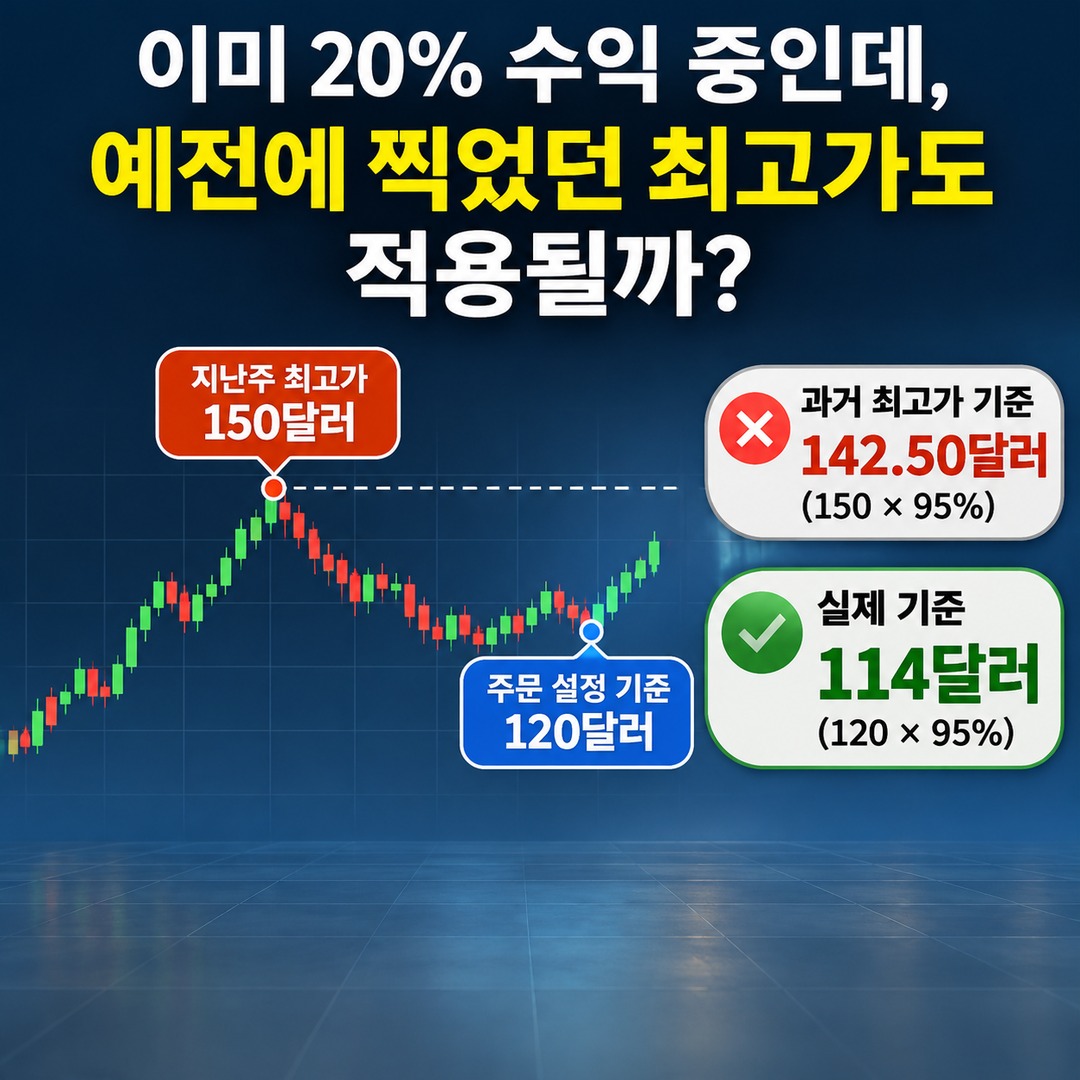
When calculating the highest price for a trailing stop, the general rule is to use the tracked price after the order becomes active. A stock's previous historical high is not automatically applied retroactively.
Consider the following hypothetical situation.
Purchase price: USD 100
Previous week's high: USD 150
Reference price when placing the current order: USD 120
Newly placed sell trailing stop: 5%
Under a typical order structure, the initial trigger price is not USD 142.50, which is 95% below the previous high of USD 150. Instead, it is USD 114, which is 95% below the current reference price of USD 120.
Charles Schwab explains that the initial reference point for a trailing stop is the reference quote at the time the order is first activated.
Therefore, even if a stock is already profitable, what matters is when you placed the order, not its previous highest price.
However, the order activation timing and reference-price calculation method should be verified with your brokerage's system.
If the Price Falls by 5%, Will the Stock Be Sold Immediately? Trigger Price vs. Actual Execution Price
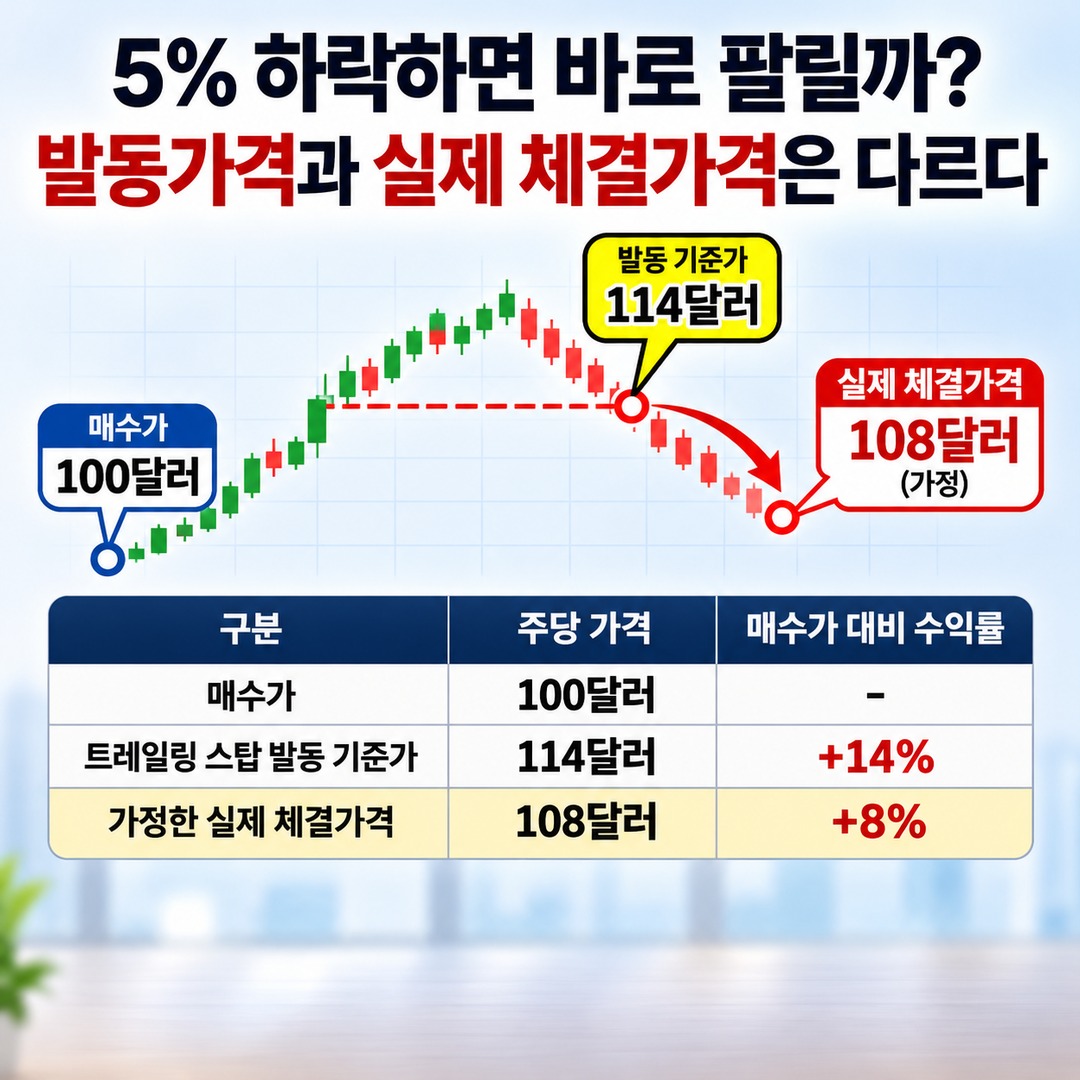
A standard sell trailing stop generally converts into a market sell order once the specified decline is reached. Therefore, even if the trigger price is USD 114, the actual selling price is not necessarily USD 114.
The U.S. SEC's investor guidance on stop, stop-limit, and trailing stop orders, updated on 2026-08-18, explains the distinction between an order's trigger price and its actual execution price.
In particular, if the stock price falls sharply, a market order may execute at a lower price than expected.
Consider a hypothetical example in which the trigger price is USD 114, but a sharp decline causes the next available trading price to become USD 108.
| Category | Price per Share |
|---|---|
| Purchase price | USD 100 |
| Trailing stop trigger price | USD 114 |
| Assumed actual execution price | USD 108 |
| Actual return relative to purchase price | +8% |
If the order executes at USD 114, the profit is 14%. However, if it executes at USD 108, the profit is 8%.
This is a hypothetical calculation, not an actual trading result.
If a larger price gap occurs, the order could even execute below the purchase price. A trailing stop does not guarantee profits or limit maximum losses to 5%.
Trailing Stop vs. Stop-Limit: Which Order Gets Executed During a Sharp Decline?
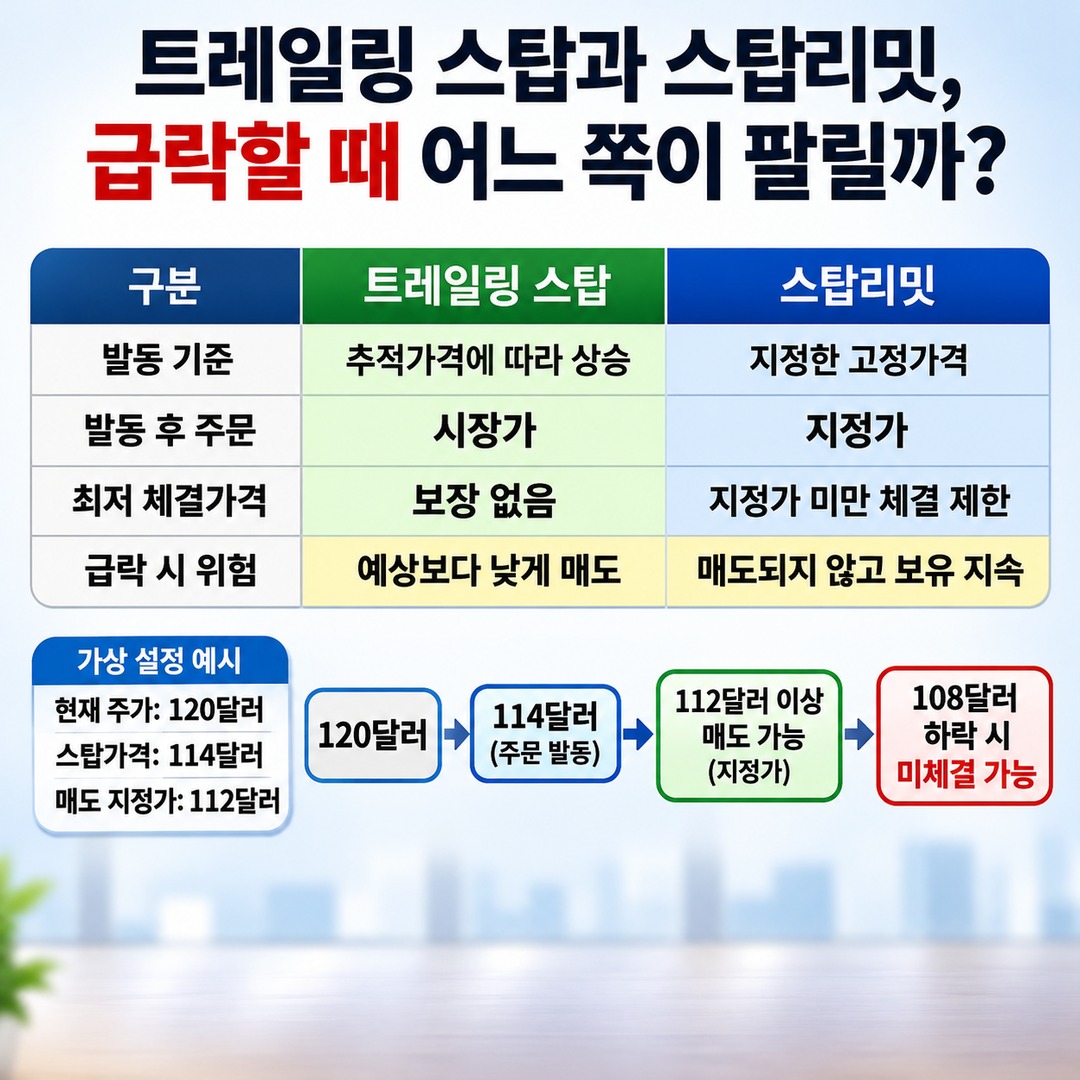
The key difference between a trailing stop and a stop-limit order is whether the order becomes a market sell order after being triggered or can only be sold at or above a specified price.
A standard trailing stop converts into a market order, so the execution price may vary. A stop-limit order, on the other hand, protects the specified minimum selling price but may not execute at all.
| Category | Trailing Stop | Stop-Limit |
|---|---|---|
| Trigger condition | Rises with the tracked price | Fixed specified price |
| Order after triggering | Market order | Limit order |
| Minimum execution price guaranteed | No | Execution below the limit price is restricted |
| Risk during a sharp decline | May sell below expectations | Order may remain unfilled, leaving shares in your portfolio |
Let's examine the difference with a specific numerical example.
Assume, hypothetically, that the current stock price is USD 120 and you place the following order.
Stop price: USD 114
Sell limit price: USD 112
When the stock reaches USD 114 and the order is triggered, a limit order is submitted that can only sell at USD 112 or higher.
However, if the market price quickly falls to USD 108 and no trades occur at or above USD 112, the sell order may remain unfilled.
The Financial Industry Regulatory Authority (FINRA) also explains in its order-type guidance that stop-limit orders restrict the execution price but carry the risk that the trade may never be executed.
There is one more order type worth distinguishing.
A Trailing Stop Limit uses a trailing mechanism to adjust the trigger price, but submits a limit order after the trigger is reached.
Therefore, a standard stop-limit and a trailing stop limit are not the same order type. You should separately check the order types available in your brokerage app and how their limit prices are calculated.
Will a Stock Be Sold Automatically If It Plunges by 5% Before or After Regular Trading Hours?
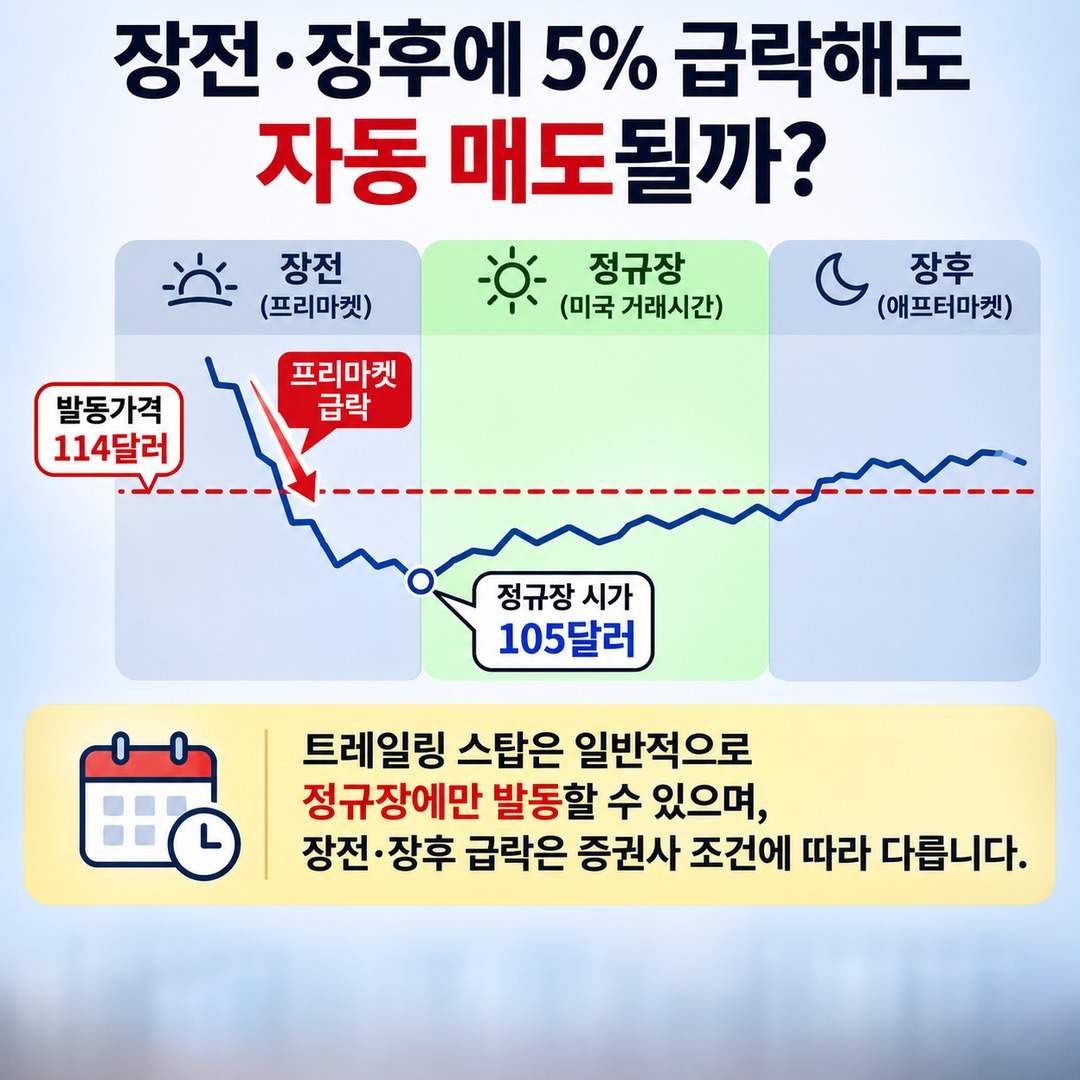
Whether a trailing stop works during premarket or after-hours trading depends on the order conditions supported by your brokerage. A stock price crossing the trigger level outside regular trading hours does not mean that every brokerage will immediately execute a sale.
Charles Schwab's explanation of trailing stops states that standard orders of this type are generally triggered during regular U.S. trading hours and do not trigger during premarket or after-hours sessions.
Therefore, when Korean investors set trailing stops on U.S. stocks, they should distinguish between the following conditions.
Whether the order tracks prices only during regular trading hours
Whether the order can also trigger during premarket and after-hours trading
Whether the order is valid for the current day only or remains active until canceled
Whether the trigger is based on executed trade prices or quoted prices
For example, suppose the trailing stop trigger price, based on the previous day's regular trading session, was USD 114, but the next regular session opens at USD 105.
If the order is triggered after the regular session opens, it may execute at a price lower than USD 114.
Therefore, around U.S. stock earnings announcements or significant corporate disclosures, you should not assume that simply placing an order guarantees your desired selling price.
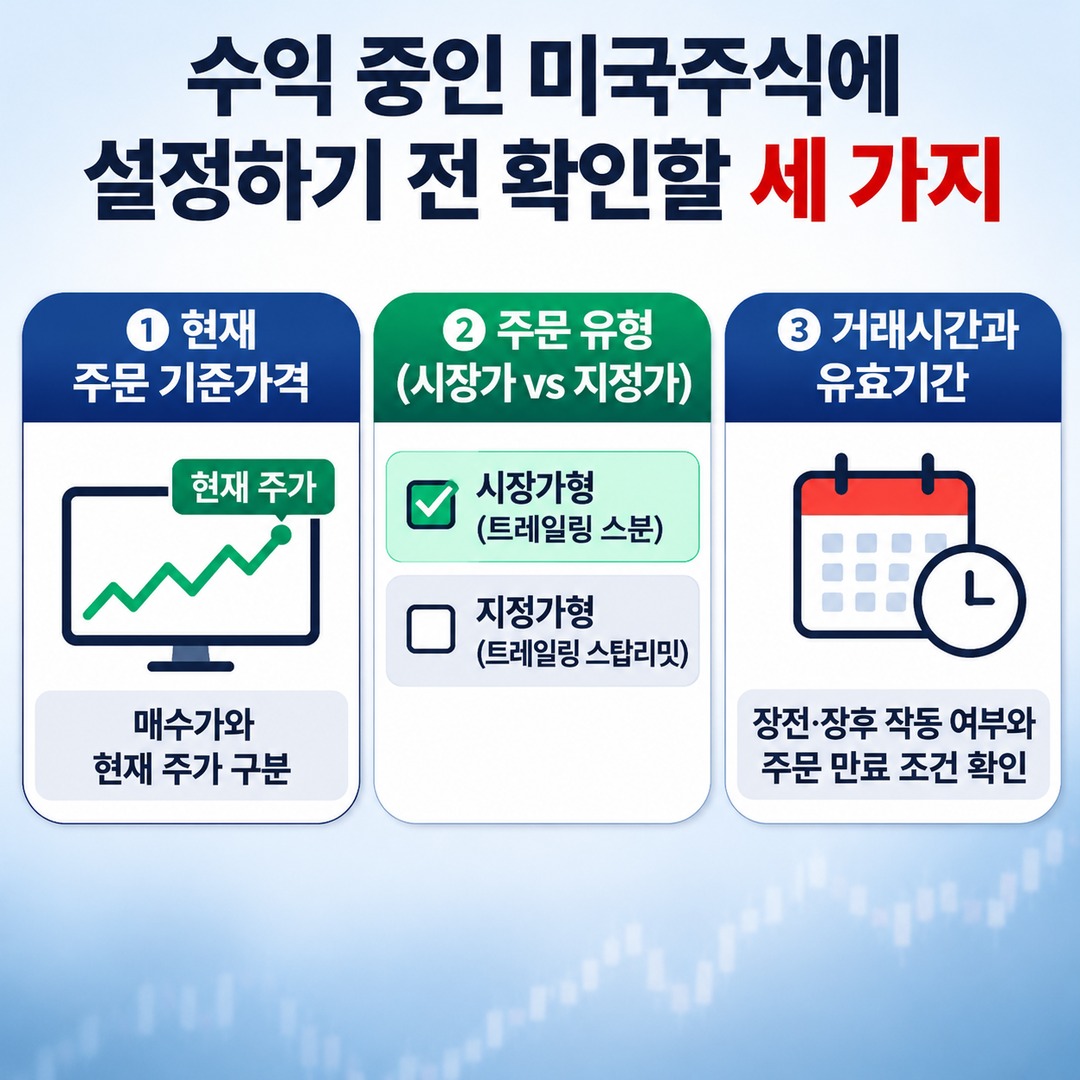
Three Things to Check Before Setting a Trailing Stop on Profitable U.S. Stocks
Before setting a trailing stop of 5%, it is more useful to check the order's trigger conditions and execution rules than to focus solely on your current return.
First, check the current reference price used by the order. Confusing the purchase price with the current stock price will lead to an incorrect estimate of the expected selling threshold.
Second, determine whether the order is market-based or limit-based. A standard trailing stop and a trailing stop limit can produce different results after the order is triggered.
Third, check trading hours and order duration. Whether the order works during premarket and after-hours sessions, as well as its expiration conditions, must be verified with the brokerage you actually use.
A trailing stop 5% is a condition that initiates the selling process when the price falls by 5% from its highest tracked price. It is not a mechanism that guarantees a loss of exactly 5% from the peak price.
To determine how much of your current gains you want to protect, you need to distinguish between your purchase price, the reference price when the order becomes active, the 5% trigger price, and the risk of execution during a sharp decline.
Before placing the actual order, the final step is to check the trigger price and order type on the order confirmation screen in your brokerage app.
※ This article is for informational purposes to help readers understand market movements and does not constitute an investment recommendation for any specific stock or asset. You are solely responsible for your final decisions and investment outcomes.