

The U.S. Fed Raised Rates by 0.25% Points, but Treasury Yields Fell: Markets Focused More on the ‘Next Hike’
이 포스팅은 쿠팡 파트너스 활동의 일환으로, 이에 따른 일정액의 수수료를 제공받습니다.
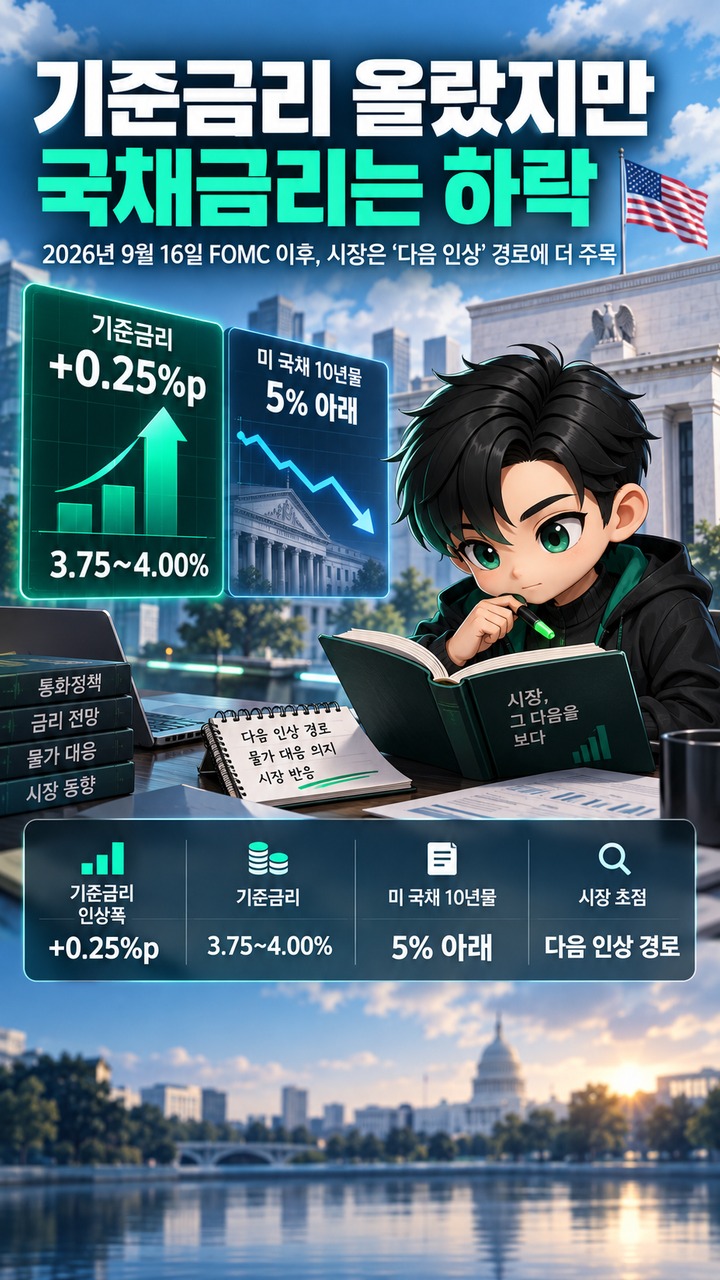
The U.S. Federal Reserve raised its benchmark interest rate by 0.25% points to 3.75–4.00% on 2026-09-16. Yet the following day, the yield on 10-year U.S. Treasuries fell back below 5%. While markets had largely anticipated the rate hike itself, the movement reflected the greater influence of expectations about the future path of policy rates and the Fed's commitment to combating inflation on bond prices.

What Was Confirmed This Time Was a 0.25%-Point Rate Hike
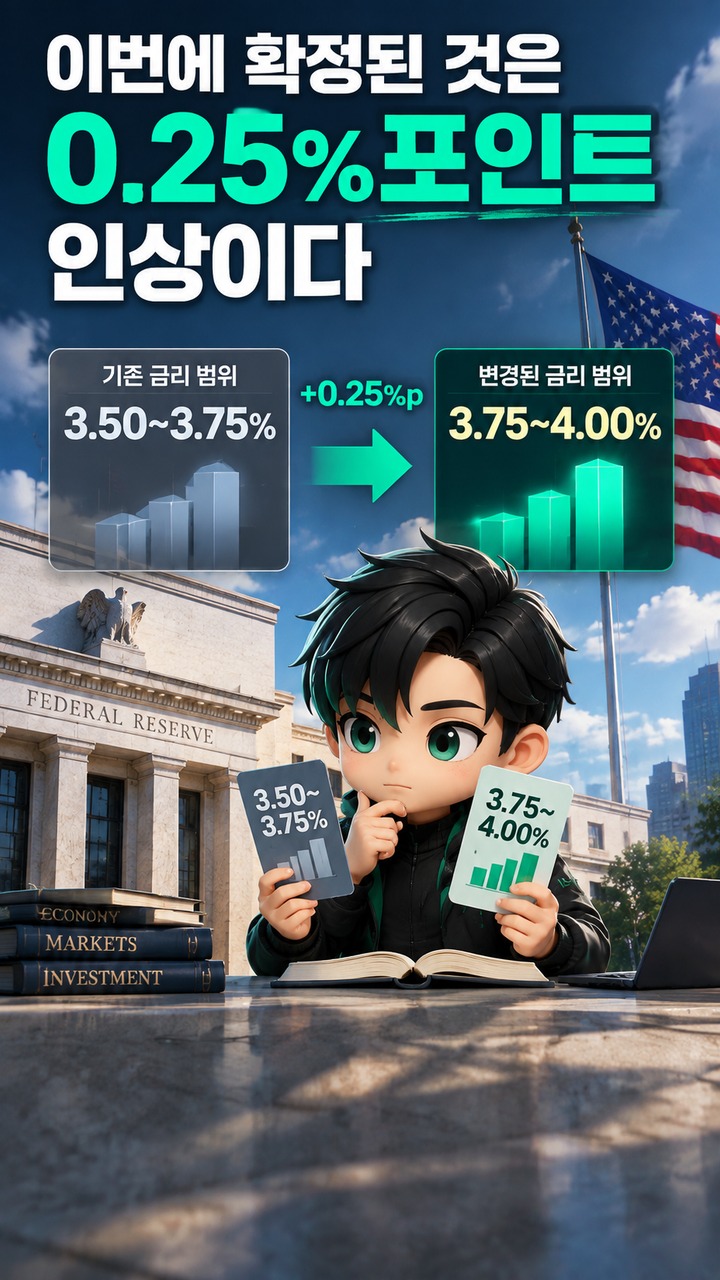
The Federal Open Market Committee (FOMC) raised its target range for the federal funds rate from 3.50–3.75% to 3.75–4.00%. All 12 voting members supported the increase.
The Fed assessed that U.S. economic activity was expanding at a solid pace and that domestic spending remained resilient. At the same time, it judged inflation to be persistently elevated.
The change confirmed by this decision is clear.
The benchmark rate, which had fallen to 3.50–3.75% in December 2025, rose again to 3.75–4.00% in September 2026. It was also the first benchmark rate increase since July 2023.
Why Didn't Treasury Yields Keep Rising Immediately?

Raising the policy rate does not mean that U.S. Treasury yields across all maturities will move in the same direction or by the same amount. Treasury yields reflect not only the current benchmark rate but also expectations for future policy rates, inflation, economic conditions, and bond supply and demand.
According to U.S. Treasury data for September 16, yields stood at 4.74% for 2-year Treasuries, 5.01% for 10-year Treasuries, and 5.35% for 30-year Treasuries.
During European morning trading on September 17, the 2-year yield fell to 4.707%, while the 10-year yield declined to around 4.989%. In particular, the 10-year yield dropped back below 5%.
Therefore, interpreting this movement simply as 'the Fed raised rates, but bond yields moved in the opposite direction' misses an important part of the story. Immediately after the Fed's announcement, reactions differed across maturities, with the 2-year yield rising, for example.
This is because shorter-term securities are more sensitive to expected changes in the Fed's policy rate, while longer-term securities also reflect long-term inflation and growth expectations.
The More Important Number Than 0.25% Points Is the Year-End Projection of 4.1%
In the September economic projections, the median estimate among FOMC participants for the appropriate federal funds rate at the end of 2026 was 4.1%. This is higher than 3.875%, the midpoint of the current target range.
This means the current 3.75–4.00% range cannot necessarily be regarded as the final level of this rate-hiking cycle.
The change becomes clearer when the Fed's projections are compared with those from June.
In June, the median policy rate projection for the end of 2026 was 3.8%, but it rose by 0.3% points to 4.1% in September. The projection for the end of 2027 also increased from 3.6% to 4.1%.
Therefore, what markets need to assess is not just this single 0.25%-point increase, but the level at which the policy rate will eventually peak.
However, 4.1% is not a confirmed future benchmark rate. It is the median of the policy paths FOMC participants currently consider appropriate based on their economic outlooks, and the Fed has explicitly stated that considerable uncertainty surrounds the future rate path.
Inflation Projections Also Matter
The Fed's median projection for personal consumption expenditures (PCE) inflation in 2026 is 3.7%. This is above the Fed's longer-run inflation target of 2%.
Even more notable is the direction of the risks surrounding those projections.
Of the 18 participants contributing to the September projections, 17 judged the risks to their PCE inflation forecasts to be tilted to the upside. For core PCE inflation, 15 out of 18 participants also saw greater upside risks.
Meanwhile, the median projection for real GDP growth in 2026 was 2.3%, and the unemployment rate projection was 4.1%.
To understand why the Fed raised rates, it is important to consider not only whether the economy is deteriorating so rapidly that rates will need to be cut again, but also how quickly elevated inflation can be brought down while the economy remains resilient.
Does This Confirm the Start of a Tightening Cycle?
A single rate increase is not enough to conclude that a prolonged cycle of consecutive rate hikes has been confirmed.
What is confirmed is that the Fed raised rates by 0.25% points and presented 4.1% as the median policy rate projection for the end of 2026. Because that figure is higher than the midpoint of the current target range, the economic projections leave room for additional increases.
However, the Fed's policy rate projections are not a predetermined schedule. If inflation and economic conditions change, its assessment of the appropriate interest rate may also change.
Therefore, rather than saying that a tightening cycle has been confirmed, the available evidence more accurately supports the conclusion that the first rate hike in approximately 3 years has occurred, and Fed participants' projected policy paths have shifted toward including the possibility of further tightening.
Why You Shouldn't Look at Only 10-Year Treasuries When Assessing U.S. Bonds
Following this FOMC meeting, it is important to examine both 2-year and 10-year Treasury yields.
The 2-year yield is relatively sensitive to expectations about the Fed's future policy rates. By contrast, the 10-year yield reflects a wider range of factors, including long-term growth, inflation, and the term premium, as well as policy rates.
According to U.S. Treasury data for September 16, the 2-year yield was 4.74%, while the 10-year yield was 5.01%. The difference between the two yields was 0.27% points, or 27bp. This is the author's calculation using the two published figures.
A situation like this one, in which the benchmark rate rises but the 10-year yield falls in the next trading session, is not a contradiction. Markets simultaneously price in the already-known current rate increase and the expected future path of interest rates across different maturities.
Dates and Figures to Watch Next
The Fed's next regularly scheduled FOMC meeting is set for October 2026 27–28, followed by another meeting on December 8–9.
Going forward, rather than focusing only on whether the 10-year U.S. Treasury yield rose or fell on a particular day, investors should examine whether the Fed's projected policy path is actually changing. Particularly important will be upcoming inflation data, movements in 2-year and 10-year yields, and whether the policy rate path is revised again in the December economic projections.
Based solely on the figures confirmed so far, the more significant change than the 0.25%-point increase in September is that the median policy rate projection for the end of 2026 rose from 3.8% in June to 4.1% in September.
In U.S. Treasury investing, the basic relationship is that when yields rise, the prices of existing bonds fall, and when yields decline, the prices of existing bonds rise. However, actual investment returns can vary depending on bond maturity, purchase price, exchange rates, holding period, and other factors. It is therefore difficult to judge investment outcomes based solely on a single day's movement in market yields.
※ This article is provided for informational purposes to help readers understand market developments and does not constitute an investment recommendation regarding any specific security or asset. Final investment decisions and responsibility rest with the individual investor.
Related Articles
이 포스팅은 쿠팡 파트너스 활동의 일환으로, 이에 따른 일정액의 수수료를 제공받습니다.