

U.S. August Employment Rises by 162, While July Figures Are Revised From Negative to Positive
이 포스팅은 쿠팡 파트너스 활동의 일환으로, 이에 따른 일정액의 수수료를 제공받습니다.
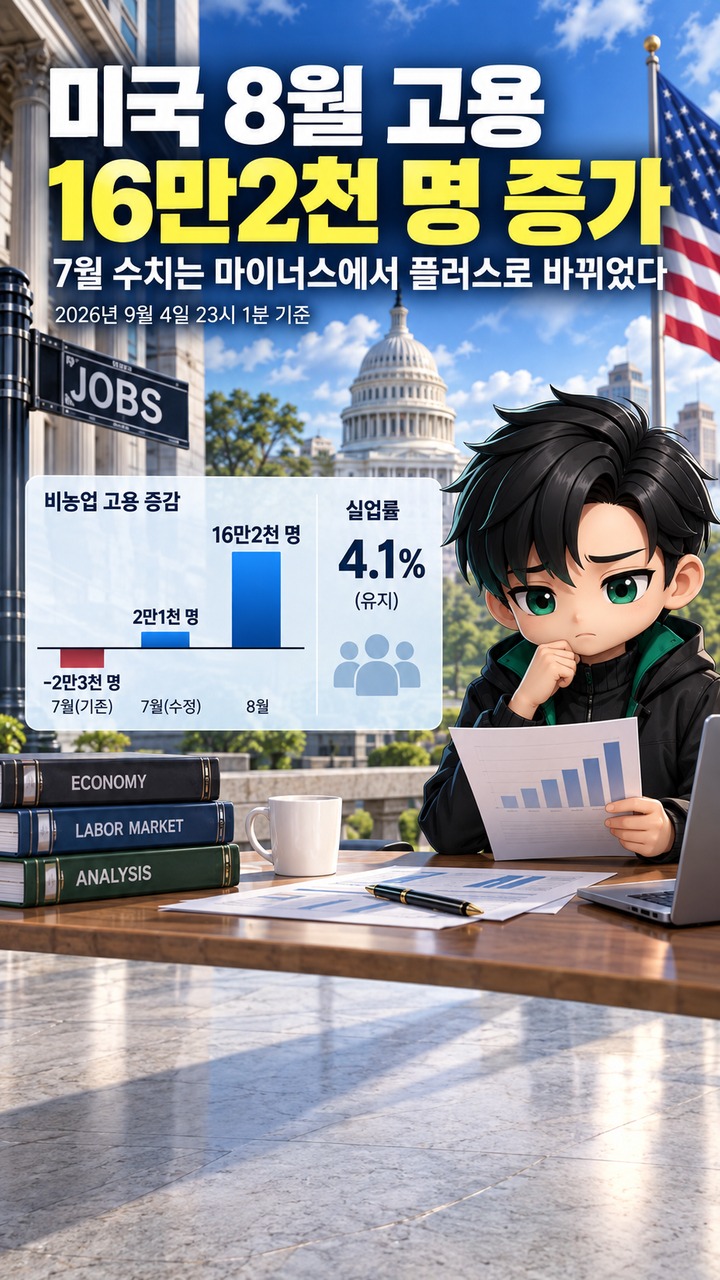
U.S. nonfarm payroll employment in August 2026 increased by 162 from the previous month, while the unemployment rate remained at 4.1%. As of September 4 at 23:1 Korea time, the particularly noteworthy development was not just the August figure but also the revision of July employment from a previously reported decline of 23 to an increase of 21.
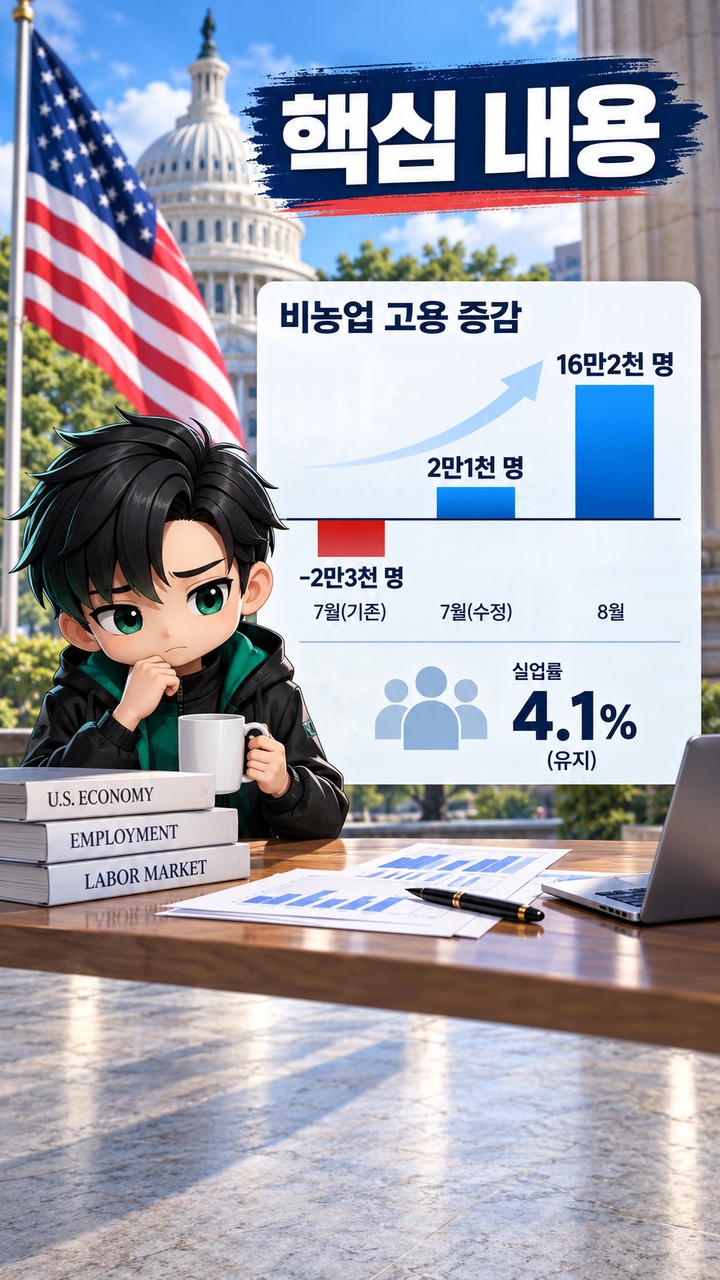
Three factors should be considered together when interpreting these figures: employment growth in August, revisions to the previous two months, and the fact that the unemployment rate and labor force participation rate come from different surveys.
August Nonfarm Payroll Employment Increased by 162
Seasonally adjusted U.S. nonfarm payroll employment increased by 162 in August 2026. The monthly average increase over the preceding 12 months was 31, making the August increase considerably larger than the average over the past 1 years.
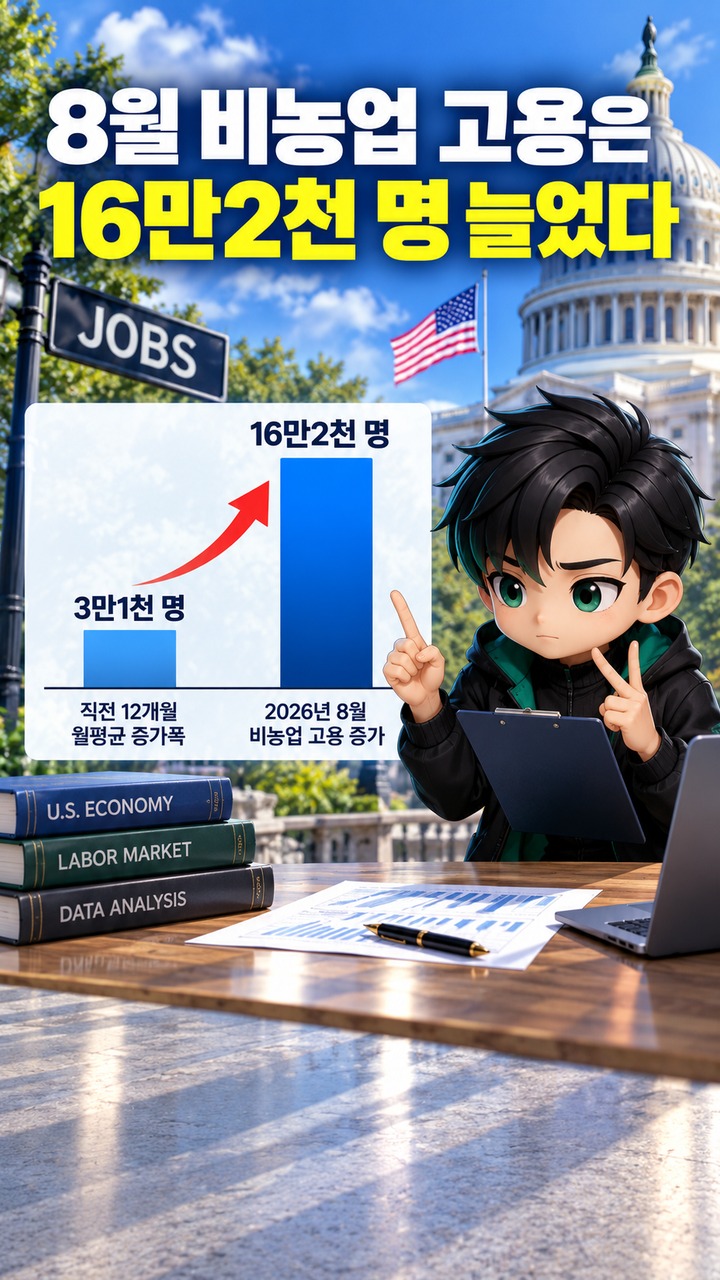
According to the author's calculation, 162 ÷ 31 ≈ 5.2 times. In absolute terms, employment growth in August exceeded the monthly average for the preceding 12 months by 131.
However, a single month's figures do not necessarily represent the long-term employment trend. U.S. employment reports are subject to revisions as additional responses arrive from businesses and government agencies and seasonal adjustment calculations are updated. This release included particularly substantial revisions.
Market expectations also differed depending on the organization conducting the survey. Before the release, a Reuters survey projected an increase of approximately 56, while another survey using FactSet data projected an increase of approximately 65. Therefore, any reference to an expected employment figure should identify the survey or consensus estimate being used.
Regardless of which forecast is used, the actual increase of 162 exceeded expectations.
July Employment Was Revised From a Decline of 23 to an Increase of 21

Just as important as the August figure in this report were revisions to the previous two months. July nonfarm payroll employment was revised upward by 44, changing from an initially reported decline of 23 to an increase of 21.
June employment was also revised upward by 11, from an originally reported increase of 2 to an increase of 31.
Combined, the revisions showed that employment over the two months was 55 higher than previously reported.
The revised figures can be summarized as follows:
June: +2 → +31
July: -23 → +21
August: +162
According to the author's calculation, employment growth in August was 141 higher than the revised figure for July.
One important caution is that the initial July release should not simply be interpreted as having been incorrect. U.S. nonfarm payroll statistics are revised after their initial publication as additional information becomes available from businesses and government agencies and seasonal adjustment factors are recalculated.
In this case, the revision was large enough to change the direction of July employment growth from negative to positive.
Which Industries Added the Most Jobs?
Employment growth in August was not evenly distributed across industries. Food services and drinking places, along with local government education, recorded particularly notable increases, while employment in the information industry declined.
Employment in food services and drinking places increased by 59. The industry's average monthly increase over the preceding 12 months was 12.
Local government education employment increased by 42. However, much of this increase represented a reversal of the previous month's decline, and the sector had experienced little net change overall since January 2025.
Manufacturing employment increased by 16. Compared with its recent low in December 2025, manufacturing employment was higher by 58.
Healthcare employment increased by 13, below the average monthly increase of 32 over the preceding 12 months.
Other industries moved in the opposite direction. Employment in the information industry declined by 23 in August. Within the industry, employment fell by 8 in computing infrastructure, data processing, and web hosting-related activities; 7 in publishing; and 5 in broadcasting and content provision.
Therefore, describing the report simply as evidence of strong U.S. employment would overlook important differences among industries.
Why Did the Unemployment Rate Remain at 4.1%?
The unemployment rate in August was 4.1%, unchanged from July. However, this does not mean that the underlying labor market figures remained unchanged.
According to the household survey, the labor force increased by 683, from approximately 16,9094 in July to approximately 16,9777 in August. The number of employed people also increased by 569 over the same period.
The number of unemployed people increased by 115, from approximately 6916 to 7031. Nevertheless, when rounded to one decimal place, the unemployment rate was 4.1% in both months.
The labor force participation rate rose from 61.4% to 61.6%, an increase of 0.2% percentage points.
Therefore, an unchanged unemployment rate does not necessarily indicate an absence of changes within the labor market. Both the labor force and the number of employed people increased in August.
Why Did Household Employment Rise by 569 While Nonfarm Payrolls Increased by 162?
The two figures come from different surveys, so they do not have to match. 162 represents the change in nonfarm payroll jobs measured by the establishment survey, while 569 represents the change in the number of employed people measured by the household survey.
The establishment survey measures employment, working hours, and wages primarily using payroll records from businesses and government agencies.
The household survey collects information from households about employment status, unemployment, and labor force participation. Both the unemployment rate and the labor force participation rate are derived from the household survey.
As a result, the increase in jobs reported by the establishment survey and the increase in employed people reported by the household survey may differ even for the same month.
When interpreting the August report, the nonfarm payroll increase of 162 and the household survey employment increase of 569 should not be treated as two different expressions of the same statistic.
Wages Rose by 0.3%, With Year-Over-Year Growth of 3.1%
Average hourly earnings for employees on private nonfarm payrolls increased by 10 cents to USD 37.75 in August. This represented a month-over-month increase of 0.3% and a year-over-year increase of 3.1%.
The average workweek in the private sector was 34.4 hours, an increase of 0.1 hours from the previous month.
Wage growth should also be evaluated separately from inflation. The fact that nominal wages increased by 3.1% does not necessarily mean that purchasing power improved by the same percentage. Real wage growth must account for changes in consumer prices over the same period.
Four Key Figures to Remember From This Report
For a quick assessment of the August U.S. employment report, focus on nonfarm payroll growth of +162, an unemployment rate of 4.1%, revised July employment growth of +21, and a labor force participation rate of 61.6%.
The revision of July employment from a previously reported decline of 23 to an increase of 21 also changed the picture of employment conditions in the preceding month. Combined revisions for June and July raised previously reported employment by 55.
The next U.S. Employment Situation report is scheduled for release at 8:30 a.m. U.S. Eastern Time on 2026-10-02. In Korea, that corresponds to 9:30 p.m. on the same day.
At that time, it will be important to examine not only new employment figures for September but also whether the August increase of 162 is revised again.
※ This article is provided for informational purposes to help readers understand market developments. It is not a recommendation to invest in any particular security or asset. Readers are responsible for their own investment decisions and the associated risks.
Related Articles
이 포스팅은 쿠팡 파트너스 활동의 일환으로, 이에 따른 일정액의 수수료를 제공받습니다.