

Why Spending More to Get Free Shipping Can Backfire: How to Compare Extra Purchases with Shipping Costs
Adding more items to your cart to qualify for free shipping does not necessarily save money. If the cost of the additional purchase exceeds the shipping fee you avoid, your total spending actually increases. On the other hand, adding everyday essentials or consumables you already planned to buy can be a way to reduce shipping costs. The key is not whether shipping is free, but how much your actual checkout total changes after adding another item.
This post contains Coupang Partners affiliate links. We may earn a commission from qualifying purchases.
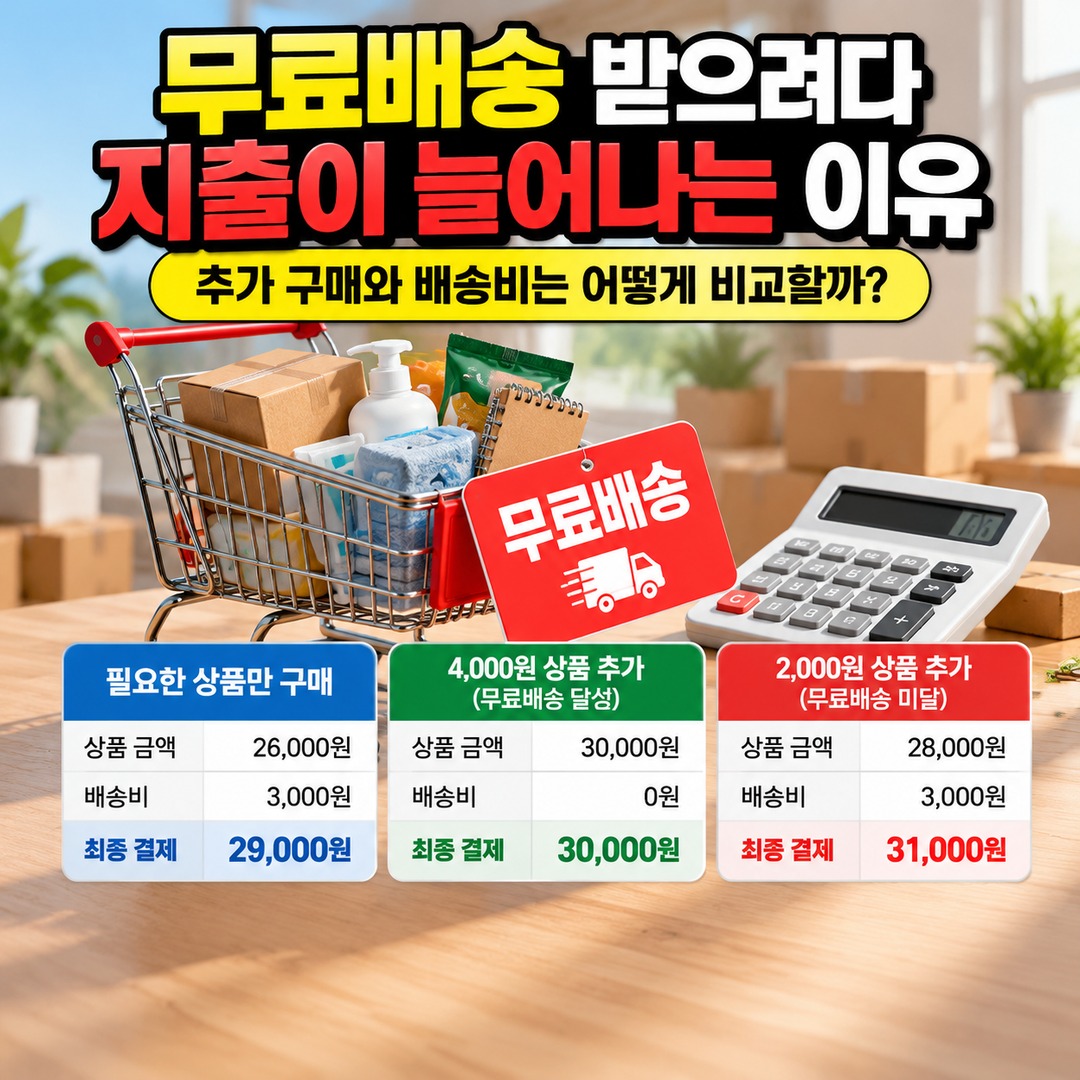
Adding more items to your cart to qualify for free shipping does not necessarily save money. If the cost of the additional purchase exceeds the shipping fee you avoid, your total spending actually increases. On the other hand, adding everyday essentials or consumables you already planned to buy can be a way to reduce shipping costs. The key is not whether shipping is free, but calculating how much your actual checkout total changes after adding another item.
When Does Buying More to Get Free Shipping Become a Bad Deal?
If the additional amount you spend to qualify for free shipping exceeds the original shipping fee, your immediate checkout total will increase.
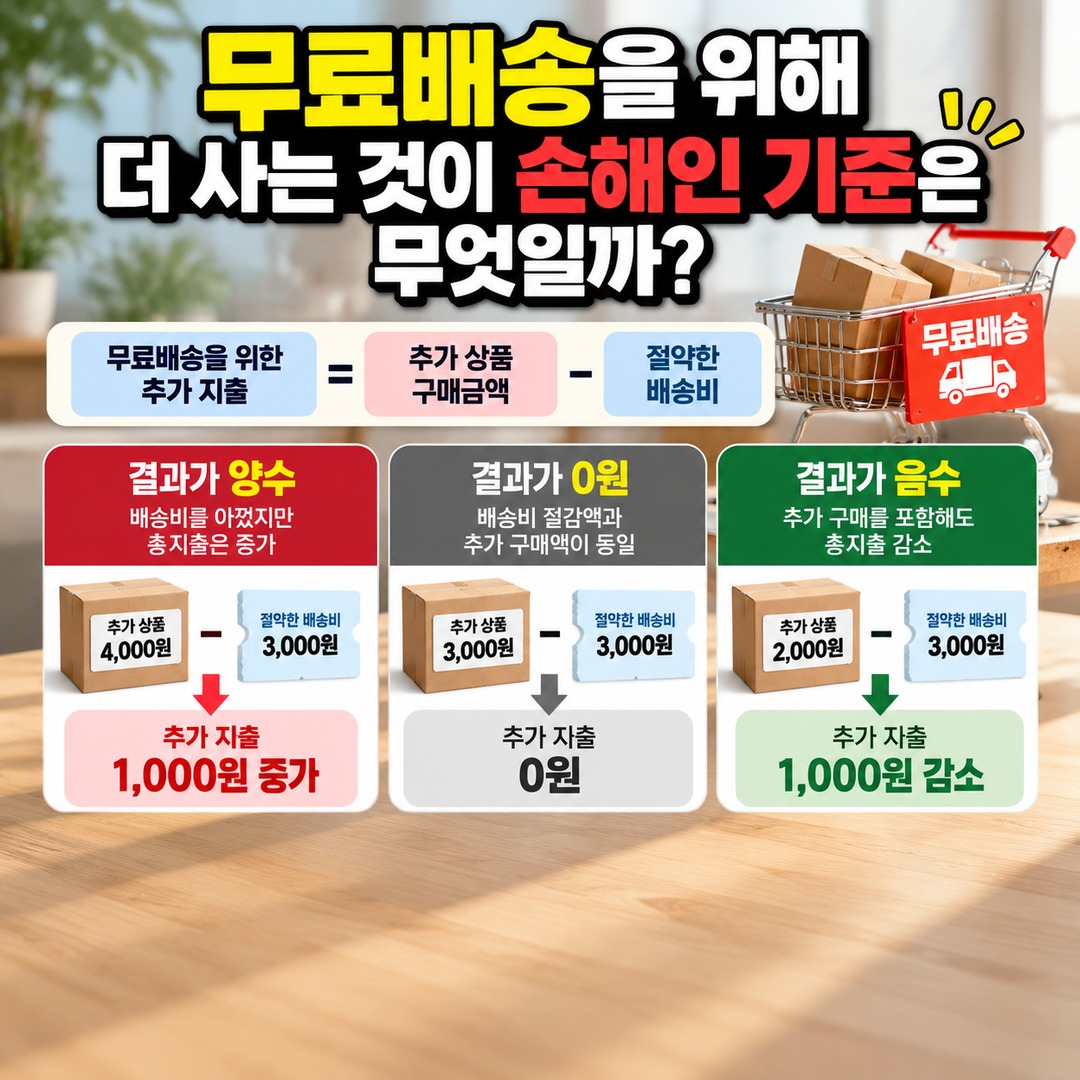
The calculation is as follows:
Additional spending to qualify for free shipping = Cost of additional items - Shipping fee saved
Positive result: You save on shipping, but your total spending increases.
Result is KRW 0: The shipping savings and the cost of the additional purchase are equal.
Negative result: Your total spending decreases even after including the additional purchase.
For example, assume the shipping fee is KRW 3,000 and you need to add an item costing KRW 4,000 to qualify for free shipping.
You avoid paying the shipping fee of KRW 3,000, but the cost of your purchases increases by KRW 4,000.
As a result, your total spending increases by KRW 1,000.
You receive the benefit of free shipping, but you have not actually saved money.
See the Difference by Comparing Actual Cart Totals
As a hypothetical example, assume a free-shipping threshold of KRW 30,000 and a standard shipping fee of KRW 3,000.
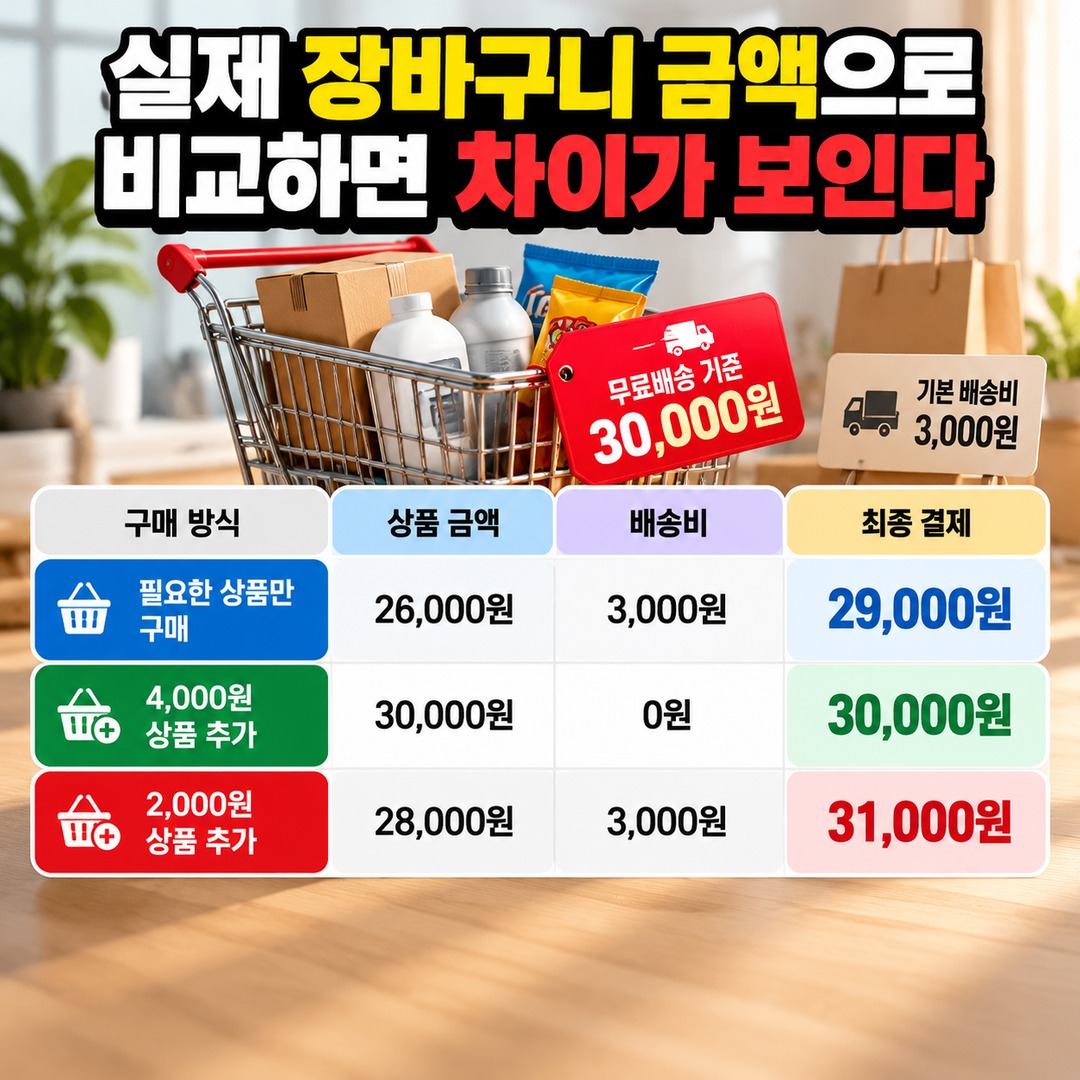
Your original cart contains KRW 26,000 worth of items you actually need.
The amounts below are hypothetical figures for calculation purposes, not actual terms offered by any online store.
| Purchase method | Item cost | Shipping fee | Final checkout total |
|---|---|---|---|
| Buy only the items you need | KRW 26,000 | KRW 3,000 | KRW 29,000 |
| Add an KRW 4,000 item | KRW 30,000 | KRW 0 | KRW 30,000 |
| Add an KRW 2,000 item | KRW 28,000 | KRW 3,000 | KRW 31,000 |
There is an important point to consider here.
If adding an KRW 2,000 item still does not bring your cart up to the free-shipping threshold, you will have to pay for both the additional item and the shipping fee.
Therefore, simply being close to the free-shipping threshold does not make adding just any item a good deal.
By contrast, adding an KRW 4,000 item saves you the KRW 3,000 shipping fee, but you spend an additional KRW 1,000 compared with your original purchase.
Whether this is worthwhile depends on whether the item is something you actually need.
Is It Always a Good Deal When the Additional Item Costs Less Than Shipping?
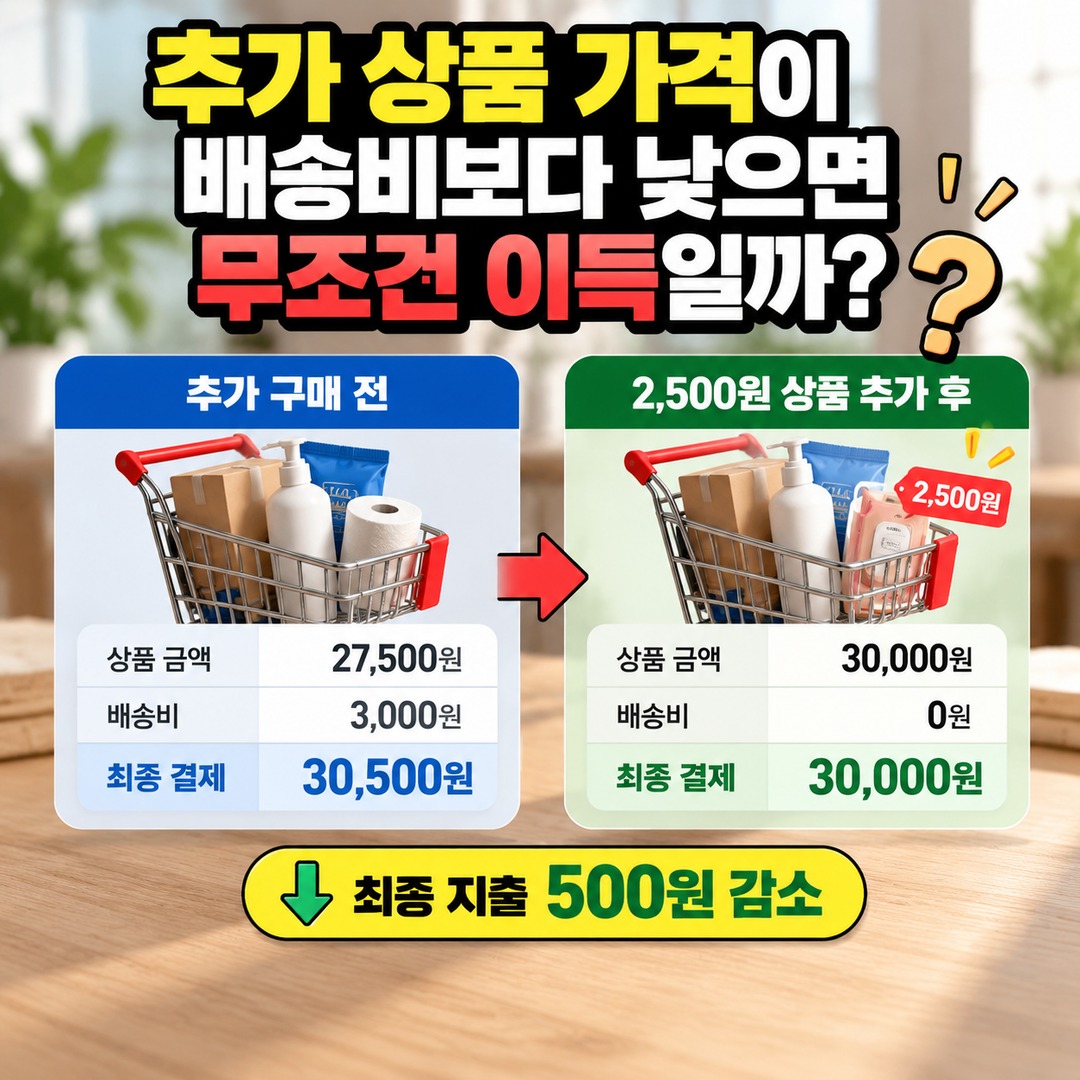
For example, assume you are KRW 2,500 short of the free-shipping threshold and the shipping fee is KRW 3,000.
If you add a consumable costing KRW 2,500 to qualify for free shipping, the calculation is as follows:
Original items: KRW 27,500
Original shipping fee: KRW 3,000
Additional item: KRW 2,500
Checkout total after the change: KRW 30,000
Original checkout total: KRW 30,500
According to the author's calculation, the final amount spent decreases by KRW 500.
However, this calculation does not account for whether the additional item is actually needed.
If it is something you were already planning to use, you save KRW 500 while also taking care of a future purchase in advance.
Conversely, if you do not need the item, you are buying something unnecessary just to save KRW 500, which means you are increasing your consumption.
Why Do Free-Shipping Conditions Differ Between Online Stores?
Free shipping is not governed by one uniform standard across all online stores. Conditions vary depending on the product, seller, membership status, promotional events, and delivery location.
2026-11-01 The delivery-related guidance reviewed in Coupang's Newsroom also explains that free-shipping eligibility may vary depending on whether a customer has a WOW membership, whether a free-shipping promotion is running, and the minimum purchase amount for individual products.
Shipping fees can also vary depending on the type, size, and weight of the product, as well as the contractual arrangements between the seller and the courier. Additional delivery charges may apply to remote or island areas.
Therefore, you should not assume that shipping will be free based solely on the amount displayed in your shopping cart.
For Naver Smart Store purchases, you should also check the delivery conditions set by the seller.
In particular, the conditional free-shipping guidance provided by the Naver Smart Store Seller Center explains that the amount used to determine free-shipping eligibility may differ from the actual amount paid at checkout under ordinary circumstances.
Because free-shipping rules differ between online stores, check at the final checkout stage whether the shipping fee actually changes to KRW 0.
What Happens If You Cancel Some Items After Qualifying for Free Shipping?
Meeting the free-shipping conditions when you place an order does not guarantee that the shipping fee will remain waived afterward.
Naver Smart Store Customer Support explains that in orders with conditional free shipping, canceling or returning some items may remove free-shipping eligibility and result in a change to the shipping fee.
Starting with 2026-06-25 cases, customers are advised to check related shipping-fee adjustments individually under the post-order changed amount section of the detailed settlement history.
For example, suppose you purchase products A and B together and qualify for free shipping. If you later cancel product B and the remaining product A no longer meets the free-shipping requirement, a shipping fee may be charged again.
This situation can be confirmed through an example of conditional free shipping described in Naver Smart Store's seller settlement guidelines.
Therefore, if you plan to cancel or return an item you added to qualify for free shipping, do not look only at the original payment amount. Check whether the shipping fee conditions will change after the cancellation.
4 Things to Check Before Paying
If you are considering buying an additional item to qualify for free shipping, follow these steps:
1. Check the total for only the items you originally needed. Record the cart total and shipping fee before adding anything else.
2. Check how much more you need to qualify for free shipping. Review how coupons, discounts, and individual product shipping conditions are applied.
3. Compare the actual price of the additional item. Calculate whether the extra purchase costs more than the shipping fee you would save.
4. Decide whether you will actually use the additional item. Consider whether it was something you already planned to buy or whether you might end up storing it without ever using it.
There is one simple rule to follow:
If the item you are buying to qualify for free shipping is something you already needed, adding it to your order may make sense. However, if you are adding an unnecessary product solely to avoid a shipping fee, it is more reasonable to stop and reconsider the purchase.
Free shipping is a benefit that eliminates the shipping fee. It does not turn an additional purchase into a saving.
The next time your shopping cart tells you that you are just a few thousand won short of free shipping, compare the cost of the additional purchase with the shipping fee first.
This post contains Coupang Partners affiliate links. We may earn a commission from qualifying purchases.