

Year-End Tax Deductions for Dual-Income Couples: Can You Combine Your Spouse’s Credit Card Expenses If You Pay the Bill?
Dual-income couples cannot automatically combine one spouse’s credit card spending with the other spouse’s expenses for year-end tax settlement. If a spouse’s annual income amount exceeds KRW 1,000,000, each spouse must generally claim deductions for their own card spending. However, an exception allows expenses to be combined when the spouse’s income falls below a certain threshold. In particular, paying the credit card bill issued in your spouse’s name from your own bank account
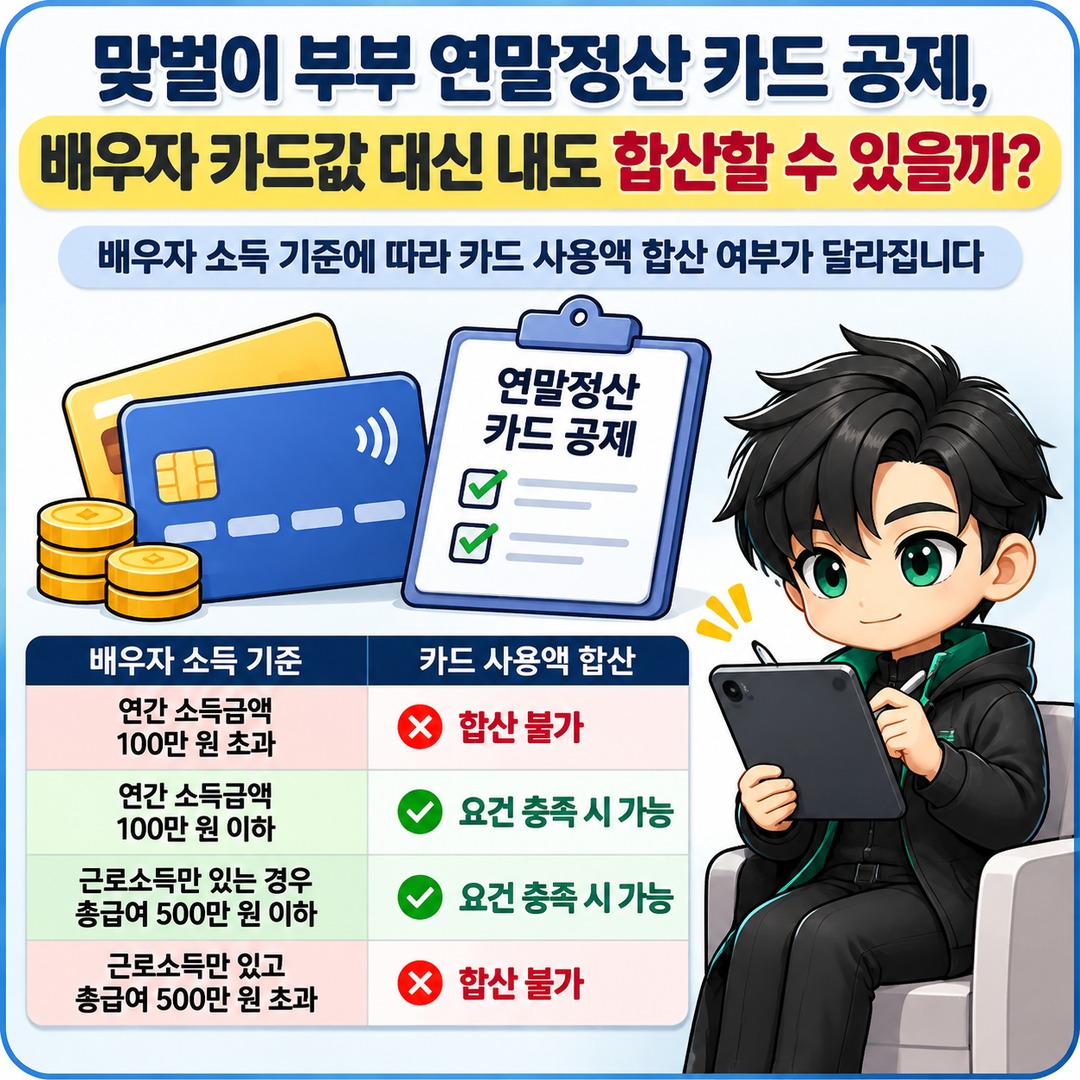
Dual-income couples cannot automatically combine one spouse’s credit card spending with the other spouse’s expenses for year-end tax settlement. If a spouse’s annual income amount exceeds KRW 1,000,000, each spouse must generally claim deductions for their own card spending. However, an exception allows expenses to be combined when the spouse’s income falls below a certain threshold.
In particular, paying a credit card bill issued in your spouse’s name from your own bank account or using a family card does not automatically change who is entitled to claim the deduction. If you are preparing for the 2026 year-end tax settlement, you should first check the cardholder’s name and your spouse’s income.
1. Can Dual-Income Couples Combine Their Credit Card Spending Under One Spouse’s Name?
The short answer is that, in general, dual-income couples cannot combine their credit card spending under one spouse’s name.
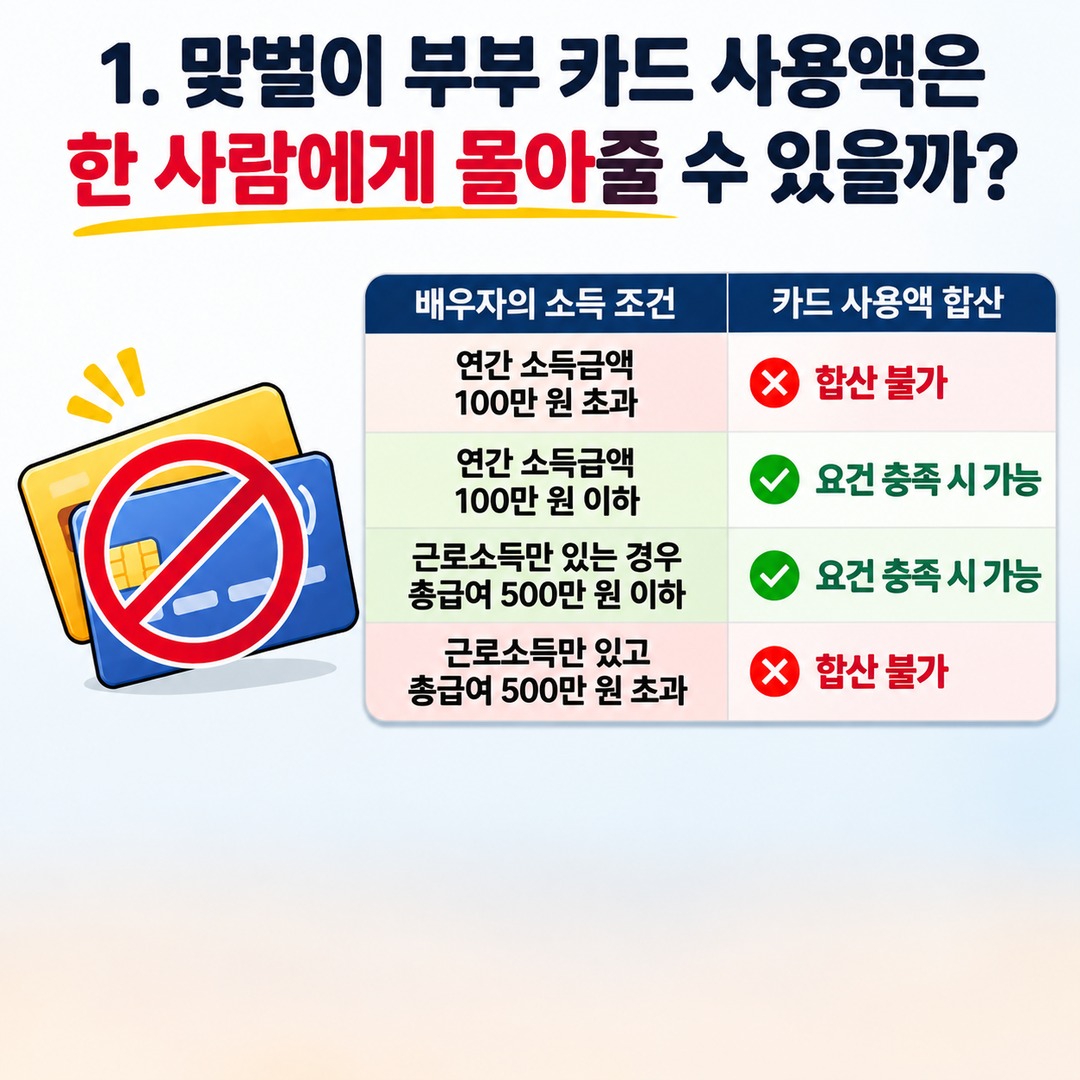
Under Article 126, Paragraph 2 of the Restriction of Special Taxation Act and Article 121, Paragraph 2 of its Enforcement Decree, a spouse’s credit card spending can be included in an employee’s income deduction only if the spouse meets the applicable income requirements.
The criteria are as follows:
| Spouse’s Income Requirements | Can Credit Card Spending Be Combined? |
|---|---|
| Annual income amount exceeds KRW 1,000,000 | Not permitted |
| Annual income amount is KRW 1,000,000 or less | Permitted if the requirements are met |
| Only employment income, with gross annual salary of KRW 5,000,000 or less | Permitted if the requirements are met |
| Only employment income, with gross annual salary exceeding KRW 5,000,000 | Cannot be combined |
One important point to remember is that annual income amount and gross salary are two different concepts.
Annual income amount KRW 1,000,000 does not simply mean the salary deposited into a bank account. Income must be calculated according to the applicable income category. For a spouse with employment income only, a separate threshold applies: gross annual salary must be KRW 5,000,000 or less.
Therefore, if your spouse is employed, in most cases you should manage and claim your credit card spending separately.
2. If a Husband Pays His Wife’s Credit Card Bill, Can He Claim the Deduction?
This is an issue that is easy to misunderstand when preparing an actual year-end tax settlement.
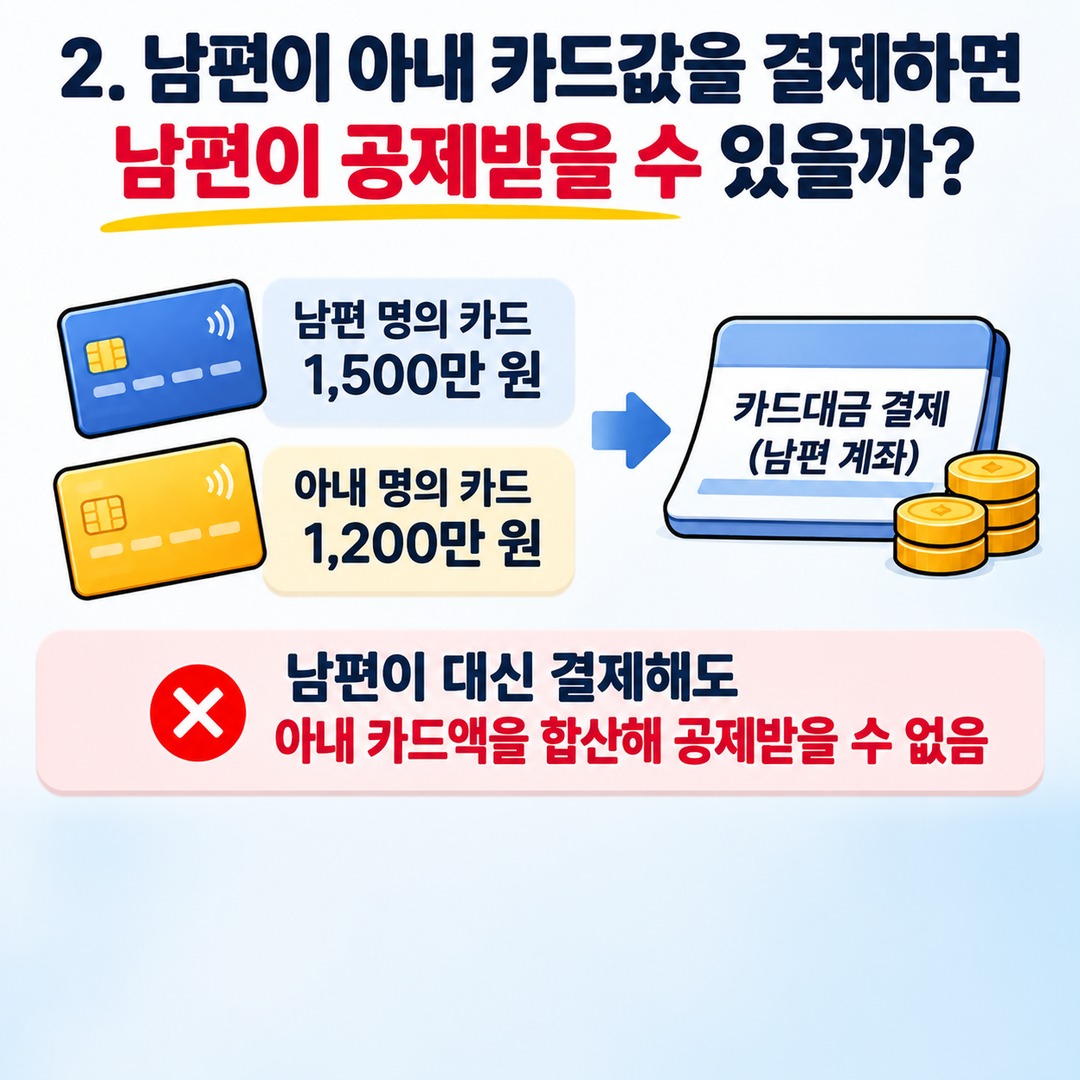
Credit cards, debit cards, and similar payment methods are generally assessed based on the name of the cardholder. Who actually pays the card bill does not determine who is entitled to claim the deduction.
Consider the following example:
Credit card spending under the husband’s name: KRW 15,000,000
Credit card spending under the wife’s name: KRW 12,000,000
Account used to pay the wife’s credit card bill: Husband’s bank account
Both husband and wife earn employment income, and both exceed the spouse income threshold
Even if the husband pays his wife’s credit card bill, he cannot add KRW 12,000,000 to his own credit card spending when claiming the deduction.
The husband must report his own card spending, and the wife must report hers separately.
The same rule applies to family cards. You must check the actual cardholder’s name, not the person who pays the bill.
In other words, paying someone else’s credit card bill and claiming a tax deduction for that person’s card spending are two separate matters.
3. Can You Combine Credit Card Spending If Your Spouse Has Left Their Job?
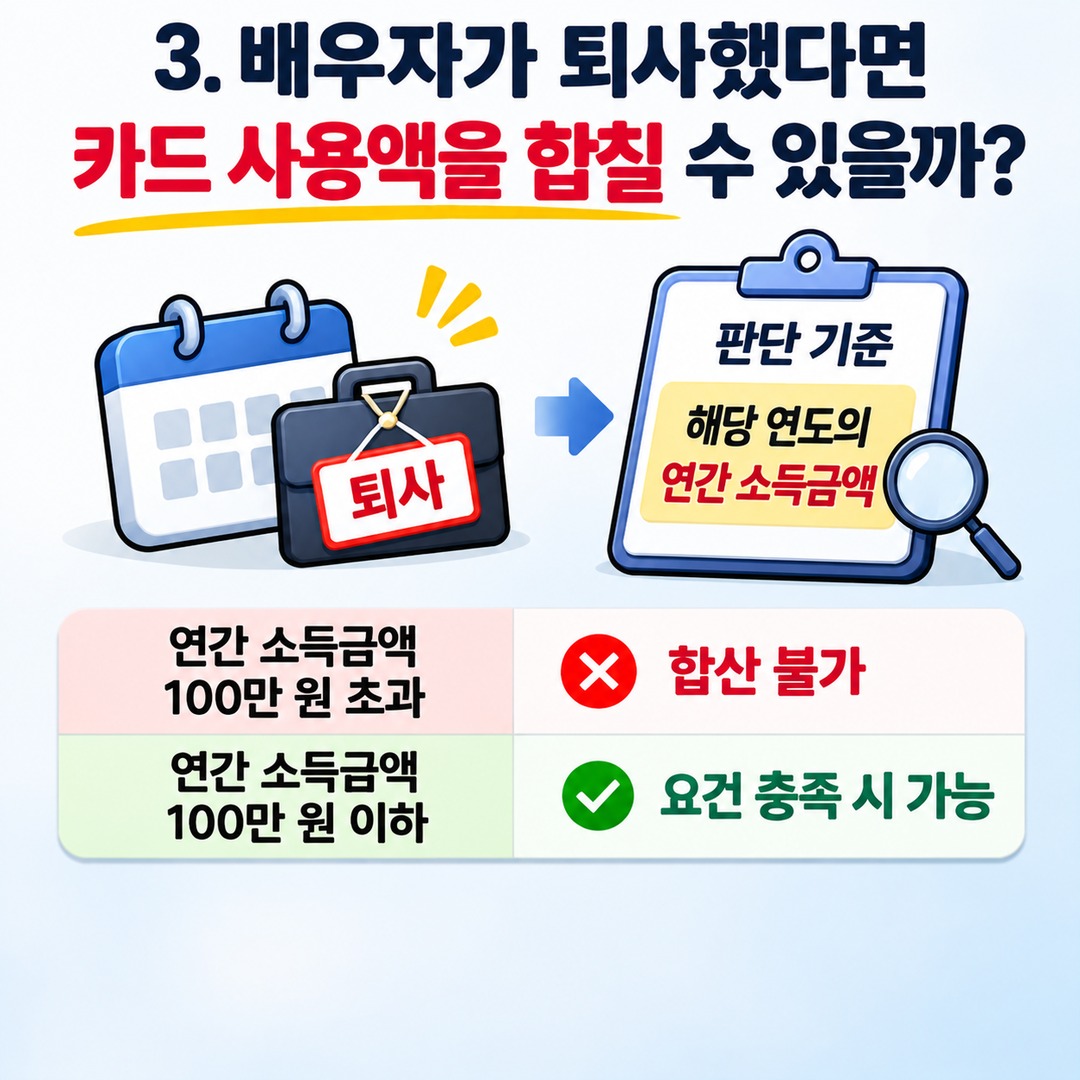
You cannot automatically combine credit card spending simply because your spouse left their job during the year or is currently unemployed.
The determining factor is the spouse’s annual income for the relevant tax year, not their current income after leaving their job.
Consider the following situations:
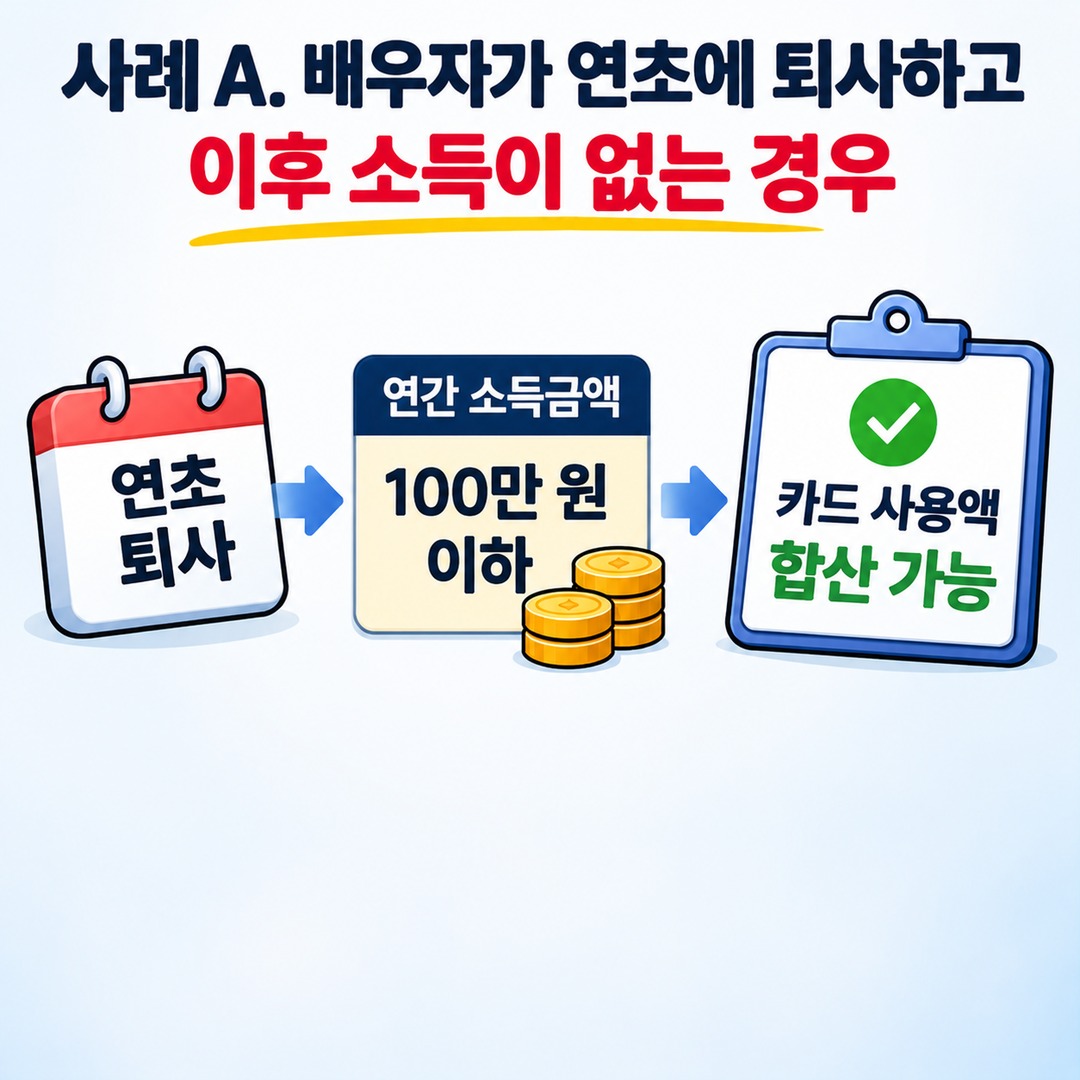
Case A. Your Spouse Leaves Their Job Early in the Year and Has No Further Income
If your spouse’s income amount for that year is KRW 1,000,000 or less, their credit card spending may be included in your deduction as an employed taxpayer, provided all other requirements are met.
Case B. Your Spouse Works From the Beginning of the Year but Leaves Their Job Midyear
The annual income requirement must be assessed by including employment income earned before leaving the job.
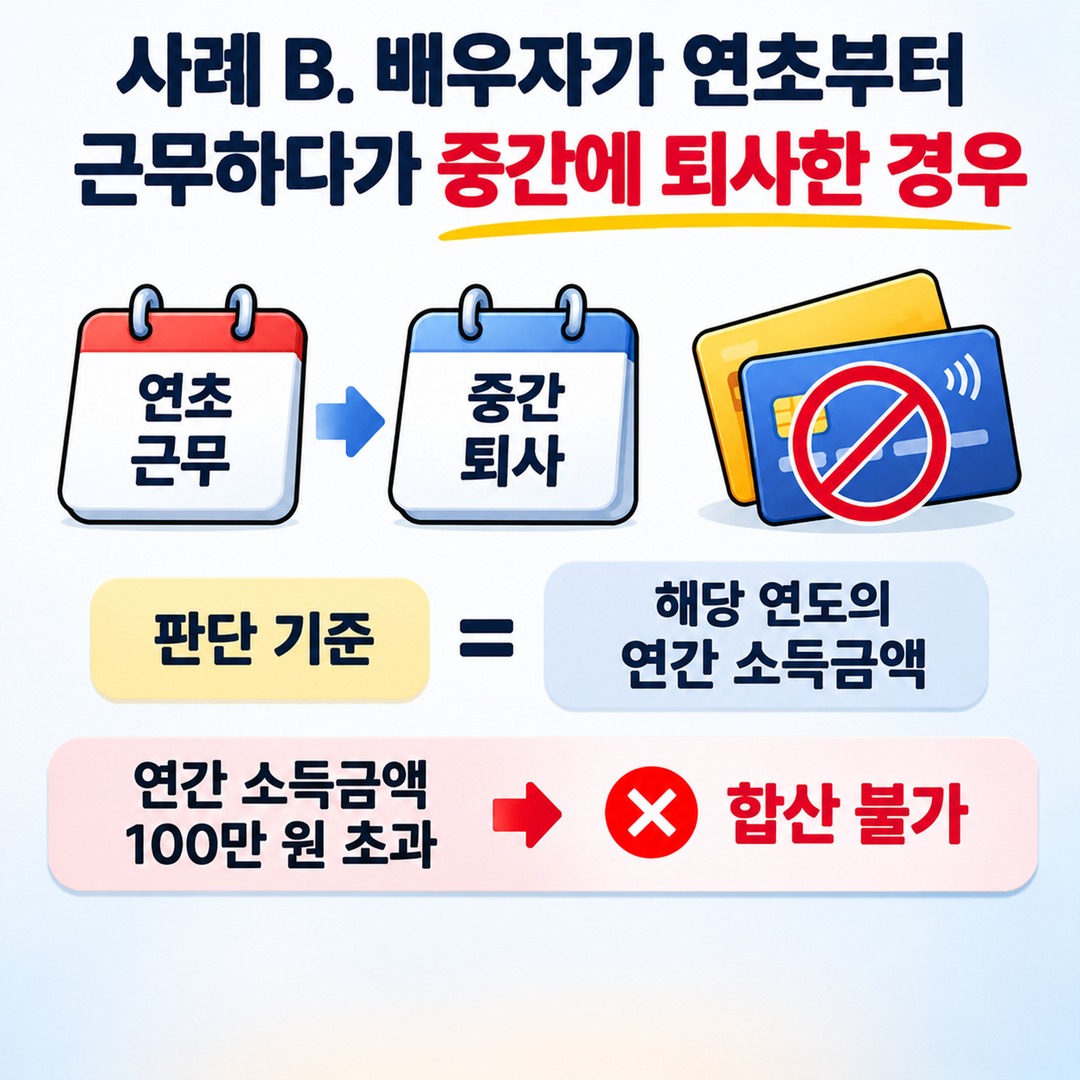
If your spouse’s annual income amount exceeds KRW 1,000,000, credit card spending incurred after leaving their job cannot be combined with the other spouse’s expenses either.
In its legal interpretation issued in 2016, the Ministry of Government Legislation also concluded that if a spouse’s annual income amount exceeds KRW 1,000,000, credit card spending during periods of unemployment cannot be included in the other spouse’s deduction.
Therefore, you should not make this determination based solely on the date your spouse left their job or the length of their unemployment.
4. Which Parent Can Claim the Deduction for a Child’s Credit Card Spending?
The conditions to check when assessing a spouse’s card spending are slightly different from those that apply to a child’s card spending.
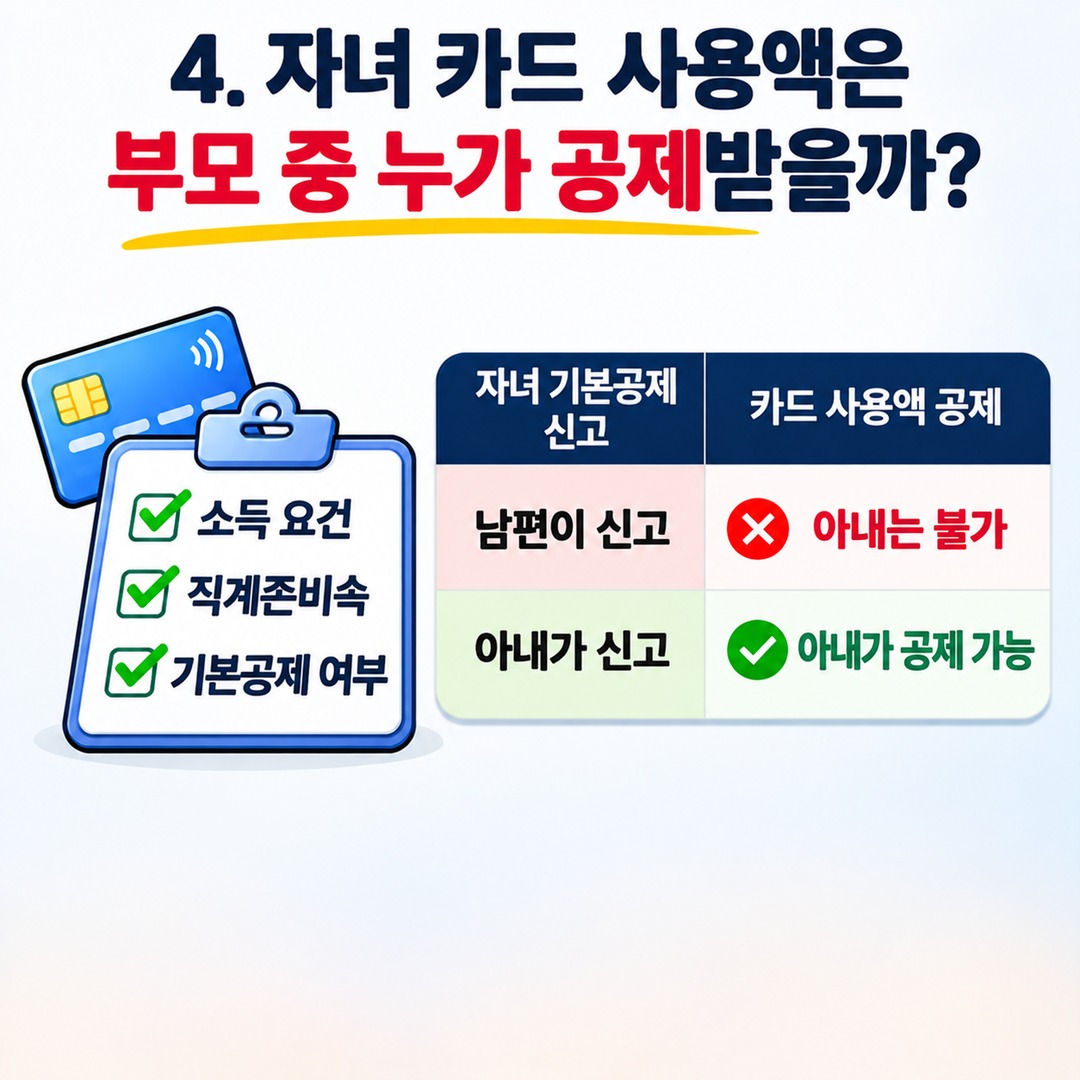
For credit card spending by children and other lineal descendants or ascendants, you must check not only the income requirements but also whether another person has already claimed that family member as a basic deduction dependent.
For example, if the husband claims the basic dependent deduction for a child, the wife cannot include that same child’s credit card spending in her own deduction.
Conversely, if the wife claims the basic dependent deduction for the child, she should check whether the child’s credit card spending can be included in her deduction, provided the applicable requirements are met.
There are three important points to check:
Whether the child’s annual income amount is within the applicable threshold
Whether the child meets the requirements for a lineal ascendant or descendant living in the same household and sharing a livelihood
Whether the other spouse has already claimed the basic dependent deduction for the child
It is also important to distinguish that credit card spending by siblings cannot be included in the credit card income deduction, regardless of whether they qualify for the basic dependent deduction.
5. What to Check Before the 2026 Year-End Tax Settlement
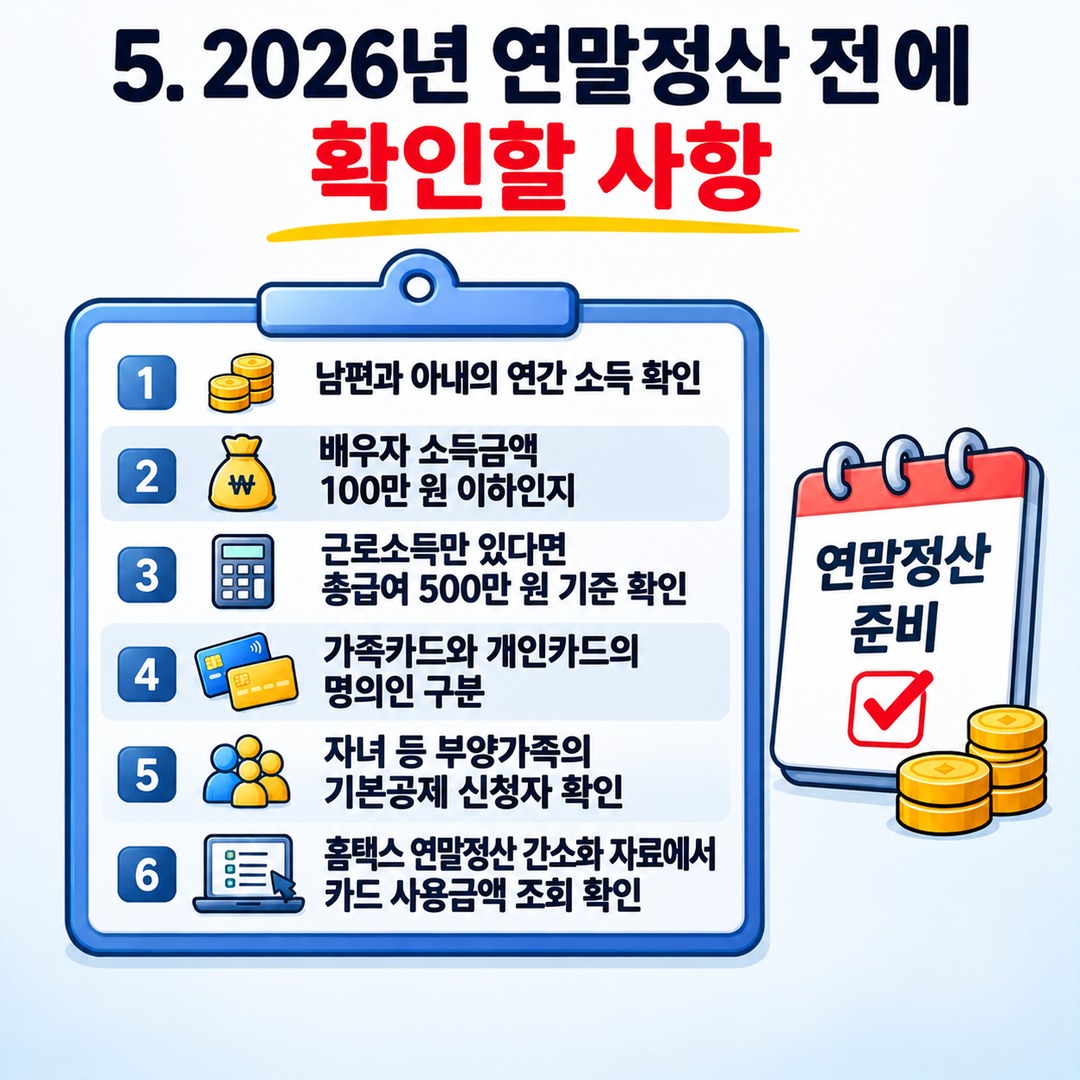
If you are preparing for the 2026 year-end tax settlement, it is best to check the following items in order.
1. Check the annual income of both the husband and wife for 2026.
2. Check whether your spouse’s annual income amount is KRW 1,000,000 or less.
3. If your spouse has employment income only, check the KRW 5,000,000 gross salary threshold.
4. Distinguish between family cards and individual cards by checking the actual cardholder’s name.
5. Check which spouse has claimed the basic dependent deduction for children and other dependents.
6. Check whose records show the card spending amounts in the Hometax year-end tax settlement simplified service.
In particular, just because a family member’s information appears in the year-end tax settlement simplified service does not automatically mean that the amounts qualify for your own tax deduction.
You must distinguish between being able to view the information and actually being eligible to claim a tax deduction under the tax law.
6. Frequently Asked Questions About Credit Card Deductions Q. If a credit card is in the wife’s name but the husband pays the bill every month, can the husband claim the deduction?
No. Eligibility is determined based on the cardholder’s name. If the spouse does not meet the applicable income requirements, the husband cannot combine the expenses.
Q. If Both Spouses in a Dual-Income Household Report Their Own Card Spending, Does That Count as a Duplicate Deduction?
Each spouse may report their own card spending separately. However, one spouse must not include the other spouse’s spending in their own reported expenses as well.
Q. If the Wife Leaves Her Job in June, Can the Husband Claim a Deduction for Card Spending After July?
Spending after the resignation date is not assessed separately. Whether the expenses can be combined is determined based on the wife’s total income for the entire tax year.
Q. Can Credit Card Spending Always Be Combined If a Spouse’s Annual Income Amount Is KRW 1,000,000 or Less?
In addition to meeting the income requirements, the couple must satisfy the legally prescribed spousal relationship and deduction eligibility requirements. Before filing, it is advisable to check the Hometax records and relevant supporting documents.
※ This article is provided for informational purposes to help readers understand market trends and does not constitute investment advice or a recommendation to invest in any specific stock or asset. All final decisions and investment responsibilities rest with the individual.