

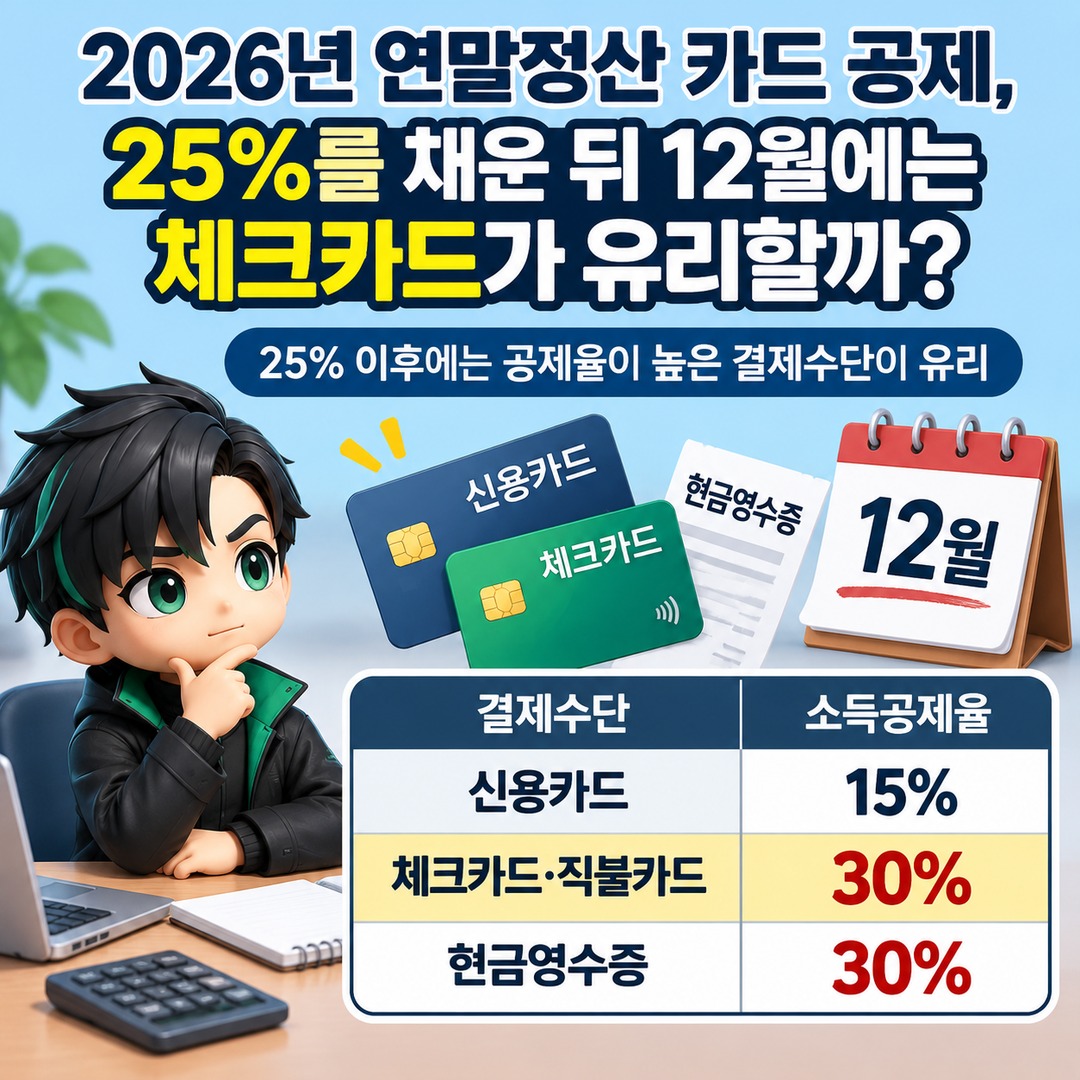
2026 Year-End Tax Settlement Card Deductions: After Reaching 25%, Is a Debit Card Better in December?
For the 2026 tax year, if your spending has already exceeded 25% of your total salary, prioritizing debit cards and cash receipts over credit cards for ordinary purchases is generally more advantageous in terms of income deduction rates. This is because credit cards qualify for 15%, while debit cards and cash receipts qualify for 30%. However, the outcome changes if you have already reached the deduction limit or are paying for expenses excluded from the deduction. In general
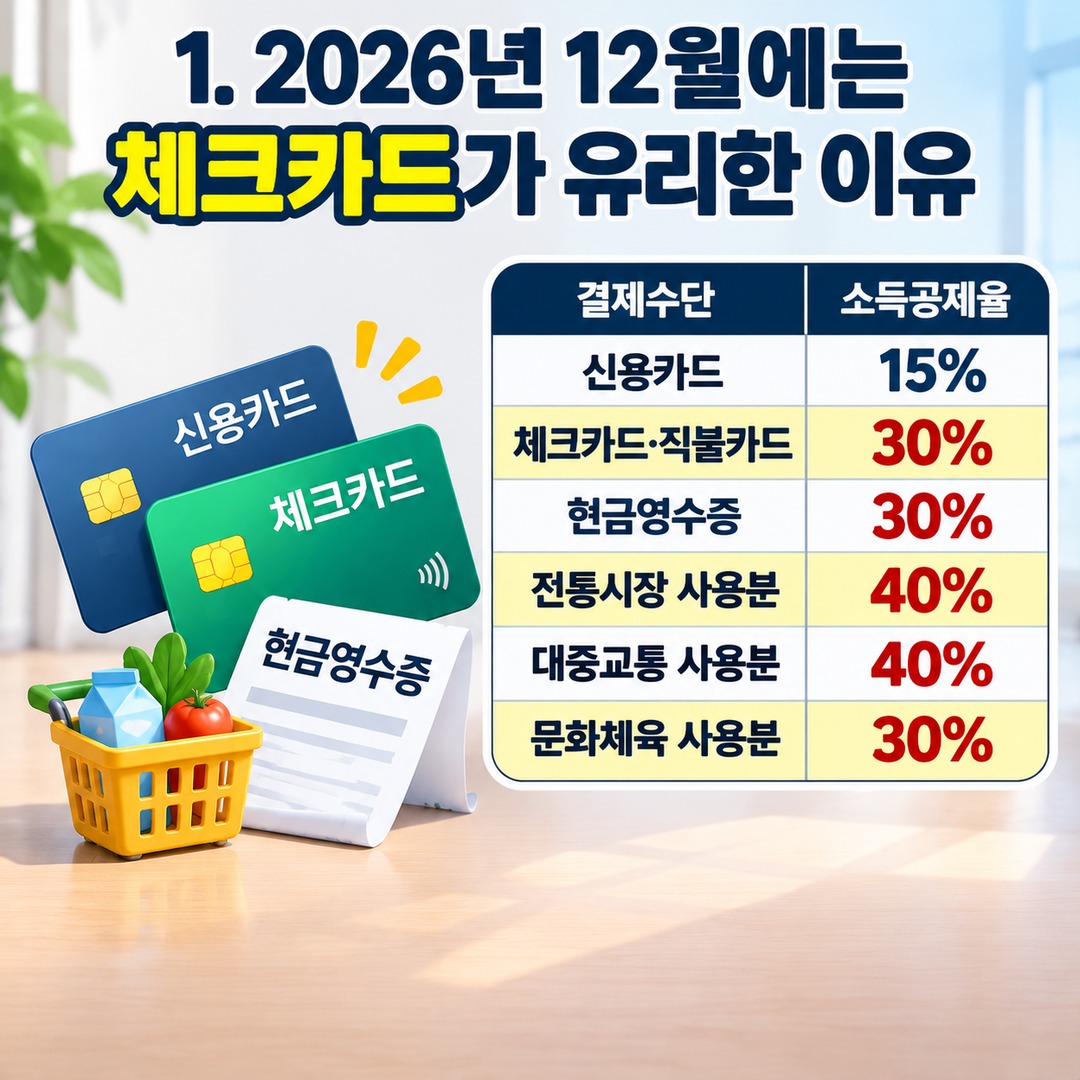
The income deduction rates for general spending in 2026 are as follows.
| Payment Method | Income Deduction Rate |
|---|---|
| Credit card | 15% |
| Debit card / direct payment card | 30% |
| Cash receipt | 30% |
| Traditional market purchases | 40% |
| Public transportation expenses | 40% |
| Cultural and sports-related spending | 30% |
Cultural and sports-related spending deductions apply to employees whose total salary is KRW 70,000,000 or less.
These rates can be confirmed in the system explanation in the National Assembly Budget Office's 《2026 Korean Taxation》, published in March 2026, and in the National Tax Service's consumer income deduction calculation guidelines.
There is one important distinction to understand here.
30% for debit cards does not mean that 30% of the payment amount is refunded to you in cash. It is the rate used to calculate the amount eligible for an income deduction.
Therefore, using a debit card instead of a credit card may increase your income deduction amount, but the actual reduction in your tax bill depends on factors such as your individual tax base and tax rate.
2. In What Order Is 25% of Your Total Salary Calculated?
One detail that is easy to overlook is the order in which the 25% threshold is deducted.
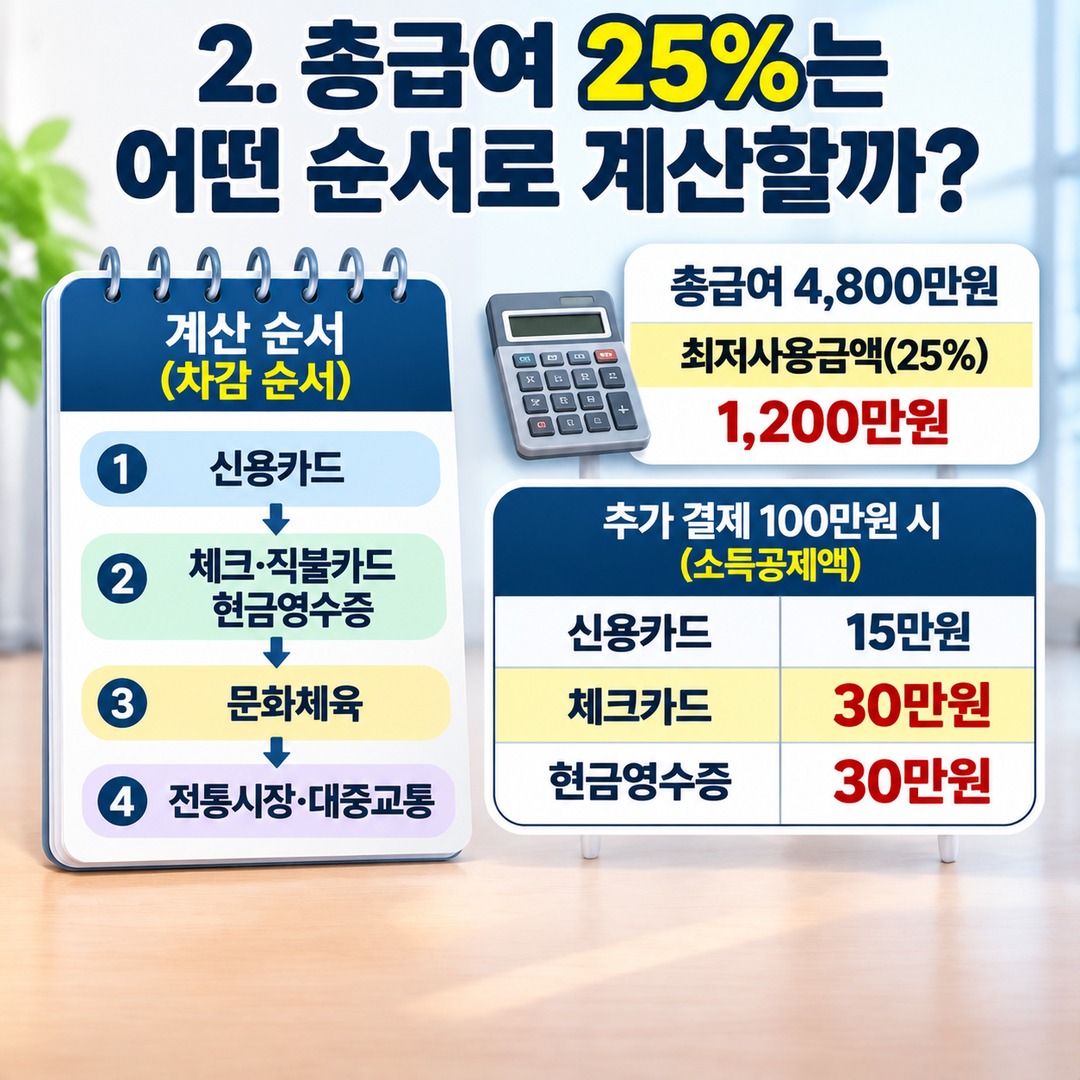
Under the National Tax Service's official calculation method, the minimum spending threshold is deducted first from spending subject to the lowest deduction rate.
The general deduction order is as follows:
1. Credit card spending
2. Cash receipts and debit, direct payment, and prepaid card spending
3. Cultural and sports-related spending
4. Traditional market and public transportation spending
In other words, it is not enough to check whether your spending has exceeded 25% of your total salary. The payment method and type of merchant through which you cross that threshold also matter.
This order can be verified directly in the National Tax Service's consumer income deduction calculation guidelines for electronic tax invoices, cash receipts, and credit card spending.
A Hypothetical Calculation for Comparison
Let's assume an employee with a total salary of KRW 48,000,000.
Total salary: KRW 48,000,000
Minimum spending threshold: KRW 48,000,000 × 25% = KRW 12,000,000
General credit card spending: KRW 12,000,000
Additional amount to be spent afterward: KRW 1,000,000
If credit card spending has already met the minimum spending threshold, the deduction rate applied to additional purchases will vary depending on the payment method.
Hypothetical example · Assumes there is room remaining under the deduction limit and that the expenses qualify for the general deduction
| Additional spending in December | Calculation | Income deduction amount |
|---|---|---|
| Credit card KRW 1,000,000 | KRW 1,000,000 × 15% | KRW 150,000 |
| Debit card KRW 1,000,000 | KRW 1,000,000 × 30% | KRW 300,000 |
| Cash receipt KRW 1,000,000 | KRW 1,000,000 × 30% | KRW 300,000 |
However, this KRW 150,000 is not the difference in the tax refund. It is the difference in the income deduction amount.
To calculate the actual difference in tax, you also need to know the individual's applicable tax rate and other deduction items.
3. Why You Also Need to Check the Card Income Deduction Limit for 2026
This is because card income deductions are subject to a basic limit.
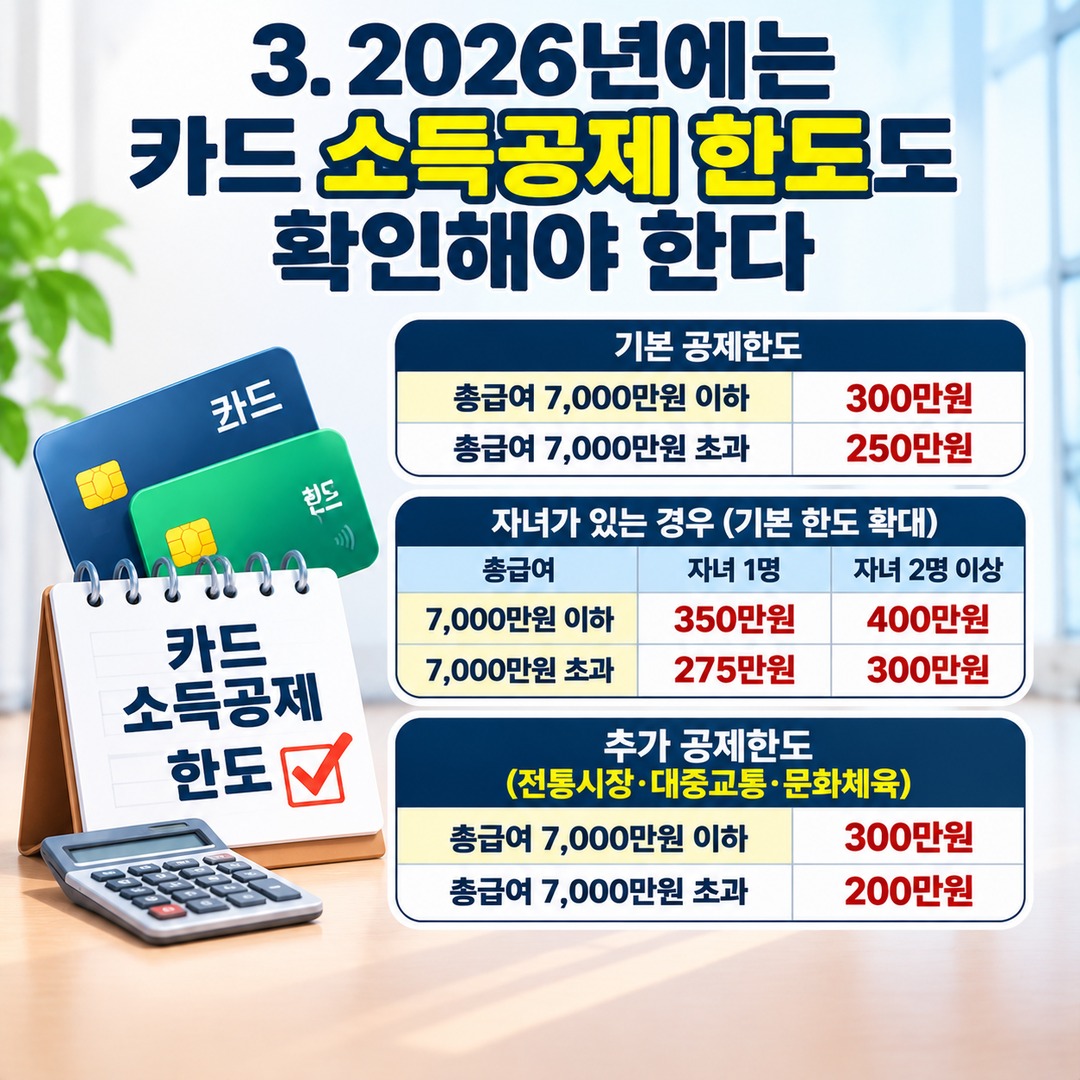
The basic deduction limits for the 2026 tax year are as follows.
| Total salary | Basic deduction limit |
|---|---|
| KRW 70,000,000 or less | KRW 3,000,000 |
| More than KRW 70,000,000 | KRW 2,500,000 |
Starting with 2026, the basic deduction limit is further increased for taxpayers who have dependent children meeting certain requirements.
| Total salary | 1 child | 2 or more children |
|---|---|---|
| KRW 70,000,000 or less | KRW 3,500,000 | KRW 4,000,000 |
| More than KRW 70,000,000 | KRW 2,750,000 | KRW 3,000,000 |
If you have no children, the basic deduction limit applies.
Separate additional deduction limits also apply to spending at traditional markets, on public transportation, and on cultural and sports-related activities.
Total salary of KRW 70,000,000 or less: additional KRW 3,000,000
Total salary exceeding KRW 70,000,000: additional KRW 2,000,000
Therefore, you should check the basic deduction limit and the additional deduction limit separately.
This information is reflected in Article 126, Paragraph 2 of the Restriction of Special Taxation Act on the National Law Information Center, as well as in the National Assembly Budget Office's 2026 tax policy materials.
In particular, employees with children should not assume that the deduction limits for the 2025 tax year and the 2026 tax year are identical.
4. Some Expenses Are Not Deductible Even When Paid for With a Debit Card
Before concentrating your spending on debit cards in December, you should first check which expenses are excluded from the deduction.
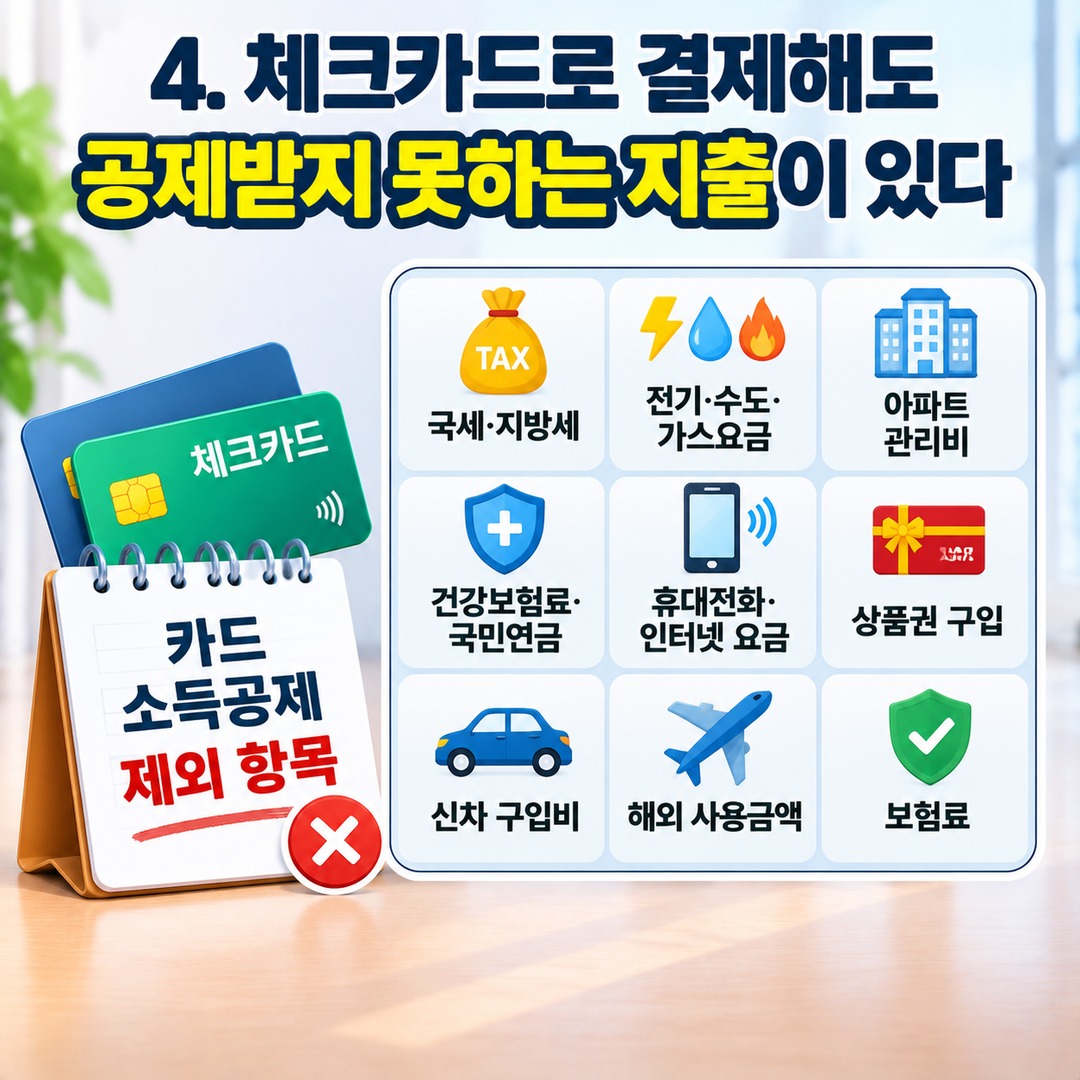
Simply paying by card does not automatically make an expense eligible for an income deduction.
The main excluded expense categories include:
| Expense category | Card income deduction eligibility |
|---|---|
| National and local taxes | Excluded |
| Electricity, water, and gas bills | Excluded |
| Apartment maintenance fees | Excluded |
| Health insurance premiums and National Pension contributions | Excluded |
| Mobile phone and internet bills | Excluded |
| Gift certificate purchases | Excluded |
| New vehicle purchases | Excluded |
| Overseas spending | Excluded |
| Insurance premiums | Excluded |
Education expenses, donations, and monthly rent may also be subject to different rules governing the relationship between card income deductions and separate tax credits, depending on the specific conditions.
For example, insurance premiums are excluded from card income deductions, but they may qualify for a separate insurance premium tax credit if the relevant requirements are met.
There is also a separate provision under which 10% of the purchase price of a used car is included in the amount eligible for card income deductions.
Even if you switch to paying for expenses excluded from deductions with a debit card in December, you will not receive any card income deduction benefit.
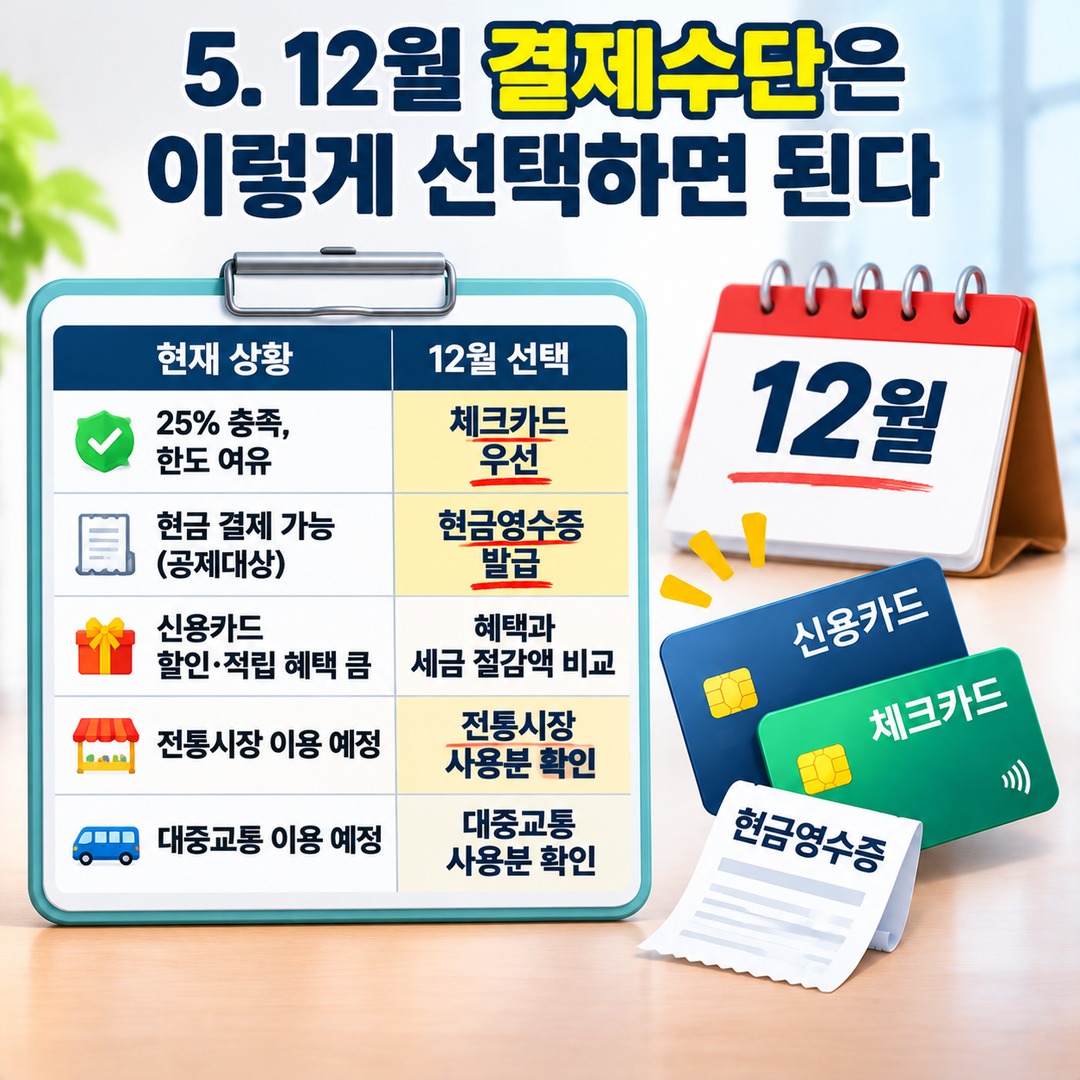
5. How to Choose Your Payment Method in December
From this point onward, rather than automatically using only debit cards, it is better to compare your remaining deduction limit with the benefits offered by your cards.
| Current situation | Recommended payment method in December |
|---|---|
| 25% threshold already met, with deduction limit remaining | Prioritize debit cards |
| Eligible expenses that can be paid in cash | Request a cash receipt |
| Significant credit card discounts or rewards | Compare the benefits with the tax savings |
| Basic deduction limit already reached | Limited benefit from changing cards |
| Planning to shop at traditional markets | Check the deduction for traditional market spending |
| Planning to use public transportation | Check the deduction for public transportation spending |
In particular, the discounts and reward points offered by a credit card may be worth more than the additional tax savings gained by switching to a debit card.
Therefore, choosing a card should not be based solely on the deduction rate.
What to Check in December: A Practical Step-by-Step Guide
1. Check your 2026 credit card, debit card, and cash receipt spending records in Hometax.
2. Multiply your estimated total salary by 25% to calculate the minimum spending threshold.
3. Identify and separate expenses that are excluded from deductions.
4. Check how much of the minimum spending threshold has been covered by credit card spending.
5. Check your remaining basic and additional deduction limits.
6. If you still have room under the limit, consider prioritizing debit cards or cash receipts for ordinary purchases.
Spending for the 2026 tax year is calculated based on purchases made from 2026-01-01 through December 31. This spending period is also specified in the National Tax Service's 2026-09-21 implementation notice.
Therefore, once December 31 has passed, you can no longer increase the amount of spending eligible for the 2026 tax year.
6. The Key Point to Check at the End Is the Deduction Limit
For employees whose spending has exceeded 25% of their total salary, the 30% deduction rate for debit cards and cash receipts is higher than the 15% rate for credit cards when making ordinary additional purchases.
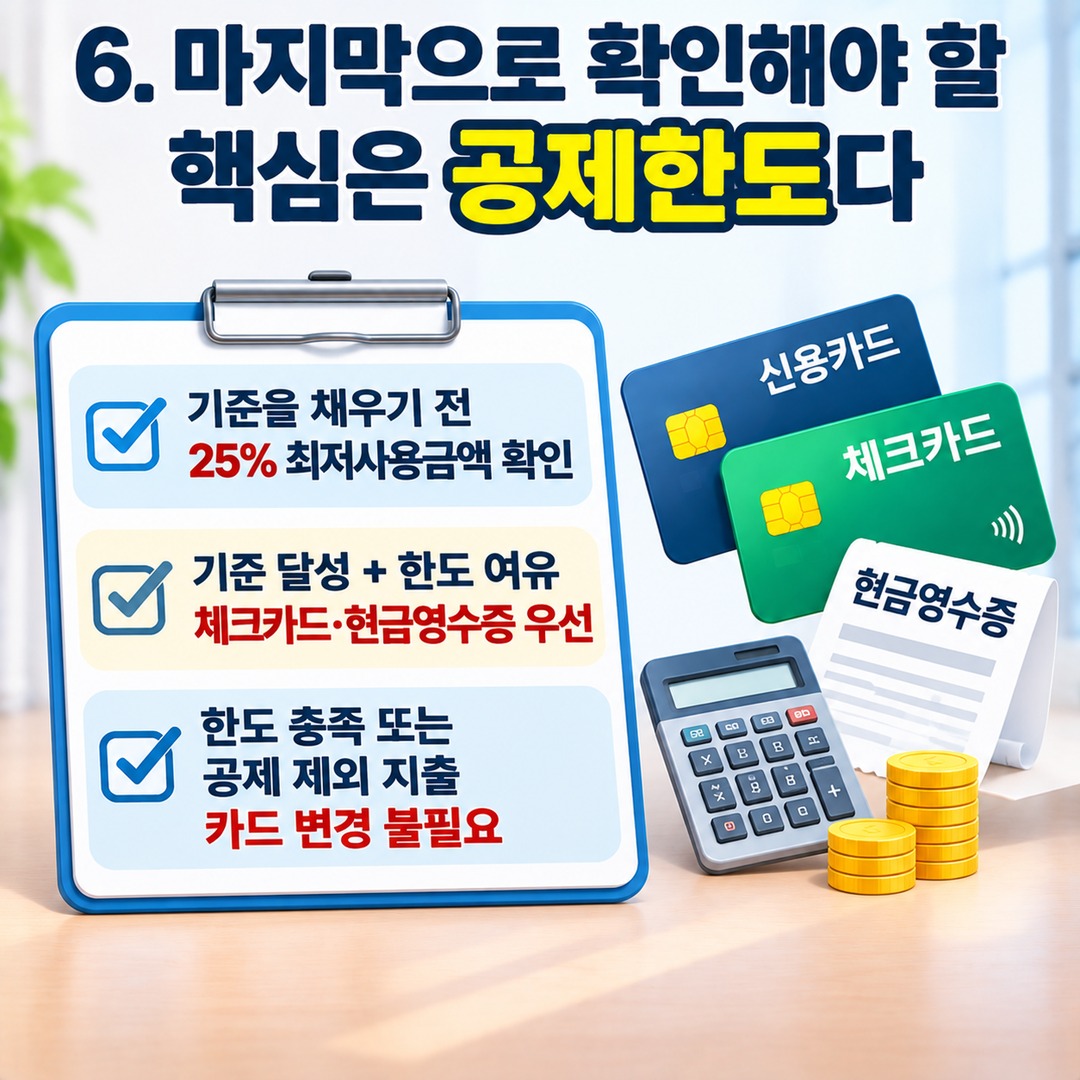
However, if you have already reached your income deduction limit, changing your payment method may provide no additional deduction benefit.
For December 2026, remember these three key points.
Before meeting the deduction threshold, first check the 25% minimum spending requirement.
If you have exceeded the threshold and still have room under the deduction limit, prioritize debit cards and cash receipts.
If you have reached the limit or are paying for excluded expenses, do not change your spending habits solely to obtain a card deduction.
Ultimately, the key to year-end tax settlement is not to increase card spending indiscriminately, but to make sensible choices about which payment method to use for purchases you already planned to make.