

How Wall Street Could Affect the KOSPI on August 4: Conditions for a Samsung Electronics and SK Hynix Rebound
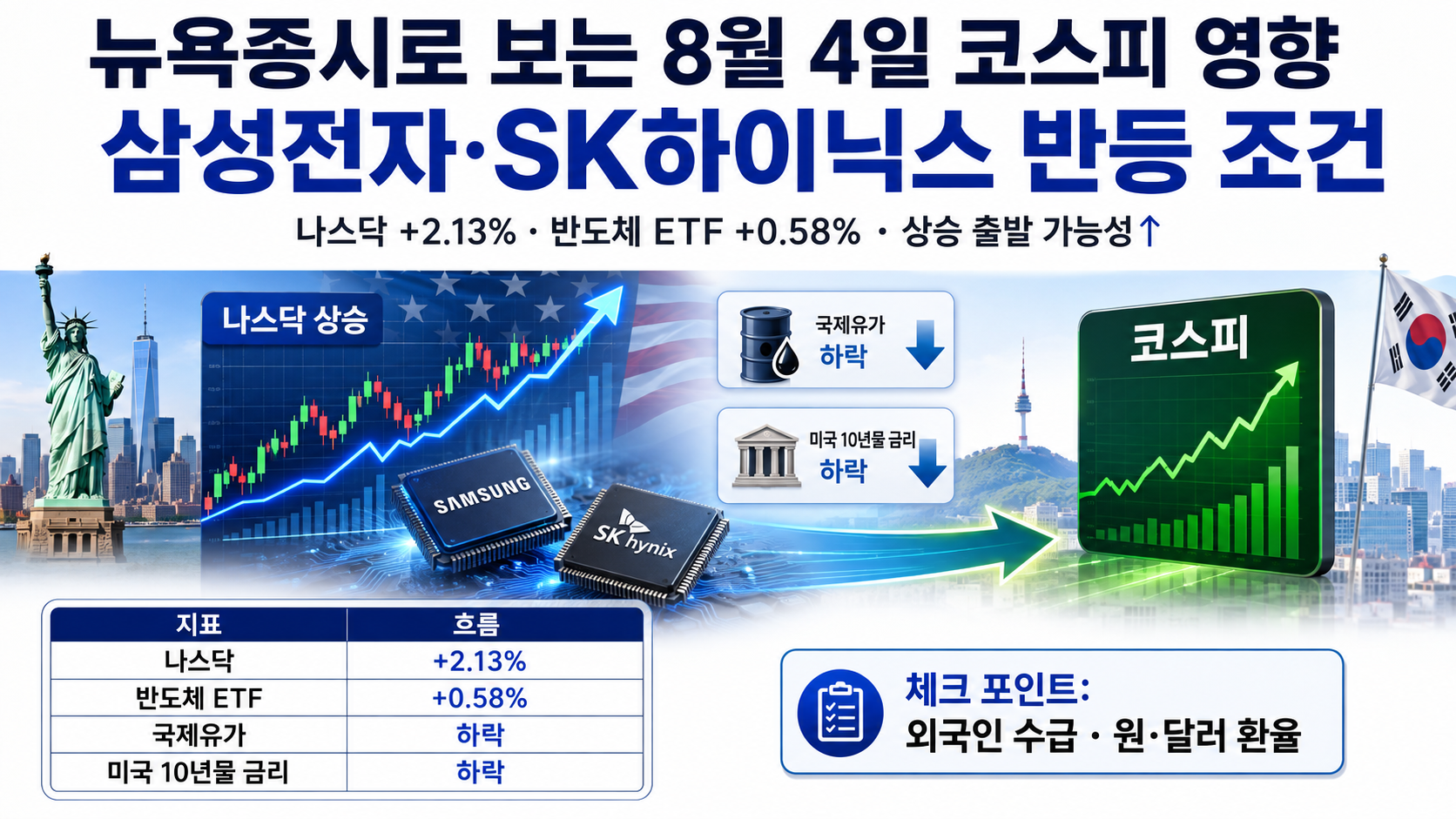
South Korean stocks are now more likely to open higher on August 4. The Nasdaq rose 2.13% overnight, while international oil prices and 10-year U.S. Treasury yields both declined, helping restore risk appetite. However, the U.S. semiconductor ETF gained only about 0.58%, so the strength of any rebound in South Korean semiconductor stocks will depend on foreign investor flows and the won-dollar exchange rate.
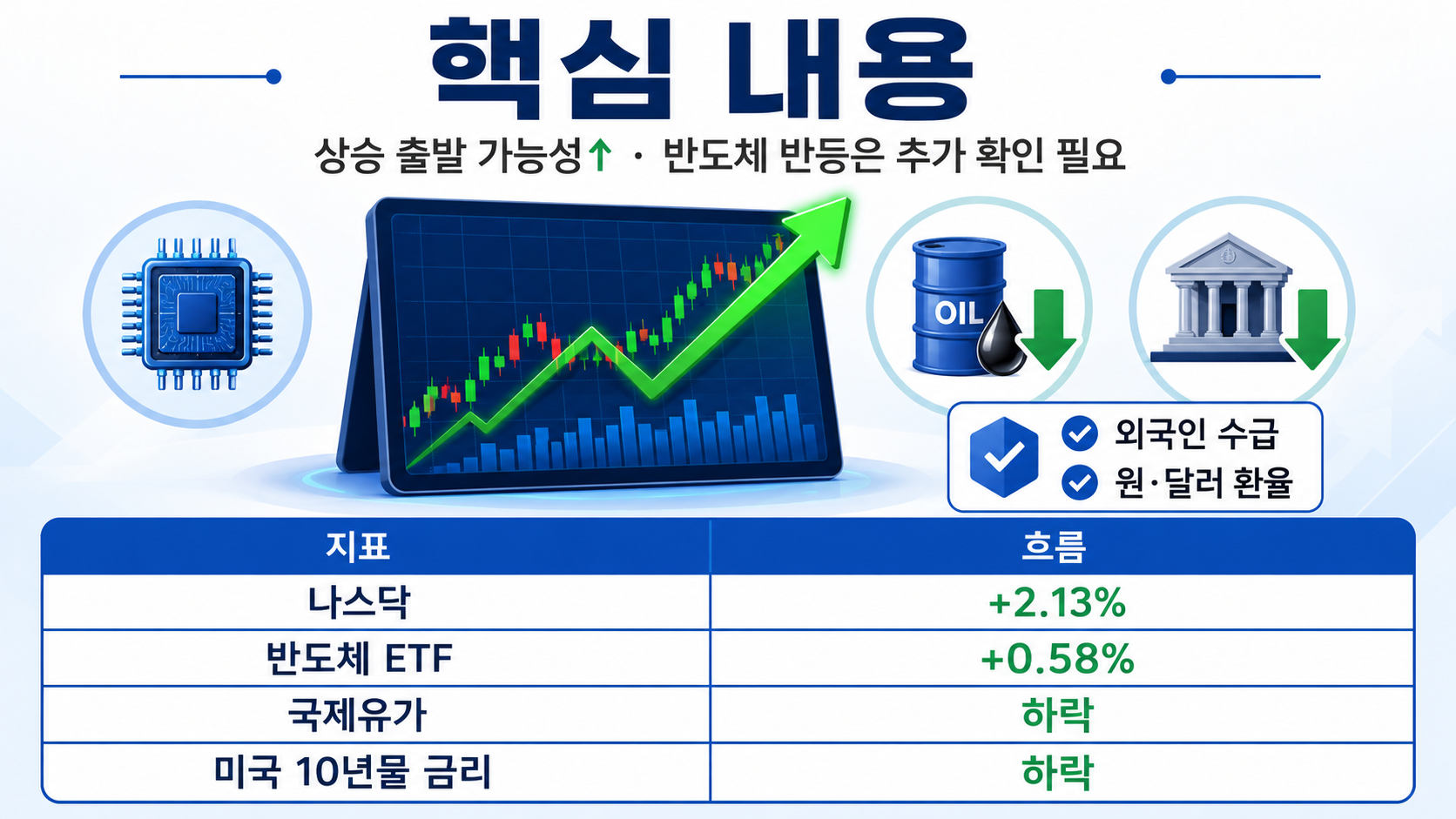
Why Did Wall Street Rise Overnight?
Wall Street advanced as expectations of a possible easing of tensions between the United States and Iran, a sharp decline in international oil prices, and falling U.S. Treasury yields all contributed to the rally. The Dow Jones Industrial Average recorded an all-time closing high, while the technology-heavy Nasdaq posted the largest gain.
| Category | August 3 U.S. Market Results | Implications for South Korean Stocks |
|---|---|---|
| Dow Jones | 53,178.41, up 1.32% | Investor sentiment recovered even among economically sensitive stocks |
| S&P500 | 7,600.50, up 1.48% | Broad strength across major U.S. companies |
| Nasdaq | 25,913.90, up 2.13% | Positive for South Korean growth and technology stocks |
| Russell 2000 | 2,981.91, up 1.70% | Risk appetite was not limited to large technology companies |
| Brent crude | USD 83.77 per barrel, down 7.0% | Potential relief for South Korea's inflation and trade balance pressures |
| WTI | USD 80.34 per barrel, down 5.1% | Positive for airlines, transportation, and consumer-related industries |
| U.S. 10-year Treasury yield | 4.684%, down 6.13bp | Reduced pressure from discount rates on growth-stock valuations |
Lower international oil prices benefit South Korea, which imports most of its crude oil, by reducing costs and inflationary pressure. With U.S. Treasury yields also declining, the combination is favorable for investor sentiment toward South Korean growth and semiconductor stocks.
However, negotiations between the United States and Iran have not been finalized. The United States says talks are underway, while Iran denies that negotiations are taking place at all. As a result, oil prices and stock markets could become volatile again.
Why a Wall Street Rally Does Not Necessarily Mean a Sharp Semiconductor Rebound
Although U.S. technology stocks performed strongly, semiconductor stocks showed relatively weaker gains. The Nasdaq rose 2.13%, but SOXX, a U.S. semiconductor ETF, gained only about 0.58%.
According to the author's calculation, the difference between the two gains was 1.55% percentage points.
Calculation: Nasdaq 2.13% - SOXX 0.58% = 1.55% percentage points
Implication: The rally in U.S. technology stocks did not translate into an equally strong recovery across the semiconductor sector
Nvidia gained approximately 2.94%, and AMD rose about 1.74%, while Micron increased only around 0.74%. Memory semiconductor stocks, which have close connections to the South Korean market, showed weaker gains than the broader Nasdaq.
Therefore, even if Samsung Electronics and SK Hynix rebound early in the session, it would be premature to conclude that their trends have reversed based solely on the Nasdaq's advance.
The Previous Session in South Korea Also Matters
On August 3, the KOSPI closed at 6,257.45, down 5.12%. Samsung Electronics fell 8.76%, while SK Hynix declined 8.79%. Foreign and institutional investors recorded substantial net selling in the KOSPI market.
In contrast, the KOSDAQ closed at 737.35, up 2.44%. This reflected sector rotation, with some capital leaving large KOSPI semiconductor stocks and moving into KOSDAQ growth stocks, including biotechnology and robotics companies.
| August 3 South Korean Market | Result |
|---|---|
| KOSPI | 6,257.45, down 5.12% |
| KOSDAQ | 737.35, up 2.44% |
| Samsung Electronics | Down 8.76% |
| SK Hynix | Down 8.79% |
| Foreign investor flows in KOSPI | Approximately KRW 2,826,400,000,000 in net selling |
| Institutional investor flows in KOSPI | Approximately KRW 1,947,700,000,000 in net selling |
| Individual investor flows in KOSPI | Approximately KRW 4,653,100,000,000 in net buying |
Overnight, EWY, a U.S.-listed ETF investing in South Korean equities, rose approximately 1.95%. This is a positive signal for a rebound in South Korean stocks, but the move was not large enough to fully offset the previous session's KOSPI decline of 5.12%.
According to the author's calculation, EWY's gain was 3.17% percentage points smaller than the KOSPI's decline in the previous session.
Sector-by-Sector Impact on August 4
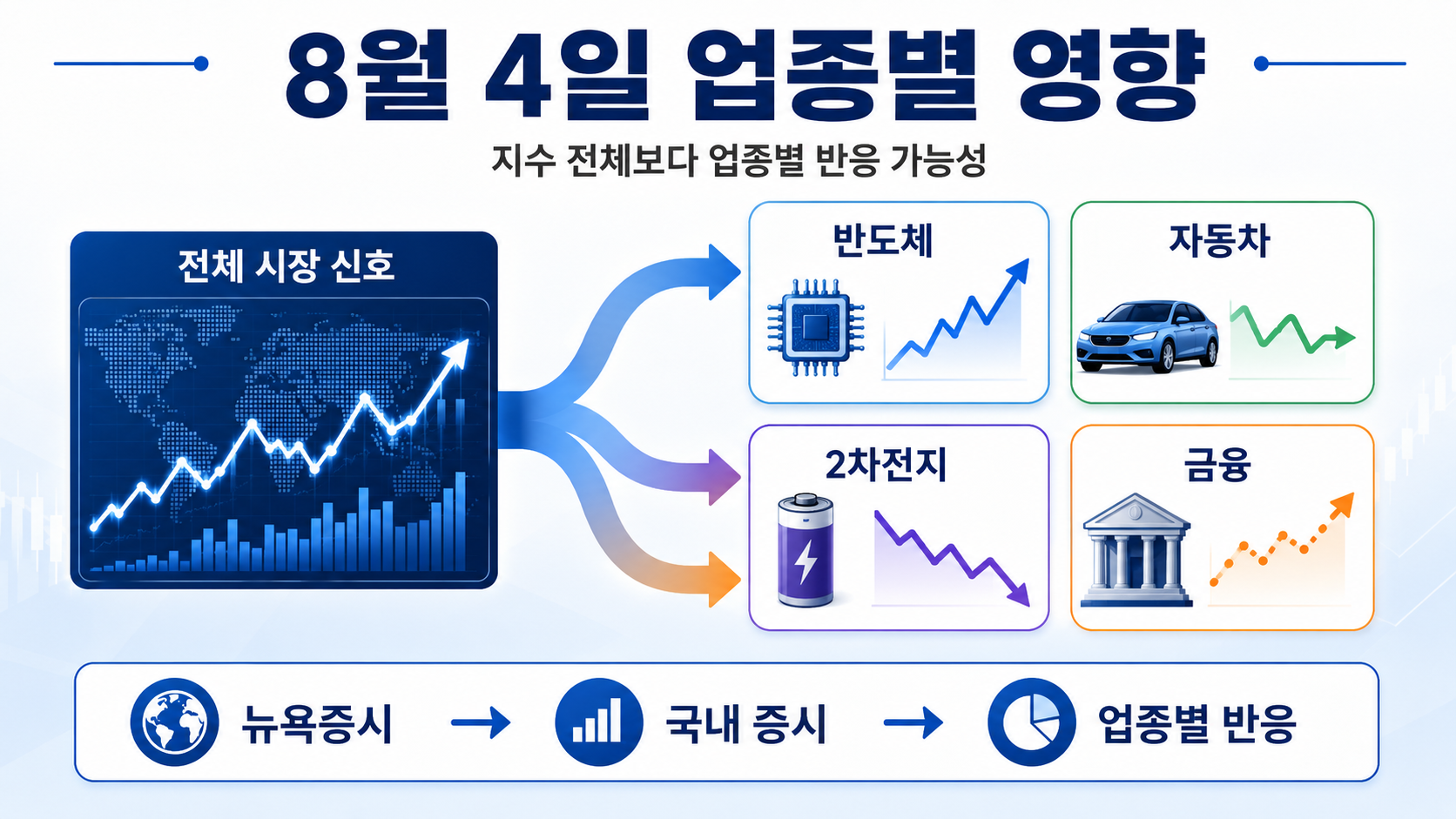
Today, reactions are likely to differ significantly across sectors rather than move uniformly with the broader index.
| Sector | Expected Impact | What to Monitor |
|---|---|---|
| Samsung Electronics and SK Hynix | Potential rebound attempts | Foreign investor flows in cash equities and futures |
| Semiconductor equipment and materials | Potentially greater volatility than major semiconductor stocks | Early-session trading volume and the number of advancing stocks |
| Airlines and transportation | Potential benefits from sharply lower oil prices | Whether oil prices remain lower |
| Chemicals, tires, and consumer goods | Reduced raw material cost pressures | Time lag before changes in input costs are reflected in product prices |
| Oil refining and energy | Sharp oil-price declines may create short-term pressure | Refining margins and inventory valuation effects |
| Biotechnology and robotics | Sector rotation may continue | Strength of the rebound in major KOSPI semiconductor stocks |
| Export-oriented stocks | Performance may vary with exchange-rate movements | Won-dollar exchange-rate movements around KRW 1,430 |
Lower oil prices can reduce costs for airlines and transportation companies, but they are not necessarily good news for oil refiners. Refiners may see the value of their existing inventories decline as oil prices fall, while the actual earnings impact depends on refining margins.
South Korea's July Consumer Inflation Is Another Pre-Market Variable
According to a breaking report released at 8 a.m., South Korea's consumer prices for July rose 2.8% from the same month a year earlier. This was 0.4% percentage points below the 3.2% increase recorded in June, bringing the inflation rate back into the 2% range for the first time in three months.
Slower inflation could ease domestic interest-rate pressures and support investor sentiment toward growth stocks. However, petroleum product prices were still reported to be 15.5% higher than a year earlier, making it difficult to conclude that inflationary pressures have been completely resolved.
It is prudent to review the detailed product categories and core inflation figures from the National Data Agency before assessing the implications for interest rates and individual sectors.
Practical Indicators to Check After 9 a.m.
Rather than immediately chasing stocks that rise at the opening bell, investors should watch whether the following three conditions occur together.
1. Are Foreign Investors Buying KOSPI 200 Futures?
If foreign investors shift to net buying in futures, a rebound in major semiconductor stocks is more likely to translate into broader index gains.
If the index rises while foreign investors continue selling futures, the early-session rebound could lose momentum under profit-taking pressure.
2. Is the Won-Dollar Exchange Rate Stabilizing?
The won-dollar exchange rate closed at KRW 1,429.8 in Seoul's foreign exchange market during the previous session. If today's exchange rate stabilizes below KRW 1,430 or declines, it would be positive for foreign investor flows.
Conversely, if the exchange rate rises rapidly above KRW 1,430 while foreign selling continues, the rebound in major KOSPI stocks could be limited.
3. Are Samsung Electronics and SK Hynix Rising on Higher Trading Volume?
There is a difference between the two stocks merely avoiding a lower opening and attracting genuine buying interest.
A sustained rebound becomes more likely when rising share prices are accompanied by increasing trading volume and confirmed foreign buying. If the index rises while both stocks remain weak, sector rotation could continue toward biotechnology, robotics, consumer stocks, and other industries.
Three Possible Market Scenarios Today
A Normal Rebound Led by Semiconductor Stocks
This scenario would occur if the won-dollar exchange rate stabilizes and foreign investors buy futures alongside Samsung Electronics and SK Hynix. It would indicate that the Nasdaq's gains and lower interest rates are being reflected in South Korea's major technology stocks.
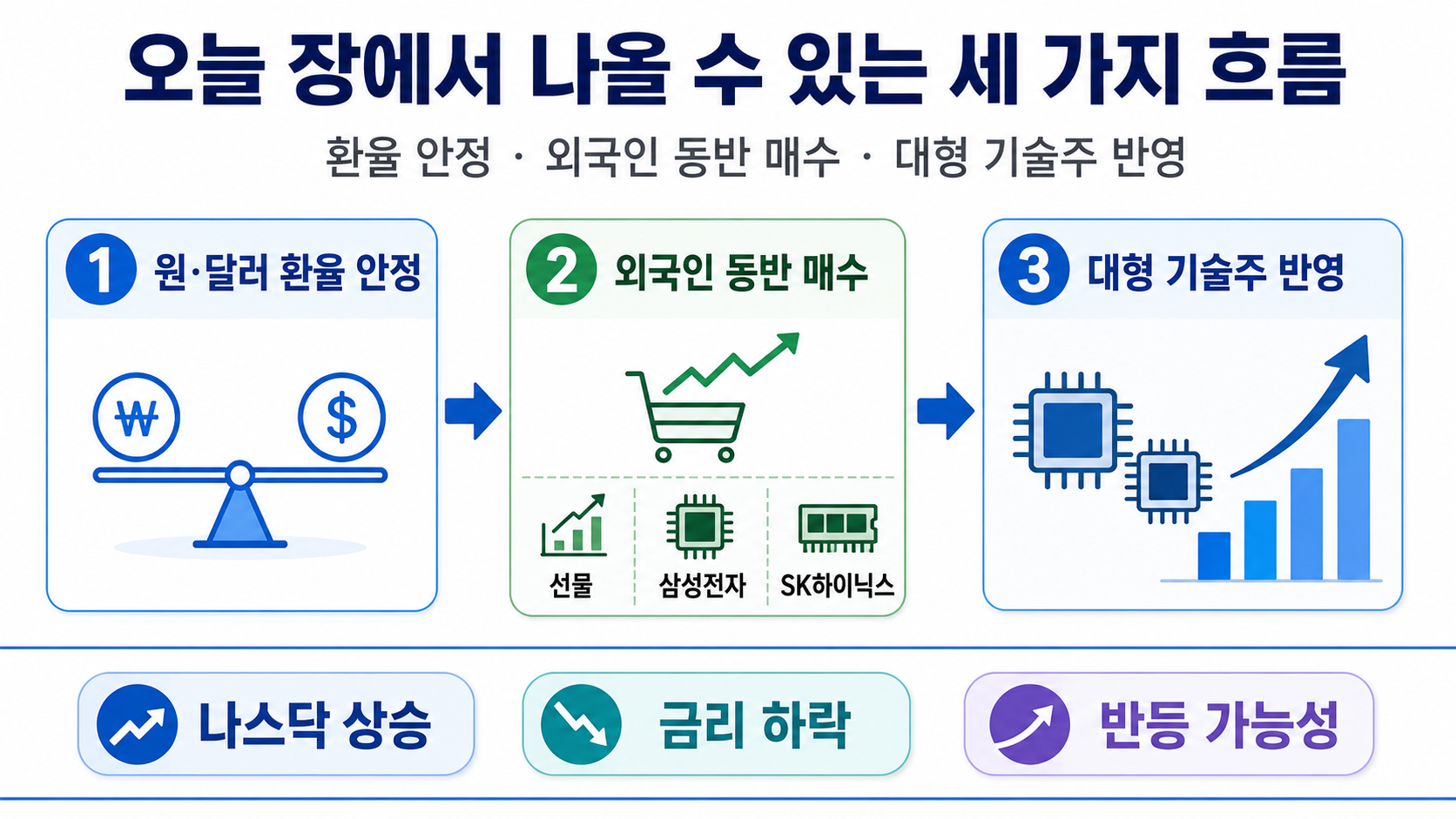
A Higher Opening Followed by Renewed Selling
In this scenario, the index opens higher, but foreign selling continues and the exchange rate rises. After a technical rebound from the previous session's sharp decline, selling pressure could increase again.
Sector Rotation with the KOSDAQ Outperforming the KOSPI
This scenario would occur if major semiconductor stocks show only a weak rebound while buying continues in KOSDAQ growth stocks such as biotechnology and robotics companies. The divergence between the KOSPI and KOSDAQ seen in the previous session could continue for another day.
Today's Conclusion
On August 4, South Korean stocks are entering the session in an environment favorable to a rebound, supported by Wall Street's rally, sharply lower international oil prices, declining U.S. Treasury yields, and easing domestic inflation.
However, given that the U.S. semiconductor ETF gained less than the Nasdaq and foreign investors sold heavily in South Korea during the previous session, the following three factors matter more than a higher opening itself.
A shift to net buying by foreign investors in KOSPI 200 futures
Stability in the won-dollar exchange rate around KRW 1,430
A rebound in Samsung Electronics and SK Hynix accompanied by higher trading volume
If all three conditions are confirmed, the rebound is more likely to be sustained. If any one of them fails to materialize, investors should examine sector-specific capital flows and volatility before chasing index gains.
This article is a reference summary of market information confirmed through 8:16 a.m. on 2026-08-04. Developments in Middle East negotiations, oil prices, exchange rates, and foreign investor flows may change during the trading session. This article does not recommend buying or selling any particular stock or guarantee investment returns.
---
Sources and Verification of Figures in This Article
The closing levels of the 3 major U.S. stock indexes, U.S. sector performance, corporate earnings, and expectations for interest-rate increases were verified using Reuters market-closing reports.
Brent crude and WTI closing prices, the U.S. 10-year Treasury yield, and the differing positions of the United States and Iran on negotiations were verified using Reuters global market reports.
Closing levels of major U.S. indexes, including the Russell 2000, were cross-checked against AP data.
The percentage changes for Nvidia, Micron, AMD, SOXX, and EWY were calculated relative to their previous closing prices using values confirmed after the U.S. trading session ended.
The August 3 closing levels of the KOSPI and KOSDAQ, along with investor-category trading flows, were verified using domestic market-closing reports citing Korea Exchange data.
The publication date of the July consumer inflation figures was confirmed using the National Data Agency's release schedule, while the year-over-year inflation rate from the breaking report released at 8 a.m. was incorporated based on the latest reporting.
---
※ This article is provided for informational purposes to help readers understand market trends and does not constitute investment advice regarding any particular stock or asset. Readers are responsible for their own final investment decisions.