

Southern Korea's Drought Worsens: Gyeongnam Rainfall at 33% of Normal Levels—How Have Conditions Changed at 3 Dams?
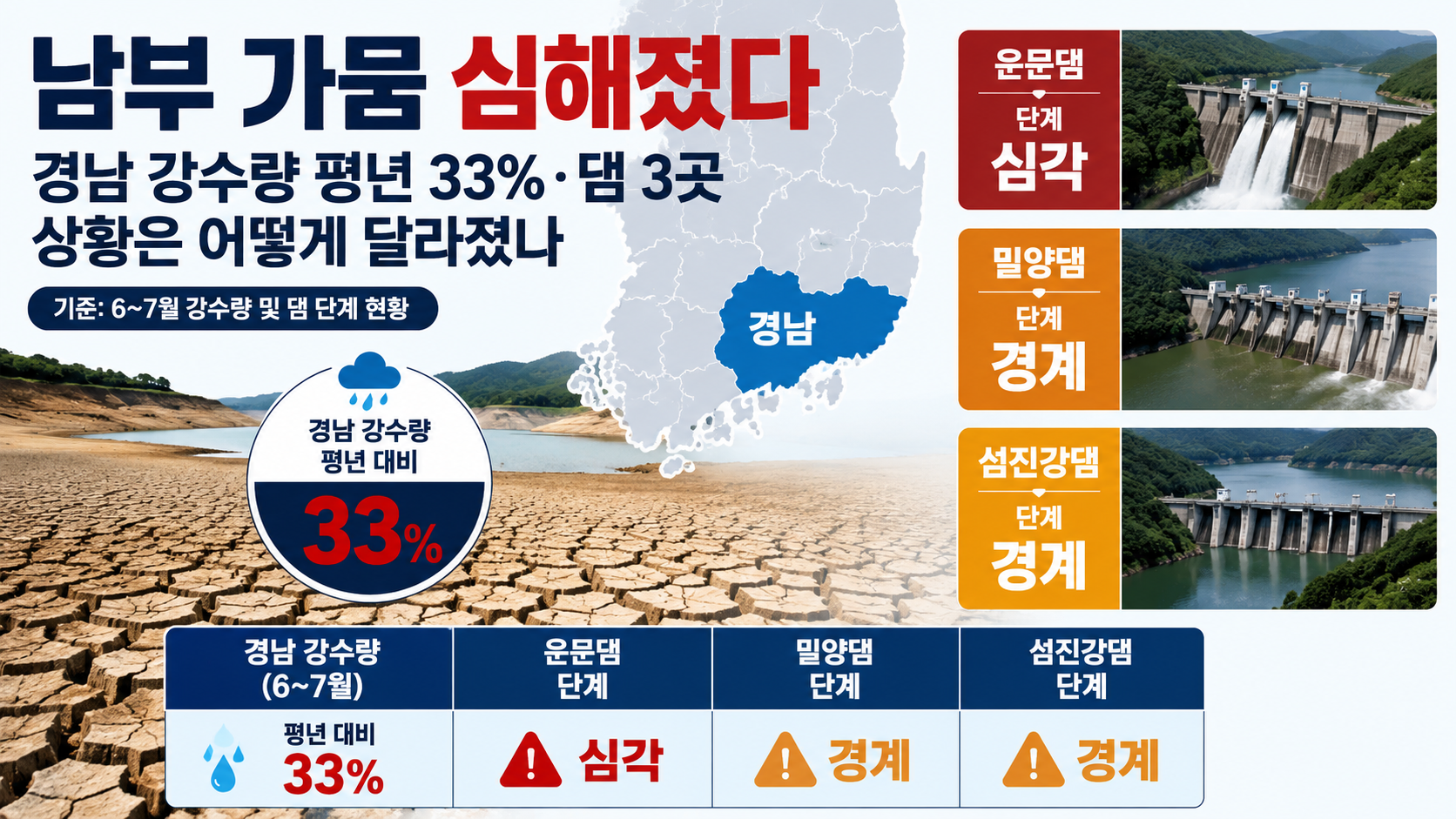
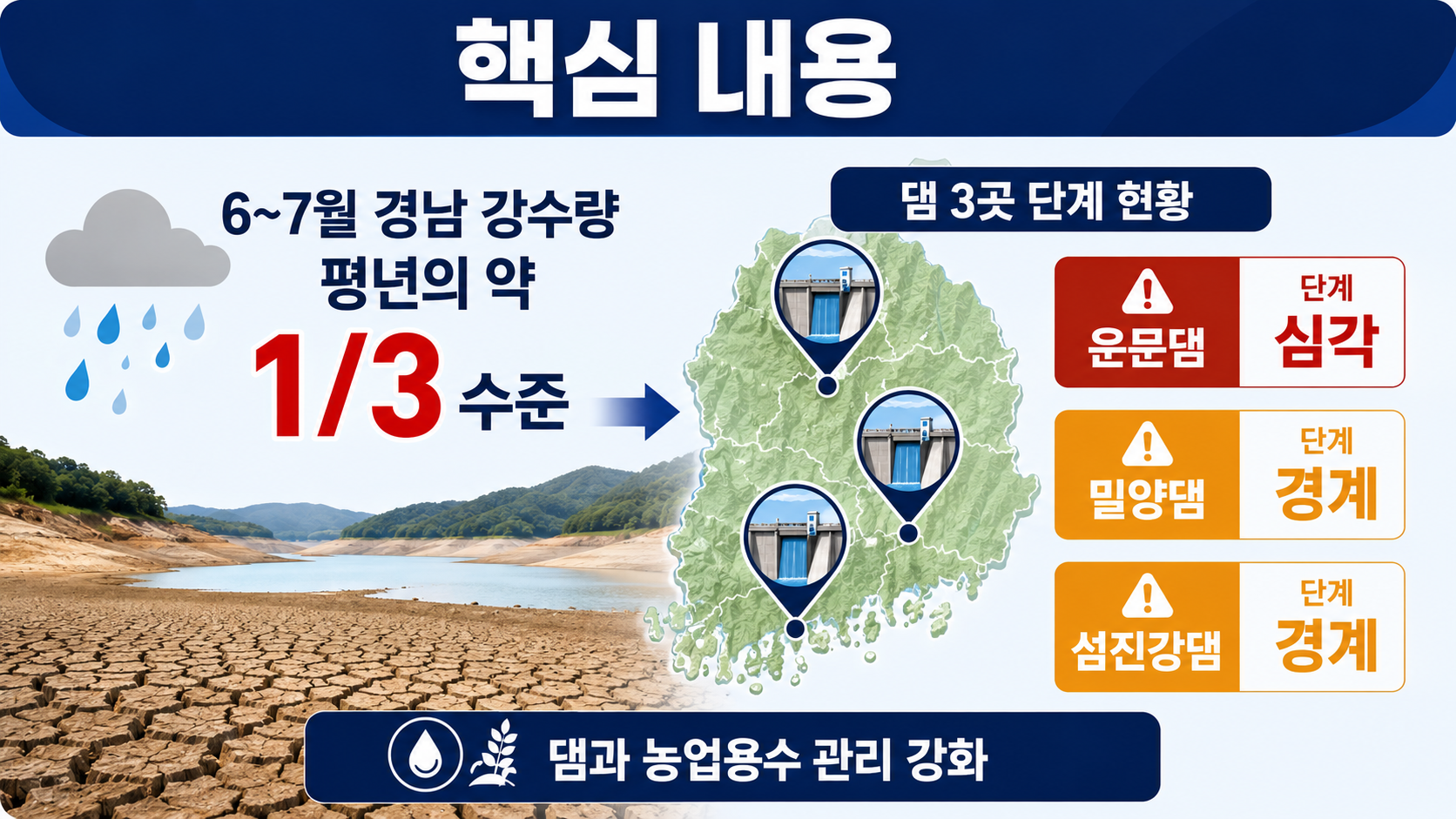
The drought in southern Korea is more than just a few days without rain. Rainfall in Gyeongnam during 6–7 reached only about 1 of 3 of its normal level. Unmun Dam entered the 'Severe' drought stage, while Miryang Dam and Seomjingang Dam reached the 'Alert' stage, prompting tighter management of dam water supplies and agricultural water resources.
Although rain and showers are forecast for parts of southern Korea on August 9, resolving the current drought will require sustained precipitation capable of replenishing water reserves in dam catchment areas and agricultural regions, rather than brief, localized rainfall.
The Biggest Reason Southern Korea's Drought Has Worsened Is the Uneven Distribution of Rainfall
Looking at July alone, it is not as though the entire country received no rain this year.
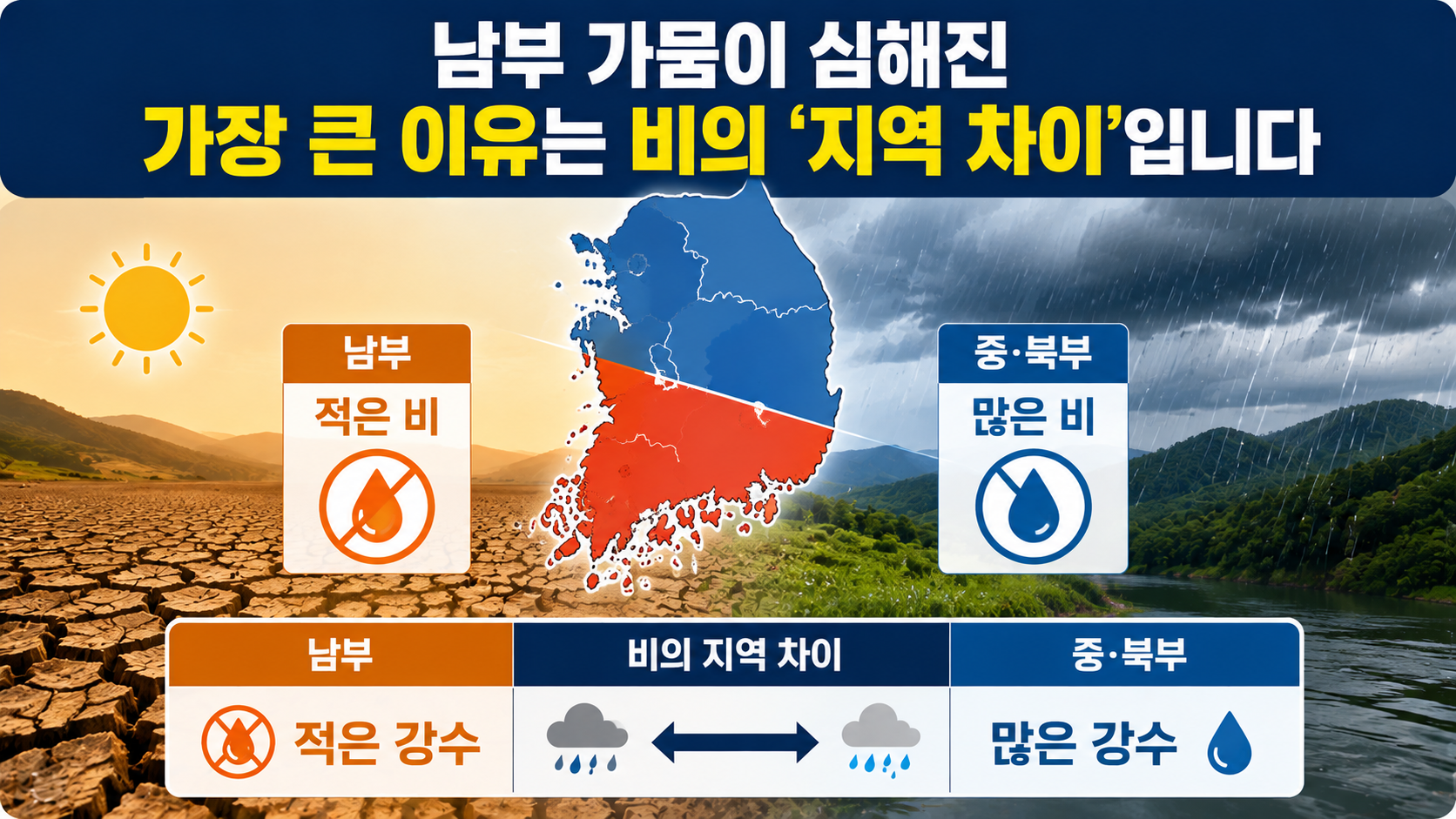
The nationwide average rainfall was 220.0 mm. The problem was that rainfall was concentrated in central Korea, while southern regions received very little.
In particular, Gyeongnam recorded just 68.0 mm of rainfall in July. This was the lowest level for the same month since 1973.
The situation remains similar when the period is extended from June 1 to July 31.
Gyeongnam's cumulative rainfall was 162 mm, compared with the normal level of 487 mm.
According to the author's calculation, this represents a shortfall of 325 mm compared with normal rainfall.
The calculation is `487 mm - 162 mm = 325 mm`.
In percentage terms, this means approximately 66.7% less rainfall than normal.
With continued news coverage of heavy downpours in central Korea, people may assume that water supplies are sufficient nationwide. However, drought conditions depend more on how much rain actually falls within the catchment areas where dams and farmland are located than on the national average.
Unmun Dam, Miryang Dam, and Seomjingang Dam Are at Different Drought Alert Stages
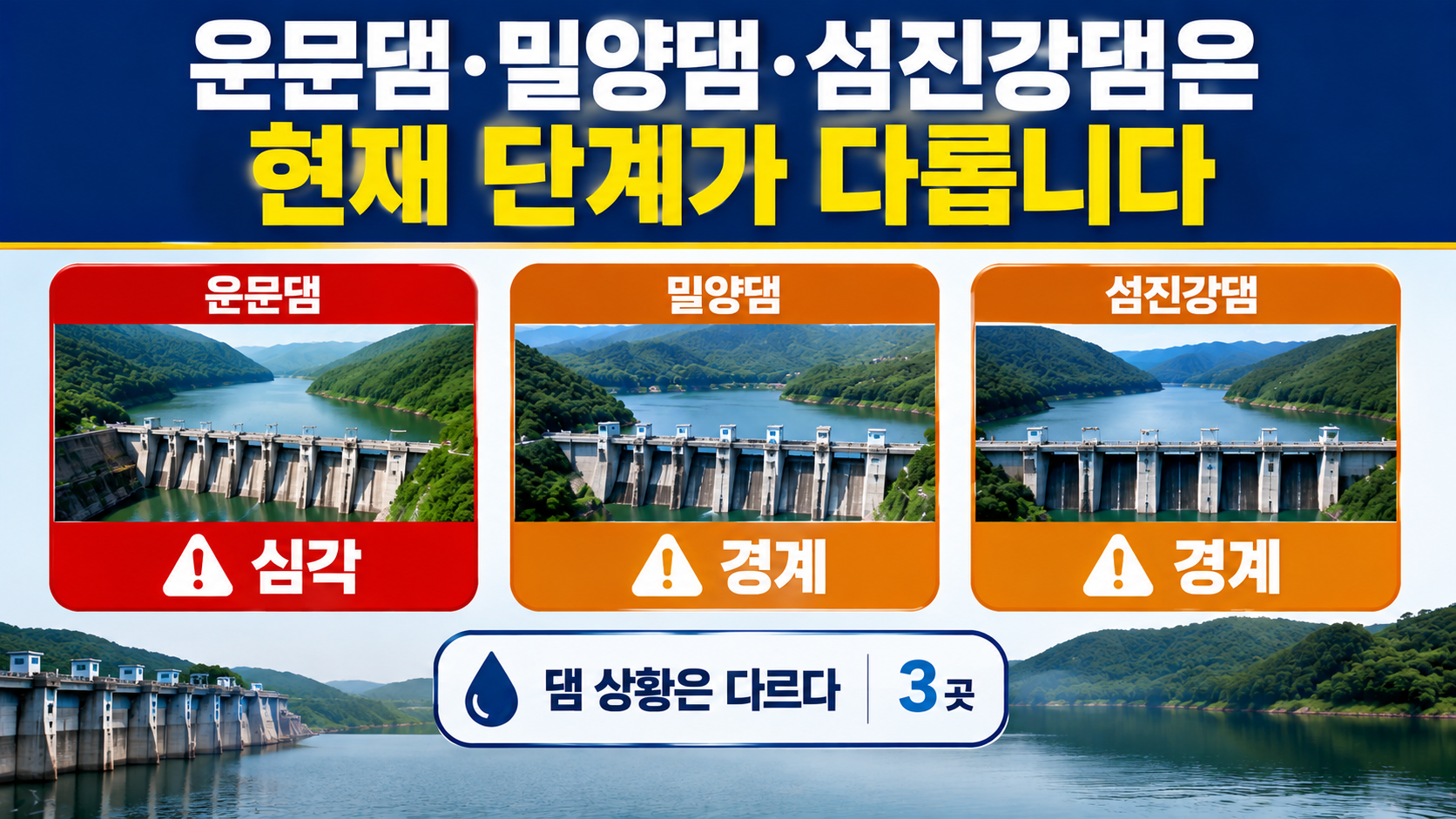
When assessing the drought in southern Korea, the three dams should not be treated as though they are experiencing identical conditions.
Unmun Dam entered the 'Severe' drought alert stage on July 15.
The 'Severe' stage requires authorities to conserve as much water as possible in the dam while actively using alternative water sources. At Unmun Dam, measures are already underway to reduce environmental flows needed to maintain river conditions and draw on alternative sources, including the Nakdong River and Geumho River.
Miryang Dam was raised to the 'Alert' stage on August 2.
Cumulative rainfall this year has been substantially below normal. Water reserves declined rapidly, particularly because rainfall was insufficient during the period when securing water supplies for the peak summer season was essential.
Seomjingang Dam also entered the 'Alert' stage on August 5. At the time, its reservoir storage rate was around 22.5%.
Because Seomjingang Dam supplies not only domestic water but also agricultural water connected to the Honam Plain, agricultural water management becomes an increasingly important concern if reservoir levels continue to fall.
In other words, the current drought in southern Korea is not confined to one particular area. It is more accurate to view it as a situation in which pressure on water resource management is increasing simultaneously in parts of the Nakdong River and Seomjingang River basins.
Why Farmers Feel the Pressure Before Household Water Users
The onset of a drought does not mean that household tap water supplies will immediately be cut off.
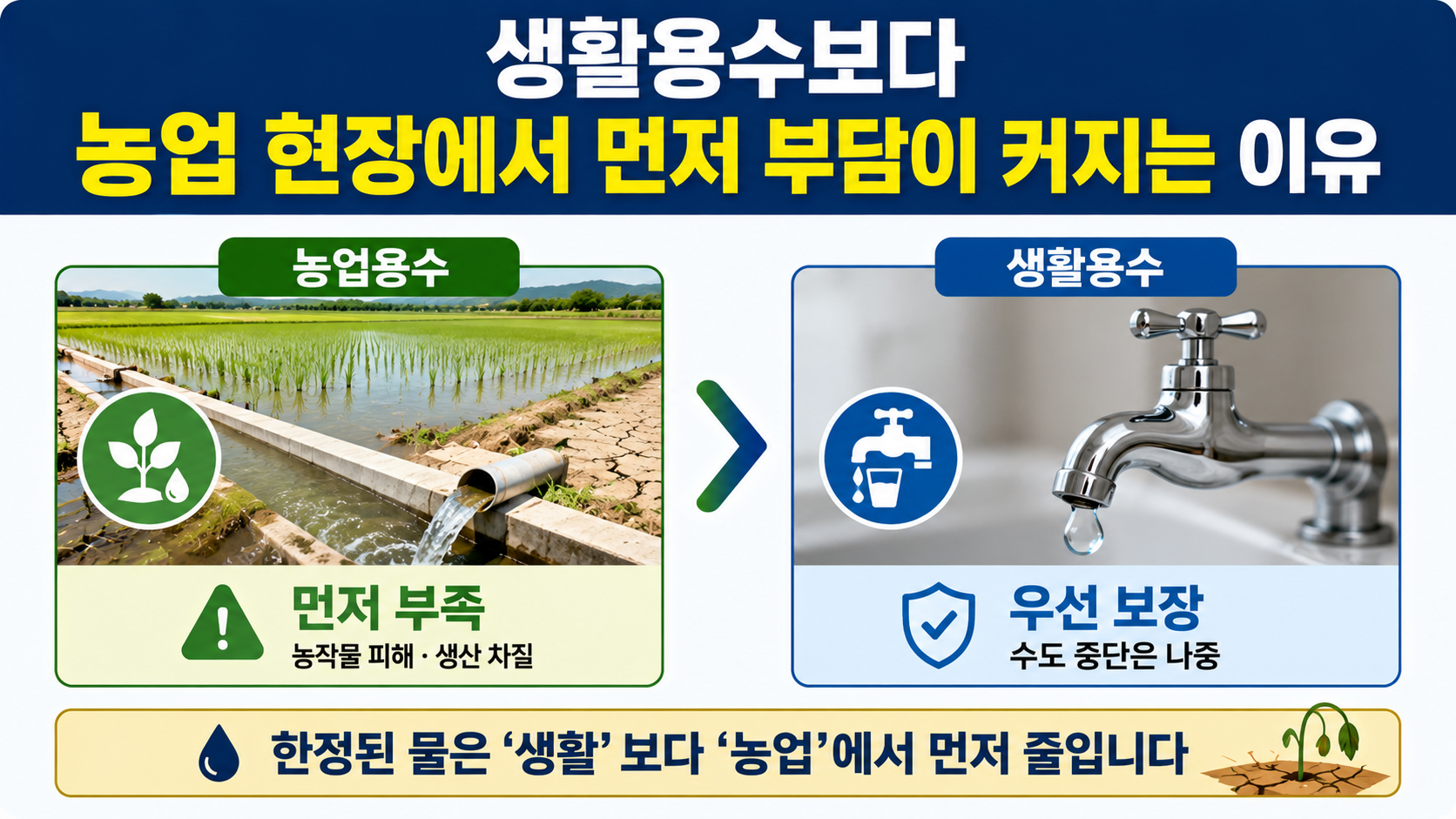
When a dam's drought alert stage rises, authorities generally try to maintain stable domestic and industrial water supplies as much as possible. They respond by adjusting environmental flows or agricultural water allocations and using alternative intake sources to conserve water stored in existing dams.
Agriculture, however, faces a time constraint because crops must receive water when they need it.
Rice paddies and other farmland, in particular, increasingly require supplementary irrigation methods such as pumps, groundwater wells, and river water as reservoir levels decline.
In fact, as rainfall in Gyeongnam during 6–July fell to just 33% of its normal level, additional assistance and on-site water supply measures were introduced for areas experiencing agricultural water shortages.
That is why rural communities may experience the same drought much earlier and more severely than ordinary households, even when residents have yet to notice any major changes in their daily water supply.
Will Rain on August 9 End the Drought?
Rain is forecast for parts of Busan, Ulsan, and Gyeongnam on August 9, with showers also possible across several inland areas of southern Korea.
However, 'rain is forecast' and 'the drought will end' do not mean the same thing.
Showers can vary considerably in intensity and amount from one location to another and may be concentrated over a short period. Although they can help moisten the surface of farmland, the recovery in reservoir storage levels may be limited unless sufficient rain falls throughout the upstream catchment areas of dams.
The key figures to monitor are not limited to a single day's rainfall total.
It is important to examine how much rain actually falls within dam catchment areas, how much inflow into the dams increases after rainfall, and whether reservoir storage levels continue rising over several days.
Reservoir Storage Rates Alone Do Not Tell the Whole Story of a Drought
A low reservoir storage rate is certainly a warning sign, but that figure alone is not enough to determine the likelihood of water supply interruptions in a particular area.
Each dam has different normal water consumption levels and service areas. The ability to bring in water from other rivers or dams also varies.
It is therefore necessary to check which water allocations have been reduced following an increase in the drought alert stage, whether alternative water sources have been secured, and whether rain is forecast in the coming days.
In particular, drought alert stages such as 'Concern,' 'Caution,' 'Alert,' and 'Severe' are not merely descriptions of weather conditions. They are best understood as thresholds used by water supply authorities to strengthen water conservation and adjust distribution.
What Will Matter Most for Southern Korea's Drought Going Forward?
The first factor is cumulative rainfall within dam catchment areas.
Rather than brief showers, what matters is whether enough sustained rainfall reaches the upstream areas of Unmun Dam, Miryang Dam, and Seomjingang Dam to meaningfully replenish their water reserves.
The second factor is the direction of reservoir storage rates.
If storage rates continue falling even after rainfall, it means water consumption and releases exceed inflows. Conversely, if storage rates begin recovering over several days, authorities may be able to consider easing drought response measures.
The third factor is agricultural water supply.
August is an important period for water availability as crops grow and approach harvest. Even if domestic water supplies remain largely unaffected, irrigation conditions at agricultural reservoirs, rice paddies, and other farmland must be assessed separately.
To summarize the current drought in southern Korea in one sentence: Central Korea has received substantial rainfall, but parts of the south, including Gyeongnam, have experienced a severe rainfall shortage, pushing major dams into higher drought alert stages.
Rather than assuming that a few days of forecast rainfall will bring the drought to an end, the most accurate approach is to monitor how much cumulative rainfall and dam reservoir storage levels actually recover.