

Base Rate Hike to 3%: When Will Interest on My Variable-Rate Mortgage Increase?
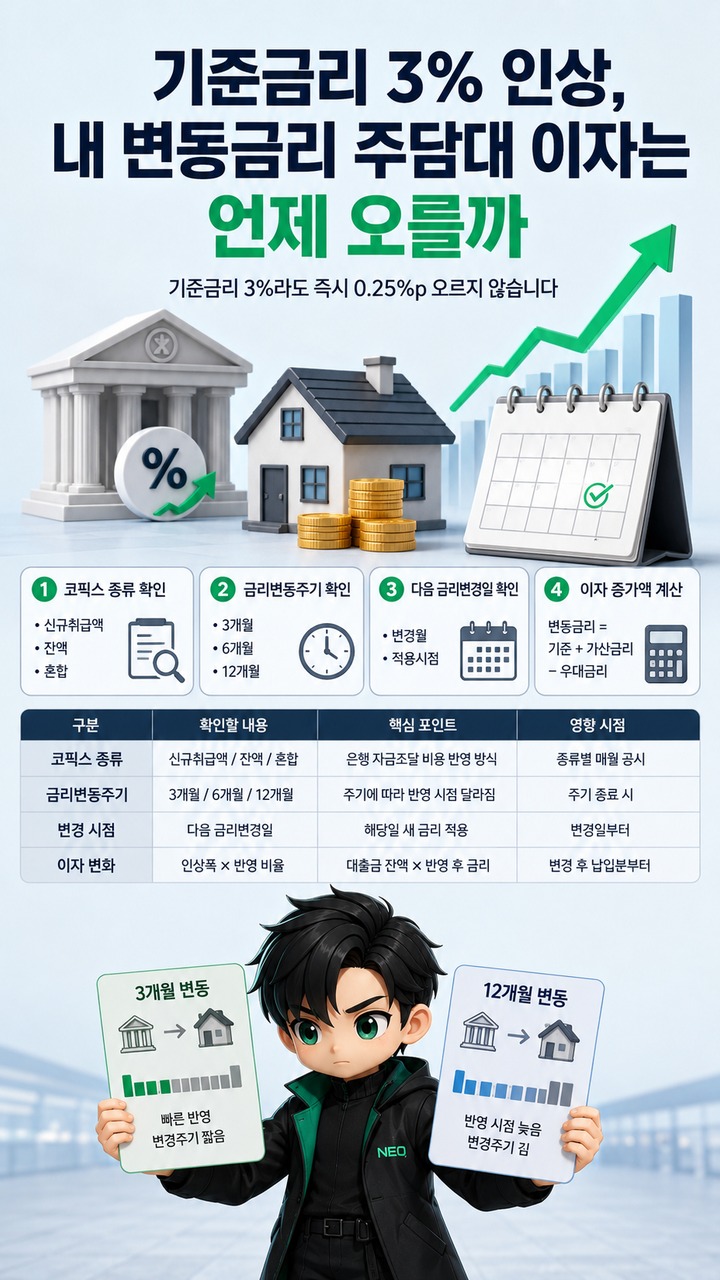
Although the Bank of Korea raised its base rate from 2.75% to 3.00% per year on 2026-08-27, interest on existing variable-rate mortgages does not immediately increase by 0.25% percentage points starting today. The actual timing and size of the increase depend on which benchmark rate your loan is linked to and when your next interest rate adjustment is scheduled.
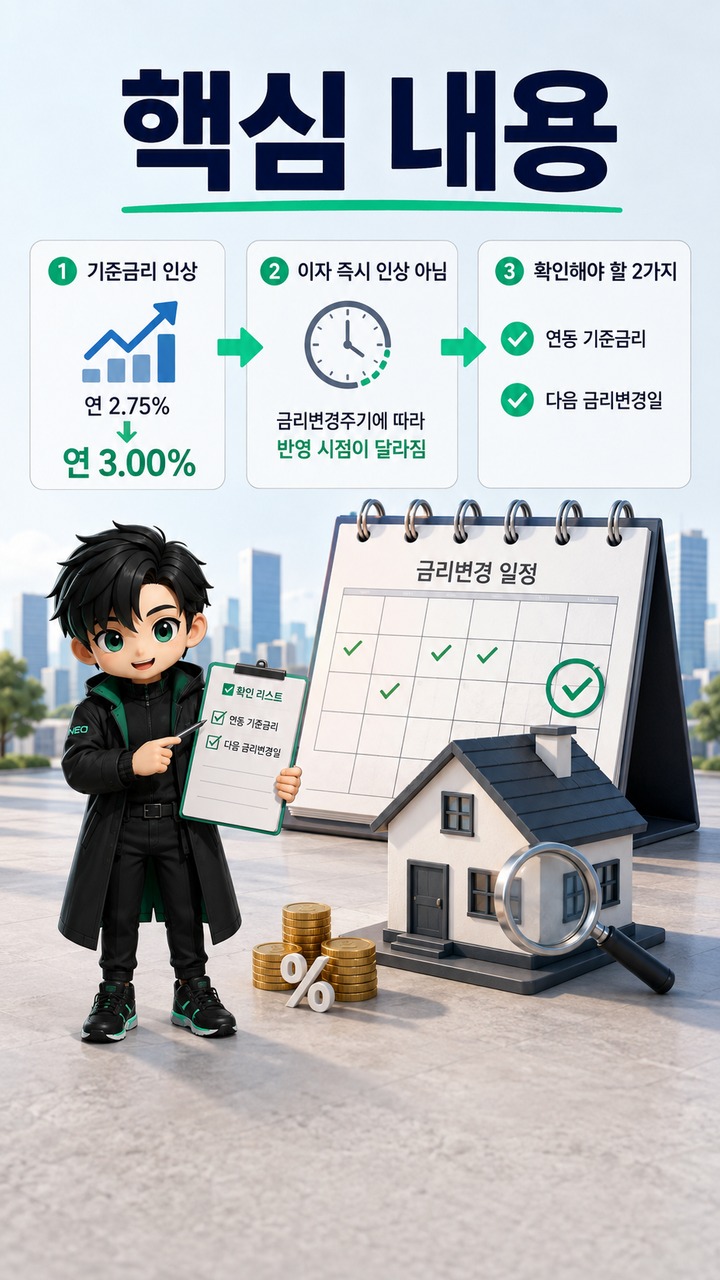
Therefore, the first things to check are not the Bank of Korea's base rate itself, but the benchmark rate type, interest rate adjustment cycle, and next rate adjustment date shown in your banking app or loan agreement.
Why Has My Mortgage Rate Stayed the Same Even Though the Base Rate Reached 3%?
The Bank of Korea's base rate and the interest rate you actually pay on your mortgage are not the same figure.
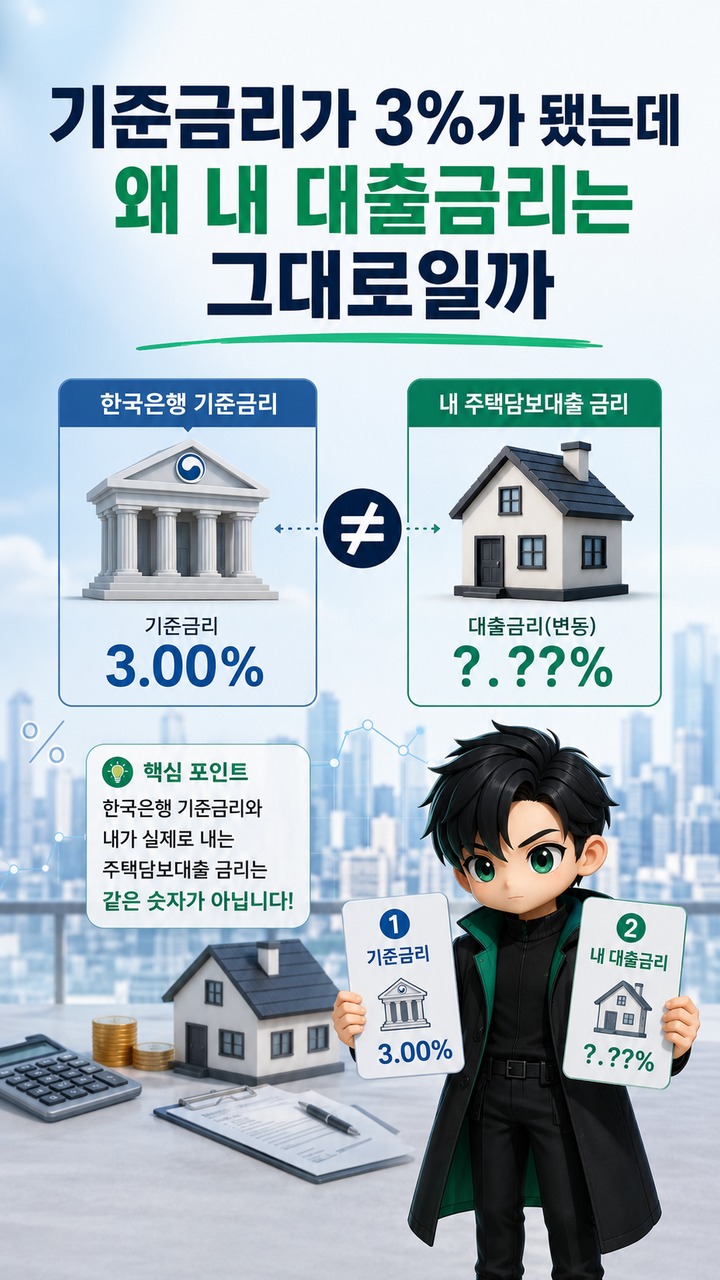
Bank lending rates are generally determined using the following structure.
Loan interest rate = Benchmark rate + Additional spread - Preferential rate discount
The benchmark rates used for loans may include various indicators, such as the Cost of Funds Index (COFIX) and financial bond yields. COFIX is widely used for variable-rate mortgages.
When the Bank of Korea raises its base rate, the decision can affect banks' funding costs, including deposits and bonds, as well as market interest rates. Those changes may subsequently be reflected in COFIX or financial bond yields.
In other words, the process is more accurately understood as follows:
Bank of Korea base rate hike → Changes in market and deposit rates and bank funding costs → Changes in COFIX and financial bond yields → Reflection on the loan's interest rate adjustment date
That is why a 0.25%-percentage-point increase in the base rate does not mean every loan rate will rise by exactly 0.25% percentage points on the same day.
If Your Mortgage Uses COFIX, First Check Which Type of COFIX Applies
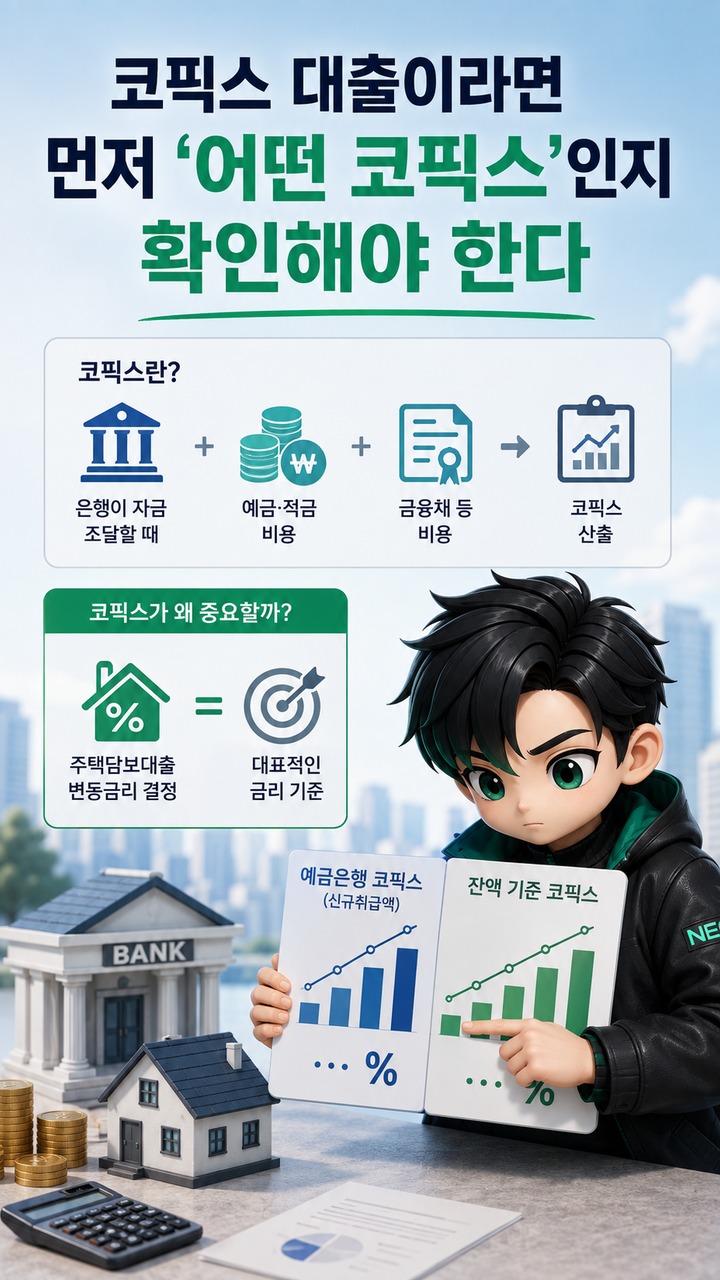
COFIX is an index calculated based on the costs banks incur when raising funds through deposits, savings products, financial bonds, and other instruments. It is one of the main benchmark rates used to determine variable mortgage interest rates.
However, there is more than one type of COFIX.
Major types include newly originated funds COFIX, outstanding balance COFIX, and new outstanding balance COFIX. The speed and magnitude of interest rate changes can differ depending on which index is used.
The newly originated funds index tends to reflect recent changes in the interest rates on newly raised funds relatively quickly.
By contrast, the outstanding balance and new outstanding balance indices also include funds raised in the past, so recent market interest rate changes may be reflected more gradually.
Therefore, even if the news simply reports that "COFIX has risen," you should first check whether your loan is actually linked to that particular COFIX index.
The Date Your Interest Actually Increases Is Your Next Rate Adjustment Date
For existing variable-rate borrowers, the most important date is not the Bank of Korea's Monetary Policy Board meeting date, but the interest rate adjustment date specified in their own loan agreement.
For example, a product with a 6-month variable-rate cycle recalculates the loan interest rate by applying the benchmark rate at regular intervals.
Suppose your current rate was last determined on June 2026 and your loan has a 6-month adjustment cycle. Your next rate adjustment would generally occur around December.
Even if the base rate or COFIX changes during that period, the existing applicable rate may remain unchanged until the contractual adjustment date arrives.
Conversely, if your next rate adjustment date is approaching, such as September or October, your loan may reflect recent market rate and COFIX changes relatively quickly.
The key point is that the newly announced base rate of 3.00% is not applied directly to your loan. Instead, the benchmark rate specified in your contract is reapplied when your loan rate is recalculated.
How Much More Interest Would You Pay If Your Loan Rate Rose by 0.25% Percentage Points?
A 0.25%-percentage-point increase in the base rate does not necessarily mean your actual mortgage rate will increase by the same amount.
However, to estimate the potential financial burden, we can make a simple calculation assuming your actual loan interest rate rises by 0.25% percentage points.
With an outstanding loan balance of KRW 100,000,000, the additional annual interest would be approximately KRW 250,000, or about KRW 20,833 when expressed as a monthly average.
For KRW 200,000,000, the additional interest would be approximately KRW 500,000 per year, or KRW 41,667 per month on average.
For KRW 300,000,000, the additional interest would be approximately KRW 750,000 per year, or KRW 62,500 per month on average.
For KRW 500,000,000, the additional interest would be approximately KRW 1,250,000 per year, or KRW 104,167 per month on average.
The formula is straightforward.
Outstanding loan balance × Interest rate increase = Additional annual interest
For example:
KRW 300,000,000 × 0.25% = KRW 750,000 per year
However, for loans with equal total monthly payments or equal principal repayments, the outstanding principal decreases each month. As a result, the actual additional interest will differ from this simplified calculation.
The final interest rate may also vary depending on how much COFIX or financial bond yields actually change and whether the borrower continues to qualify for preferential interest rate discounts.
The August 27 Rate Hike Does Not Automatically Add 0.25% Percentage Points to the Next COFIX
This is one of the most common sources of misunderstanding.
Just because the Bank of Korea raised its base rate by 0.25% percentage points on August 27 does not mean the next published COFIX will automatically rise by 0.25% percentage points.
COFIX is not a figure that simply copies the Bank of Korea's base rate. It reflects banks' actual funding costs. Changes in various funding instruments, including deposit rates and financial bond yields, influence the index together.
In particular, financial markets sometimes anticipate base rate decisions and move before the official announcement.
In fact, during 2026, mortgage rates at major Korean banks began rising as market interest rates increased even before the Bank of Korea shifted toward a monetary tightening stance.
Therefore, when reviewing the next COFIX announcement, the important question is not simply whether "0.25% percentage points will be added," but how much the index has actually changed compared with the current COFIX.
Fixed-Rate and Hybrid Mortgages Work Differently
Not every product labeled a "mortgage loan" responds to interest rate changes in the same way.
For loans that are still within their fixed-rate period, the existing contractual interest rate generally remains in effect throughout that period. Therefore, the Bank of Korea's latest base rate hike does not immediately change the loan rate.
Hybrid mortgage products may have a structure in which the interest rate is fixed for the first several years before switching to a variable rate.
Therefore, even if you believe you have a fixed-rate mortgage, it is worth reviewing your loan agreement again.
The following four items are sufficient to check:
1. Current applicable interest rate
2. Type of loan benchmark rate
3. Interest rate adjustment cycle
4. Next interest rate adjustment date
If your fixed-rate period is nearing its end, you should also confirm when the fixed rate expires and which benchmark rate will apply afterward to calculate your actual future interest burden.
What to Check in Your Banking App Right Now
If you want to know how much your mortgage interest might change because of this base rate hike, reviewing your existing loan agreement is more reliable than trying to predict future interest rates.
In the loan details section of your banking app or your loan transaction agreement, look for "Applicable Interest Rate," "Benchmark Rate," "Interest Rate Adjustment Cycle," "Next Interest Rate Adjustment Date," and "Preferential Interest Rate Discount."
For example, if your loan details show the following, the meaning is relatively straightforward.
Newly originated funds COFIX + Additional spread - Preferential rate discount / 6-month variable rate
This generally means the loan rate will be recalculated on the next adjustment date using the COFIX applicable at that time.
Conversely, if the benchmark is listed as a 6-month financial bond yield or a 5-year financial bond yield, you should monitor movements in the relevant market interest rate rather than COFIX.
Do not overlook preferential interest rate discounts, either.
If you fail to meet preferential conditions, such as salary deposits or credit card usage requirements, your actual applicable rate may rise independently of changes in the benchmark rate. Loan interest rates are determined not only by the benchmark rate but also by the additional spread and preferential discounts.
Ultimately, Your Loan Agreement Matters More Than the Headline Base Rate
The increase in the base rate to 3.00% per year on 2026-08-27 is an important development for variable-rate borrowers. The Bank of Korea has raised its base rate twice consecutively, following its earlier increase on July 16.
However, you cannot calculate exactly how much interest you will pay next month simply by looking at the headline base rate of 3%.
You need to consider whether your loan is linked to COFIX or financial bond yields, how many months your adjustment cycle covers, when the next adjustment takes place, and whether your preferential interest rate discounts remain unchanged.
If you already have a mortgage, the first question you should answer is this:
"When is my next interest rate adjustment date?"
Once you confirm that date and the type of benchmark rate, you can apply the actual changes in COFIX or financial bond yields to make a realistic estimate of when and how much this base rate hike will affect your mortgage interest.
※ This article is provided for reference to help readers understand market trends and does not constitute an investment recommendation regarding any specific security or asset. All final decisions and investment responsibilities rest with the individual.
Related Articles
Korea's Base Rate Rises to 3% Following Rate Hike: What Will Change First for Loans and Deposits?