

South Korea's Base Rate Rises to 3%: What Will Change First for Loans and Deposits
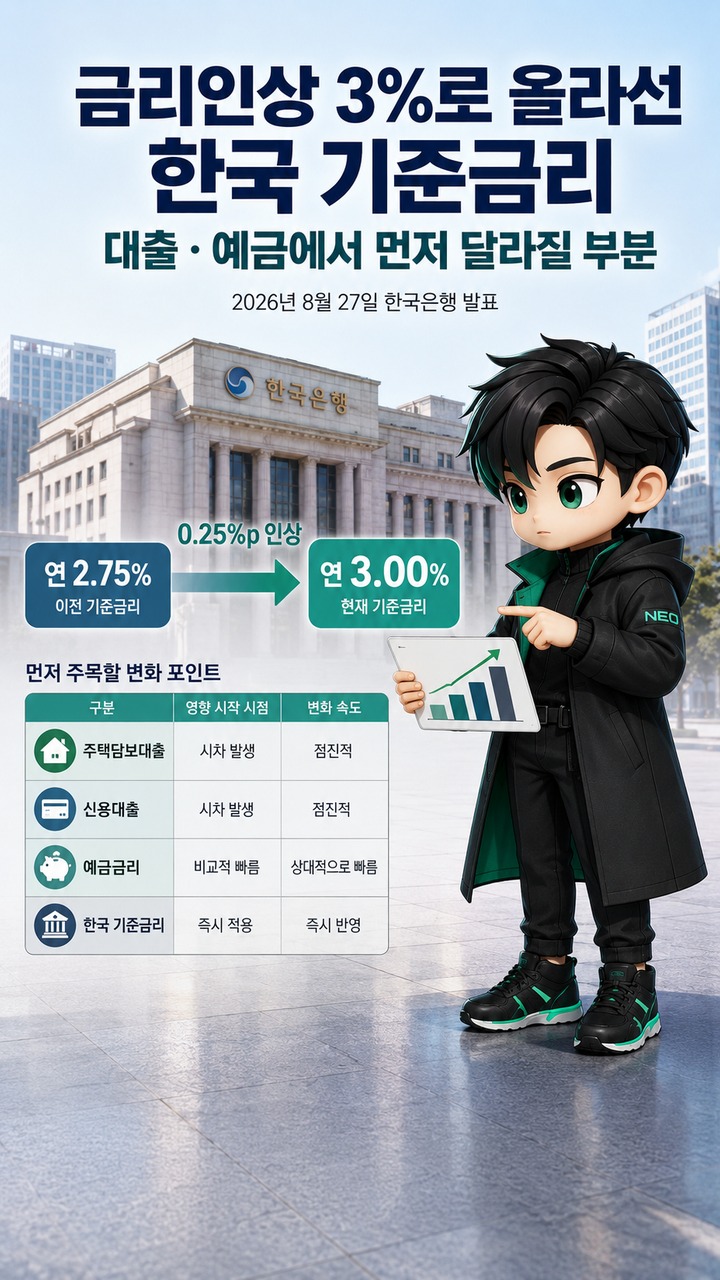
The Bank of Korea's Monetary Policy Board raised the annual base rate from 2.75% to 3.00% by 0.25% percentage points on 2026-08-27. This marks the second consecutive rate hike following the increase in July 16. However, a 0.25%-percentage-point increase in the base rate does not mean that mortgage rates, personal loan rates, and deposit rates will all rise by exactly 0.25% percentage points starting today.
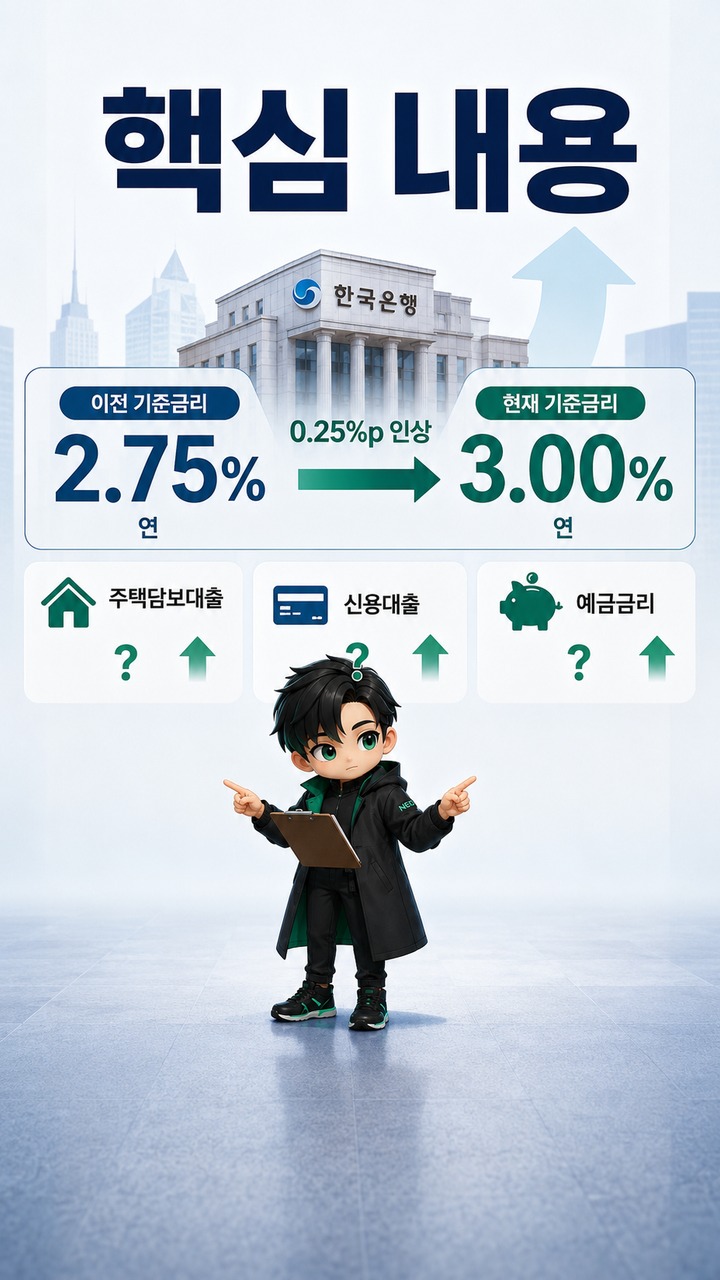
The most important point in this decision is not simply that 'the interest rate has reached 3%,' but rather that the Bank of Korea has not ruled out further rate hikes. The central bank stated that it would determine the timing and pace of additional increases while monitoring inflation, economic conditions, housing prices in the Seoul metropolitan area, household debt, and other financial stability factors.
Why Did the Bank of Korea Raise Rates Again in August After July?
The Bank of Korea's central assessment was that economic growth, inflation, and financial stability all needed to be considered together. It judged that the domestic economy was continuing to grow strongly, driven by exports and investment, while inflation was expected to remain above its target for a considerable period. The bank also saw a continued need to monitor rising housing prices in the Seoul metropolitan area and increasing household loans.
The Bank of Korea's inflation target is 2.0%. Consumer price inflation in July 2026 was 2.8% compared with the same month a year earlier, while core inflation excluding food and energy was 2.6%. The Bank of Korea projected consumer price inflation of 2.7% for this year and 2.3% for 2027.
Growth forecasts were also revised upward. The Bank of Korea projected economic growth of 3.3% for 2026 and 2.9% for 2027. Its previous forecasts in May had been 2.6% and 2.1%, respectively. This means the forecast for 2026 was raised by 0.7% percentage points, while the forecast for 2027 increased by 0.8% percentage points. These are the author's calculations, and actual growth may differ from the forecasts.
The rate decision was not unanimous. 6 members of the Monetary Policy Board supported raising the rate to 3.00%, while board member Hwang Geon-il argued for keeping it at 2.75%. Although rate hikes were approved for two consecutive months, not every board member agreed on the same pace of monetary tightening. This distinction will also be important when assessing the next Monetary Policy Board meeting.
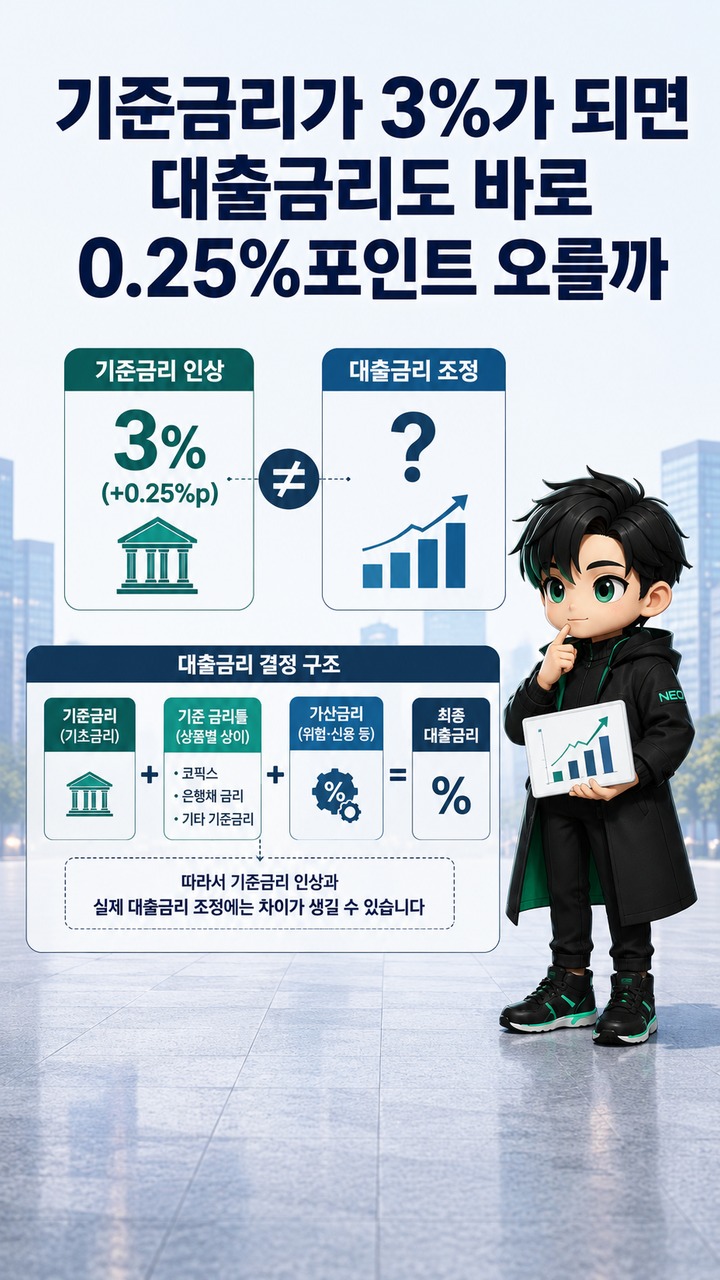
Will Loan Rates Immediately Rise by 0.25% Percentage Points When the Base Rate Reaches 3%?
Interest rates do not move that simply. Loan rates are not determined by the central bank's base rate alone. Depending on the product, lenders use different reference rates, such as COFIX or bank bond yields, and add a lending spread. As a result, the increase in the base rate and the actual adjustment in loan rates may differ.
In fact, statistics from July, when the rate hikes began, show that interest rates did not all move in the same direction. According to the Bank of Korea's weighted-average interest rate statistics for financial institutions in July 2026, released on August 26, the average lending rate on newly issued loans at deposit-taking banks was 4.27% per year, down 0.04% percentage points from the previous month. Meanwhile, the average lending rate on outstanding loans at the end of July was 4.37% per year, up 0.03% percentage points from the end of the previous month.
In other words, even within the category of 'loan interest rates,' the average rates on new loans and existing outstanding loans moved differently. Therefore, calculating how much your own loan rate will change based solely on the base rate of 3.00% could produce a result that differs from what actually happens.
If you have a variable-rate loan, the most accurate first step is to check the interest rate adjustment frequency, the type of reference rate, and the next rate adjustment date in your loan agreement or financial institution's app. For a fixed-rate product, changes in the central bank's base rate may not immediately affect the contractual interest rate during the agreed fixed-rate period.
For example, if we make the simplified assumption that the full 0.25%-percentage-point increase is reflected in the interest rate on a loan of KRW 100,000,000, the annual increase in interest expenses would be approximately KRW 250,000.
Author's calculation:
KRW 100,000,000 × 0.25% = KRW 250,000
Divided into monthly averages, this would be approximately KRW 20,833. However, this calculation does not mean that 0.25% percentage points will necessarily be applied directly to actual loan rates. The actual burden will vary depending on the outstanding loan balance, repayment method, rate adjustment frequency, and the lender's interest rate calculation method.
Had Deposit Rates Already Started Moving?
Deposit rates can move ahead of a base rate increase or around the time of the announcement, reflecting market interest rates and banks' funding conditions. Therefore, it would also be incorrect to assume that every bank will raise its savings and time deposit rates by the same amount on the day the base rate increases.
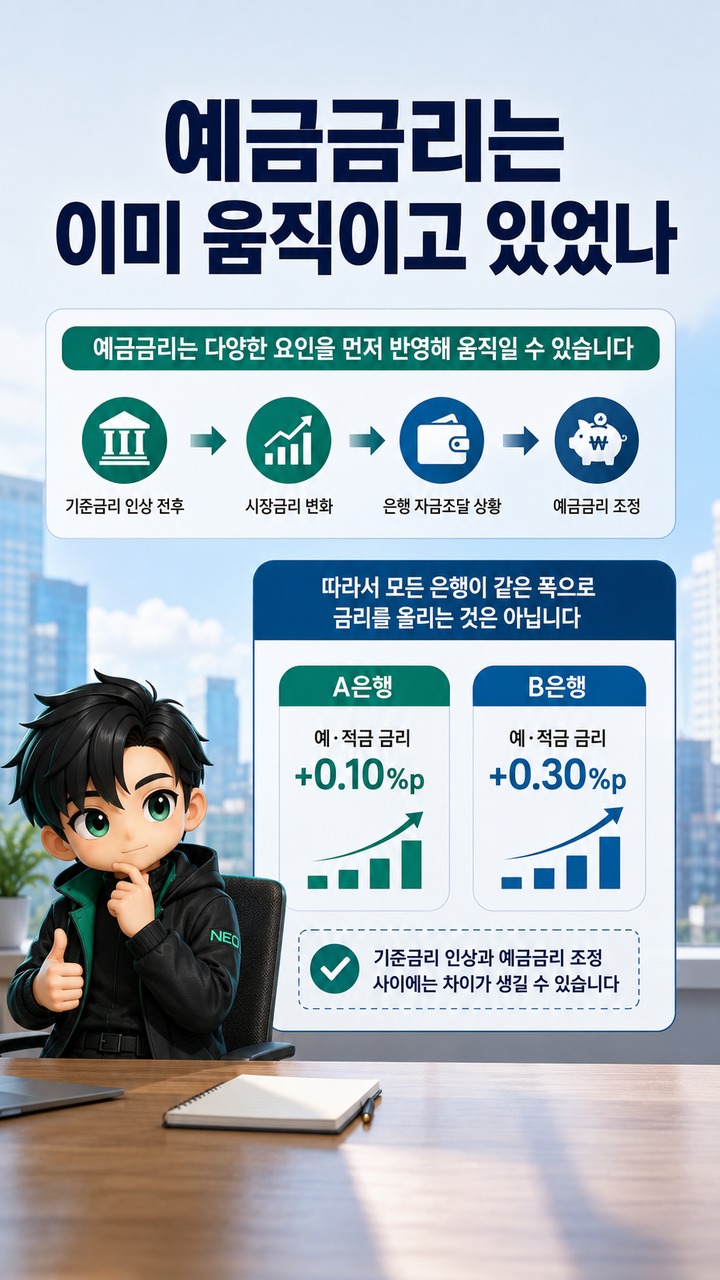
According to the Bank of Korea's latest finalized statistics for July 2026, the average interest rate on newly accepted savings-type deposits at deposit-taking banks was 3.21% per year, up 0.13% percentage points from the previous month. The average interest rate on total outstanding deposits at the end of July was 2.15% per year, 0.08% percentage points higher than at the end of the previous month.
Compared with the new lending rate of 4.27% in the same month, the simple difference between the average rate on newly accepted savings-type deposits and the average rate on new loans was 1.06% percentage points.
Author's calculation:
4.27% - 3.21% = 1.06% percentage points
This figure does not represent the loan-to-deposit interest rate spread or actual operating margin of any particular bank. It is simply a comparison of the average figures for all deposit-taking banks published by the Bank of Korea, based on newly originated business.
If you are considering opening a deposit account, it is better to check how much financial institutions actually change the rates on individual products rather than assuming that 'because the base rate has risen, waiting a few days will definitely bring a higher interest rate.'
Why Were Housing Prices and Household Debt Mentioned Alongside This Rate Hike?
In its policy decision statement, the Bank of Korea identified the rapid rise in housing prices in the Seoul metropolitan area and the substantial increase in household loans as issues requiring continued attention from a financial stability perspective. This means the central bank considered financial stability alongside inflation and economic conditions when making its interest rate decision.
However, explaining the decision as simply 'the base rate was raised because housing prices increased' would place more emphasis on a single cause than the Bank of Korea's announcement supports. The official statement says the bank considered stronger-than-expected economic growth, inflation forecasts above the target, and financial stability risks together in concluding that a 0.25%-percentage-point increase was appropriate.
This matters for borrowers because it has not been established that the current rate increase will end as a one-off adjustment. In particular, anyone with a variable-rate loan or plans to take out a new loan should consider not only the current interest rate but also the next rate reset date and the level of interest expenses they could afford if rates rise further.
Will the Bank of Korea Raise Interest Rates Further?
Whether there will be additional rate hikes and where the rate will ultimately peak have not yet been determined. In its August 27 announcement, the Bank of Korea stated that it would decide the timing and pace of further increases while assessing inflation, economic developments, and financial stability conditions.
Therefore, claiming that 'rate hikes have ended at 3.00%' or, conversely, that the rate will definitely rise to 3.25% at the next meeting would go beyond what has been officially announced.
Overseas monetary policy is another variable. In discussing international financial markets, the Bank of Korea identified the US Federal Reserve's monetary policy, developments in the Middle East, and changes in major economies' monetary and fiscal policies and trade environments as factors to monitor.
At the time of this decision, the US policy interest rate stood at 3.50–3.75%. With South Korea's base rate rising to 3.00%, the interest rate differential based on the upper end of the US range became 0.75% percentage points. However, the interest rate gap between South Korea and the United States alone cannot determine the direction of South Korea's next base rate decision.
The next monetary policy decision meeting is scheduled for 2026-10-22. Since another decision will not be made immediately in the month following the August meeting, changes in inflation, growth, financial markets, and household debt indicators released in the meantime may influence the next assessment.
What Should People With Loans or Deposits Check Now?
For borrowers, it is more practical to start by checking when and on what basis the interest rate in their own contract will be recalculated, rather than focusing solely on the news headline that 'the base rate has reached 3%.' Those preparing to take out a new loan should compare the actual rates offered by multiple financial institutions, while existing borrowers should first determine whether their loans have fixed or variable rates.
For a variable-rate loan, one approach is to check the type of reference rate and the interest rate adjustment frequency, then calculate the monthly repayment amount if the rate changes by 0.25% percentage points or more at the next reset date. With a loan repaid through equal monthly payments of principal and interest, the actual change in monthly payments differs from a simple interest calculation. It is therefore more accurate to consult the lender's repayment schedule.
For savings accounts and time deposits, decisions should be based on the actual interest rates and preferential rate requirements of products currently on sale, rather than solely on the announcement of a base rate increase. Even if a product advertises a high preferential rate, the rate actually applied may be lower if conditions such as salary transfers, card spending, or new-customer eligibility are not met.
What has been confirmed by the 2026-08-27 rate hike is that South Korea's base rate increased from 2.75% to 3.00%, and the Bank of Korea stated that it would determine the timing and pace of any additional increases going forward. The most important thing from here is not the prediction that 'interest rates will rise again,' but rather monitoring how actual inflation, economic growth, housing prices in the Seoul metropolitan area, household debt, and financial markets develop.