

What Happens If You Apply for National Pension Back Payments but Never Pay? Rules for Nonpayment, Cancellation, and Reapplication

Even if you apply to make retroactive National Pension contributions (back payments), the relevant period will not automatically be added to your contribution period unless you actually pay the premiums. However, missing the payment deadline does not mean your application is immediately canceled. Whether you can cancel and reapply depends on whether you have paid nothing or have already made a partial payment.
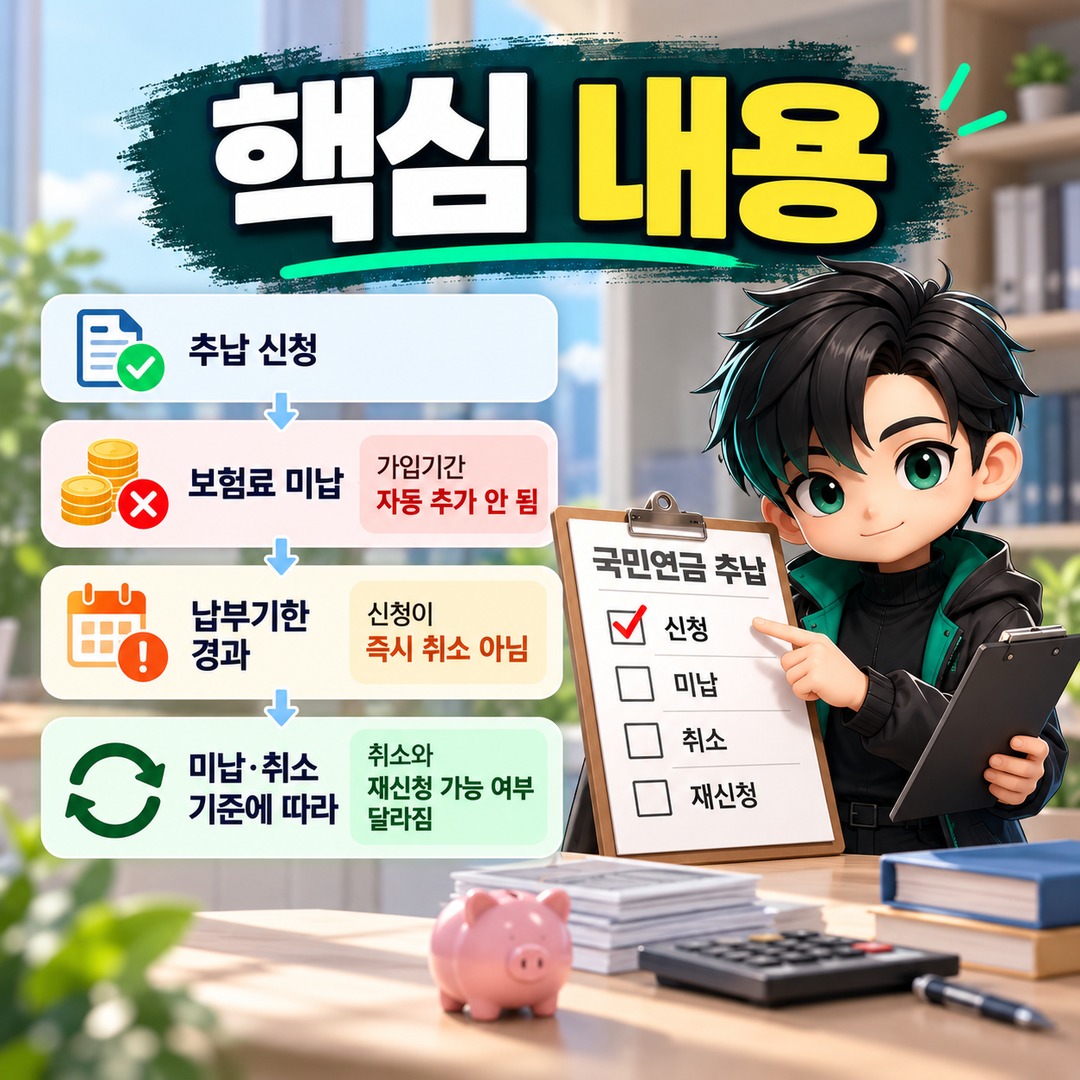
Based on guidance from the National Pension Service (NPS) as of 2026-10-18, this article explains what applicants should check if they change their minds after applying or miss the payment deadline.
1. Is a Back-Payment Application Automatically Canceled If You Fail to Pay?
A back-payment application is not automatically canceled simply because the payment deadline has passed.
The National Pension Service explains that even if a person loses their insured status, they may still pay previously applied-for retroactive contributions as long as the right to collect those contributions has not expired.
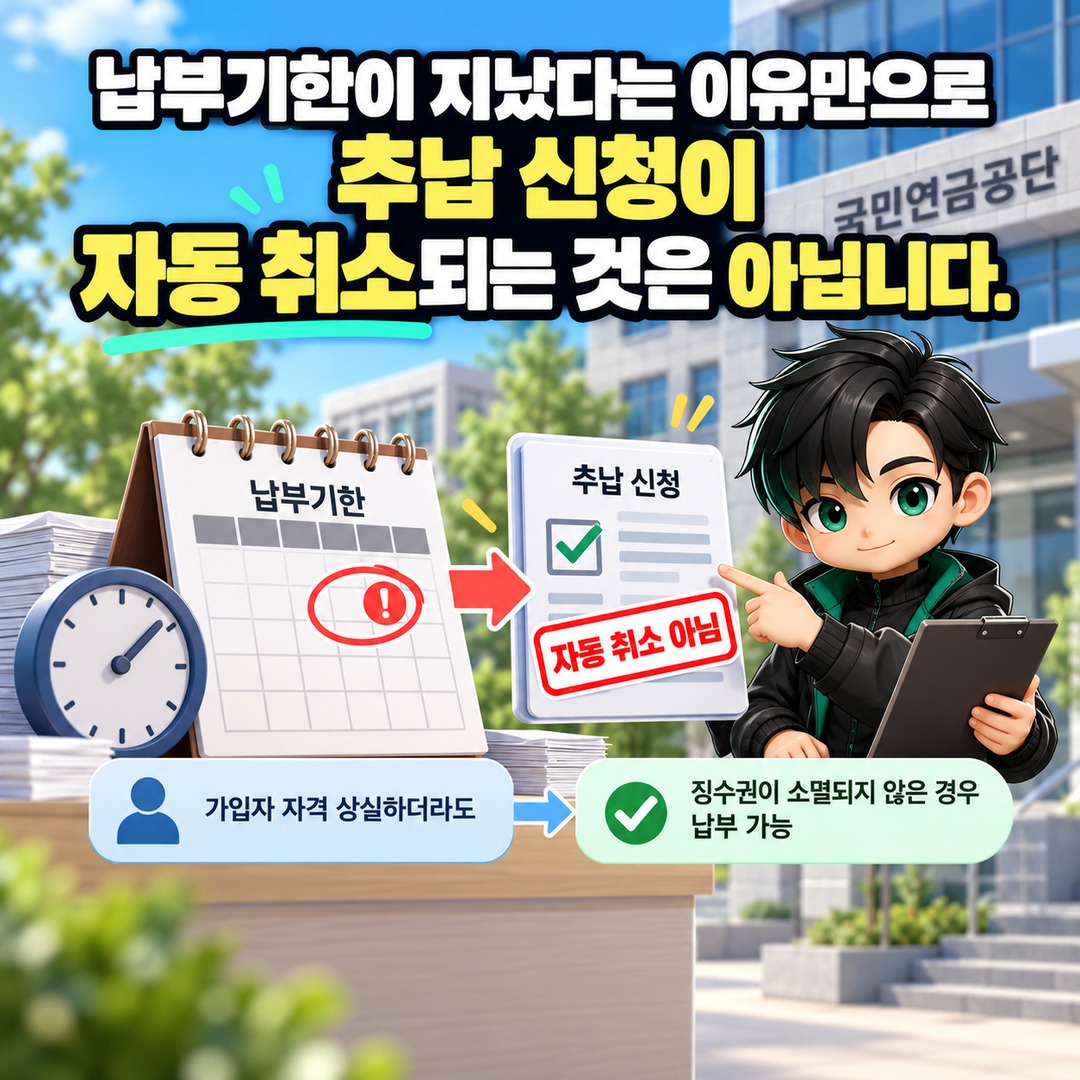
However, additional interest charges may apply after the payment deadline.
There are three situations to distinguish.
| Situation | What to Check |
|---|---|
| Application submitted but no payments made | Whether cancellation and reapplication are possible |
| Payment deadline has passed | Additional interest charges and whether payment is still possible |
| Some installments have been paid | Whether changes to or cancellation of the existing application are restricted |
In particular, completing a back-payment application is not the same as actually increasing your recognized National Pension contribution period.
The contribution period credited through back payments must be verified based on the premiums actually paid.
2. Can You Cancel and Reapply If You Have Never Made a Payment?
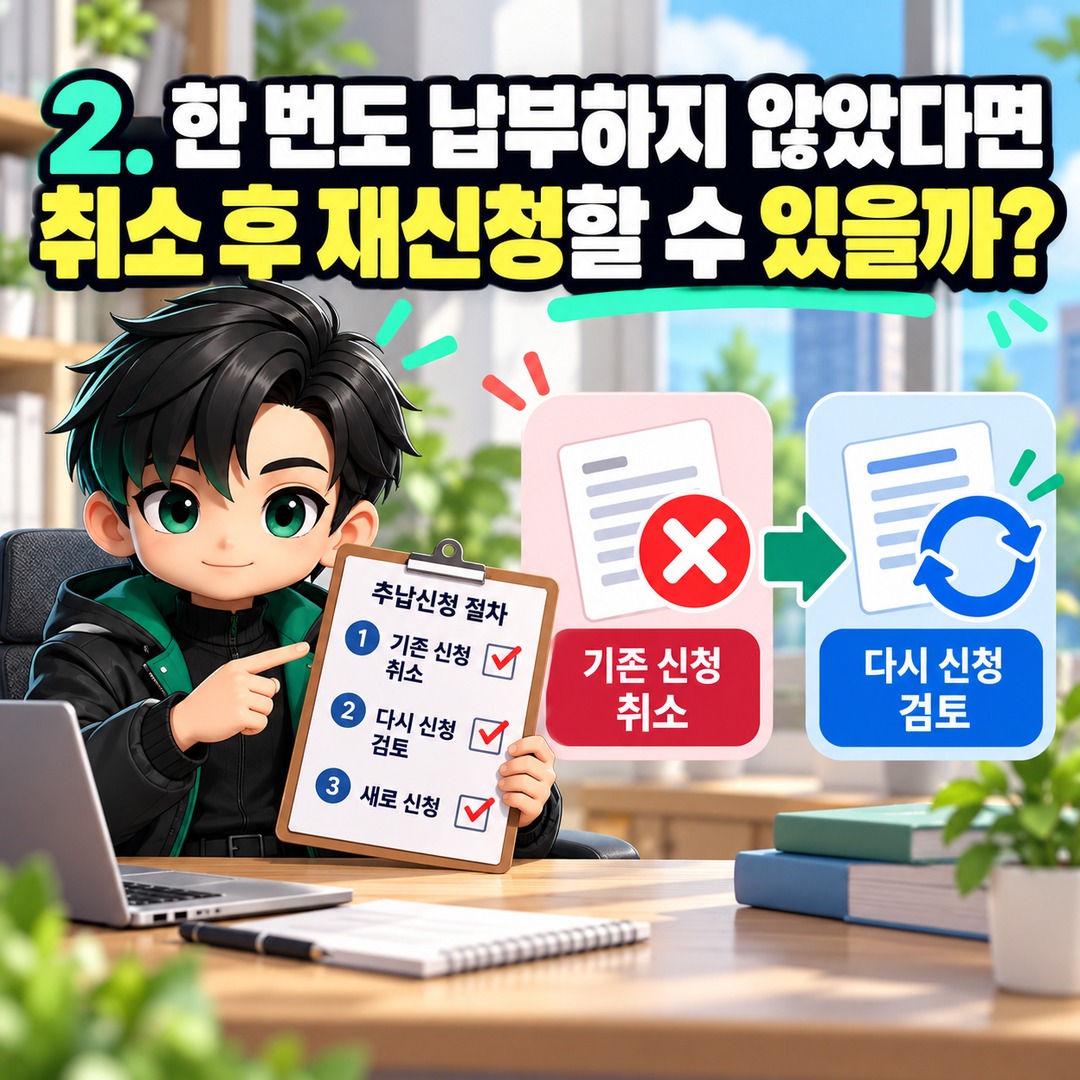
If you have not paid any retroactive contributions, you may consider canceling your existing application and submitting a new one.
In a publicly available consultation response, the National Pension Service explained that applicants who had paid none of their retroactive contributions could cancel their existing application and reapply.
By contrast, it explained that if an applicant chose installment payments and paid even 1 installment, changing the amount of the existing application or canceling and reapplying could be restricted.
Therefore, the following two situations must be distinguished.
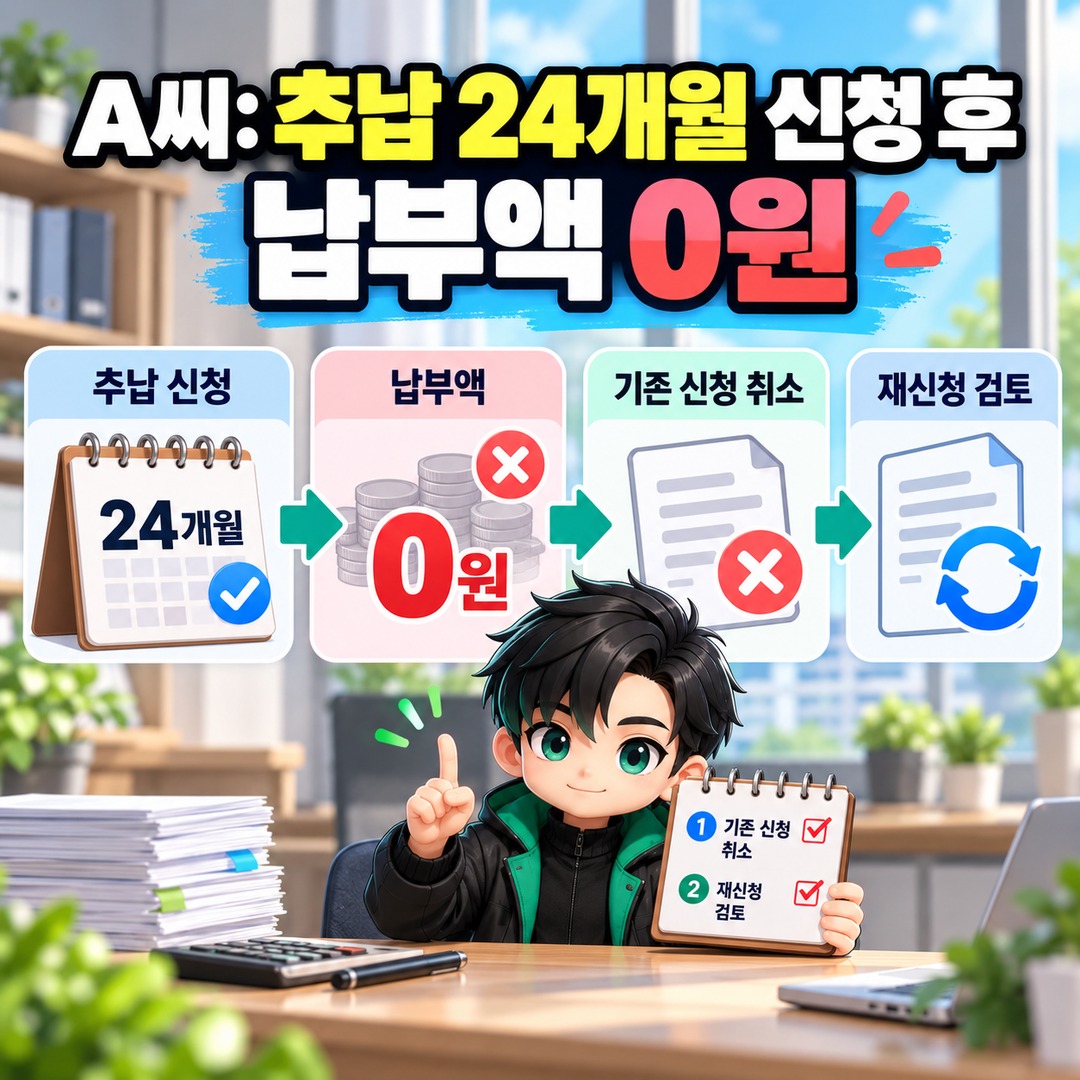
Person A: Applied for 24 Months of Back Payments and Paid KRW 0
Because no payments have been made, Person A can check whether the existing application can be canceled and a new application submitted.
Person B: Applied for 24 Months of Back Payments and Paid Some Contributions
Because some contributions have already been paid and a corresponding contribution period may have been credited, Person B cannot necessarily be treated the same way as Person A.
These principles come from earlier NPS consultation responses. Whether cancellation is actually possible and how it will be processed must be confirmed with the National Pension Service based on the status of the individual application.
3. Will the Original Contribution Amount Remain the Same If You Reapply?
If you cancel an existing application and submit a new one, the amount of retroactive contributions may change.
This is because retroactive contributions are not calculated simply by paying the historical premiums again. Instead, they are calculated using factors such as the standard monthly income and the applicable contribution rate at the time of application.
The National Pension contribution rate for 2026 is 9.5%.
For example, assume a standard monthly income of KRW 2,000,000 and a retroactive contribution period of 24 months.
| Standard Monthly Income | Monthly Retroactive Contribution | Total for 24 Months |
|---|---|---|
| KRW 1,000,000 | KRW 95,000 | KRW 2,280,000 |
| KRW 2,000,000 | KRW 190,000 | KRW 4,560,000 |
| KRW 3,000,000 | KRW 285,000 | KRW 6,840,000 |
*Author's calculation: Standard monthly income × 9.5% × 24 months. This example excludes installment-payment interest and individual adjustments.*
If the standard monthly income changes from KRW 2,000,000 to KRW 3,000,000, the calculated total increases by KRW 2,280,000 even when the same 24 months are covered by retroactive contributions.
However, applicants cannot freely change their standard monthly income to any amount they prefer. It is determined according to their enrollment category and income-reporting rules.
In addition, a scheduled increase in the National Pension contribution rate applies, from 9.5% in 2026 to 10% in 2027.
Therefore, applicants should also consider the possibility that the applicable contribution rate may differ depending on when they reapply and when payment is due.
The important point is that canceling and reapplying does not necessarily reduce the cost.
4. Could Missing the Payment Deadline Lead to Collection Demands or Asset Seizure?
The National Pension Service explains that when retroactive contributions remain unpaid, it provides a notice of the unpaid amount on 1 occasion and does not initiate delinquency enforcement proceedings.
Therefore, unpaid retroactive contributions should not be treated in exactly the same way as ordinary overdue National Pension contributions.
However, the absence of delinquency enforcement does not mean that payment can be made after the deadline without additional charges.
According to NPS guidance, the process is as follows.
A payment notice is sent around 11–15 of the month following the back-payment application.
Payment is due by the last day of the month following the application.
If payment is not made, a notice of the unpaid amount is provided on 1 occasion.
Additional interest charges may apply when payment is made after the deadline.
Delinquency enforcement proceedings are not initiated for unpaid retroactive contributions.
For example, if you applied for retroactive contributions in 10 of 2026, the payment deadline would generally be the last day of 11 of 2026.
However, you should first verify the actual payment deadline and amount shown on your payment notice.
5. Where Can You Check Whether Your Back-Payment Application Can Be Canceled?
If you have already submitted a back-payment application, the most reliable approach is to confirm cancellation eligibility with the National Pension Service customer service center or the branch office responsible for your case.
If you have already made partial payments, you should check the status of your application rather than simply leaving the remaining amount unpaid.
Follow these steps.
1. Visit the National Pension Service website.
2. Check your retroactive contribution application and payment records through the electronic civil services portal.
3. Verify the number of months covered by the application, the total billed amount, and the amount actually paid.
4. Contact the National Pension Service customer service center at 1355 to ask whether cancellation or reapplication is possible.
5. If cancellation is permitted, confirm that the existing application has been fully processed as canceled before submitting a new application.
Applications for retroactive contributions can be submitted online, but submitting the application form does not mean the application is immediately finalized. It is processed after review by the responsible NPS official.
In addition, applicants generally must maintain their National Pension insured status to submit a new application.
If you have already lost that status, you must distinguish between whether you can still pay contributions under an existing application and whether you are eligible to submit a new retroactive contribution application.
6. Can You Get a Refund of Retroactive Contributions You Have Already Paid?
Retroactive contributions that were properly applied for and paid generally cannot be canceled or refunded simply because you have changed your mind.
The National Pension Service's *2023 National Pension Rights and Remedies Casebook* includes a case in which an individual requested cancellation after paying retroactive contributions because their personal circumstances had changed, but the request was rejected.
This illustrates that canceling an application when no contributions have been paid and reversing retroactive contributions that have already been paid are two different matters.
Therefore, when deciding whether to make retroactive contributions, you should consider not only the payment cost but also your future pension benefits, living expenses, and the relationship with other pension systems.
7. What to Check Before Deciding Whether to Keep or Cancel Your Back-Payment Application
Retroactive contributions are not mandatory. The system allows eligible individuals to select the period they wish to cover, up to a maximum of 119 months, to increase their recognized contribution period.
Therefore, if the financial burden becomes greater after applying, it is advisable to check the following points first.
| Item to Check | Assessment Criteria |
|---|---|
| Actual payment status | Whether no contributions have been paid or some have already been paid |
| Current enrollment status | Whether you retain the insured status required to reapply |
| Payment deadline | Whether additional interest charges have accrued |
| Cost of reapplication | Changes in standard monthly income and contribution rates |
| Pension contribution period | Whether you meet the minimum 120 months without retroactive contributions |
In principle, eligibility for the National Pension old-age pension requires a contribution period of at least 10 years, equivalent to 120 months.
The need for retroactive contributions may differ between someone who has accumulated 100 months of contributions and someone who has already completed 240 months.
For the former, meeting the eligibility requirements for old-age pension benefits is an important consideration. For the latter, the decision involves comparing the potential increase in pension benefits from additional contribution periods against the financial burden of making those payments.
In conclusion, if you have not made any payments after applying for retroactive contributions, you can check whether cancellation and reapplication are possible. However, if you have paid even part of the contributions, you should not assume that the same procedure is available.
Even if you miss the payment deadline, do not assume that your application has been automatically canceled. Instead, check the status of your existing application and any additional interest charges first.
<text color="secondary" size="xs">Information current as of: 2026-10-18. Individual eligibility for cancellation or reapplication can be confirmed with the National Pension Service at 1355 or the relevant branch office.</text>
※ This article is provided for reference to help readers understand market trends and does not constitute an investment recommendation for any particular security or asset. Final investment decisions and responsibility rest with the individual.