

Domestic-Listed Overseas ETFs: When They Trade Above NAV or iNAV, When to Buy and How to Set Limit Orders
If a domestic-listed overseas ETF’s market price differs from its NAV or iNAV, check the price gap and quotes before placing a market order. In particular, just after the market opens and during the closing auction, liquidity providers (LPs) are not required to submit quotes, so your order may execute at a less favorable price than expected. The three key points to examine based on 2026-11-23 are

If a domestic-listed overseas ETF’s market price differs from its NAV or iNAV, check the price gap and quotes before placing a market order. In particular, just after the market opens and during the closing auction, liquidity providers (LPs) are not required to submit quotes, so your order may execute at a less favorable price than expected.
How do NAV, iNAV, and market price differ?
NAV is the reference price calculated by dividing the ETF’s net assets—its assets minus liabilities—by the number of outstanding shares. iNAV is an estimated net asset value calculated during the trading day, while the market price is determined by the prices at which investors’ orders actually execute.
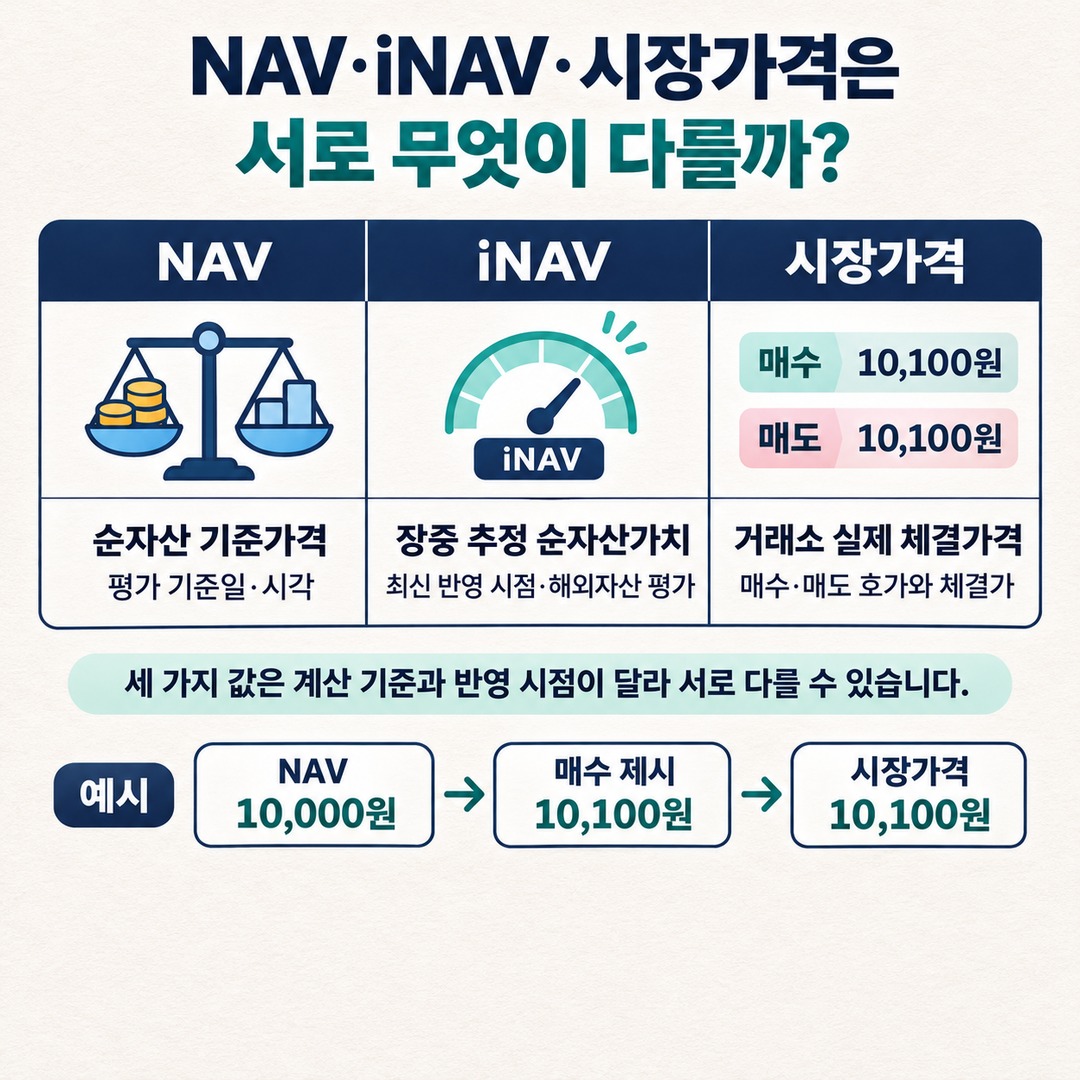
The three prices do not always match because they are calculated differently and use different reference times.
| Category | Meaning | What to check when placing an order |
|---|---|---|
| NAV | Net asset value reference price | Valuation date and time |
| iNAV | Estimated net asset value during the trading day | Most recent update time and overseas asset valuation method |
| Market price | Price formed on the exchange | Actual buy and sell quotes and execution price |
It matters that ETFs trade in the market. Even if the fund’s asset value is calculated per 1 shares at KRW 10,000, if an actual buyer offers KRW 10,100, the market price may form at that level.
Conversely, the market price may form below the net asset value.
The percentage measure of this difference is called the premium or discount rate.
Premium or discount rate (%) = (Market price - iNAV) ÷ iNAV × 100
A positive rate means the market price is above iNAV, the comparison benchmark; a negative rate means it is below.
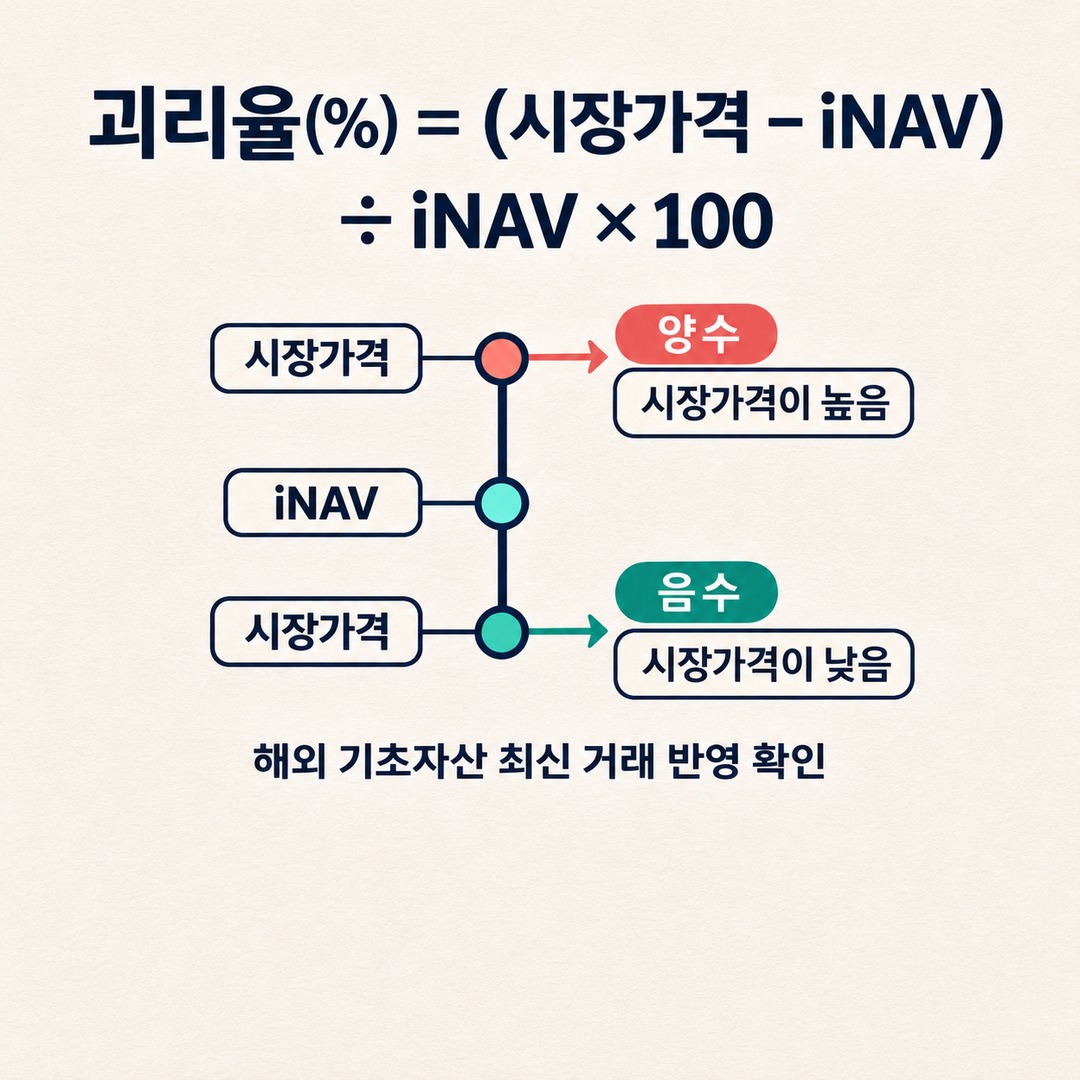
For overseas ETFs, however, you should also check whether the iNAV itself adequately reflects the latest trading conditions of the underlying overseas assets.
Why can overseas ETFs’ iNAV and actual prices diverge more widely?
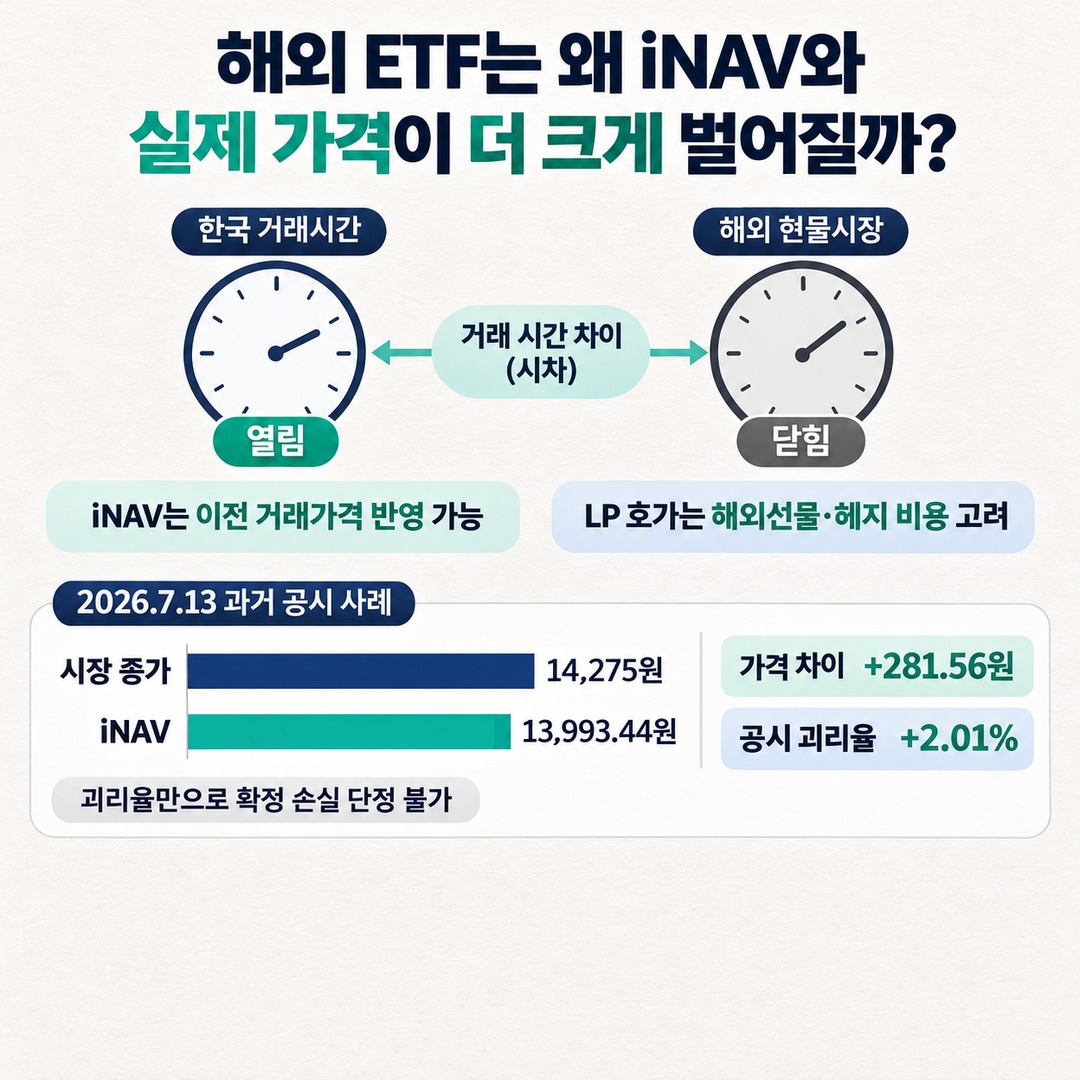
For domestic-listed overseas ETFs, the difference between Korean trading hours and the trading hours of the overseas underlying assets is an important factor in explaining price gaps.
When the Korean stock market is open, the U.S. cash market is often closed for ETFs based on U.S. stocks and other assets.
In such cases, some ETFs’ iNAV is calculated using the previous trading prices in overseas markets, while liquidity providers set buy and sell quotes by considering prices for overseas futures or other ETFs, as well as hedging costs.
Therefore, the fact that an ETF is priced above iNAV does not, by itself, prove that it is necessarily more expensive than its actual value.
The Korea Exchange’s published premium or discount rate for 2026-07-13 PLUS Apple Bond Mix also cited valuation timing differences for overseas underlying assets and liquidity providers’ hedging transactions as factors that explain price differences.
The difference becomes clearer when you look at the actual published figures.
| Item | 2026-07-13 |
|---|---|
| ETF | PLUS Apple Bond Mix |
| Market closing price | KRW 14,275 |
| iNAV | KRW 13,993.44 |
| Price difference | +KRW 281.56 |
| Published premium or discount rate | +2.01% |
The author’s own calculation also gives approximately 2.01% for (14,275 - 13,993.44) ÷ 13,993.44 × 100.
This is an actual past published example, not the current price based on 2026-11-23.
The point to take from this example is that a premium or discount rate of 2.01% does not immediately mean a confirmed loss of 2.01%. Because iNAV and the market price use different valuation times, how the price will reflect conditions once overseas markets open must be assessed separately.
Is it better to buy or sell ETFs between 9:5 a.m. and 3:20 p.m.?
For ordinary ETF orders during regular trading hours, it is generally reasonable to check the quotes from after 9:5 a.m. until before 3:20 p.m. This is because liquidity providers’ quote-submission obligations may apply during that period.
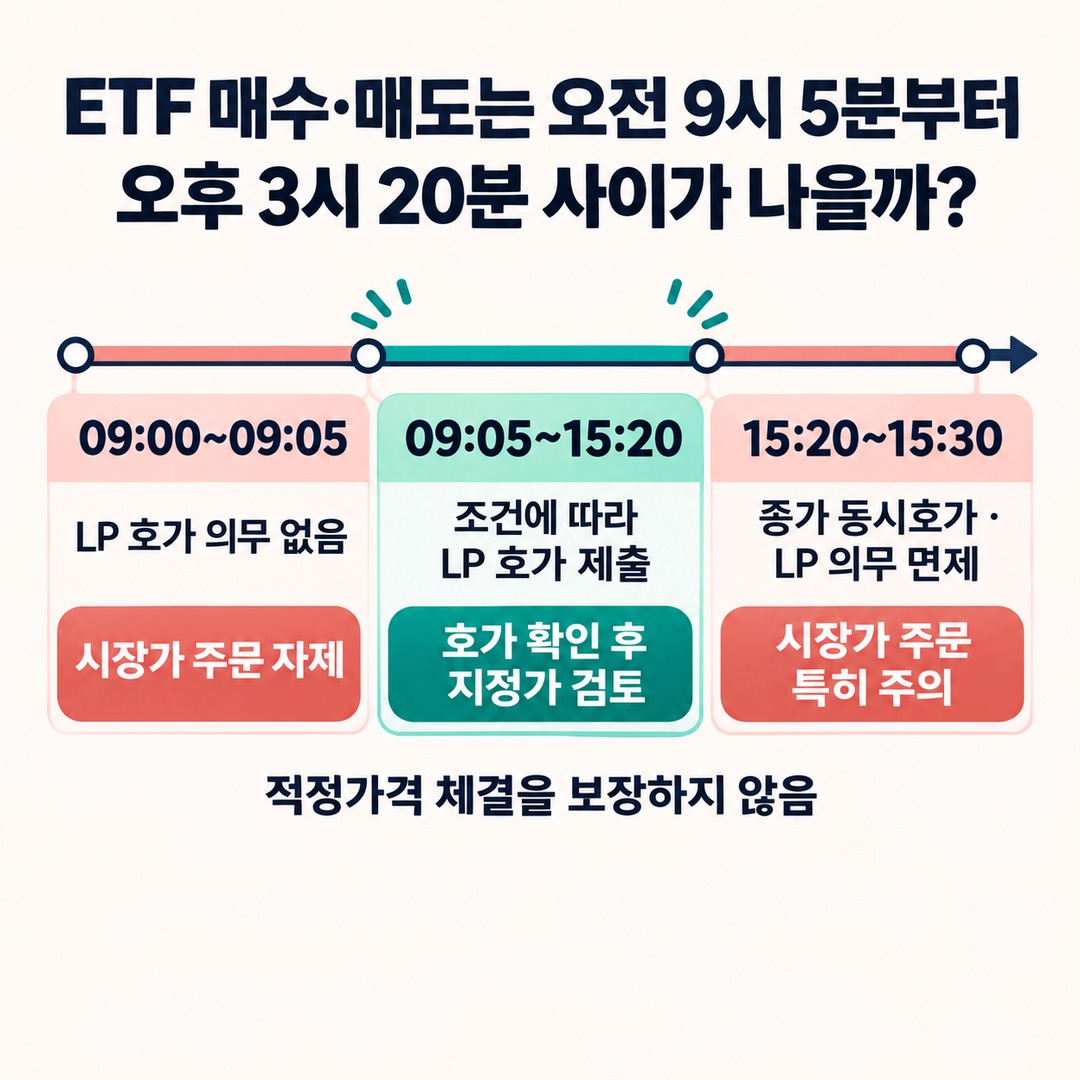
However, placing an order during this period does not guarantee execution at a fair price.
According to Samsung Asset Management’s Kodex ETF guide to liquidity providers, LPs are not required to submit quotes for 5 minutes after the market opens or during the closing auction. Even during regular trading hours, LPs may not submit separate quotes if the spread between the market’s buy and sell quotes is within the reported threshold.
| Trading hours | Risk to check | Order decision |
|---|---|---|
| 09:00–09:05 | LPs are not required to submit quotes | Avoid urgent market orders |
| 09:05–15:20 | LP quotes may be submitted depending on the conditions | Check quotes, then consider a limit order |
| 15:20–15:30 | Closing auction; LP quote-submission requirement waived | Be especially cautious with market orders |
ETF prices do not automatically normalize as soon as it is 9:5 a.m.
You should also consider overseas market holidays, sharp movements in the underlying assets, the spread between buy and sell quotes, and delays in the information reflected in iNAV.
In fact, a financial consumer complaint and dispute case report distributed by the Financial Supervisory Service on 2025-09-24 describes an investor who bought an ETF at the market price during the closing auction and ended up paying at least 2% more than its net asset value.
The investor sought compensation for losses caused by the LP not submitting a sell quote. However, the Financial Supervisory Service concluded that it was difficult to find the LP’s handling of the matter improper, taking into account the rule that LPs are not required to submit quotes during that period.
This case shows that the timing and type of order can affect the actual execution price.
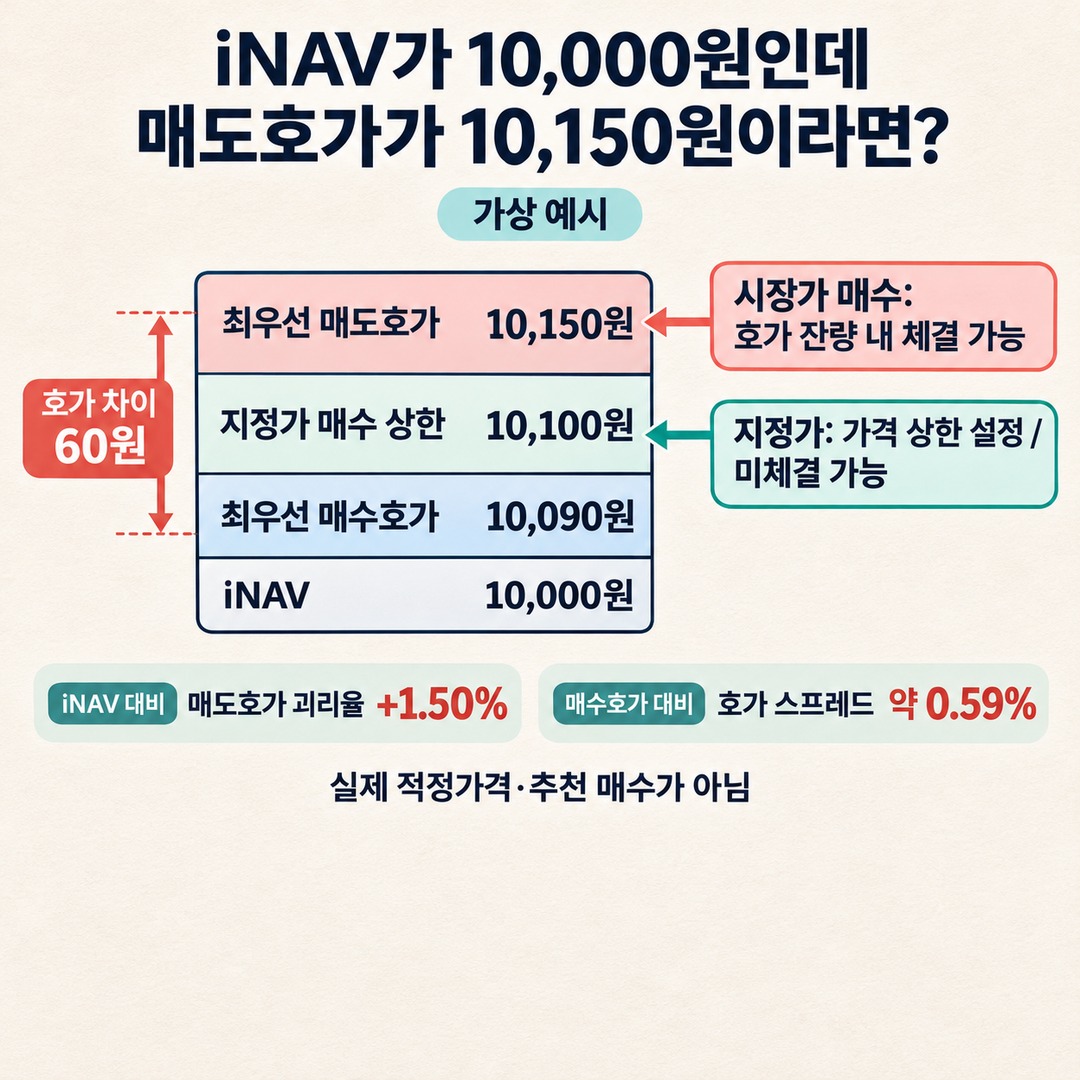
What if iNAV is KRW 10,000 and the best ask is KRW 10,150?
If iNAV is KRW 10,000 and the best ask is KRW 10,150, considering a limit order that sets an acceptable purchase price gives you more control over the price than placing a market order.
However, KRW 10,000 does not necessarily mean that this is a fair execution price.
The following is a hypothetical example to illustrate how order types work.
| Item | Hypothetical price |
|---|---|
| iNAV | KRW 10,000 |
| Best bid | KRW 10,090 |
| Best ask | KRW 10,150 |
| Difference between the best ask and iNAV | +1.50% |
| Bid-ask spread | KRW 60 |
The author’s calculation gives an iNAV-relative premium or discount rate for the best ask of (10,150 - 10,000) ÷ 10,000 × 100 = 1.50%.
The bid-ask spread calculated using the best bid as the denominator is (10,150 - 10,090) ÷ 10,090 × 100, or approximately 0.59%.
These two figures mean different things.
The premium or discount rate compares iNAV with the market price, while the bid-ask spread shows the price difference you face when buying or selling immediately.
If a buyer places a market order at KRW 10,150, it may execute at that price up to the available quantity at that ask. If the order is larger than the available quantity, it may also execute against asks at higher prices.
By contrast, placing a limit buy order at KRW 10,100 lets you set a price ceiling so you do not buy above KRW 10,100.
However, if no one is offering to sell at KRW 10,100, the order may not execute. A limit order sets a price limit; it does not guarantee execution.
This example does not present a fair price or recommended purchase price for any actual ETF. Trading fees, taxes, market movements, and changes in available order quantities are excluded from the calculation.
If the premium or discount rate is negative, does that mean it is cheap and you should buy right away?
A negative premium or discount rate means the market price is below iNAV, but that alone does not make it a buying opportunity.
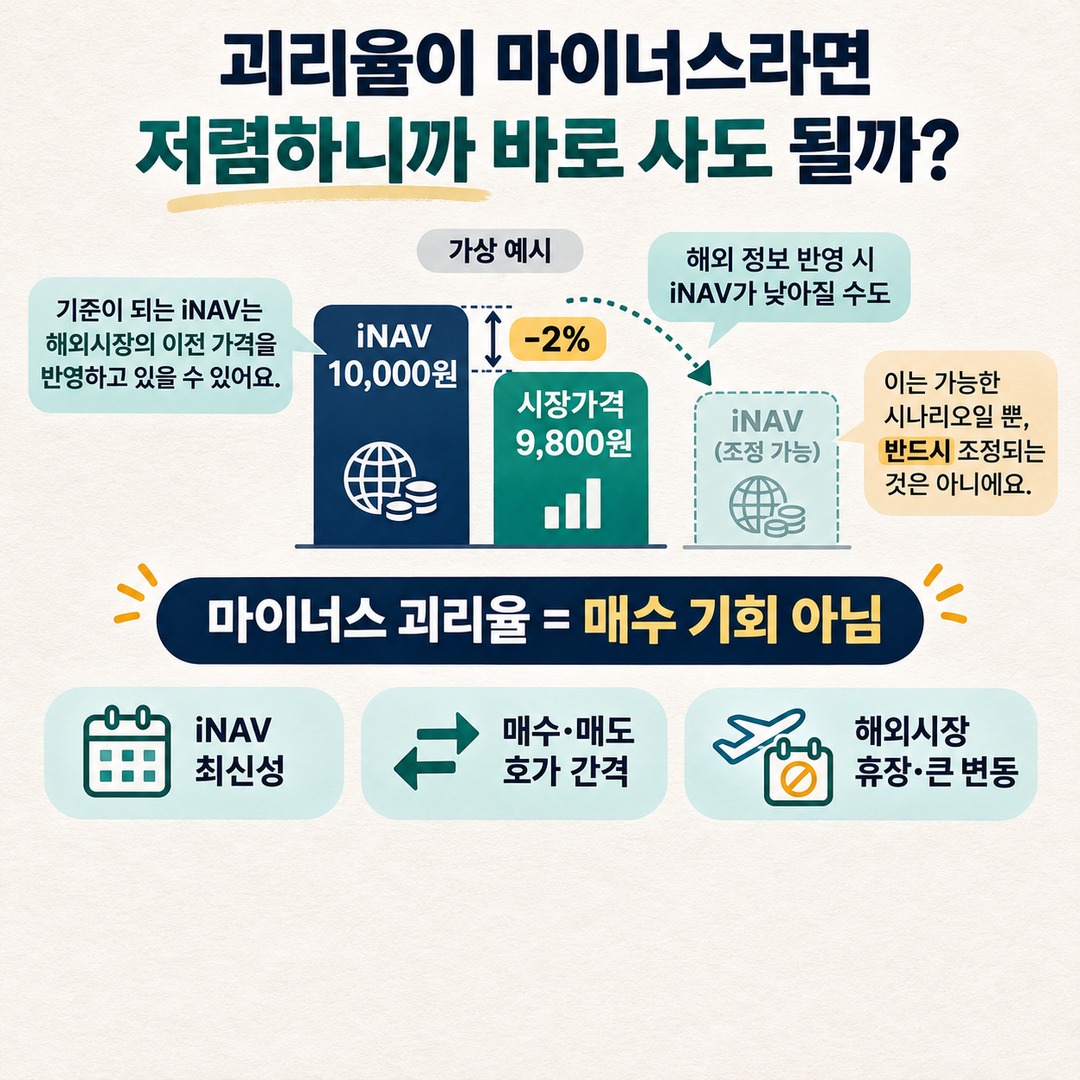
If an overseas ETF’s iNAV reflects prices from an earlier overseas trading session, the domestic market price may already be reflecting movements in overseas futures and other instruments that have not yet been fully reflected in iNAV.
The Korea Exchange’s disclosure for 2026-06-25 TIGER Global Innovation Active also explains that the premium or discount rate for an overseas asset ETF may widen because of valuation timing differences for underlying assets and price movements in overseas hedging instruments.
So if you see a negative premium or discount rate, distinguish between the following:
Whether the market price is below iNAV
Whether iNAV adequately reflects current information about overseas assets
Whether the spread between buy and sell quotes has widened
Whether the overseas underlying market was closed or experienced a sharp price move
For example, if iNAV is KRW 10,000 and the market price is KRW 9,800, the calculated premium or discount rate is -2%.
However, you could also imagine a scenario in which iNAV later falls closer to the market price. Therefore, it would not be appropriate to expect a gain of 2% based only on the figure -2%.
Even in this case, you need to decide on an order price first, then check the latest quotes and valuation information.
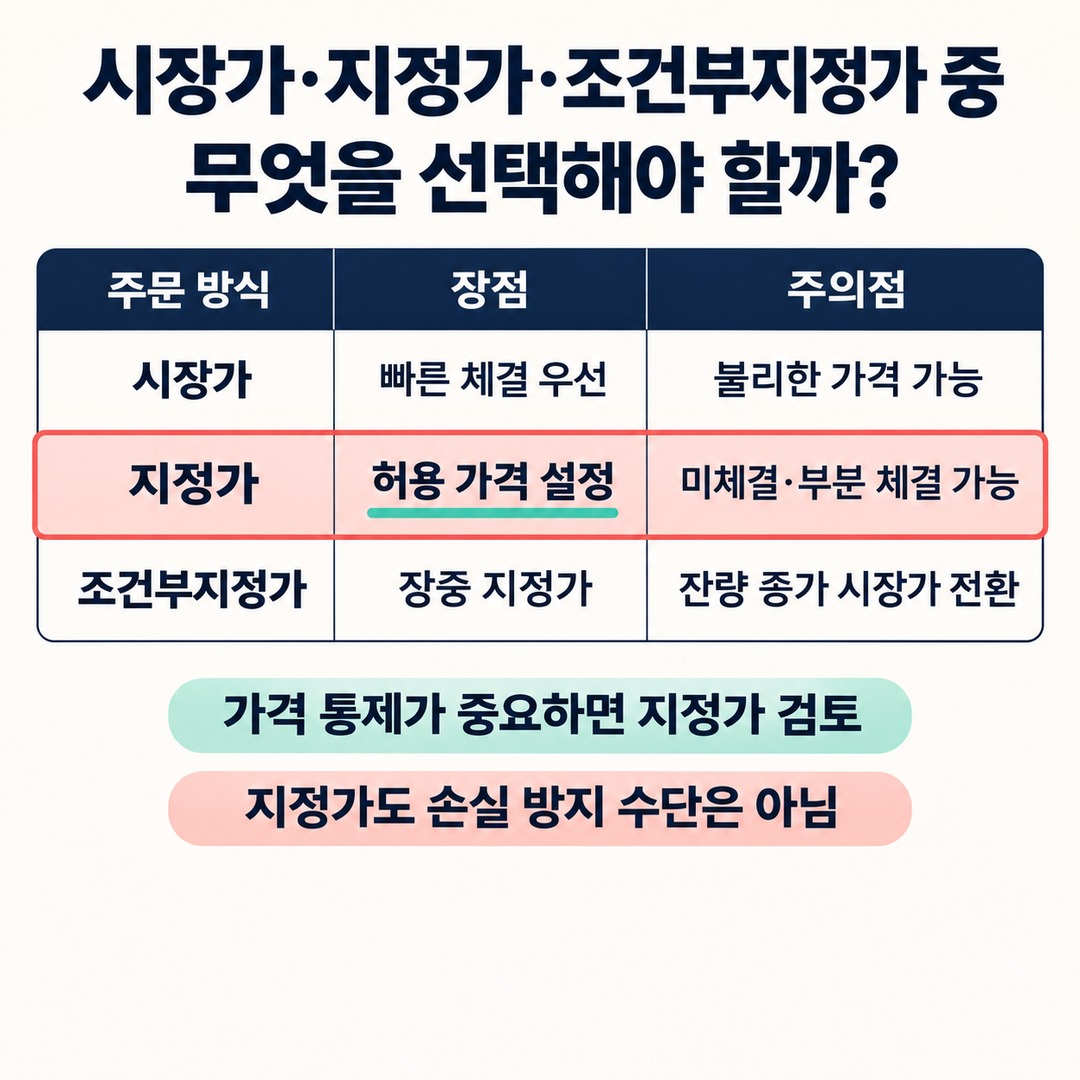
Which should you choose: a market order, a limit order, or a conditional limit order?
For trading overseas ETFs when price gaps are a concern, a limit order is better suited to controlling the execution price.
A market order prioritizes fast execution but does not set an advance limit on the execution price. With a conditional limit order, any unfilled quantity during the day converts to a market order during the closing price determination process, so it may not suit someone trying to avoid price gaps near the close.
| Order type | Advantage | Caution |
|---|---|---|
| Market order | Prioritizes fast execution | May execute at a less favorable price than expected |
| Limit order | Sets an acceptable price | May be unfilled or partially filled |
| Conditional limit order | Limit order during the day; unfilled quantity converts to a market order at the close | Limited control over the closing execution price |
You can assess an actual order in the following steps.
1. Check the ETF’s current bid and ask quotes and available quantities on your brokerage’s trading screen.
2. Check the reference time for the displayed iNAV and the trading conditions of the underlying overseas assets.
3. For a buy, decide the maximum price you are willing to pay; for a sell, decide the minimum price you are willing to accept.
4. After placing a limit order, check whether it has executed and whether any quantity remains unfilled.
5. If the price gap widens or quotes become unstable, cancel the order and reassess.
A limit order is not a way to prevent losses. Even if it executes at your chosen price, you may still lose money if the ETF’s underlying asset prices or exchange rates later move against you.
Before placing an order, check the execution price—not just the premium or discount rate
NAV and iNAV are reference points for assessing an ETF’s price, but the amount an investor actually pays or receives is determined by the execution price.
So rather than deciding whether to trade based only on the premium or discount rate, check the quote prices and quantities, the valuation time for the underlying overseas assets, and the order type.
It is generally best not to rush into a market order just after the market opens or during the closing auction. Even during regular trading hours, you can delay trading if quotes are unusually wide or there is not enough information to assess the price.
The key is not to automatically avoid prices that differ from iNAV, but to make sure you understand the difference and decide in advance what execution price you are willing to accept.
※ This article is for reference to help readers understand market movements and is not a recommendation to invest in any specific security or asset. You are responsible for your own final decisions and investments.