

Domestic ETF Trading Value Halves, Falling from 33 Trillion to 17 Trillion: What Has Changed?
이 포스팅은 쿠팡 파트너스 활동의 일환으로, 이에 따른 일정액의 수수료를 제공받습니다.
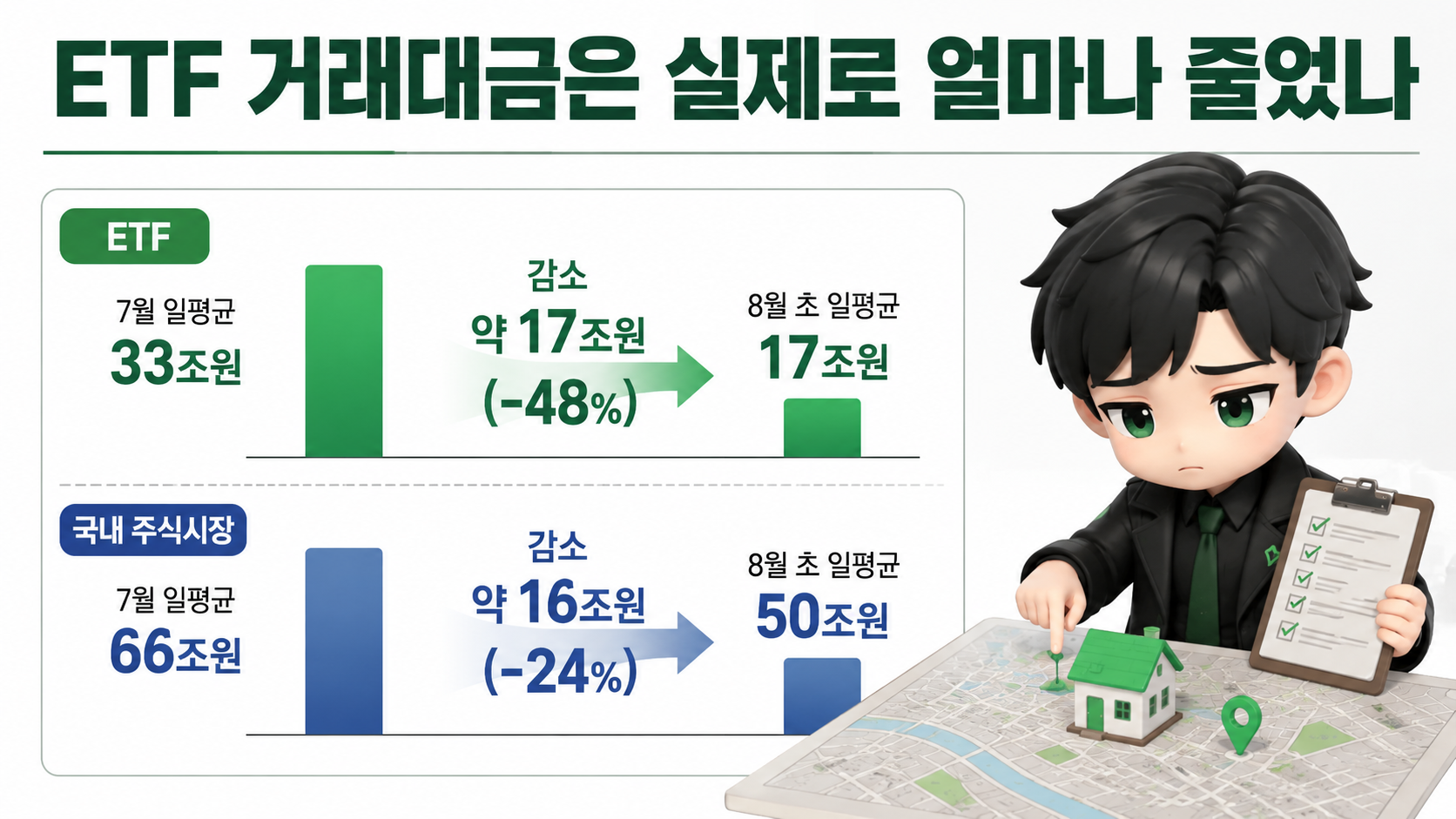
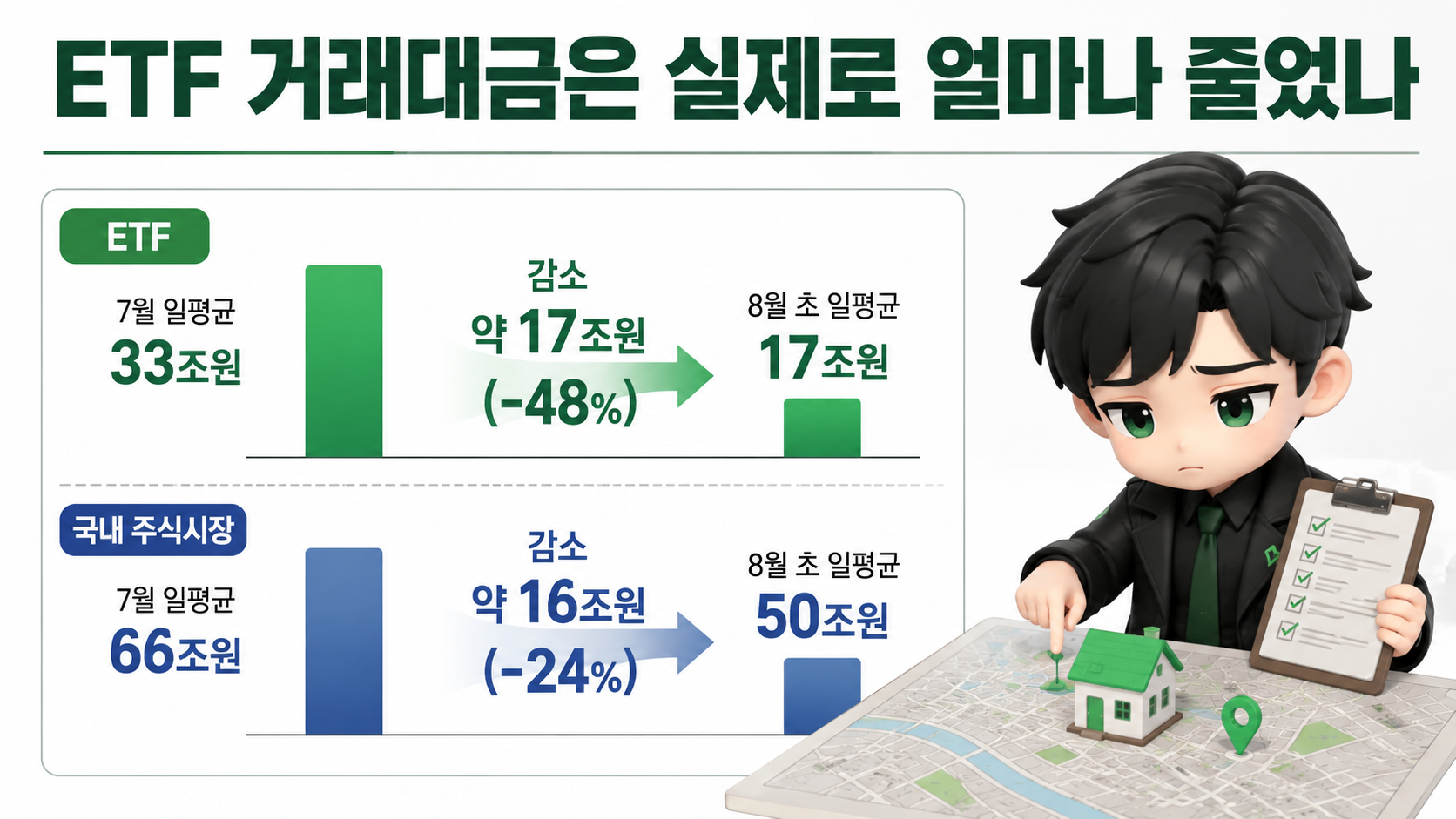
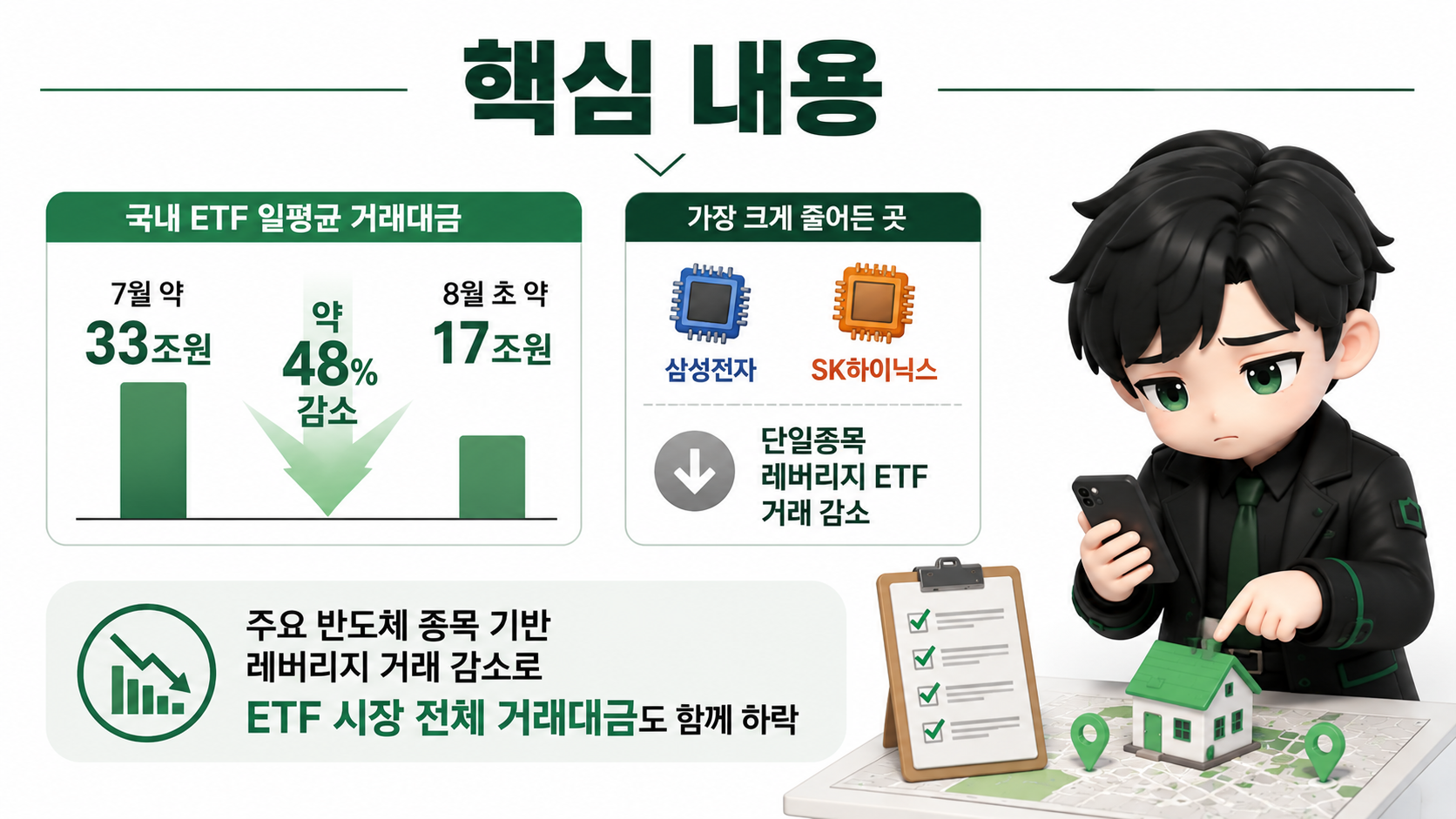
According to the latest figures available as of 2026-08-20, the average daily trading value of domestic ETFs fell from approximately KRW 33,000,000,000,000 in July to approximately KRW 17,000,000,000,000 in early August. This represents a decline of approximately 48%. Trading in single-stock leveraged products tracking Samsung Electronics and SK Hynix fell particularly sharply, bringing down trading value across the broader ETF market.
The term 'halved' does not mean that half of the ETF market itself has disappeared. It means that trading value, or the amount of money involved in buying and selling, has declined. This should not be confused with ETF net assets or the prices of all ETFs falling by half.
How Much Has ETF Trading Value Actually Declined?
The average daily trading value of domestic ETFs was approximately KRW 17,000,000,000,000 in early August. Compared with approximately KRW 33,000,000,000,000 in July, that is close to half the previous level. Over the same period, average daily trading value in the domestic stock market also fell, from approximately KRW 66,000,000,000,000 in July to approximately KRW 50,000,000,000,000 in early August, but the decline was steeper for ETFs.
Using the author's calculation, assuming a decline from KRW 33,000,000,000,000 to KRW 17,000,000,000,000:
(KRW 17,000,000,000,000 - KRW 33,000,000,000,000) ÷ KRW 33,000,000,000,000 × 100 = approximately -48.5%
This indicates that describing the decline as 'halving' is not simply an exaggeration but is fairly close to the actual figures.
The share of domestic stock market trading value accounted for by ETFs has also changed. In July, average daily ETF trading value was equivalent to approximately 50% of average daily trading value in the domestic stock market. By early August, that share had fallen to approximately 34%.
In other words, the key point is that ETF trading declined relatively faster even as trading activity across the broader stock market contracted.
Single-Stock Leveraged ETFs Experienced the Sharpest Decline
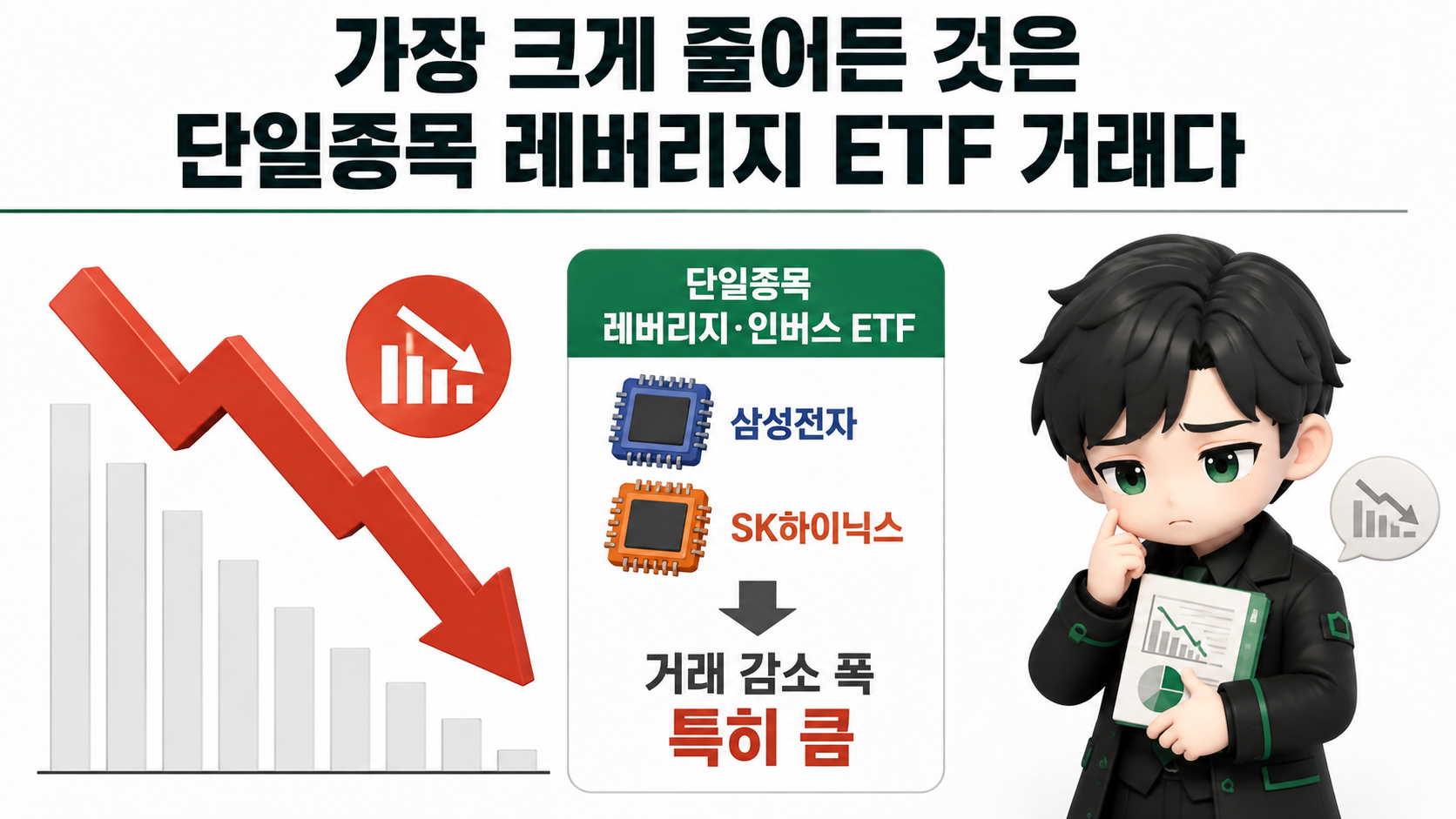
Trading did not decline equally across all ETFs. The largest decreases were concentrated in single-stock leveraged and inverse products tracking underlying assets such as Samsung Electronics and SK Hynix.
On July 30, immediately before the financial authorities' stricter measures took effect, the daily trading value of single-stock leveraged products was approximately KRW 12,400,000,000,000. When the strengthened measures took effect on July 31, it fell to approximately KRW 3,100,000,000,000. By August 5, it had dropped below KRW 1,000,000,000,000. As of August 7, it was estimated to have declined to approximately KRW 800,000,000,000.
A simple comparison between approximately KRW 12,400,000,000,000 on July 30 and approximately KRW 800,000,000,000 on August 7 produces a trading-value decline of approximately 93.5%, according to the author's calculation.
This means that trading in single-stock leveraged products fell much more sharply than overall ETF trading value, which declined by nearly half.
In July, single-stock leveraged ETF trading accounted for a substantial portion of the ETF market. At that time, the monthly trading value of these products was KRW 261,000,000,000,000, representing approximately 36% of total ETF trading.
Consequently, the market was structured in such a way that a sharp decline in trading within this product category would inevitably have a significant impact on overall ETF trading-value figures.
What Changed Starting July 31?
The clearest confirmed regulatory change was the tightening of minimum deposit requirements for single-stock leveraged ETFs and ETNs.
The Financial Services Commission brought forward measures originally scheduled for implementation in mid-August and began applying them on 2026-07-31. Previously, investors could satisfy the minimum deposit requirement of KRW 10,000,000 using eligible securities, including stocks, ETFs, and bonds, as collateral substitutes. Under the revised rules, investors trading single-stock products must meet a cash deposit requirement of KRW 30,000,000. Stocks, ETFs, and bonds are no longer accepted as substitutes for the minimum deposit.
Selling securities does not mean that the proceeds are immediately counted as a cash deposit. Under the Financial Services Commission's guidelines, proceeds qualify toward the minimum deposit only at T+2, when settlement is completed and the cash becomes available. Funds obtained through loans secured by pending securities sale proceeds are also excluded from the minimum deposit.
These measures are not limited to domestically listed products. The Financial Services Commission stated that the strengthened minimum deposit requirements apply to both domestic and overseas-listed single-stock leveraged products.
For investors who previously traded with deposits of approximately KRW 10,000,000, the entry requirements have therefore become substantially more demanding.
Why This Does Not Necessarily Mean Overall ETF Investment Has Contracted
A decline in trading value, the size of ETF assets, and investors' long-term holdings are different indicators.
Trading value shows how much buying and selling takes place during a day. If the same investor trades repeatedly throughout the day, trading value can increase substantially. Conversely, when investors hold ETFs for extended periods without trading, trading value may remain low even if the assets under management are large.
Rather than interpreting the latest change as evidence that all ETF investors have left the market, the figures more closely support an explanation in which trading activity in certain frequently traded single-stock leveraged products dropped sharply, pulling down overall trading value.
Indeed, after trading requirements for single-stock leveraged products were tightened, index-based products such as KODEX 200, KODEX Leverage, KODEX Inverse, KODEX 200 Futures Inverse 2X, and KODEX KOSDAQ 150 Leverage appeared among the ETFs with the highest trading values. However, it cannot be concluded that trading activity lost from single-stock products shifted directly into index-based ETFs.
This is why a single figure for the entire ETF market should not be used to conclude that overall investment demand has declined by the same proportion.
Ordinary ETFs and Single-Stock Leveraged ETFs Must Be Distinguished
The primary targets of the latest measures are not all domestic ETFs but single-stock leveraged products.
For example, an ETF tracking a market index composed of multiple stocks has a different structure from a single-stock leveraged ETF designed to track a multiple of the daily return of an individual stock such as Samsung Electronics or SK Hynix.
The strengthened cash minimum deposit requirement of KRW 30,000,000, applied by the Financial Services Commission starting July 31, is also limited to single-stock products. Investors seeking to purchase ordinary ETFs are not universally required to hold KRW 30,000,000 in cash.
Interpreting the rules as meaning 'ETF regulations now require investors to have KRW 30,000,000 to buy ETFs' would be an overly broad reading of their scope.
In addition to bringing forward the stricter minimum deposit requirements, the Financial Services Commission pursued measures including a temporary suspension of new listings of single-stock leveraged products, a ban on advertising, and tighter management of price deviations. A price deviation refers to the difference between an ETF's market price and the actual value of its underlying assets.
Trading Value Is Not the Only Figure to Watch Going Forward
Although it is confirmed that ETF trading value in August declined significantly compared with July, it is too early to conclude from this alone that the ETF market has entered a prolonged period of contraction.
First, it will be necessary to examine the final monthly average daily trading value for August after trading for the entire month has ended. The current comparison figure of 'approximately KRW 17,000,000,000,000' is based on data from early August and must therefore be distinguished from the average for the full month of August.
Second, attention should be paid to whether trading in single-stock leveraged ETFs remains at a low level. Trading that had been in the KRW 12,000,000,000,000 range on July 30 fell to the KRW 3,000,000,000,000 range immediately after the regulations took effect, and subsequently declined to around KRW 1,000,000,000,000 or below. The share attributable to these products should therefore be examined separately when assessing changes in overall ETF trading volume.
Third, it is important to determine whether trading activity is shifting toward ordinary index-based ETFs and other ETF categories. Total trading value alone may indicate a decline, but examining product rankings and capital flows together can reveal whether the types of products being traded within the market are changing.
Ultimately, the precise meaning of the latest 'halving of domestic ETF trading value' is not that half of the entire ETF market has disappeared, but that a sharp decline in trading of single-stock leveraged products, which had substantially boosted trading activity in July, brought average daily ETF trading value down from approximately KRW 33,000,000,000,000 to approximately KRW 17,000,000,000,000 in early August.
Investors can gain a more accurate understanding by treating overall ETF trading value, single-stock leveraged product trading value, and ETF net assets as separate indicators. Because leveraged ETFs are designed to track multiples of daily returns, their long-term returns may not simply equal a multiple of the underlying asset's cumulative return, and losses can also be significantly amplified.
※ This article is provided for informational purposes to help readers understand market trends and does not constitute an investment recommendation for any particular security or asset. Final investment decisions and responsibility rest with each individual investor.
이 포스팅은 쿠팡 파트너스 활동의 일환으로, 이에 따른 일정액의 수수료를 제공받습니다.