

Is Mild Cognitive Impairment Dementia? Differences, Tests, and How to Use Dementia Care Centers
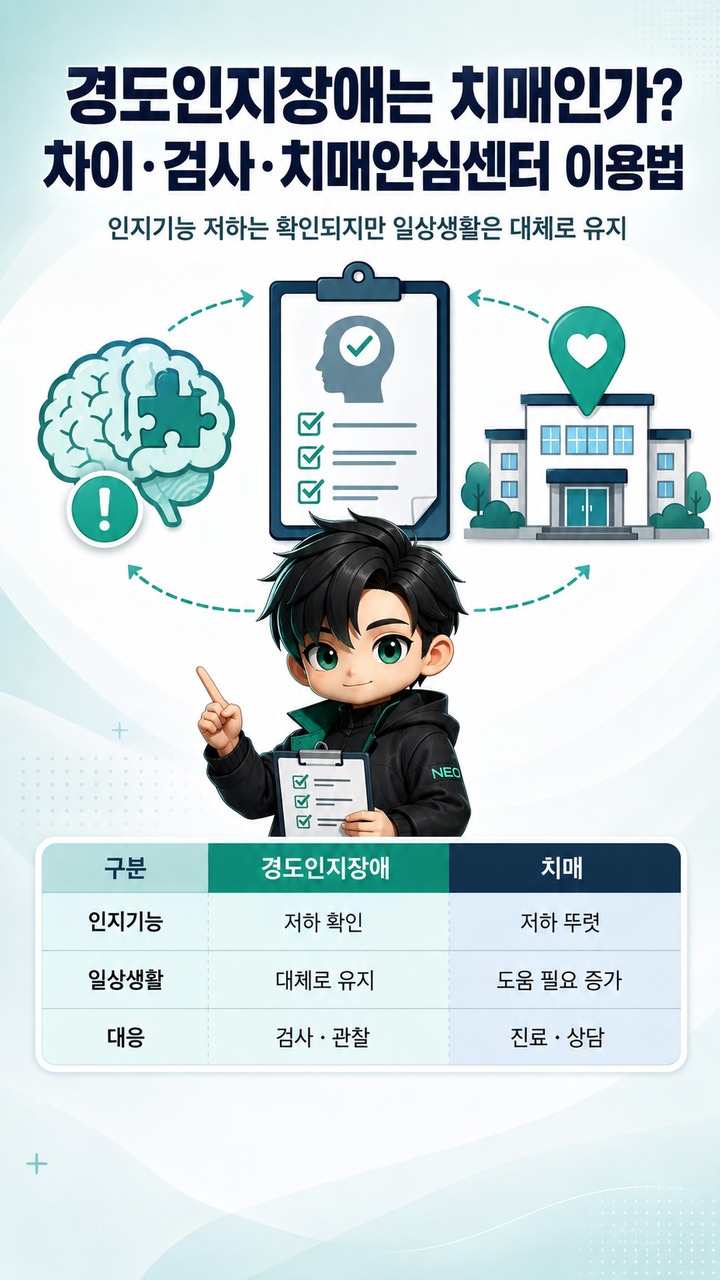
Mild cognitive impairment (MCI) is not the same condition as dementia. It is a stage in which declines in cognitive functions such as memory and concentration can be objectively confirmed, while the ability to carry out daily activities independently is generally preserved. However, because the risk of dementia is higher than with normal aging, it is important to undergo testing to identify the cause if symptoms recur or begin to affect daily life.

Recently, Jeon Won-joo's previous diagnosis of mild cognitive impairment was mentioned again amid news that the production team behind her YouTube channel had stepped down. However, her agency stated that the 2026-08-24 production team replacement was unrelated to Jeon Won-joo's health condition.
The Biggest Difference Between Mild Cognitive Impairment and Dementia Is the Ability to Manage Daily Life
The distinction is not simply about whether someone frequently forgets things. An important criterion is whether cognitive decline prevents a person from continuing to perform activities they previously managed independently.

| Category | Mild Cognitive Impairment | Dementia |
|---|---|---|
| Decline in memory and concentration | May occur | May occur |
| Decline identified through objective testing | May be confirmed | Confirmed |
| Daily activities such as eating, going out, and managing finances | Mostly possible independently | Noticeable difficulties compared with previous abilities may develop |
| Significance | One of the conditions associated with a high risk of dementia | Cognitive impairment that affects daily functioning |
| Subsequent management | Identifying causes and follow-up monitoring | Diagnosis, treatment, and management according to the underlying cause |
The Korea Disease Control and Prevention Agency's National Health Information Portal also describes mild cognitive impairment as a condition in which cognitive functions such as memory or concentration have declined, but the person does not experience major difficulties carrying out daily activities independently. Dementia, by contrast, occurs when cognitive decline has progressed to the point of interfering with independence in everyday life.
Therefore, temporarily forgetting a name or appointment is not enough to conclude that someone has dementia.
Not Everyone Who Experiences Forgetfulness Has Mild Cognitive Impairment
As people age, their speed of processing information and ability to remember new information may decline compared with earlier years. These changes alone do not necessarily indicate a medical condition.

Conversely, if the following changes occur increasingly often compared with the past, it is better to seek an evaluation rather than dismiss them as ordinary forgetfulness.
Frequently being unable to remember recent events or conversations from a few days earlier.
Repeatedly forgetting appointments or where belongings were placed.
Finding it more difficult than before to handle familiar everyday tasks.
Feeling that judgment, planning, concentration, or language abilities have declined along with memory.
Experiencing persistent changes noticeable enough that family members or people nearby recognize a difference from previous behavior.
The Korea Disease Control and Prevention Agency advises seeking a professional evaluation if memory decline makes it difficult to perform tasks that a person previously handled well in daily or social life.
How Is Mild Cognitive Impairment Tested?
An assessment involves more than answering a few simple memory questions once.

First, individuals can undergo a screening test at a Dementia Care Center or medical institution to assess their cognitive condition. If the screening suggests cognitive decline, further evaluation may include neurocognitive testing that examines multiple cognitive domains, including memory, language, attention, and visuospatial abilities, along with a consultation with a medical specialist.
When necessary, additional examinations such as blood tests, CT scans, or MRI scans may be performed to identify possible causes of cognitive decline.
The important point is that a screening test result does not automatically constitute a dementia diagnosis. Even when cognitive decline is detected, there are many possible causes. Further evaluation is needed to distinguish mild cognitive impairment from dementia or other underlying conditions.
Free Cognitive Screening Is Also Available at Dementia Care Centers
If you are concerned about your memory but are unsure whether you need to visit a university hospital immediately, you can first contact a nearby Dementia Care Center.
The Korea Disease Control and Prevention Agency explains that free basic cognitive screening is available at Dementia Care Centers established within local public health centers. In some areas, the CIST cognitive screening test is conducted first, followed by diagnostic testing or differential diagnostic examinations at affiliated medical institutions, depending on the results.
However, eligibility based on age and residence, the scope of financial support for testing, and appointment procedures may vary by region. The most reliable approach is to contact your local Dementia Care Center before visiting to confirm eligibility and required documents or materials.
Mild Cognitive Impairment Does Not Inevitably Progress to Dementia
Because mild cognitive impairment is sometimes described as a 'pre-dementia stage,' people may assume that receiving an MCI diagnosis means they will eventually develop dementia. This is not necessarily true.
There are many possible causes of cognitive decline. In addition to brain disorders, depression, certain medications, nutritional deficiencies, metabolic disorders, and chronic illnesses can affect cognitive function. Therefore, it is important to assess not only a person's current cognitive condition but also why their cognitive abilities have declined.
In particular, if confusion suddenly becomes severe or a person's condition changes rapidly over a short period, they should not assume that it is simply aging or mild cognitive impairment. Instead, they should seek medical evaluation to identify the cause.
What Really Matters When Managing Cognitive Health
Managing risk factors across everyday life is more important than relying on a single nutritional supplement.
The Korea Disease Control and Prevention Agency identifies regular exercise, management of high blood pressure and cholesterol, quitting smoking, reducing excessive alcohol consumption, maintaining social activities, managing hearing and vision, and engaging in regular cognitive activities as measures that may help reduce dementia risk.
By contrast, there is insufficient evidence that so-called 'brain supplements' or health functional foods alone can prevent the progression of dementia. If cognitive decline is already suspected, assessing the current condition and identifying its cause should take priority over looking for supplementary products.
In summary, the key distinction between mild cognitive impairment and dementia is not simply that memory has declined somewhat, but whether cognitive decline can be objectively confirmed and whether it is severe enough to interfere with independent daily living. If changes in memory or judgment occur repeatedly, it is more accurate to seek an evaluation at a Dementia Care Center or a medical department such as neurology or psychiatry rather than attempting to determine independently whether dementia is present.
Related Articles
7.4-Magnitude Earthquake Strikes Colombia: Why the Damage Was Greater Despite a Depth of 107km