

Household Debt Nears 2 Thousand Trillion Won: Key Figures to Check in the Official August 19 Statistics
이 포스팅은 쿠팡 파트너스 활동의 일환으로, 이에 따른 일정액의 수수료를 제공받습니다.
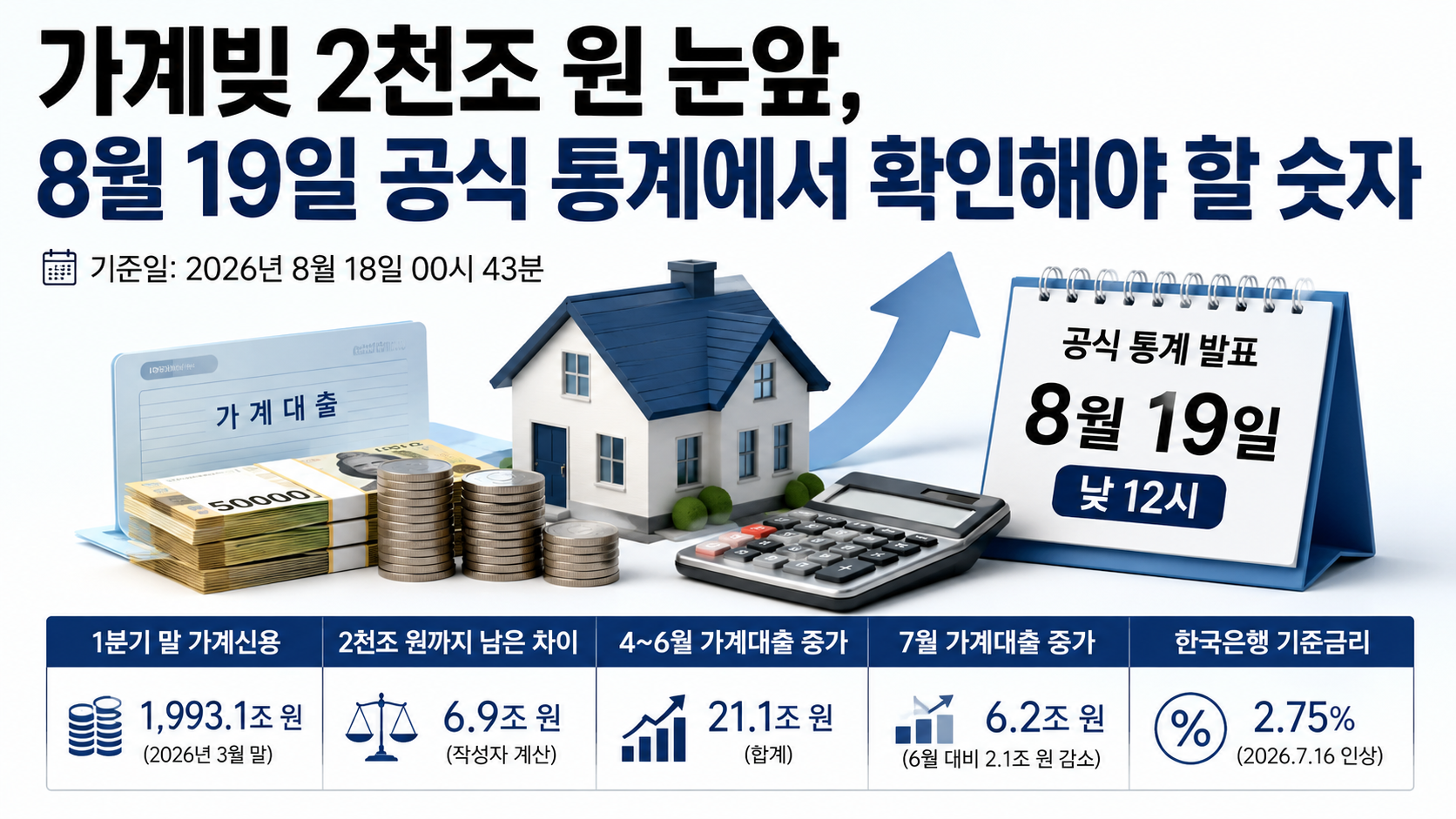
As of 2026-08-18 at 0:43, it is still too early to conclude that South Korea's household debt has officially exceeded 2 thousand trillion won. The latest published household credit balance stood at 1,993 trillion 1 hundred billion won at the end of the 1 quarter of 2026, while the preliminary figures for the 2 quarter are scheduled for release at 12 p.m. on August 19.
However, household loans across all financial institutions increased by a combined 21 trillion 1 hundred billion won during 4–June, followed by another increase of 6 trillion 2 hundred billion won in July. Meanwhile, the Bank of Korea raised its benchmark interest rate from 2.50% to 2.75% on July 16. The key issue now is not simply whether debt has crossed the 2-thousand-trillion-won threshold, but how borrowers' repayment capacity is changing as interest rates rise again while outstanding debt continues to grow.
Has Household Debt Officially Exceeded 2 Thousand Trillion Won?
Not yet, according to officially confirmed statistics. The latest household credit figures released by the Bank of Korea show a balance of 1,993 trillion 1 hundred billion won at the end of March 2026, an increase of KRW 14,000,000,000,000 from the previous quarter.
Household credit includes not only household loans from financial institutions but also outstanding credit purchases, such as goods and services purchased using credit cards but not yet paid for. At the end of the 1 quarter, household loans accounted for 1,865 trillion 8 hundred billion won, while credit purchases outstanding totaled 127 trillion 3 hundred billion won.
The remaining gap to 2 thousand trillion won was 6 trillion 9 hundred billion won.
Author's calculation:
KRW 2,000,000,000,000,000 - KRW 1,993,100,000,000,000.0 = KRW 6,900,000,000,000.0
However, the increase in household loans across financial institutions since April cannot simply be added to 1,993 trillion 1 hundred billion won to calculate household credit for the 2 quarter. The Financial Services Commission's monthly statistics on household loans across all financial institutions and the Bank of Korea's quarterly household credit statistics differ in their coverage and methodology.
Therefore, the accurate way to determine the actual household credit balance for the 2 quarter of 2026, and whether it exceeded 2 thousand trillion won for the first time, is to consult the Bank of Korea's 'Household Credit for the 2/4 Quarter of 2026 (Preliminary),' scheduled for release at 12 p.m. on August 19.
Why Is Crossing the 2-Thousand-Trillion-Won Threshold Considered Likely?
The main reason is the substantial increase in household lending during the 2 quarter. According to the Financial Services Commission, household loans across all financial institutions increased by 3 trillion 5 hundred billion won in April 2026, 9 trillion 3 hundred billion won in May, and 8 trillion 3 hundred billion won in June.
The combined increase over the three months was 21 trillion 1 hundred billion won.
Author's calculation:
KRW 3,500,000,000,000.0 + KRW 9,300,000,000,000.0 + KRW 8,300,000,000,000.0 = KRW 21,100,000,000,000.0
This figure is not equivalent to the official increase in household credit for the 2 quarter. Nevertheless, household credit was already just 6 trillion 9 hundred billion won below 2 thousand trillion won at the end of the 1 quarter. Continued lending growth during 4–June helps explain why the announcement on August 19 is attracting attention.
Lending growth continued in July. Household loans across all financial institutions increased by 6 trillion 2 hundred billion won during that period. Although the increase was smaller than the 8 trillion 3 hundred billion won recorded in June, lending did not shift into contraction.
Compared with June, the increase in lending declined by 2 trillion 1 hundred billion won.
Author's calculation:
KRW 8,300,000,000,000.0 - KRW 6,200,000,000,000.0 = KRW 2,100,000,000,000.0 decrease
Measured as a percentage of the previous increase, this represents a slowdown of approximately 25.3%.
Author's calculation:
2.1 ÷ 8.3 × 100 = approximately 25.3%
Of the 6 trillion 2 hundred billion won increase in July, mortgage loans accounted for 3 trillion 5 hundred billion won, while other loans accounted for 2 trillion 7 hundred billion won. Mortgage lending growth also slowed from 4 trillion 5 hundred billion won in June to 3 trillion 5 hundred billion won in July.
There is an important distinction here. Slower lending growth and an actual decline in total household debt are entirely different developments. Outstanding balances continued to increase in July.
The Benchmark Interest Rate Is Already 2.75%: Why It Matters for Household Debt
The Bank of Korea's Monetary Policy Board raised the annual benchmark interest rate from 2.50% to 2.75% on 2026-07-16, an increase of 0.25% percentage points. As of August 18, the Bank of Korea's benchmark interest rate stands at 2.75%.
In making its decision, the central bank considered strengthening economic growth driven by exports and investment, inflation expected to remain above its target for a considerable period, and persistent financial stability risks.
An increase of 0.25% percentage points in the benchmark rate does not mean that every household loan rate rises by exactly 0.25% percentage points on the same day. The timing and size of actual adjustments depend on whether a loan carries a fixed or variable rate, which reference rate applies, and when the interest rate is scheduled to reset.
Actual bank lending rates also deserve attention. The average interest rate on newly issued loans at deposit-taking banks in June 2026 was 4.31% annually, up 0.12% percentage points from the previous month. Because these statistics cover June, before the benchmark rate increase in July, subsequent monthly data must be examined separately to assess future lending rate trends.
For households, checking the current interest rate, adjustment cycle, next rate reset date, and remaining principal in their loan agreements is far more directly useful than simply focusing on the benchmark interest rate.
Does Household Debt of 2 Thousand Trillion Won Mean Every Household Faces Greater Risk?
Aggregate household debt and the repayment risks faced by individual households must be assessed separately. A rise in total debt to 2 thousand trillion won does not mean every borrower faces the same level of financial pressure.
Even with identical outstanding loan balances, repayment burdens can vary significantly depending on interest rate structures, income, maturity dates, and repayment methods. Borrowers with fixed-rate loans may retain their contracted rates for the time being, while those with variable-rate loans may experience changes in their repayment burdens when rates reset. Households steadily reducing their principal are also in a different position from those that continually need additional borrowing.
That is why total debt alone is insufficient to assess household financial risks.
The first things individuals should check are relatively straightforward.
1. Check the remaining principal on each outstanding loan.
2. Distinguish between fixed-rate and variable-rate loans.
3. For variable-rate loans, check the next interest rate reset date and applicable reference rate.
4. Calculate whether living expenses and emergency savings would remain manageable if monthly principal and interest payments increased.
5. If borrowing from multiple financial institutions, add together all monthly repayments rather than evaluating each loan separately.
Borrowers already struggling with monthly repayments would be better served by assessing whether they could manage higher payments under their existing loan agreements than by trying to predict whether the benchmark rate will rise further.
How Is the Government Managing Household Lending Growth?
Financial authorities are maintaining their policy of controlling aggregate household lending in 2026. In their management plan announced earlier in the year, they set the target growth rate for total household loans across financial institutions in 2026 at 1.5%. They also outlined a longer-term goal of reducing the household debt-to-GDP ratio to approximately 80% by 2030.
Recent monthly trends suggest that the need for continued oversight has not disappeared. Household loans across all financial institutions increased by a cumulative 35 trillion 3 hundred billion won during 1–July of 2026.
Looking specifically at July, lending growth slowed. At an expanded household debt review meeting held on August 14, the Financial Services Commission reported that household loans across all financial institutions increased by 6 trillion 2 hundred billion won in July, down from 8 trillion 3 hundred billion won in the previous month.
Mortgage lending growth slowed from 4 trillion 5 hundred billion won in June to 3 trillion 5 hundred billion won in July. Growth in other loans also declined, from 3 trillion 8 hundred billion won to 2 trillion 7 hundred billion won.
However, financial authorities maintain that household lending trends require continued monitoring because risk factors remain, including expectations of rising housing prices, particularly in the Seoul metropolitan area, increasing housing transaction volumes, and demand for financing.
In other words, it would be premature to conclude that slower lending growth means the problem has been resolved. Equally, it would be unjustified to assume that all households are on the verge of financial distress. The essential indicators are changes in total outstanding loans, interest rate levels, and borrowers' actual repayment capacity.
What Should You Look for in the August 19 Announcement?
The first figure to examine is the household credit balance at the end of the 2 quarter of 2026. Beyond determining whether it exceeded 2 thousand trillion won, it is important to assess how much it increased from 1,993 trillion 1 hundred billion won at the end of the 1 quarter.
The second consideration is the composition of the increase. Because household credit consists of household loans and outstanding credit purchases, it is necessary to determine which component contributed to the overall growth.
The third consideration is the underlying trend within household lending. If housing-related loans and other loans show different patterns, the aggregate figure alone will not adequately explain the nature of lending growth.
Finally, monthly household lending trends should also be considered. The 2-quarter statistics reflect conditions at the end of June, but household loans across all financial institutions had already increased by another 6 trillion 2 hundred billion won in July. Therefore, the 2-quarter figures released on August 19 should be interpreted separately from the latest monthly lending trends.
Three points can currently be stated with confidence.
At the end of the 1 quarter of 2026, household credit stood at 1,993 trillion 1 hundred billion won, just 6 trillion 9 hundred billion won below 2 thousand trillion won. Household lending across financial institutions continued to increase during 4–July. The Bank of Korea raised its benchmark interest rate to 2.75% on July 16.
However, as of August 18 at 0:43, the official figures have not yet been released, so it remains unconfirmed whether household credit has actually exceeded 2 thousand trillion won and, if so, by how much. The figures can be confirmed when the official statistics are released at 12 p.m. on August 19.
※ This article is provided for informational purposes to help readers understand market trends and does not constitute an investment recommendation for any specific stock or asset. All final investment decisions and associated responsibilities rest with the individual.
이 포스팅은 쿠팡 파트너스 활동의 일환으로, 이에 따른 일정액의 수수료를 제공받습니다.