

What Does One Share of SPCX Include?

If you buy SpaceX stock SPCX, are you also investing in Starlink and xAI? The actual business composition based on 2-quarter revenue# If you buy SpaceX stock SPCX, are you also investing in Starlink and xAI? The actual business composition based on 2-quarter revenue
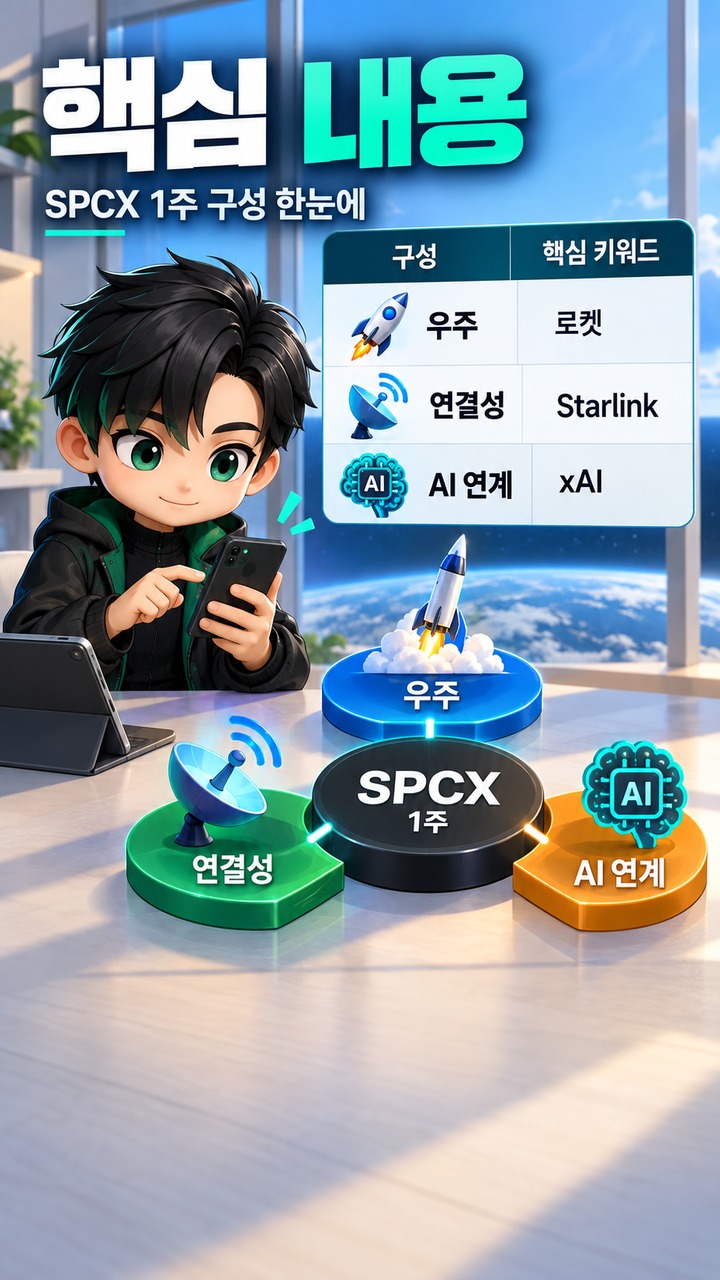
Buying SpaceX stock SPCX means investing in more than just its rocket business. SpaceX currently operates space, Starlink-centered connectivity, and xAI-centered AI businesses within a single publicly traded company, meaning SPCX shareholders gain economic exposure to all three businesses. However, investors cannot choose to invest exclusively in Starlink or xAI through this structure.
As of 2026-09-19, this distinction is important. In SpaceX's 2 quarter of 2026, the business generating the largest share of revenue was not rockets but the Connectivity segment, which includes Starlink.
What Does One Share of SPCX Include?
Space Exploration Technologies Corp., or SpaceX, currently reports its financial results across three business segments: Space, Connectivity, and AI.

The Space segment covers space launches and development activities involving Falcon, Starship, and other programs.
The Connectivity segment includes high-speed internet and mobile connectivity services using Starlink satellites, as well as sales of Starlink terminals. This segment serves not only consumers but also business and government customers.
The AI segment includes AI models such as Grok, consumer and enterprise AI solutions, the X platform, and AI computing infrastructure. xAI, which SpaceX acquired in early 2026, is a central part of this business.
Therefore, buying SPCX is better understood as investing in SpaceX as a whole, combining space launches, Starlink, and AI/xAI businesses, rather than simply investing in a rocket company. This more accurately reflects the company's current structure.
Starlink Accounts for the Largest Share of Actual Revenue
SpaceX's 2-quarter financial results for 2026, filed with the SEC, provide a clearer picture of its business composition.
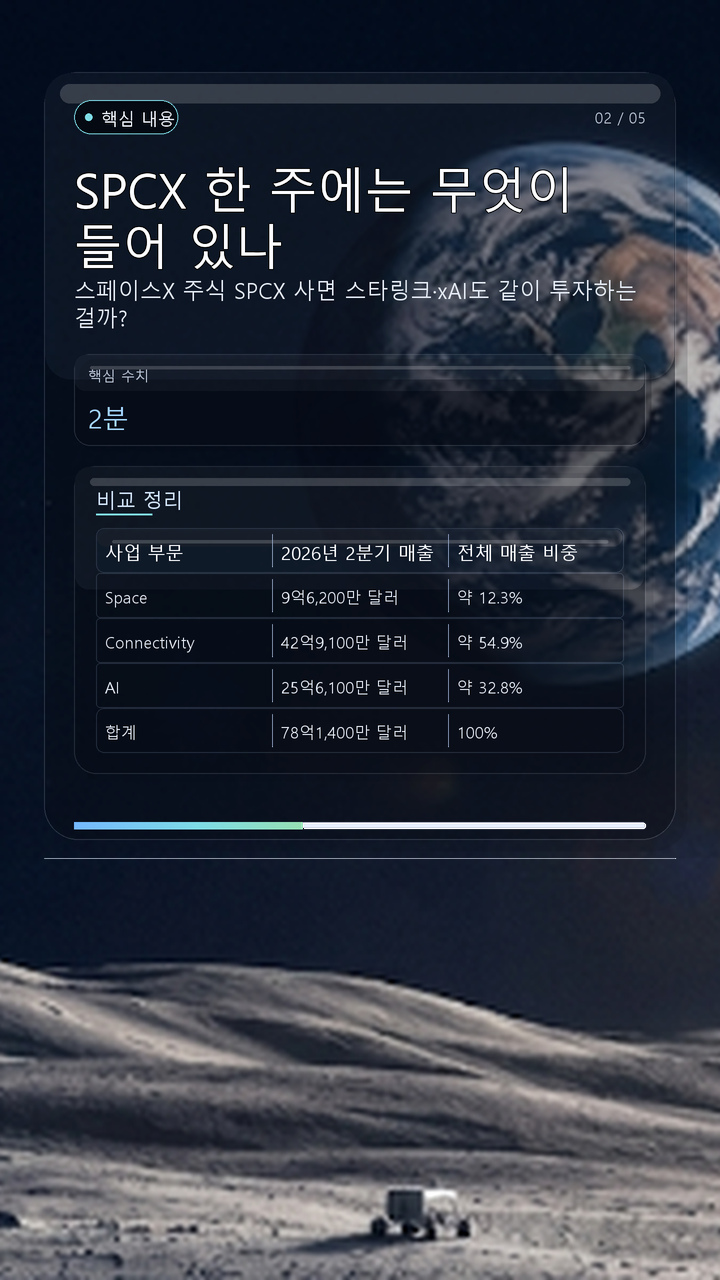
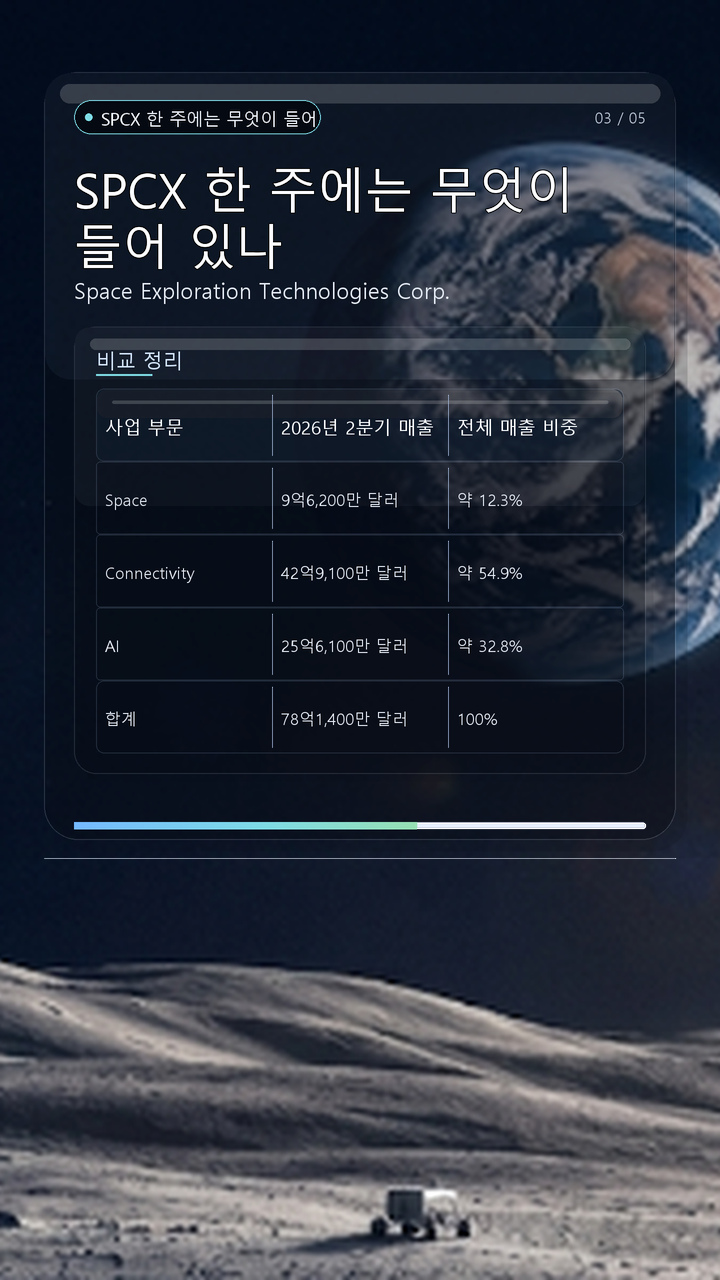
| Business Segment | Revenue in 2 Quarter of 2026 | Share of Total Revenue |
|---|---|---|
| Space | 9억6,200만 dollars | Approximately 12.3% |
| Connectivity | 42억9,100만 dollars | Approximately 54.9% |
| AI | 25억6,100만 dollars | Approximately 32.8% |
| Total | 78억1,400만 dollars | 100% |
The percentages are calculated by the author by dividing each segment's revenue reported by SpaceX by total 2-quarter revenue of 78억1,400만 dollars.
In other words, more than half of the company's revenue in the 2 quarter came from Connectivity. This segment includes Starlink consumer services, business and government customers, and sales of Starlink terminals.
By contrast, the Space segment accounted for approximately 12.3% of revenue. Anyone assuming that rockets and space launches generate most of the company's revenue because of its name may find that the actual figures tell a different story.
The AI segment also accounted for approximately 32.8%. SpaceX cited new AI infrastructure contracts as a major factor behind the increase in AI segment revenue during the 2 quarter.
Can You Buy Starlink Stock Separately?
According to SpaceX's current disclosures, Starlink is not separately listed as a publicly traded stock. Investors seeking direct stock-market exposure to the Starlink business currently gain that exposure through its parent company, SpaceX, by purchasing SPCX shares.
SpaceX explains that its Connectivity segment recognizes revenue from Starlink broadband and mobile connectivity services, as well as sales of Starlink Kits.
Investors should therefore be careful not to accidentally purchase another stock with a similar name when searching for 'Starlink stock' in a brokerage app.
The Nasdaq-listed Class A common stock ticker symbol for SpaceX is SPCX. The company began trading under this ticker on 2026-06-12.
xAI Is Not a Separately Traded Stock Either
Similarly, investors currently cannot gain exposure to xAI by purchasing separately listed shares independent of SpaceX.
SpaceX's 2-quarter report for 2026 divides the company into three segments—Space, Connectivity, and AI—and includes Grok, X, AI solutions, and computing infrastructure within the AI segment. The company also disclosed that existing xAI shares were converted into SpaceX shares as part of the merger process.
As a result, SPCX investors are exposed not only to Starlink's growth but also to the performance and costs of the AI business.
In fact, while the AI segment generated 25억6,100만 dollars in revenue during the 2 quarter of 2026, it recorded an operating loss of 12억5,700만 dollars. During the same period, the Connectivity segment recorded operating profit of 16억5,600만 dollars.
This is why it is difficult to simplify the investment case to 'If Starlink does well, SPCX will definitely do well.' The company's overall financial performance reflects not only Starlink but also AI investment costs, research and development expenses, and development costs associated with its space business.
Do SPCX Shareholders Have the Same Voting Rights as Musk?
Economic ownership and corporate control must be considered separately. SpaceX Class A shares traded by ordinary investors carry 1 vote per 1 share, while Class B shares carry 10 votes per 1 share.
Immediately after the IPO, Class A shares represented approximately 11.5% of total voting power, while Class B shares represented approximately 88.5%. SpaceX's offering documents explicitly identify the risk that Class B shareholders may retain substantial influence over board composition and major matters requiring shareholder approval.
Therefore, buying SPCX Class A shares provides participation in the economic value of SpaceX's entire business, but that does not necessarily mean investors have substantial influence over the company's management.
Distinguishing SPCX From 'SpaceX-Related ETFs'
SPCX itself represents SpaceX Class A common stock. However, the market also offers separate ETFs whose performance is linked to SpaceX's share price.
A separate 2-times leveraged SpaceX ETF called SPCU is also listed on Cboe.
For this reason, checking the ticker symbol rather than relying on the product name is the safer approach before placing an order.
SPCX = SpaceX Class A common stockSPCF, SPCU, etc. = Separate products using SpaceX as their underlying asset
Products containing terms such as '2X,' 'Daily,' or 'Leveraged' have different structures and risks from SpaceX common stock.
Ultimately, There Is More Than One Number to Watch When Investing in SPCX
Looking only at the number of rocket launches is not enough to understand SpaceX's current business structure when evaluating its stock price.
In the 2 quarter of 2026, approximately 54.9% of revenue came from Connectivity, approximately 32.8% from AI, and approximately 12.3% from Space. At the same time, Connectivity generated an operating profit, while the Space and AI segments recorded operating losses.
Therefore, investors evaluating SPCX should monitor at least Starlink subscriber numbers and growth in the connectivity business, AI revenue and large-scale investment costs, development expenses in the space business including Starship, and overall cash flow.
SPCX is no longer simply a 'rocket stock,' a 'Starlink stock,' or an 'xAI stock.' Combining all three businesses within one company expands its growth potential while also exposing investors to the risks associated with each business.
Because the share price and business valuation may change depending on future earnings, investment spending, competitive conditions, and other factors, it is difficult to predict the direction of the stock price or investment returns based solely on the growth of one business.
※ This article is provided for informational purposes to help readers understand market developments and does not constitute a recommendation to invest in any particular stock or asset. Investors are responsible for their own final decisions and investment outcomes.