

SK Hynix Wage and Collective Bargaining Agreement Rejected by 25 Votes: The PS Treasury Share 60% Proposal and Next Steps
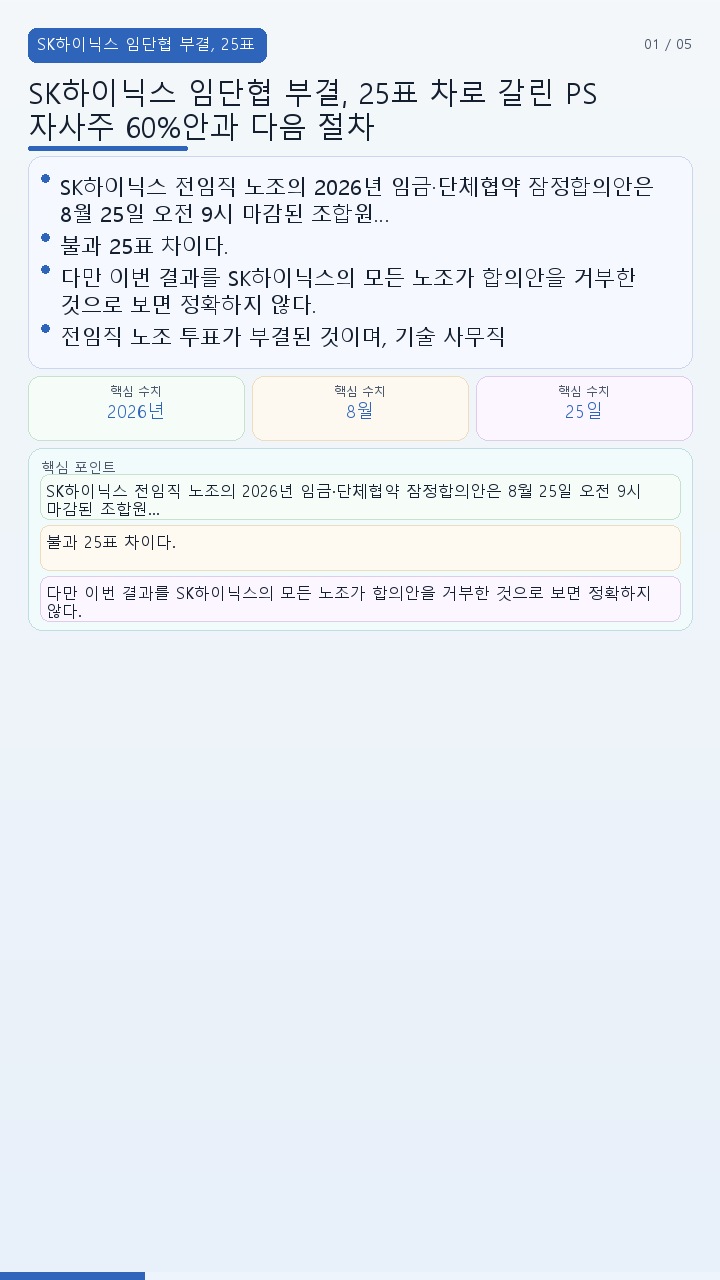
The tentative 2026 wage and collective bargaining agreement reached by SK Hynix's production workers' union was rejected in a membership vote that closed at 9 a.m. on August 25, with 7,535 votes against and 7,510 votes in favor. The margin was just 25 votes. However, it would be inaccurate to interpret this result as a rejection of the agreement by all SK Hynix unions. The production workers' union rejected the proposal, while the technical and office workers' union was conducting its own separate voting process.
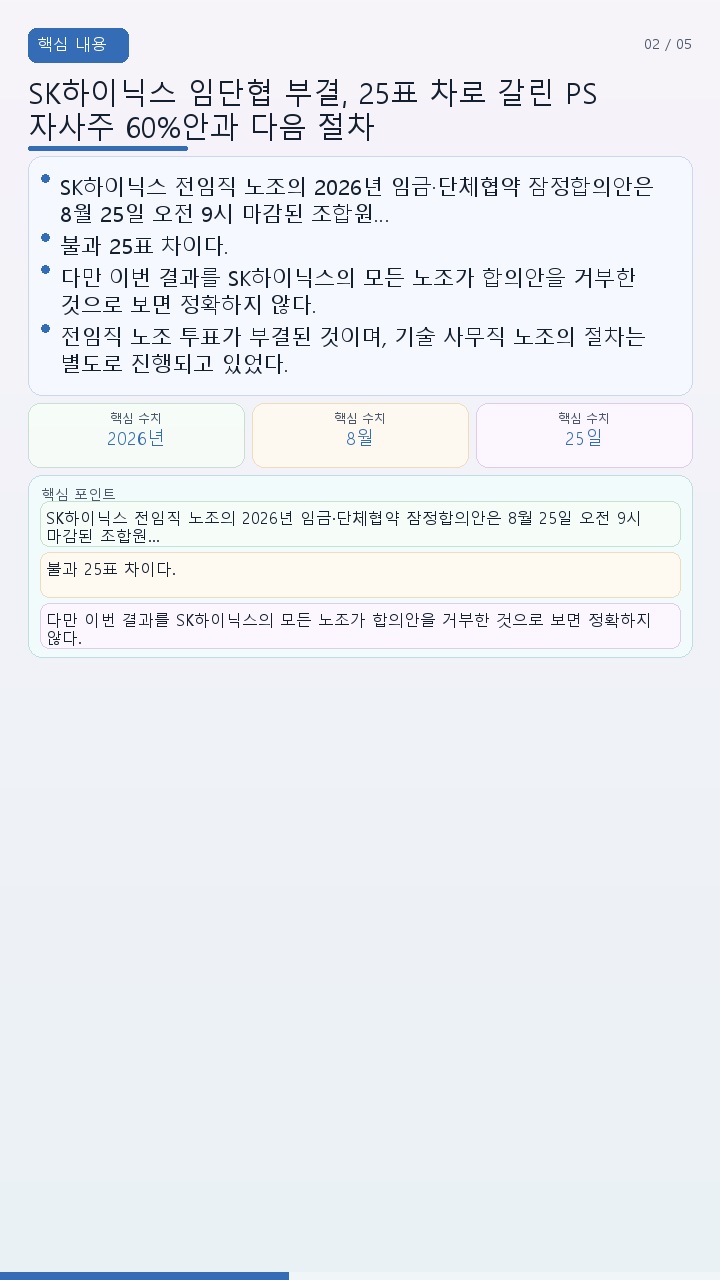
The tentative agreement included a 6.3% wage increase and a proposal to pay the company's profit-sharing bonus, known as PS, 40% in cash and 60% in treasury shares. Because the tentative agreement was not finalized, the production workers' union and the company must return to negotiations.
The information was verified as of 2026-08-25 at 11 a.m. Korea Standard Time.
Rejected by 25 Votes: What Were the Actual Voting Results?
The vote was effectively split down the middle. Of the production workers' union's 1만6,083 members, 1만5,045 participated, producing a 93.81% turnout rate.
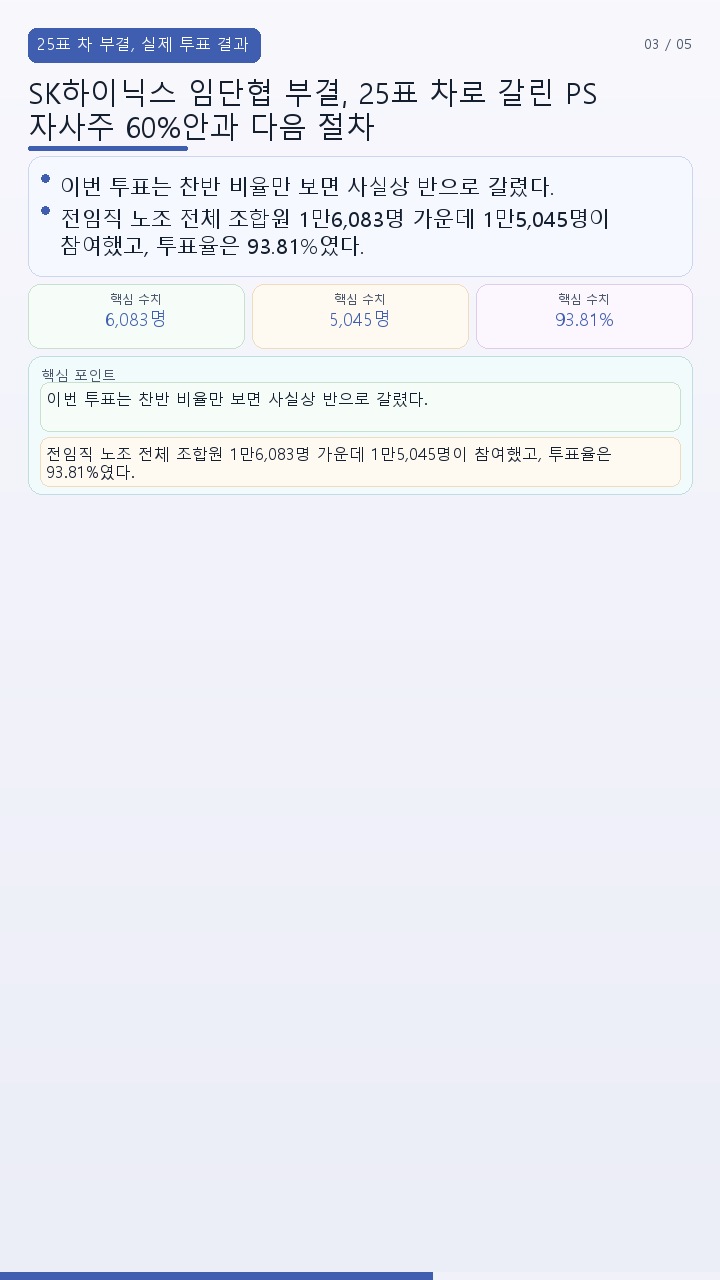
There were 7,535 votes against, representing 50.08%, and 7,510 votes in favor, representing 49.92%. Opposition exceeded support by 25 votes, preventing the tentative agreement from passing.
According to the author's calculation, the margin between votes for and against represented approximately 0.17% of the total 1만5,045 voters.
The calculation is `25 ÷ 15,045 × 100`. The difference between the displayed approval and rejection percentages is 0.16% percentage points, while the actual vote margin divided by the total number of votes is approximately 0.17%.
Voting took place from August 24 at 6 a.m. until 25 at 9 a.m. A tentative agreement does not automatically become final simply because management and labor have negotiated it. It must pass the required membership approval process before proceeding to final agreement.
In this case, the participation requirement was satisfied, but the proposal failed to secure approval from a majority of voters.
What Was the PS Payment Structure That Drew More Attention Than the 6.3% Wage Increase?
The tentative agreement included a 6.3% wage increase and changes to the PS payment structure. PS is a profit-sharing bonus linked to the company's performance.
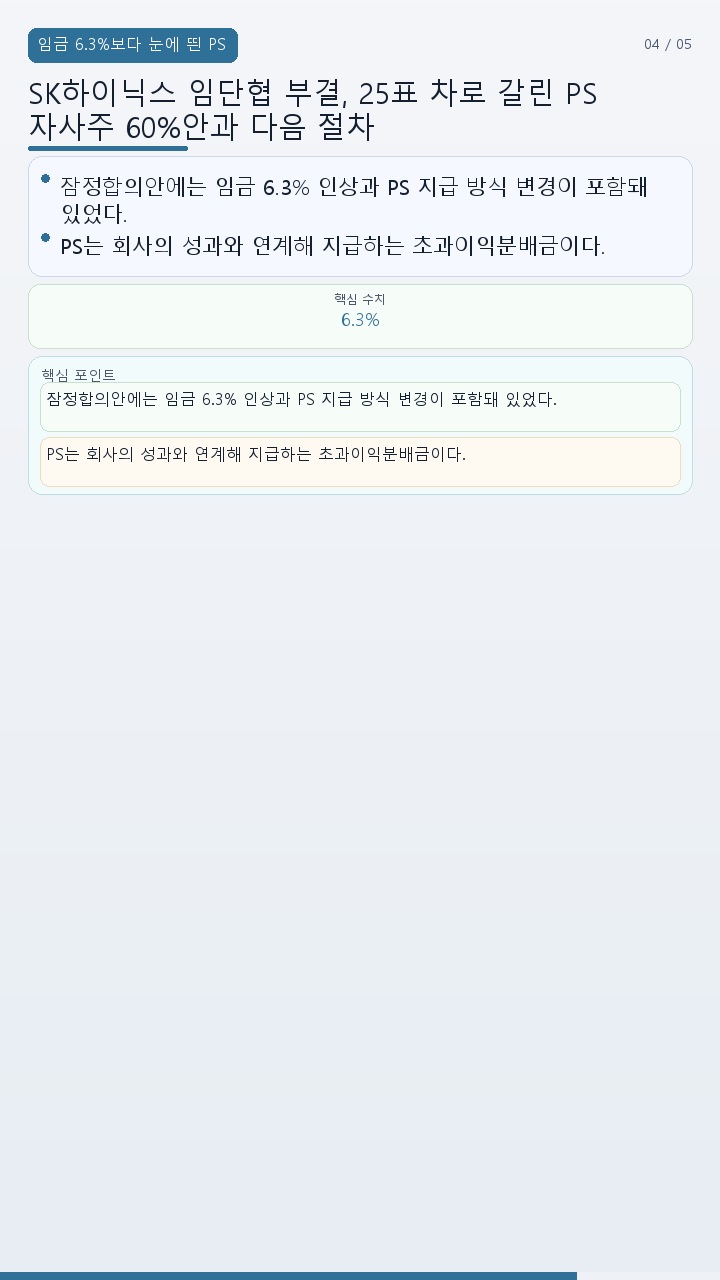
Under the tentative proposal, 40% of PS would be paid in cash, while the remaining 60% would be paid in SK Hynix treasury shares.
The proposal did not allow all shares within the 60% stock portion to be sold at the same time. Based on the total PS amount, shares equivalent to 40% could be sold in the year they were received, while 20% would be distributed on a deferred basis in 10% installments over the following 2 years.
For example, if the total PS payment is represented as 100 for simplicity, the structure would be as follows.
Cash payment: 40
Shares that could be sold in the year of payment: 40
Deferred shares after 1 year: 10
Deferred shares after 2 years: 10
However, specifically for the 2026 PS scheduled to be paid in early 2027, the tentative agreement also included an exception allowing employees to choose cash instead of the portion of shares that could be sold in the year of payment. With this option, employees could receive up to 80% in cash for that payment.
Therefore, it would also be inaccurate to say that '60% of the performance bonus would automatically be paid in shares that remain locked up for an extended period.' The tentative agreement distinguished between shares that could be sold immediately and those subject to deferred distribution.
How Would This Have Differed From the Existing PS System?
An important distinction in these negotiations is the difference between the formula used to determine the PS funding pool and the actual method of payment. Confusing these two elements can lead to misunderstandings.
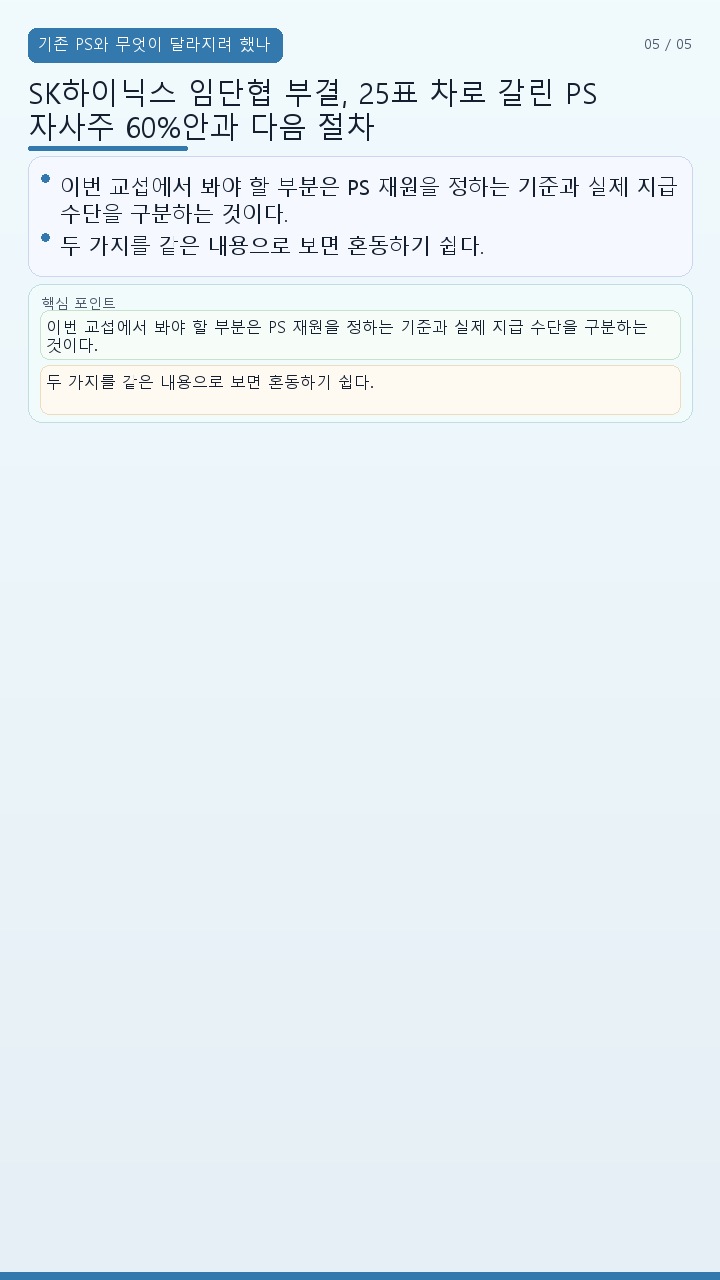
SK Hynix management and labor had previously agreed to remove the PS ceiling and maintain a system allocating 10% of operating profit to the PS funding pool for 10 years. Under that arrangement, 80% would be paid first, with the remaining 20% distributed over 2 years.
The main change proposed in the 2026 tentative agreement was not the underlying PS funding formula but the introduction of a substantial treasury share component into the payment method.
In other words, the proposal did not mean that 'PS would be eliminated' or that 'the 10% operating profit allocation formula would be abolished.' The tentative agreement confirmed on August 25 included provisions redefining the proportions and timing of cash and stock payments within PS.
With the rejection in this vote, those proposed changes have not been finalized either.
This Rejection Is Not the Final Result for All SK Hynix Unions
The rejection confirmed on the morning of August 25 reflects the voting results of the production workers' union. This distinction can easily be overlooked in abbreviated reports stating that 'the SK Hynix union rejected the agreement.'
At SK Hynix, the production workers' union and the technical and office workers' union have negotiated separately with the company, and their respective votes on tentative agreements are counted independently. Because the production workers' union rejected the proposal, renewed negotiations are required between that union and the company.
At the same time, the technical and office workers' union was conducting its own vote. Therefore, as of 11 a.m., it would have been premature to say that 'the final position of all union members had been determined,' including those in technical and office roles.
More recently, a new SK Hynix integrated union was also established, extending beyond the company's traditional occupational divisions. However, the establishment of this new integrated union should be distinguished from the approval procedures already underway for the existing unions' wage and collective bargaining agreements.
Based on publicly available information, the integrated union had requested an explanation from the company regarding the progress of the existing wage and collective bargaining negotiations and the schedule and procedures for future talks.
Does the Rejection Mean the 6.3% Wage Increase Takes Effect Immediately?
No. The membership vote covered a tentative wage and collective bargaining agreement containing multiple provisions, and that agreement was rejected by the production workers' union.
Therefore, the 6.3% wage increase and the proposed PS payment structure cannot be treated as finalized terms independently of the rejected agreement. Which provisions remain unchanged and which are adjusted during renewed negotiations will become clear only when a new agreement is prepared.
In particular, immediately after the rejection, there is no basis for definitively claiming that 'the treasury share proportion will be reduced,' 'payments will revert entirely to cash,' or 'the wage increase rate will change again.'
What can currently be confirmed is that the existing tentative agreement failed to pass the membership vote and that the production workers' union and the company must resume negotiations.
The SK Hynix production workers' union has previously renegotiated with the company after tentative wage and collective bargaining agreements were rejected in 2023 and 2024. However, those precedents do not establish what revisions will be made this time or when a final agreement might be reached.
What to Watch Next: A Revised Tentative Agreement and the Separate Union Vote
The next meaningful development will come not simply from the rejection itself but from how the existing tentative agreement is revised during renewed negotiations.
The first point to watch is whether the production workers' union and the company resume negotiations and produce a revised tentative agreement. In particular, it will be important to determine whether the existing PS structure of 40% in cash and 60% in treasury shares, along with the deferred payment arrangements, remains unchanged or is adjusted.
The second issue is the separate voting process involving the technical and office workers' union. Because negotiations and voting are conducted independently, the production workers' union's result cannot be used to predict the outcome for the other union.
The third issue is whether any revised tentative agreement goes through another membership approval process and ultimately becomes a final agreement. Until a new proposal is announced, it is important not to treat the figures in the rejected tentative agreement as 'confirmed wages' or a 'finalized performance bonus payment structure.'
The developments definitively confirmed as of August 25 at 11 a.m. are clear. The production workers' union's tentative 2026 wage and collective bargaining agreement was rejected by 25 votes, and the proposed 6.3% wage increase and PS payment structure of 40% in cash and 60% in treasury shares have not yet been finalized.
※ This article is provided for informational purposes to help readers understand market developments and does not constitute investment advice or a recommendation to buy or sell any particular stock or asset. Readers are responsible for their own final investment decisions and associated risks.
Related Articles
Star News Report on BTS Jimin's Donation: Fan Activities Continuing Through USD 84,000