

US Interest Rate Outlook: 80 Economists Expect Rates to Remain Unchanged Through Year-End…90% Forecast a Hold in September
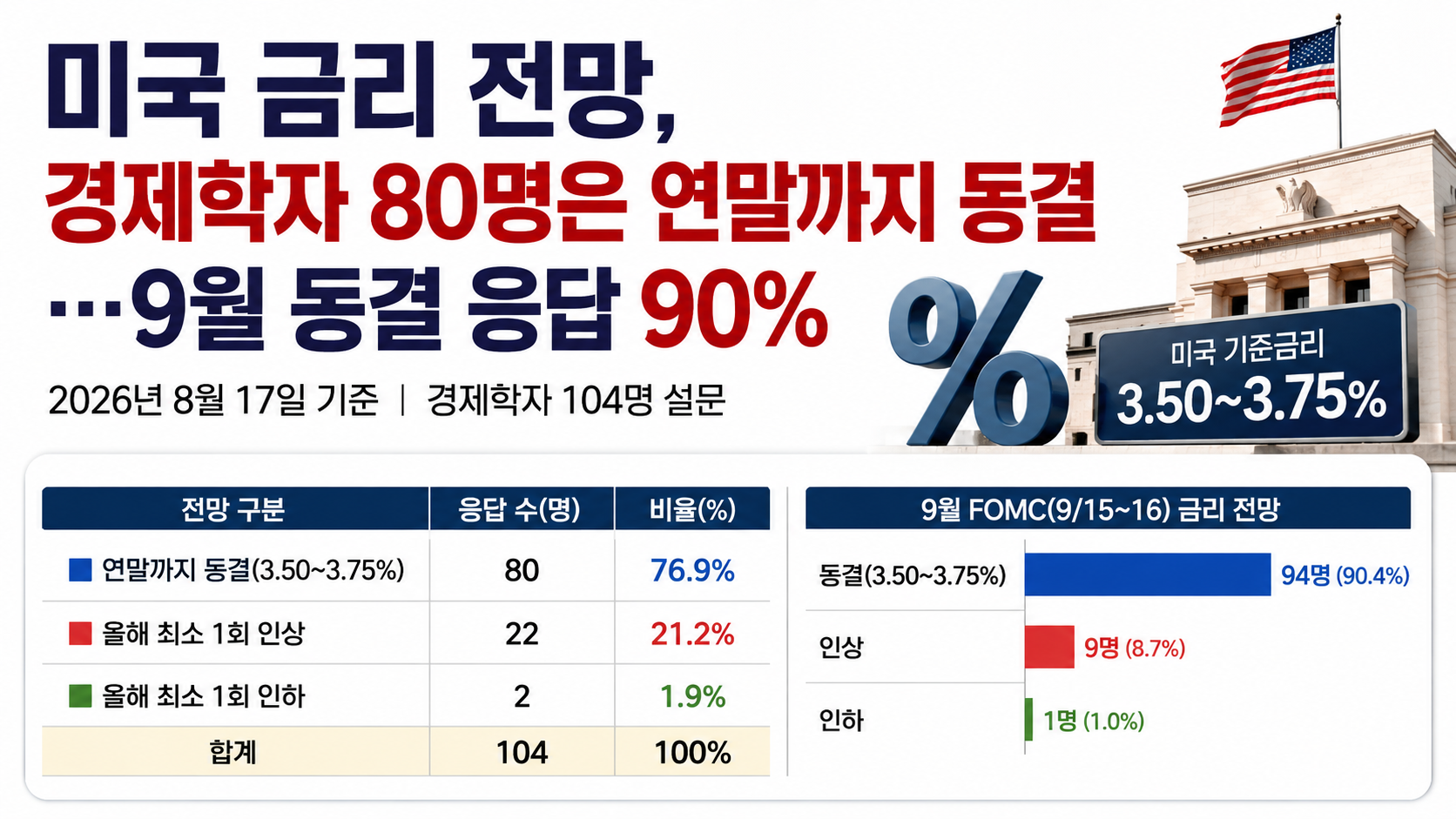
As of 2026-08-17, the US benchmark interest rate stands at 3.50–3.75% annually. In a survey of economists conducted in August 12–17, 80 out of 104 respondents expected rates to remain within this range through the end of the year, while 94, or approximately 90%, predicted no change at the September meeting.
However, it would be somewhat inaccurate to simplify the findings by saying that '80% of economists expected no rate hikes.' Exactly 80 respondents expected rates to remain unchanged through year-end, representing approximately 76.9% of the 104 surveyed, while 22 anticipated at least one rate increase this year and 2 expected a rate cut.
Exactly How Many Economists Expect Rates to Remain Unchanged Through Year-End?
In the August survey, 80 economists expected the US benchmark interest rate to remain at its current 3.50–3.75% range through year-end. 22 respondents anticipated at least one rate hike, while 2 expected a rate cut.
Calculating directly from the total of 104 respondents, approximately 76.9% expected rates to remain unchanged, 21.2% anticipated an increase, and 1.9% predicted a decrease.
Author's Calculations
Unchanged: 80 ÷ 104 × 100 = approximately 76.9%
Increase: 22 ÷ 104 × 100 = approximately 21.2%
Decrease: 2 ÷ 104 × 100 = approximately 1.9%
The key takeaway from this survey is therefore not simply the figure '80% of economists,' but rather that expectations for unchanged rates overwhelmingly dominate, although the possibility of further rate hikes has not been completely ruled out.
Notably, the 22 economists expecting rate increases substantially outnumber the 2 anticipating cuts. The survey also indicates that the remaining monetary policy debate this year is less about 'when rates will be cut' and more about 'whether additional tightening will be necessary' if inflation strengthens again.
Expectations for a Hold Are Even Stronger at the September FOMC Meeting
Opinions about the September meeting are even more heavily tilted toward one outcome than the year-end forecasts. Of the 104 economists surveyed, 94 expected the Federal Open Market Committee (FOMC) to maintain the benchmark interest rate at 3.50–3.75% at its September 15–16 meeting.
Dividing 94 by 104 gives approximately 90.4%. In other words, the proportion expecting rates to remain unchanged at the single September meeting is approximately 13.5% percentage points higher than the proportion expecting no changes through year-end.
Author's Calculations
September hold forecast: 94 ÷ 104 × 100 = approximately 90.4%
Hold through year-end forecast: 80 ÷ 104 × 100 = approximately 76.9%
Difference: approximately 13.5% percentage points
This distinction matters. Even if economists expect rates to remain unchanged in September, that does not necessarily mean they expect rates to stay at the same level through October or December.
The remaining scheduled FOMC meetings in 2026 are September 15–16, October 27–28, and December 8–9. Therefore, even if the forecast for unchanged rates in September proves correct, the direction of US interest rates for the rest of the year will not necessarily have been settled at that point.
Why Have Recent Economic Indicators Weakened Expectations for a September Rate Hike?
US inflation data released in mid-August reduced expectations that the Federal Reserve would need to raise interest rates immediately in September.
The US July Consumer Price Index (CPI) rose 0.1% from the previous month and 3.4% compared with the same month a year earlier. Core CPI, which excludes food and energy, increased 2.5% year over year.
The subsequently released July Producer Price Index (PPI) was unchanged from the previous month. On a 12-month basis, it increased 4.7%, but that was slower than the 5.5% recorded in June.
Prices for final-demand goods fell 0.7% from the previous month in July, while service prices rose 0.2%. This is why it would be difficult to conclude that inflationary pressures have disappeared based solely on the headline producer price figure.
The Personal Consumption Expenditures (PCE) price index, which the Federal Reserve considers particularly important when assessing inflation, rose 3.7% year over year in June, the latest period for which finalized data were available. Core PCE inflation, excluding food and energy, stood at 3.3%.
Given the Federal Reserve's inflation target of 2%, the fact that recent CPI and PPI figures were more moderate than expected does not mean the inflation problem has been resolved.
Why Is Another Rate Hike Still Possible Even With Rates at 3.50–3.75%?
The Federal Reserve maintained its benchmark interest rate at 3.50–3.75% during the July 29 FOMC meeting. Although the decision was to leave rates unchanged, the vote was 9 to 3.
The three dissenting committee members preferred raising rates by 0.25% percentage points. The fact that the current policy rate remains unchanged does not mean that support for rate hikes has disappeared within the FOMC.
At the time, the Federal Reserve assessed inflation as still elevated relative to its 2% target. Therefore, even though expectations for unchanged rates through year-end dominate the economists' survey, it is important to consider both the 22 respondents who still anticipate rate hikes and the differences of opinion within the Federal Reserve.
Conversely, recent economic indicators have also provided signals that reduce the immediate need to raise rates. Producer prices were flat month over month in July, while consumer price increases were relatively limited.
Ultimately, the current interest rate debate has not been conclusively resolved in either direction. What the available evidence shows is that expectations for unchanged rates are dominant, not that additional rate hikes in 2026 are impossible.
The Most Important Figures to Watch Next Are PCE and Upcoming Employment and Inflation Data
Additional data that the Federal Reserve can use in its policy decisions will be released before the September FOMC meeting. In particular, the July PCE price index and the next employment and consumer inflation reports will be important for determining whether the currently strong expectations for unchanged rates remain intact.
The July PCE price index is scheduled for release on August 26. The latest confirmed figure currently available is a year-over-year increase of 3.7% in June.
Subsequently, on September 11, the US Bureau of Labor Statistics is scheduled to release the August Consumer Price Index. Because the September FOMC meeting will take place on 15–16, the Federal Reserve will be able to review this information before making its decision.
Therefore, when assessing US interest rates, rather than tracking only 'what percentage of economists expect rates to remain unchanged,' it is more accurate to consider whether the current 3.50–3.75% rate range is maintained, how PCE inflation changes, and whether differences of opinion among committee members narrow or widen at the September FOMC meeting.
Three figures stand out most clearly from this survey. 94 economists expect rates to remain unchanged in September, 80 expect no changes through year-end, and 22 anticipate a rate increase this year. For now, unchanged rates are the majority expectation, but the final direction of US monetary policy this year cannot yet be considered settled.
※ This article is provided for informational purposes to help readers understand market developments and does not constitute investment advice or a recommendation to buy or sell any particular security or asset. Readers are responsible for their own final decisions and investment outcomes.