

SK Hynix Announces 40 Trillion Share Buyback and Cancellation as KOSPI Surges More Than 6% Intraday, Reversing Previous Day's Losses
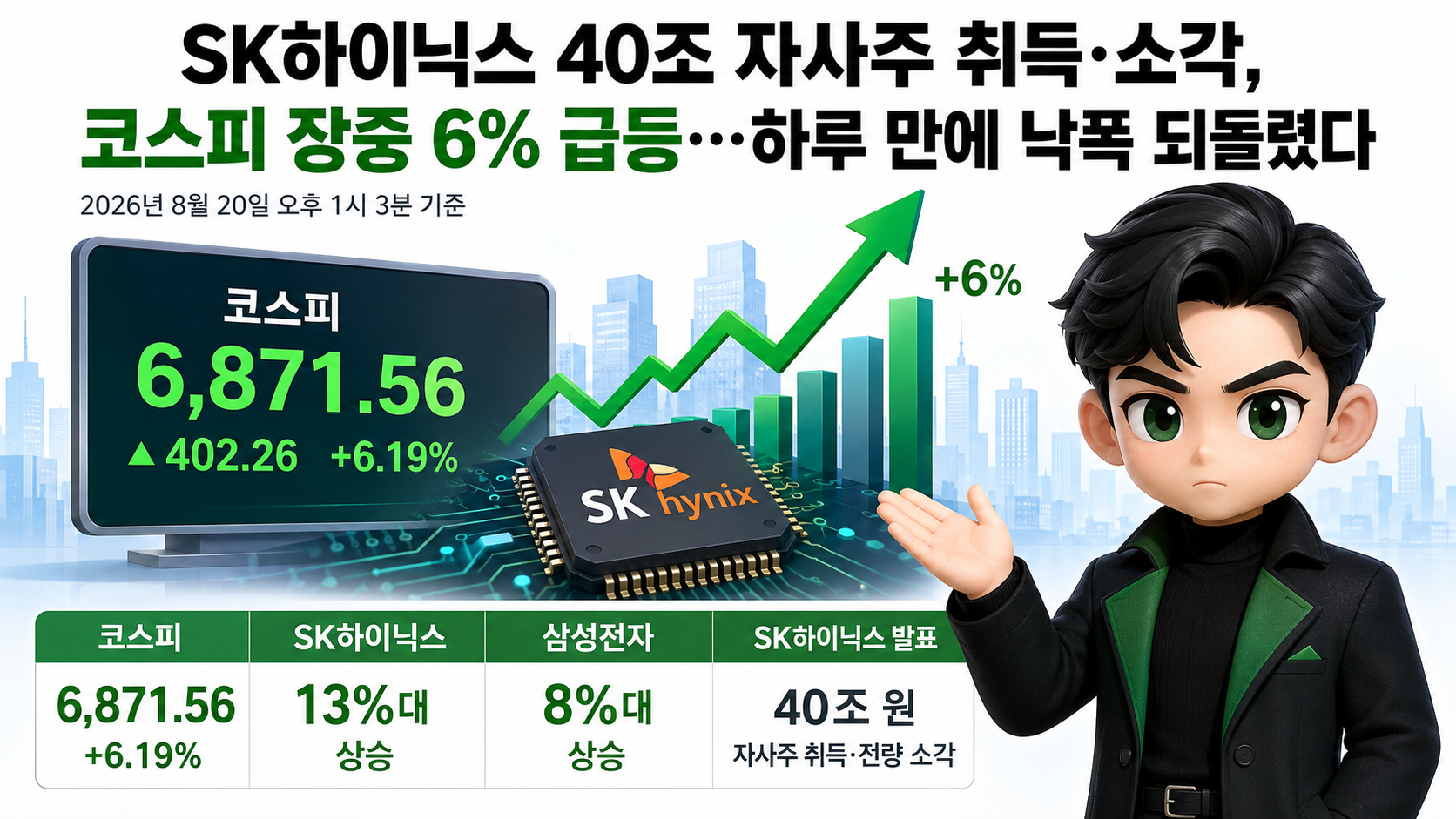
The KOSPI surged more than 6% during afternoon trading on 2026-08-20. As of 1:3 p.m., the index stood at 6,871.56, up 6.19% from the previous day. SK Hynix shares gained around 13%, while Samsung Electronics rose around 8%. The sharp rebound in major semiconductor stocks coincided with SK Hynix's plan to acquire treasury shares worth KRW 40,000,000,000,000 and cancel all of them, announced after the previous day's market close.
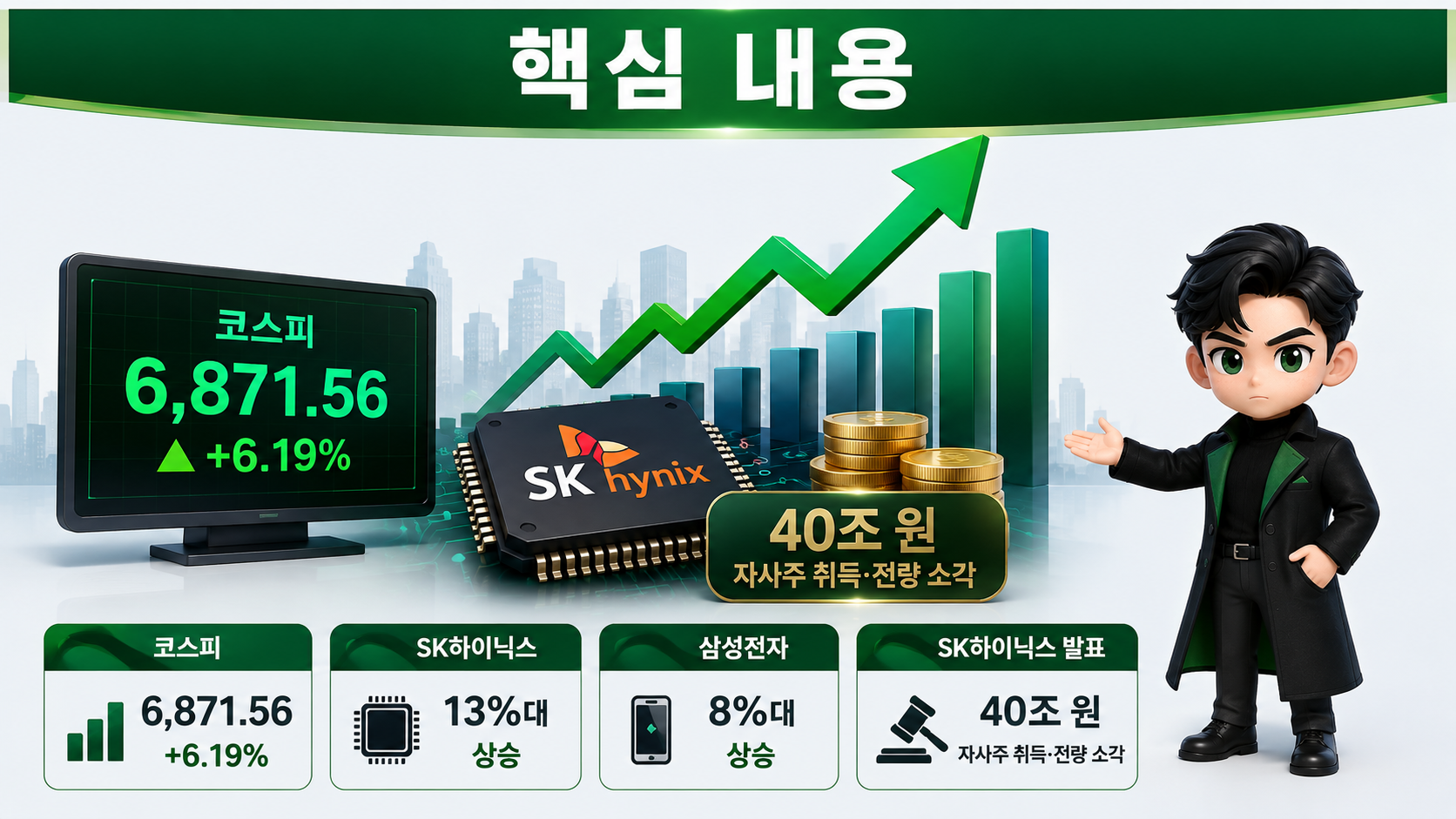
However, it would be difficult to attribute the KOSPI's rise solely to SK Hynix's share buyback. Several factors converged, including easing interest-rate pressure as long-term U.S. Treasury yields declined and net buying by foreign and institutional investors in the Korean stock market.
The information was verified as of 2026-08-20 at 1:35 p.m. Korea time. Intraday figures are not closing prices.
What Is SK Hynix's KRW 40,000,000,000,000 Share Buyback Plan?
On August 19, SK Hynix's board of directors approved a plan to acquire treasury shares worth KRW 40,000,000,000,000 and subsequently cancel all of them. The purchases will take place over approximately 3 months beginning August 20, and the company plans to cancel every share acquired once the buyback is completed.
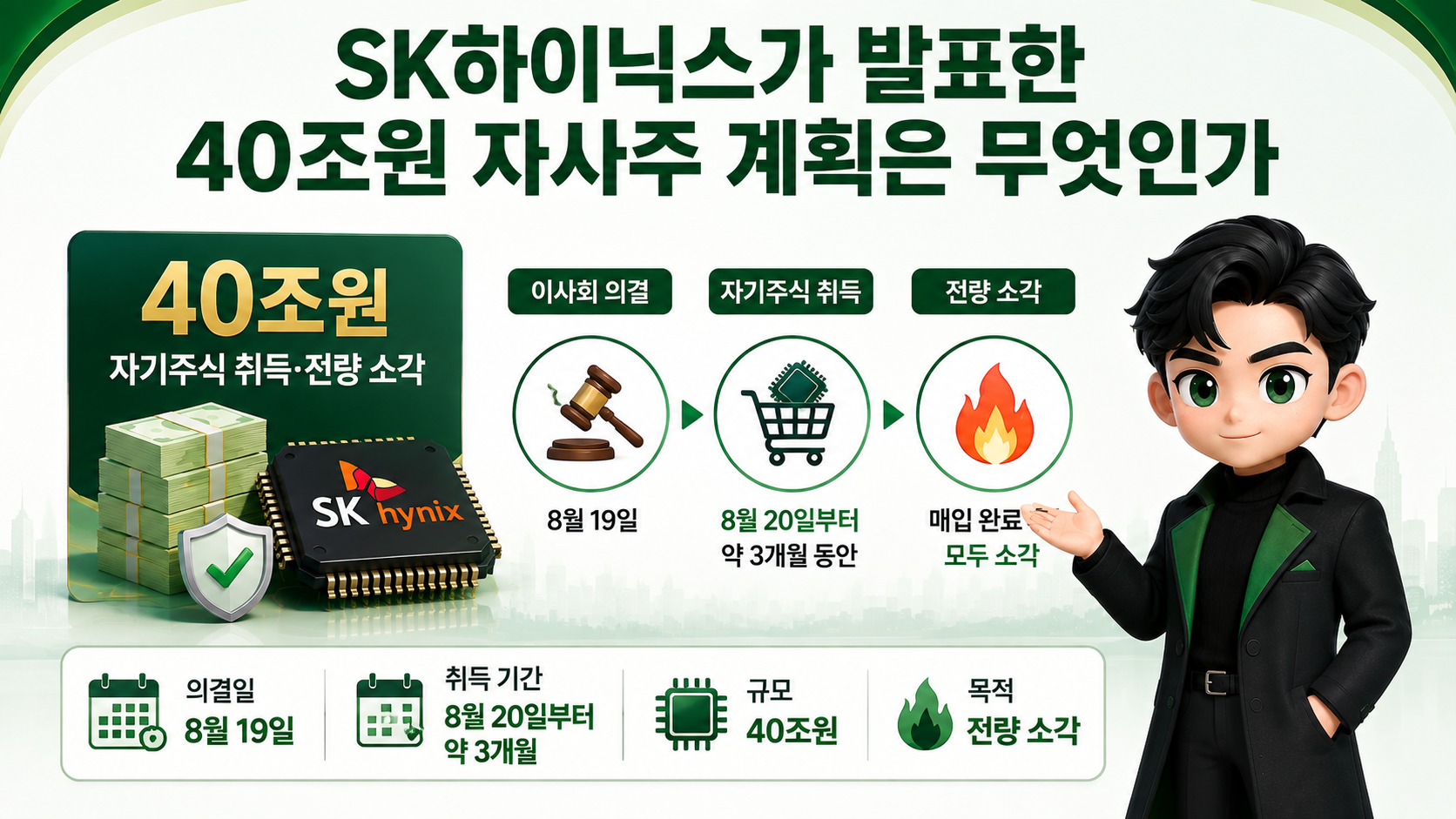
The planned purchase covers approximately 2,407 ten-thousand shares. The estimated amount is based on the closing price of KRW 1,662,000 per share on the day before the board resolution. It represents approximately 3.3% of the company's total 7 hundred million 3,049 ten-thousand 2,365 issued shares.
It is important to distinguish between a share buyback and share cancellation. A share buyback occurs when a company purchases its own shares in the market, while cancellation eliminates those shares and reduces the total number of issued shares. Under this plan, SK Hynix will not continue holding the repurchased shares. Instead, all acquired shares will be canceled.
SK Hynix also revised its existing shareholder return policy. Previously, the company planned to allocate 'up to 50%' of cumulative free cash flow (FCF) generated from 2025 to 2027 to shareholder returns. It has now proposed expanding that commitment to 'at least 50%'. Free cash flow refers to the cash a company retains after covering its operating needs and necessary investments.
The company also announced plans to combine cash dividends with share buybacks and cancellations, while considering additional shareholder returns, including regular and special dividends. The specific amounts and implementation methods will be disclosed following future board approval procedures.
How Much Did the KOSPI Actually Rise?
At 1:3 p.m. on August 20, the KOSPI stood at 6,871.56, up 400.39 points, or 6.19%, from the previous trading session. The index opened at 6,680.34, up 3.23%, before extending its gains during the session.
A buy-side trading sidecar was also triggered in the morning following a sharp increase in KOSPI 200 futures prices. A buy-side sidecar temporarily suspends the effectiveness of program buy orders to prevent rapid movements in the futures market from spreading too quickly to program trading in the cash market.
Major semiconductor stocks led the market. Around 1 p.m., SK Hynix was up approximately 13% from the previous day, while Samsung Electronics had gained about 8%. The electrical and electronics sector rose more than 9%.
At the same time, foreign investors were net buyers of approximately KRW 1,370,100,000,000 in the KOSPI market, while institutions purchased a net KRW 342,400,000,000. Individual investors, meanwhile, were net sellers of approximately KRW 2,415,900,000,000.
Not every part of the KOSPI rose by the same magnitude. Semiconductor stocks and some major large-cap companies recorded substantial gains, but certain sectors, including textiles and apparel and transportation and warehousing, weakened during the session. Interpreting the index's 6%-range gain as evidence that every stock surged would misrepresent the actual market movements.
Compared With the Previous Day's 5.8% Plunge, the Market Recovered Almost Everything in Just One Day
The rebound appears particularly dramatic because of the previous day's losses. On August 19, the KOSPI closed at 6,471.17, down 398.66 points, or 5.80%, from the preceding trading session.
The closing level on August 18 was 6,869.83.
According to the author's calculation, comparing the KOSPI's 6,871.56 level at 1:3 p.m. on August 20 with the August 18 closing level of 6,869.83 reveals a difference of just 1.73 points.
The calculation is as follows.
6,471.17 + 398.66 = 6,869.83
6,871.56 - 6,869.83 = 1.73
In other words, after plunging 5.80% the previous day, the index rebounded 6.19% intraday the following day, effectively returning to its level immediately before the previous day's decline, based on the index level alone.
The reason the 5.80% decline and 6.19% increase differ is that they are calculated from different starting points. If 100 falls by 5.8%, it becomes 94.2. For 94.2 to return to 100, it must rise by approximately 6.16%. Even when an index falls and then recovers by the same number of points, the percentage decline and percentage increase are not identical.
In a market experiencing large daily swings like this one, assuming that 'a 5.8% decline yesterday followed by a 5.8% increase today means a full recovery' can produce a result that differs from the actual index level.
KRW 40,000,000,000,000 Does Not Mean That Amount of Money Enters the Market in a Single Day
The headline figure of a 'KRW 40,000,000,000,000 share buyback' could easily lead investors to assume that KRW 40,000,000,000,000 will be injected into the stock market during August 20 alone. However, that is not what the announcement says. The purchase period runs for approximately 3 months beginning August 20.
KRW 40,000,000,000,000 represents the total planned acquisition amount. The company intends to repurchase its shares over the designated period and cancel them once the acquisition process is complete.
Furthermore, the KRW 40,000,000,000,000 figure was calculated using approximately 2,407 ten-thousand shares at KRW 1,662,000 per share, the closing price on the day before the board resolution. Because share prices fluctuate throughout the actual market purchases, the final acquisition results cannot be determined in advance simply by dividing 'KRW 40,000,000,000,000 by the current share price.'
The confirmed details are that the planned acquisition amount is KRW 40,000,000,000,000, the expected purchase volume is approximately 2,407 ten-thousand shares, the volume represents about 3.3% of issued shares, and all acquired shares will be canceled.
Why the KOSPI Surge Cannot Be Explained by the Buyback Announcement Alone
Although SK Hynix's announcement was among the most closely watched developments in the Korean stock market that day, it would be difficult to attribute the KOSPI's 6%-range increase to a single event.
Long-term U.S. Treasury yields declined overnight. After the U.S. Treasury announced plans to expand its repurchases of longer-dated government bonds, long-term yields retreated from their sharp increase the previous day. Major U.S. stock indexes also closed higher.
Rising Treasury yields had been cited as one of the pressures contributing to the previous day's plunge in Korean stocks. The reversal in yields therefore changed the broader market environment for Korean equities on 20.
In Korea, Samsung Electronics surged alongside SK Hynix. As of 11:20 a.m., Samsung Electronics had risen 8.99%, SK Hynix had gained 12.27%, and the KOSPI stood at 6,872.61, up 6.20%. Both semiconductor giants continued to show strength around 1 p.m.
Ultimately, the intraday market movements on 20 are more accurately understood as the combined result of SK Hynix's major shareholder return announcement, a semiconductor rally extending to Samsung Electronics, declining long-term U.S. interest rates, and net buying by foreign and institutional investors.
Why Share Cancellation Matters to Shareholders
When a company repurchases its shares and actually cancels them, the number of issued shares is reduced. The approximately 2,407 ten-thousand shares scheduled for cancellation represent about 3.3% of SK Hynix's total issued shares.
However, investors should not assume that 'canceling 3.3% of shares guarantees an equivalent increase in the share price.' Stock prices reflect numerous factors simultaneously, including corporate earnings, memory chip prices, demand for AI investment, interest rates, investor flows, and market valuations.
The most important change to examine in this announcement is the scale and structure of the shareholder return policy rather than short-term share price movements. Previously, the company aimed to return up to 50% of cumulative FCF generated from 2025 to 2027. It has now proposed raising that target to at least 50%.
SK Hynix reported net cash of approximately KRW 69,000,000,000,000 at the end of the 2 quarter of 2026. The company plans to pursue both share buybacks and cancellations and cash dividends, supported by its cash generation capabilities and financial position.
Not all additional shareholder returns have been finalized. Special dividends remain under consideration, and the specific scale and methods of further shareholder returns will be announced after subsequent board approval.
What Matters Next Is Actual Execution, Not Just the Intraday Gain
The most significant developments confirmed by the afternoon of August 20 were that the KOSPI had recovered almost all of the previous day's sharp losses during intraday trading and that SK Hynix had begun implementing its KRW 40,000,000,000,000 share buyback and cancellation plan.
Three developments should be monitored separately. First, how much of the planned share repurchase is actually completed during the approximately 3-month acquisition period. Second, how the company carries out its commitment to cancel all acquired shares after the purchases are completed. Third, whether the scale of additional shareholder returns is finalized during the 3-quarter earnings announcement process.
Investors should also check the final closing price on August 20, rather than relying solely on morning or 1 p.m. figures. The 6.19% gain, 6,871.56 index level, and approximately 13% rise in SK Hynix shares cited in this article are all intraday figures and may differ from the final market close.
Given the sharp declines and gains occurring within just one day, investors should avoid interpreting the announcement as 'KRW 40,000,000,000,000 announced = further gains guaranteed.' Instead, they should separately verify the actual progress of the share repurchases and the dividend and cancellation plans the company discloses in the future.
Stock market investments carry the risk of losing principal, and future share price movements cannot be determined solely from intraday prices or corporate shareholder return announcements.
※ This article is provided for informational purposes to help readers understand market developments and does not constitute investment advice or a recommendation to buy any particular stock or asset. All final investment decisions and responsibilities rest with the individual investor.