

How Much Do Tax Benefits Decrease If You Buy Overseas ETFs in an ISA or Pension Savings Account While Holding an RIA Account?
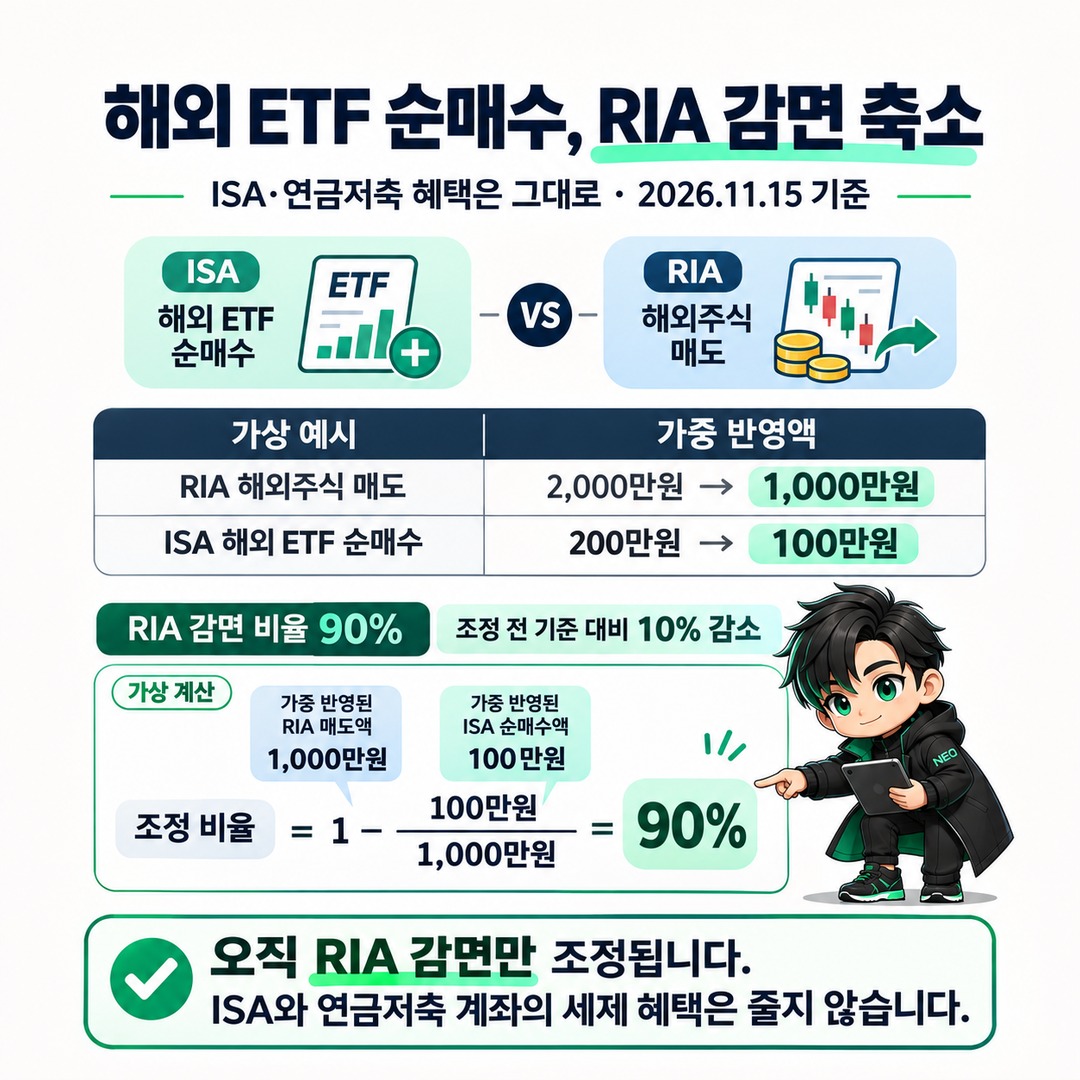
As of 2026-11-15, if you use an RIA (Domestic Market Return Account) and make net purchases of overseas stocks or overseas-investment ETFs through other financial accounts, such as an ISA, pension savings account, or general account, the RIA’s capital gains tax relief for overseas stocks decreases in proportion to the net purchase amount. The tax benefits of the ISA or pension savings account itself are not reduced. The key is the ratio between how much overseas investment you net-purchase in other accounts and how many overseas stocks you sell through the RIA.
In particular, for transactions after 2026-01-01, purchases made before opening the RIA are also included in the calculation. So opening an RIA later does not exclude overseas investment products purchased earlier through an ISA or general account.
1. Which tax benefit decreases if you buy overseas stocks in another account?
What decreases is not the tax-exempt or tax-deferral benefit of an ISA or pension savings account, but the deduction from overseas stock capital gains income available through the RIA.
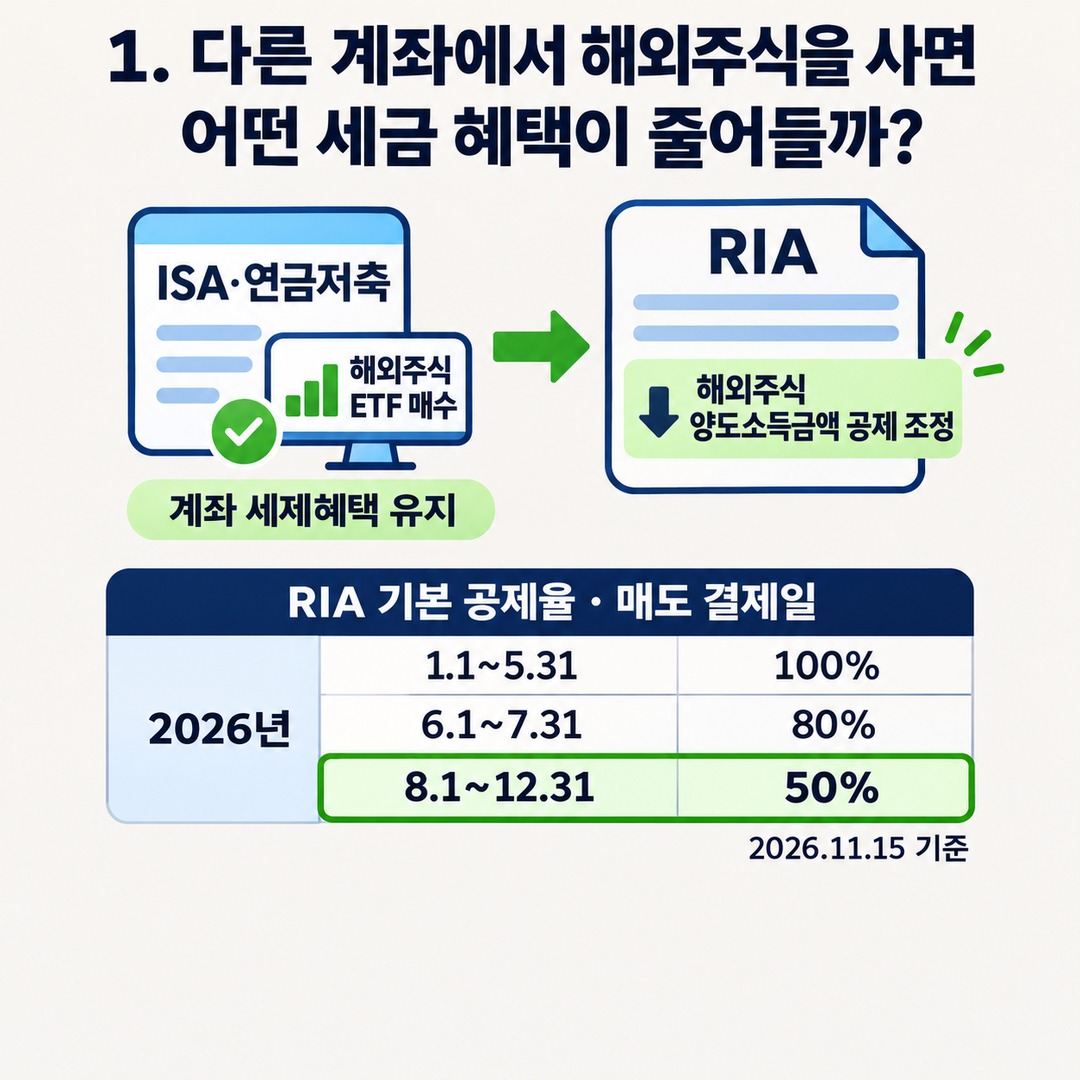
The RIA is a program that provides capital gains tax relief for overseas stocks, provided that overseas stocks held before 2025-12-23 are transferred into a dedicated account and sold, and the sale proceeds are invested in domestic stocks or domestic stock funds, among other eligible investments.
For overseas stocks sold by 2026-12-31, the deduction rate varies depending on when settlement of the sale occurs.
| Overseas stock sale settlement date | Base deduction rate |
|---|---|
| 2026-01-01~May 31 | 100% |
| 2026-06-01~July 31 | 80% |
| 2026-08-01~December 31 | 50% |
For RIA transactions with sale settlements taking place as of 2026-11-15, the base deduction rate of 50% generally applies.
This rate is before adjustment for net purchases of overseas investments in other accounts.
The relevant rules can be found in Article 91(26) of the Restriction of Special Taxation Act and in Mirae Asset Securities’ RIA Key Information Document.
2. Does it matter whether I buy through an ISA, pension savings account, or general account?
If you make net purchases of overseas stock substitute assets in accounts outside the RIA, the RIA tax relief may be adjusted regardless of the account type or financial institution.
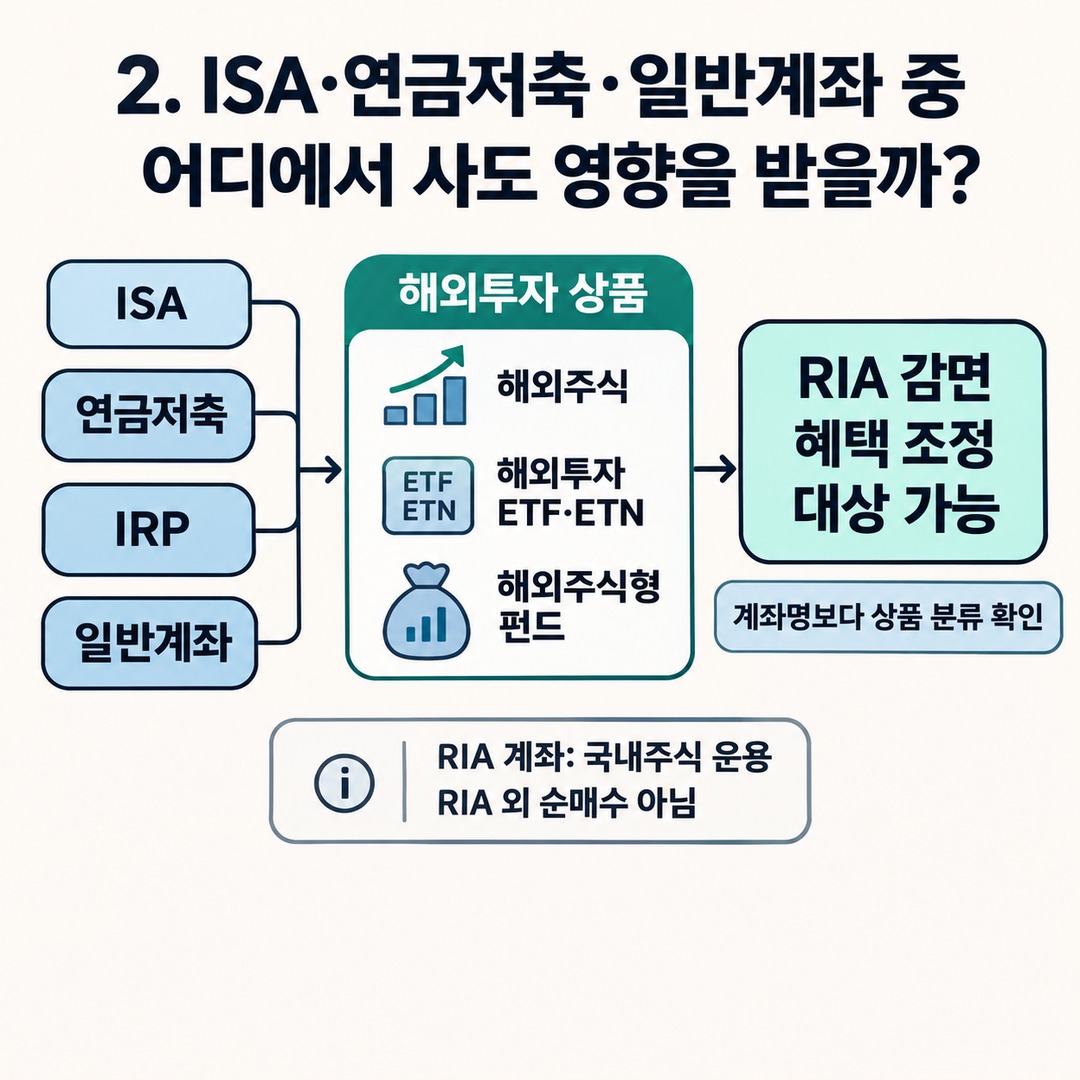
| Account type | Example of overseas investment purchase | RIA benefit adjustment |
|---|---|---|
| ISA | U.S. or overseas index ETFs listed in Korea | Applies |
| Pension savings account | Overseas stock ETFs listed in Korea | Applies |
| IRP | Eligible overseas investment ETFs | Applies |
| General account | Stocks listed on U.S. or overseas exchanges | Applies |
| General account | Overseas investment ETFs or ETNs listed in Korea | Applies |
| General account | Overseas stock fund meeting the applicable criteria | Applies |
| RIA account | Investment in domestic stocks and domestic stock products | Not counted as a net purchase outside the RIA |
There is an important point to keep in mind here.
Buying individual stocks listed on U.S. exchanges directly through an ISA or pension savings account is different from buying a U.S. index ETF listed on the Korean market.
In general, ISAs and pension savings accounts are used to invest through overseas investment ETFs or funds listed in Korea, rather than by directly buying individual stocks listed on overseas exchanges.
So what needs to be checked in practice is the product’s legal classification, not the account name.
KB Securities’ RIA tax benefit notice issued in 2026 also includes the following products among those deducted:
Stocks, DRs, ETFs, and ETNs listed on overseas exchanges
Overseas investment ETFs and ETNs established or issued in Korea
Overseas stock funds with an overseas-listed stock investment share that meets a specified threshold
In particular, depending on the product structure, an overseas investment ETF listed in Korea may be subject to deduction even if its share of overseas stocks is below 60%. Do not confuse the 60% threshold for overseas stock funds with the criteria for overseas investment ETFs established in Korea.
Product-specific determinations can be checked in KB Securities’ RIA tax benefit notice.
3. How is the reduction in RIA tax benefits calculated?
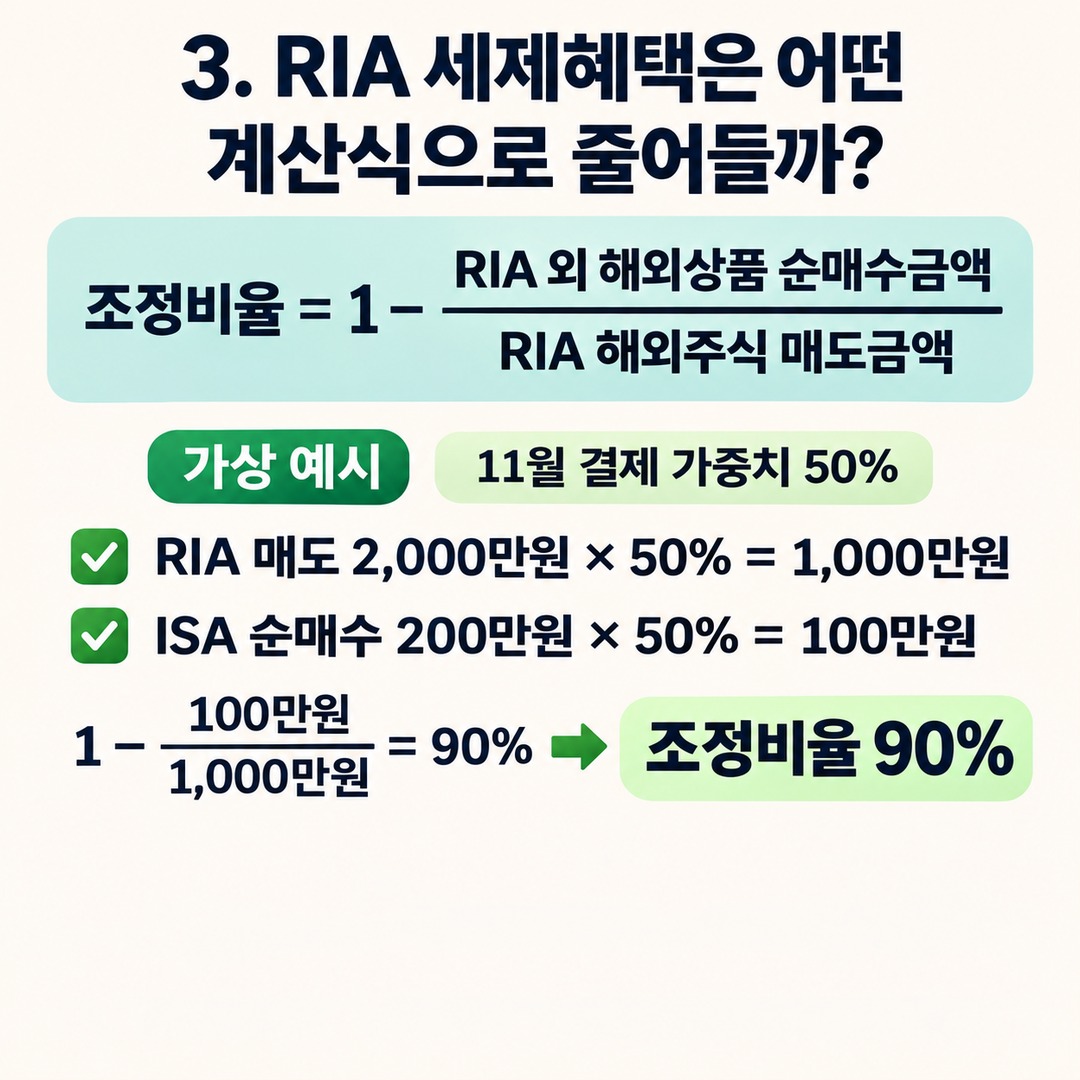
The key is to compare the net purchase amount of overseas investments in accounts outside the RIA with the amount of overseas stocks sold through the RIA account.
Mirae Asset Securities’ RIA guide gives the following adjustment ratio:
Adjustment ratio = 1 − (net purchase amount of overseas products in accounts outside the RIA / amount of overseas stocks sold through the RIA account). The important point is that this is not calculated simply by adding up the amounts purchased during 1.
Transactions in 2026 are weighted according to their settlement date.
| Settlement period | Weight applied to purchase and sale amounts |
|---|---|
| 1~May | 100% |
| 6~July | 80% |
| 8~December | 50% |
Therefore, an overseas investment ETF purchase of KRW 10,000,000 made on November is counted as KRW 5,000,000 for calculation purposes.
Even for the same KRW 10,000,000, its effect on the RIA tax relief differs depending on whether it was purchased on May or November.
How much would the benefit decrease in a calculation using actual amounts?
The following is a hypothetical example to illustrate how the calculation works.
Assumptions
Sale settlement in the RIA account for November 2026 overseas stocks sold for KRW 20,000,000
Net purchase of KRW 2,000,000 in overseas investment ETFs through an ISA for November 2026
No net purchases of overseas products in other financial accounts
Both transactions settle during 8~December
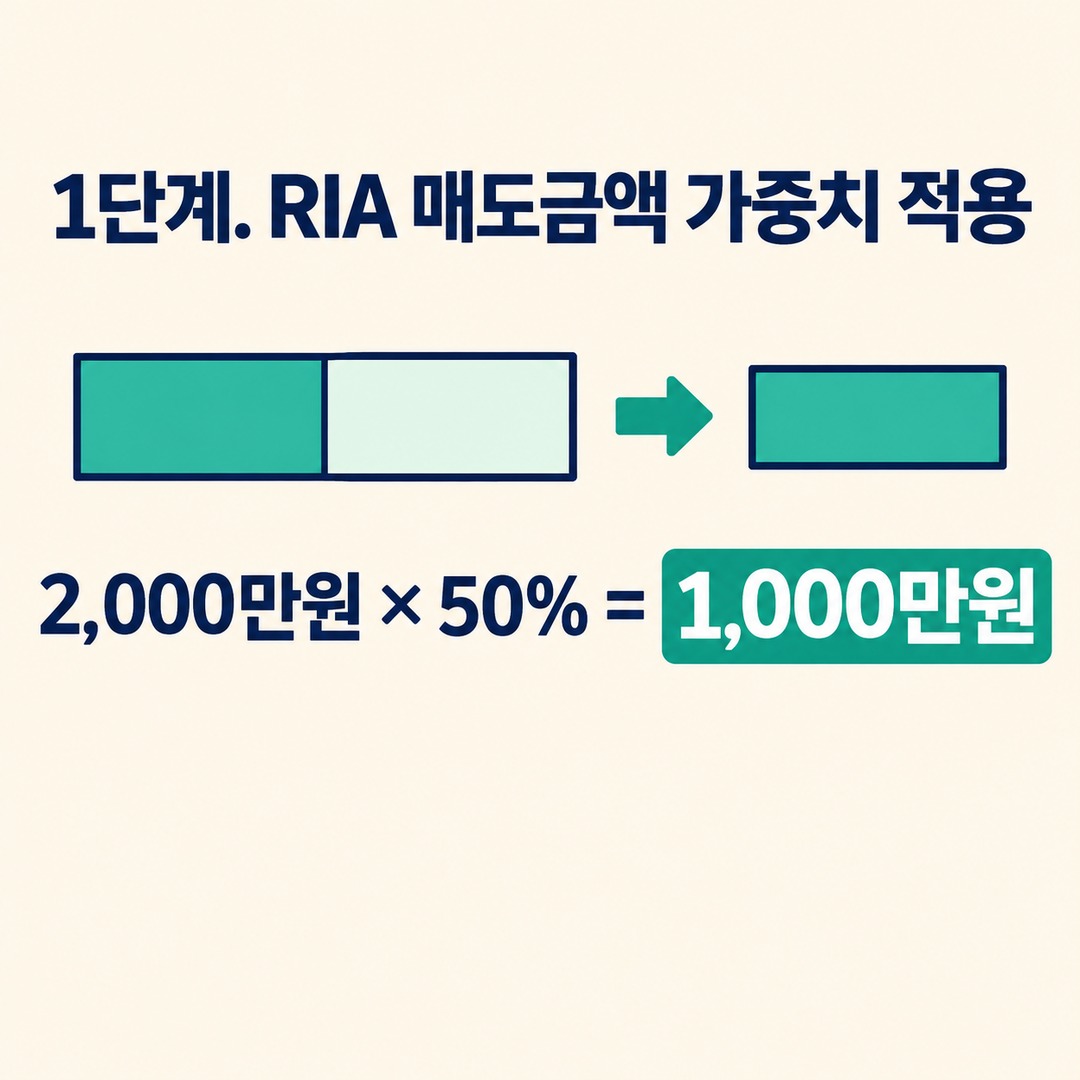
Step 1: Apply the weighting to the RIA sale amount
KRW 20,000,000 × 50% = KRW 10,000,000
Step 2: Apply the weighting to the ISA net purchase amount
KRW 2,000,000 × 50% = KRW 1,000,000
Step 3: Calculate the adjustment ratio
1 − 1001,000 = 90%. The calculation shows that 90% of the original deduction available through the RIA is recognized.
In other words, under these assumptions, net-purchasing KRW 2,000,000 in overseas investment ETFs through another account reduces the RIA deduction benefit by 10%.
However, this is the percentage reduction in the RIA deduction amount; it does not mean that the actual tax payable increases by 10%.
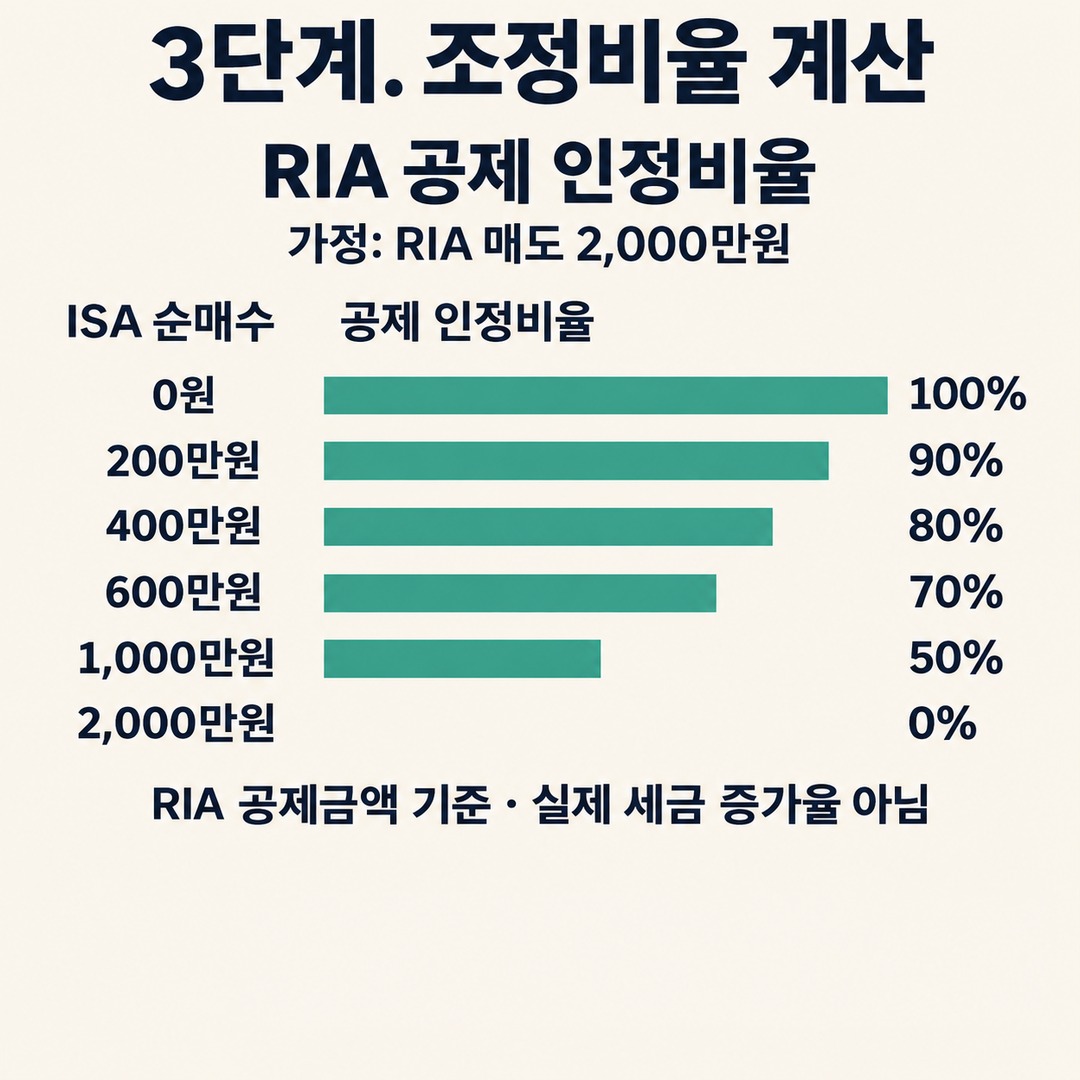
What if the purchase amount is higher?
Let’s change only the ISA net purchase amount under the same assumptions.
| ISA net purchase amount | Weighted net purchase amount | Recognized share of RIA deduction |
|---|---|---|
| KRW 0 | KRW 0 | 100% |
| KRW 2,000,000 | KRW 1,000,000 | 90% |
| KRW 4,000,000 | KRW 2,000,000 | 80% |
| KRW 6,000,000 | KRW 3,000,000 | 70% |
| KRW 10,000,000 | KRW 5,000,000 | 50% |
| KRW 20,000,000 | KRW 10,000,000 | 0% |
Author’s calculation. Assumes an RIA sale amount of KRW 20,000,000, settlement of both transactions during 8~December, and no transactions in other accounts.
The table shows that the recognized share of the RIA deduction decreases as net purchases in accounts outside the RIA increase.
When the weighted net purchase amount equals the RIA’s weighted sale amount, the calculated adjustment ratio is 0%.
Therefore, even a small purchase through an ISA can result in a larger relative reduction in benefits if the RIA sale amount is small.
4. How much difference does this make in actual tax payable?
A reduction in the deduction amount and an increase in the final tax payable should be treated as separate things.
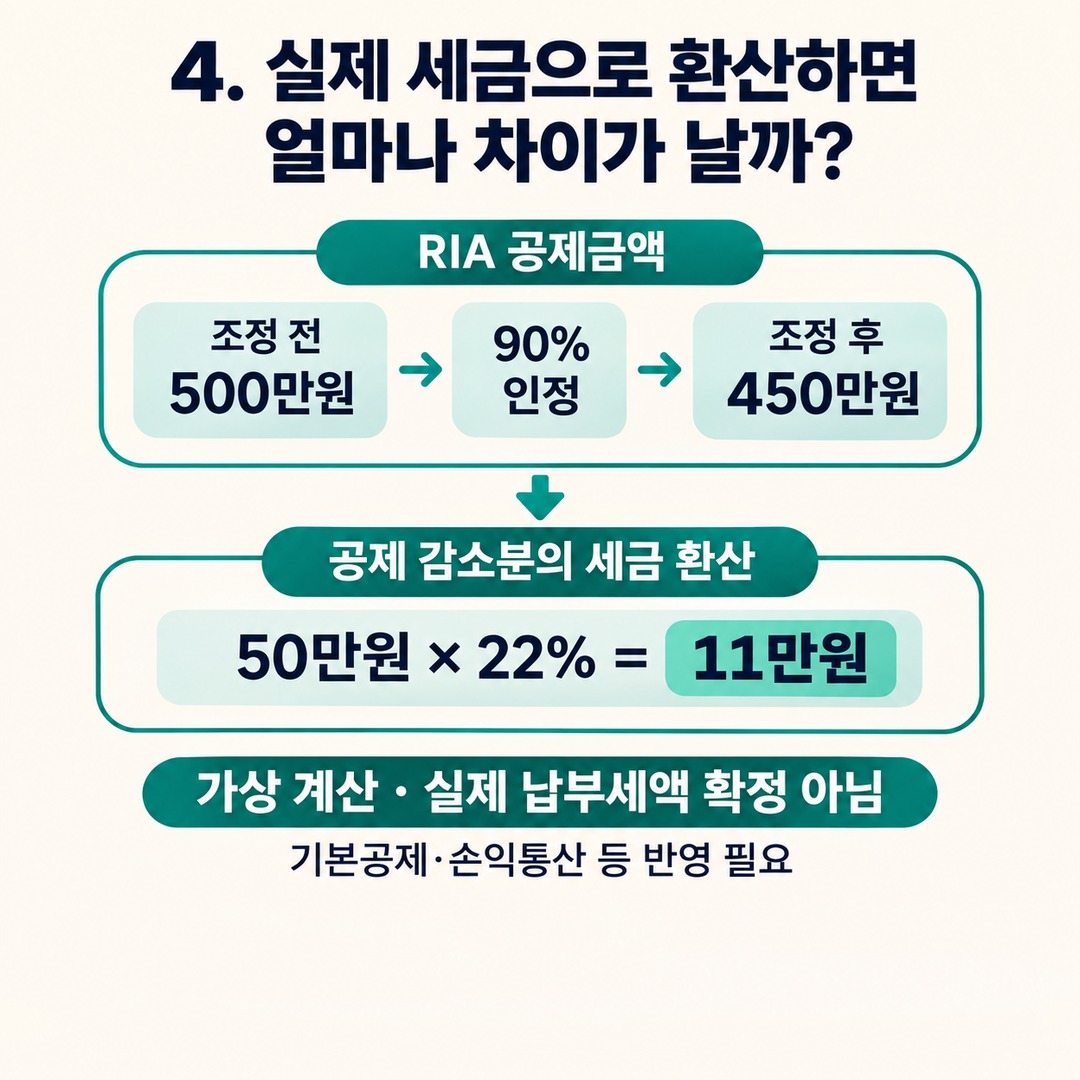
After adjusting the RIA deduction amount, the final tax is calculated by taking into account netting gains and losses on overseas stock capital gains, the basic deduction, the tax rate, and other factors.
For example, assume the following:
RIA deduction amount before adjustment: KRW 5,000,000
Adjustment ratio: 90%
RIA deduction amount after adjustment: KRW 4,500,000
Reduction in the deduction amount: KRW 500,000
Applying 22%, the combined overseas stock capital gains tax rate and local income tax rate, as a simple calculation gives:
KRW 500,000 × 22% = KRW 110,000. In other words, if all other conditions are the same and the deduction amount is actually reflected in the taxable income, the tax difference is KRW 110,000.
This is a hypothetical calculation and does not establish the actual tax payable. The basic deduction of KRW 2,500,000, netting gains and losses, and the income eligible for deduction must also be taken into account.
Therefore, it would be incorrect to calculate that buying KRW 2,000,000 in overseas ETFs means your tax will increase by KRW 440,000.
The calculation should follow this order: overseas ETF purchase amount → weighted net purchase amount → RIA deduction adjustment ratio → actual reduction in the deduction amount → final tax difference.
5. Are purchases made from January 2026 until before opening the RIA included?
Yes. This is one of the conditions investors are most likely to overlook in practice.
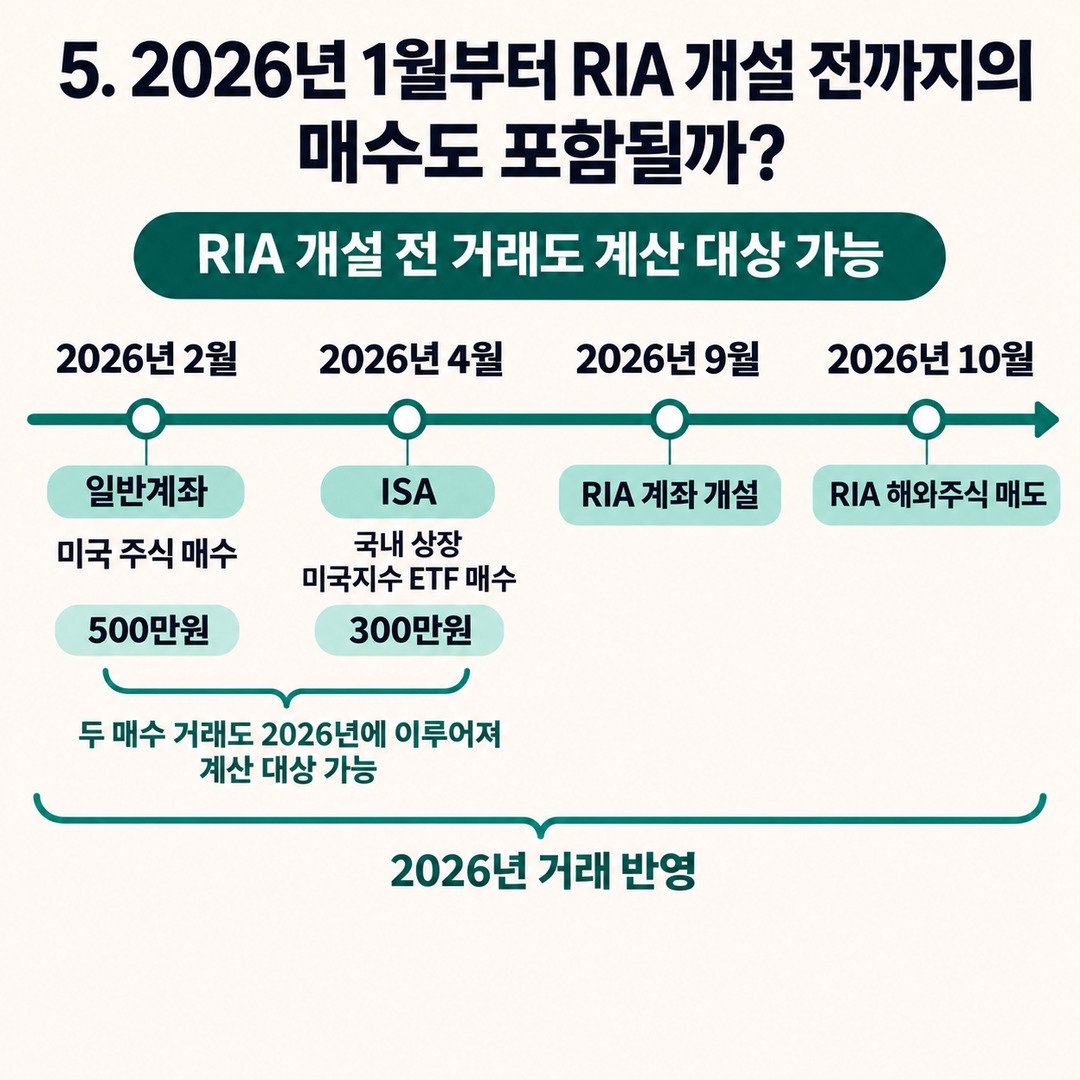
Transactions are not separated based on the RIA opening date; transactions in eligible products from 2026-01-01 through December 31 are taken into account.
For example, consider the following situation:
February 2026: Purchase of KRW 5,000,000 in U.S. stocks through a general account
April 2026: Purchase of KRW 3,000,000 in a U.S. index ETF listed in Korea through an ISA
September 2026: Open an RIA account
October 2026: Sell overseas stocks through the RIA
Transactions in February and April may be included in the calculation even if they took place before the RIA was opened, because they are transactions from 2026.
Also check the following:
1. Accounts at other securities firms are included along with accounts at the same firm.
2. Check accounts in your name at financial institutions, including banks and securities firms.
3. Automatic recurring purchases may also be included.
4. Calculate the net purchase amount by considering both purchases and sales.
5. Products acquired through inheritance or a gift during 2026 may also be included in the calculation.
In other words, it is difficult to determine the total net purchase amount accurately by checking only the transaction history at the securities firm where you opened the RIA.
In particular, if you made recurring purchases of overseas ETFs starting early in 2026, make sure you include those transactions.
6. What should you distinguish if you want to keep both an ISA and a pension savings account?
Considering the RIA tax benefit does not mean you must avoid using an ISA or pension savings account.
These two accounts have different purposes and tax structures.
ISA: An account that provides tax-exempt and separate taxation benefits on investment gains and losses within the account
Pension savings account: An account used to build retirement savings and take advantage of tax credits and tax benefits when receiving pension payments
RIA: An account that provides capital gains tax relief for overseas stocks on the condition that existing overseas stocks are brought back to the domestic market
When buying overseas investment products through another account, separately calculate the possibility that the RIA tax relief may decrease.
Use the following as a guide:
| Investment situation | What to check |
|---|---|
| Making long-term recurring purchases of overseas index ETFs through an ISA | Whether net purchases outside the RIA are included |
| Buying U.S. index ETFs through a pension savings account | Product classification and weighted net purchase amount |
| Buying additional U.S. stocks through a general account | Settlement amounts for overseas stock purchases and sales |
| Selling one overseas ETF and buying another | Net purchase amount within the same eligible asset group |
| Overseas stock purchase before opening the RIA | Whether it was a 2026 transaction and its settlement date |
The important distinction here is between domestic stock ETFs and overseas investment ETFs listed in Korea.
A typical domestic stock ETF that tracks a Korean stock index may be treated differently for RIA deduction purposes from an ETF linked to an overseas index.
Do not assume that all products are treated the same just because “ETF” appears in their name.
The final determination should be based on the product’s underlying assets, fund establishment or issuance structure, and classification as eligible for RIA deduction, rather than on its name.
7. What investors using an RIA should check as of November 15
During the remainder of 2026, it is important to check the settlement date rather than the date the purchase order was placed.
In particular, the trade execution date and settlement date may differ for U.S. stocks and overseas ETFs. Because settlement timing matters both for the RIA deduction rate and for the weighted net purchases in accounts outside the RIA, check transaction records by settlement date.
Check the following in order:
1. Gather overseas investment transaction records from all financial accounts in your name, from 2026-01-01 through the present.
2. Check whether overseas stocks, overseas investment ETFs and ETNs listed in Korea, and overseas stock funds are eligible products.
3. Subtract sales from purchases to calculate the net purchase amount.
4. Apply the 100%, 80%, and 50% weightings according to each transaction’s settlement period.
5. Apply the weighting for the relevant settlement period to the RIA overseas stock sale amount as well.
6. Compare the two amounts to determine the adjustment ratio for the RIA deduction.
If your securities firm offers a service to estimate the RIA deduction, it is a good idea to use it. Be sure to check whether transactions at other financial institutions are included in the total.
8. The key takeaway is to calculate ISA benefits and RIA benefits separately
Holding an RIA does not automatically eliminate the existing tax benefits of an ISA or pension savings account.
However, if you make net purchases of overseas investment products through those accounts, the RIA deduction for overseas stock capital gains may decrease.
The three key points of this program are:
Product classification matters more than account type. Multiple accounts in your name—including ISAs, pension savings accounts, and general accounts—may be included in the calculation.
Check transactions made before opening the RIA. Transactions from 2026-01-01 onward are included in the calculation.
Consider both the net purchase amount and the RIA sale amount. The actual tax reduction cannot be calculated from how much you bought in overseas investment products alone.
In particular, anyone whose RIA sale amount is not large but who continues to make recurring purchases of overseas ETFs through an ISA and pension savings account should first estimate the deduction they can expect.
If you want to make the most of the RIA tax benefits, the most accurate approach is to review your overseas investment transaction history through year-end 2026 across all financial institutions and ask your securities firm whether each product is subject to deduction.
※ This article is for informational purposes to help readers understand market trends and is not an investment recommendation for any particular security or asset. You are responsible for your final decisions and investments.