

KF-21 Boramae September First Delivery: What Changes from 8 Aircraft by Year-End to 40 by 2028?
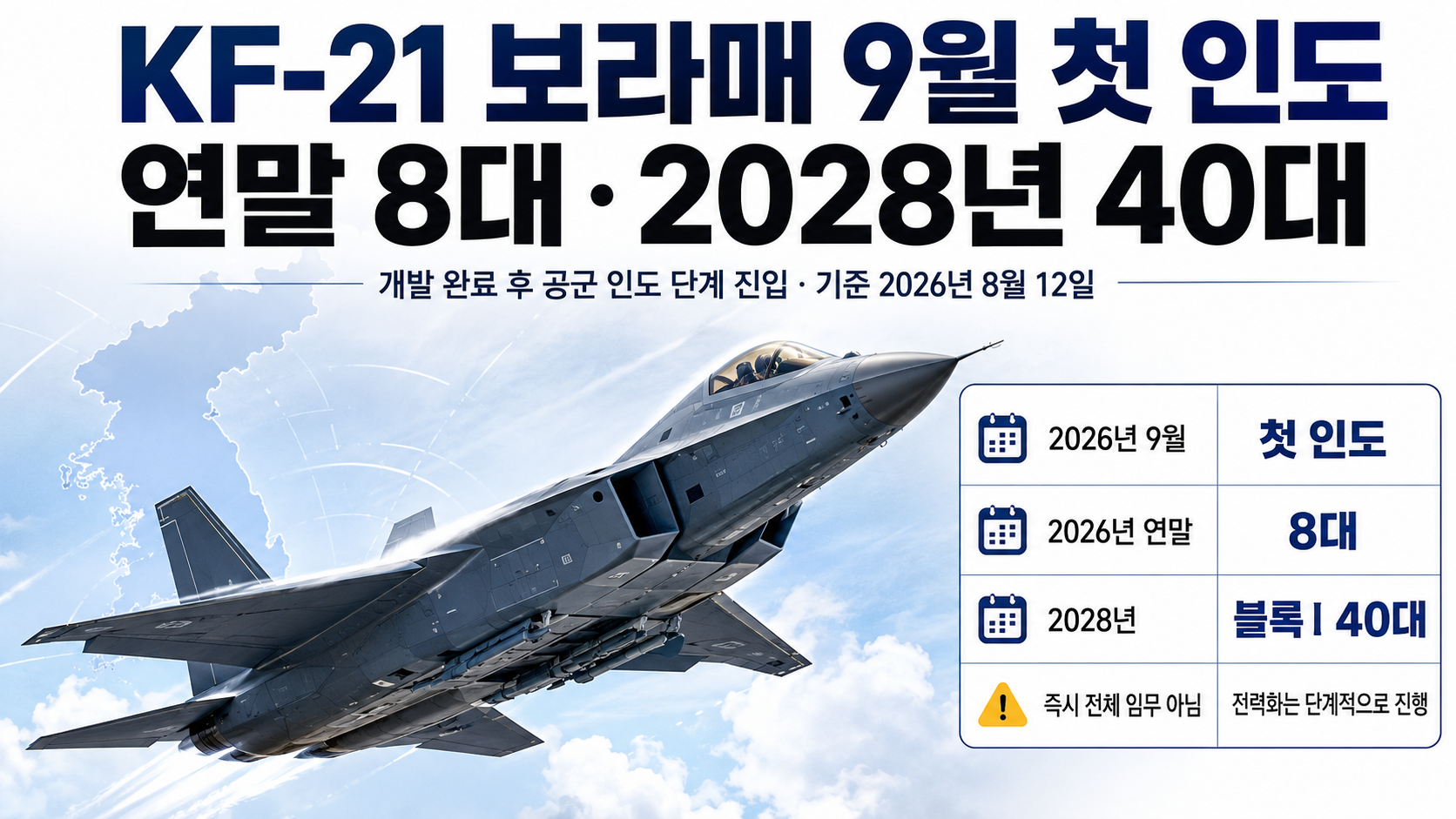
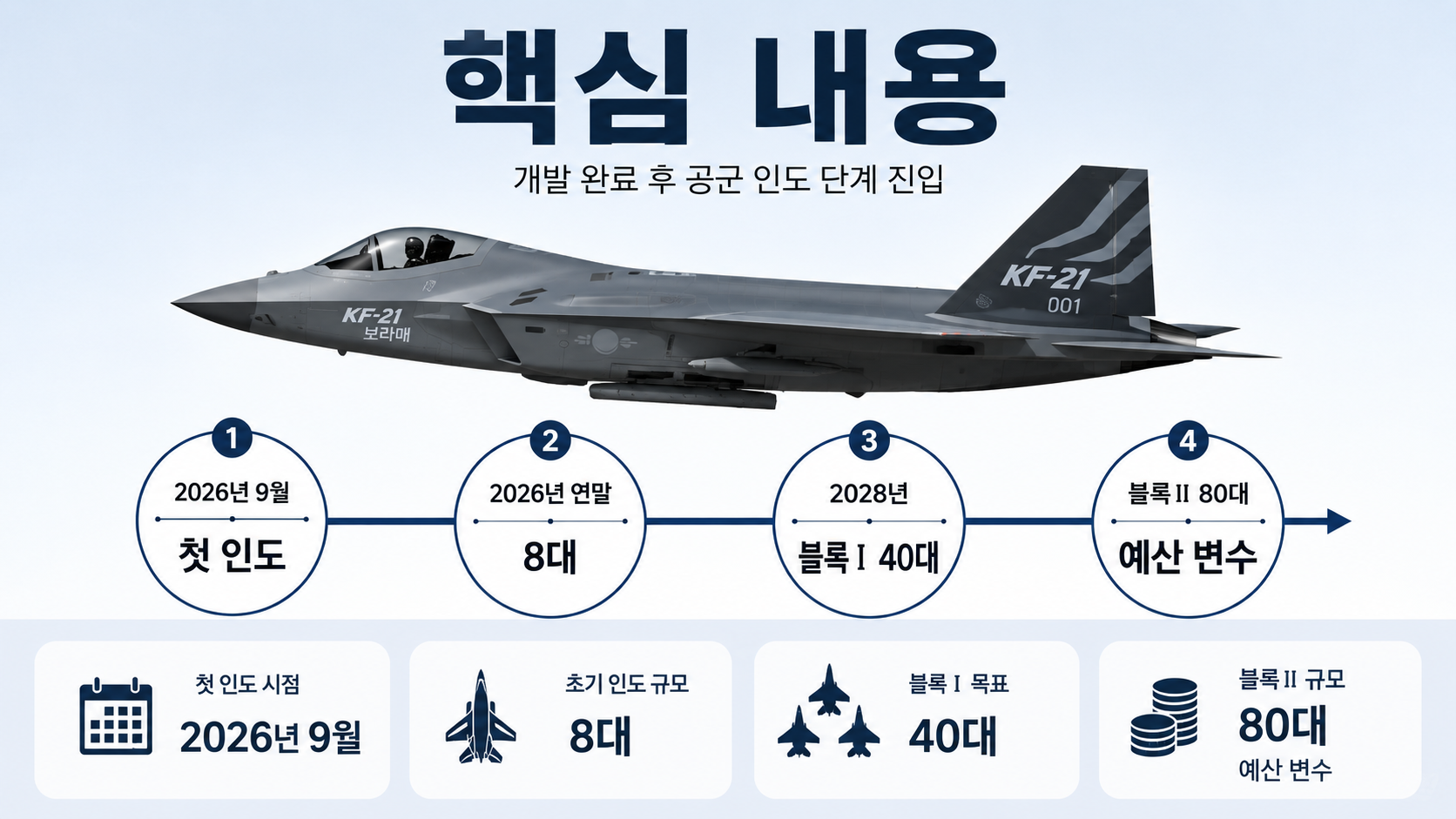
The KF-21 Boramae has completed its development phase and will move into the Air Force delivery phase starting in September 2026. Based on publicly available statements from Air Force officials and the latest reports from August 11–12, the schedule calls for the phased delivery and operational deployment of 8 aircraft by year-end and 40 Block I aircraft by 2028. However, receiving the first aircraft does not mean it can immediately perform every mission, and budget uncertainties remain a factor in the long-term schedule for 80 Block II aircraft.
Is the KF-21 Still Under Development, or Is It a Completed Fighter Aircraft?
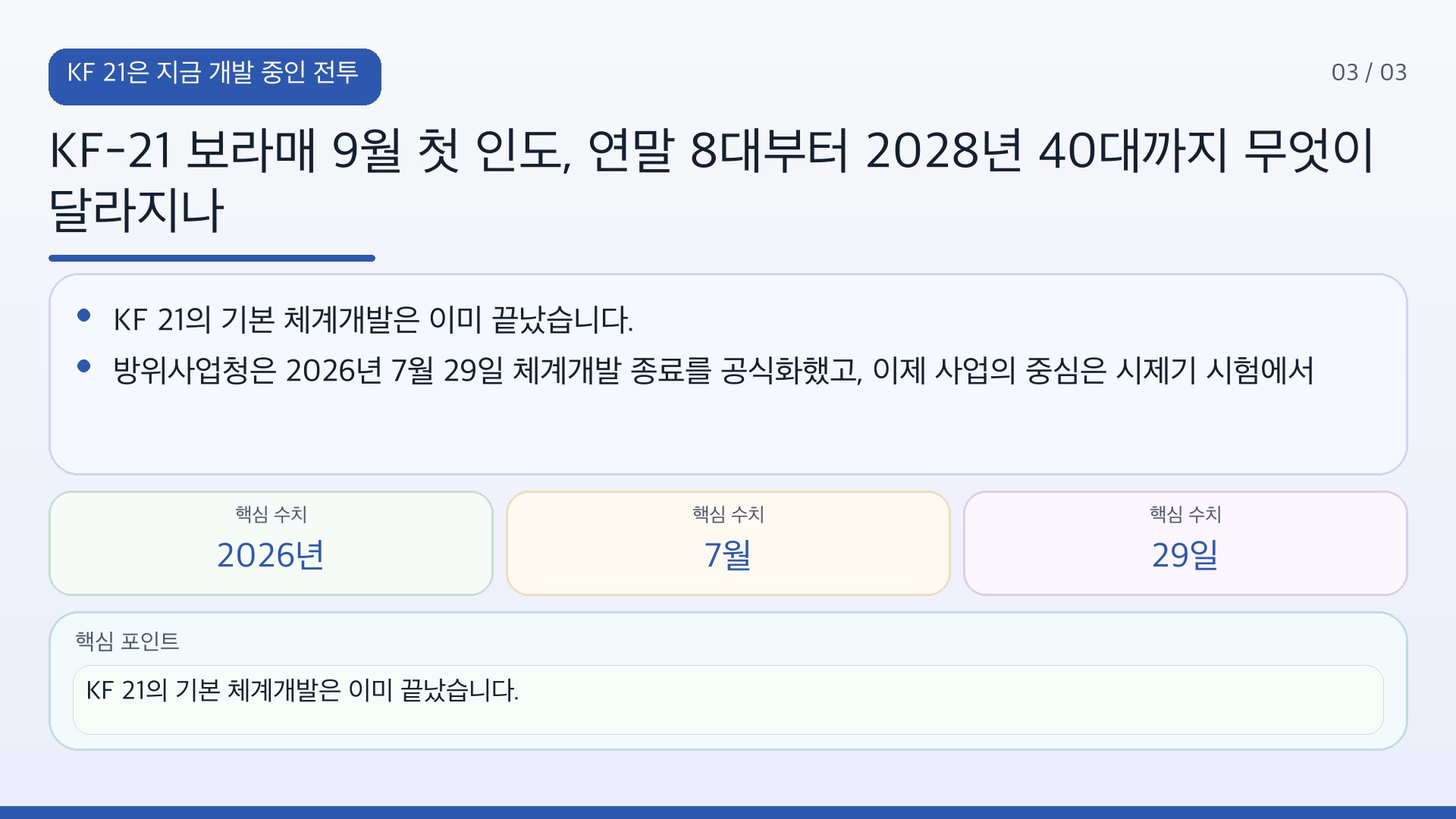
Basic system development of the KF-21 has already been completed. The Defense Acquisition Program Administration (DAPA) officially announced the completion of system development in 2026-07-29. The program's focus has now shifted from prototype testing to delivering production aircraft and putting them into Air Force service.
System development began in December 2015. Using 6 prototypes, the program conducted approximately 1,600 development test flights over roughly 42 months. After performance verification covering air-to-air weapons and aerial refueling, the aircraft received its final combat suitability determination in May 2026. According to DAPA, no accidents occurred during the development flight-test program.
Therefore, describing the KF-21 as a fighter aircraft whose development success is still uncertain does not accurately reflect its current status. A more precise description is a fighter aircraft whose basic Block I development is complete, with production, operational deployment, and subsequent capability expansion now underway.
It is also important to distinguish between 'development completed' and 'development of all capabilities completed.' The initial production Block I version focuses on air-to-air missions, while work to expand air-to-ground and air-to-ship capabilities continues under Block II.
When Exactly Will the First KF-21 Enter Air Force Service?
The most certain timeframe currently available is September 2026. When system development was completed in July 29, the official announcement anticipated delivery of the first production aircraft in the second half of the year. An Air Force official subsequently disclosed plans for delivery in late September.
However, recent reports differ on the precise date. In an interview with an Air Force official in July, the official said that the first 2 aircraft would be delivered in late September. Reports published after August 11, meanwhile, indicated a schedule for delivery of the first aircraft on September 17. As of August 12, publicly available DAPA materials do not establish September 17 as the final officially confirmed delivery date. It is therefore more accurate to distinguish between 'first delivery in September' and 'the September 17 schedule reported recently.'
The year-end quantity is relatively consistent. Both statements from Air Force officials and recent reports indicate 8 aircraft by the end of 2026.
According to the author's calculation, if 8 aircraft are delivered by year-end as planned, 20% of the initial 40 Block I production aircraft will have been transferred to the Air Force within 2026.
8 aircraft ÷ 40 aircraft × 100 = 20%
However, 'delivery' should not be confused with 'full operational deployment.' After receiving the aircraft, the Air Force must continue pilot conversion training, establish maintenance systems, familiarize personnel with operating procedures, and prepare individual units for their missions. A fighter aircraft is not equipment whose full operational capability becomes available immediately upon handover, as though someone had simply received the keys to a car.
What Missions Will the Initial Block I Aircraft Perform?
The 40 aircraft scheduled for acquisition by 2028 are KF-21 Block I fighters prioritizing air-to-air missions. Their ability to detect hostile aircraft and conduct aerial combat will enter service first, while broader multirole capabilities for attacking ground targets will be expanded under Block II.
One of the principal long-range air-to-air weapons is the Meteor missile. Its manufacturer explains that the KF-21 carried Meteor missiles from its first flight in 2022 and subsequently underwent separation tests and live-firing tests as part of the integration process. A production contract has also been concluded to supply operational missiles in time for the initial KF-21 deployment period. MBDA Systems
A domestic contract has been signed to acquire 100 Meteor missiles. Reports in August 12 indicated that 14 of those missiles would first arrive in South Korea in September 14, ahead of delivery of the first KF-21 aircraft. Because the specific arrival date for the 14 missiles comes from recent reporting, any subsequent schedule changes should be monitored separately.
IRIS-T family weapons will be used for short-range aerial combat. Ultimately, Block I should not be understood as an 'early version without weapons,' but rather as the phase in which air-combat capabilities are completed and deployed first.
Is the KF-21 a Stealth Fighter Like the F-35?
It would be inaccurate to describe the KF-21 Block I currently entering Air Force service as a fully developed 5-generation stealth fighter equivalent to the F-35. The KF-21 is currently classified as a 4.5-generation-class fighter, with a design that allows for further improvements to its stealth characteristics through future upgrades.
Although its external appearance shares many features with stealth fighters, the aircraft currently carries its weapons externally. Having a low-observable shape and potential for future upgrades is not the same as being a fully stealth-capable fighter designed around internal weapons bays.
The central change in Block II is also better understood as an expansion of multirole capabilities rather than a transition to full stealth capability. While Block I prioritizes aerial combat, Block II is planned to integrate a wider range of ground-attack weapons, including JDAM-series precision-guided bombs, KGGB, and long-range air-to-ground weapons.
Therefore, when considering the KF-21's fighter-generation classification, it is important to distinguish between 'the capabilities of the current Block I' and 'potential future upgrades.'
Does 'Domestically Developed Fighter' Mean 100% of Its Components Are Made in South Korea?
No. Calling the KF-21 a domestically developed fighter does not mean every component is manufactured in South Korea. Rather, it means South Korea has secured its own fighter platform by taking the lead in aircraft design and systems integration. Some components and technologies, including the engine, rely on overseas supply chains. NewsPim
At the same time, domestic capabilities have been developed in airframe design, flight-control software, systems integration, major avionics fields including AESA radar, and the production and maintenance infrastructure. This is the most significant difference between the KF-21 program and simply purchasing completed fighter aircraft from overseas. NewsPim
This distinction will become increasingly important. Owning an indigenous platform makes it relatively easier to retain development leadership when integrating new domestically developed weapons, sensors, and data links or improving aircraft performance. The Air Force has also explained that the significance of deploying the KF-21 goes beyond simply increasing fighter numbers. It involves establishing an airpower platform that brings together weapons, maintenance, training, and software upgrades.
In other words, 'complete domestic production' and 'securing the capability to develop a domestic fighter aircraft' are different claims. The significance of the KF-21 lies in the latter.
Will the Plans for 40 Aircraft by 2028 and 120 by 2032 Stay on Track?
The current baseline plan calls for 40 Block I aircraft by 2028, followed by 80 additional Block II aircraft, bringing the total to 120 by 2032. An Air Force official presented the same phased quantities in an interview in July.
However, the overall schedule for 120 aircraft carries greater uncertainty than the plan for 40 Block I aircraft. The main reason is that the projected cost of the follow-on Block II production program has increased substantially beyond earlier expectations.
As of 2024, the cost required for follow-on production of 80 aircraft was estimated at KRW 14,244,000,000,000. However, a total program cost review by the Korea Institute for Defense Analyses in 2026 found that KRW 18,442,200,000,000 would be required. The difference is KRW 4,198,200,000,000.
According to the author's calculation:
(KRW 18,442,200,000,000 - KRW 14,244,000,000,000) ÷ KRW 14,244,000,000,000 × 100
= an increase of approximately 29.5%.
However, KRW 18,442,200,000,000 should not simply be divided by 80 and described as the 'price of one KF-21.' The follow-on production program budget reflects various costs within the program's scope, including weapons and systems integration in addition to aircraft manufacturing. It is therefore not equivalent to the straightforward purchase price of a single fighter. Inflation, exchange rates, supply-chain factors, and expanded air-to-ground weapons capabilities have been cited as contributors to the cost increase.
In May, concerns were also raised that budget pressures could delay the operational deployment of the follow-on 80 aircraft by 2–3 years. However, this was a potential adjustment under consideration at the time and does not mean a postponement to 2034–2035 has been finally confirmed. Air Force deployment explanations released after July continued to present the plan for 40 aircraft by 2028 and 120 by 2032.
The figures worth monitoring therefore go beyond simply asking when the first KF-21 will arrive. It is necessary to track whether the 8 aircraft scheduled for delivery by the end of 2026 actually arrive on time, whether the 40 Block I aircraft target for 2028 remains unchanged, and how the final Block II program cost and annual budgets are determined.
The KF-21 has now moved beyond the stage of assessing whether its test flights will succeed. The next assessment will depend on how quickly the Air Force can establish its pilot, maintenance, and weapons-operation systems and reliably bring the planned number of aircraft into operational service. The first delivery in September is not the end of that process, but the beginning of this next phase of validation.