

Why Did Dow Jones Futures Fall 0.92% on September 8?
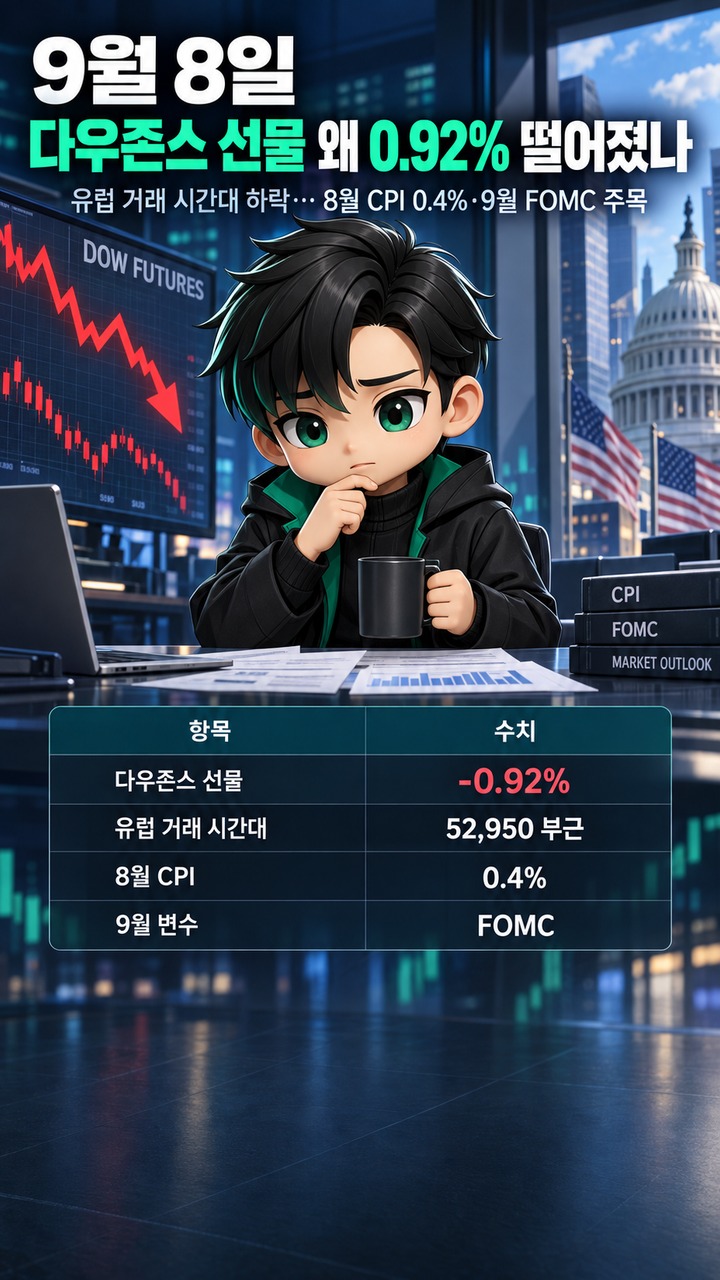
After Dow Jones futures fell 0.92%, the August CPI 0.4% and September FOMC became new market factors.# After Dow Jones futures fell 0.92%, the August CPI 0.4% and September FOMC became new market factors.
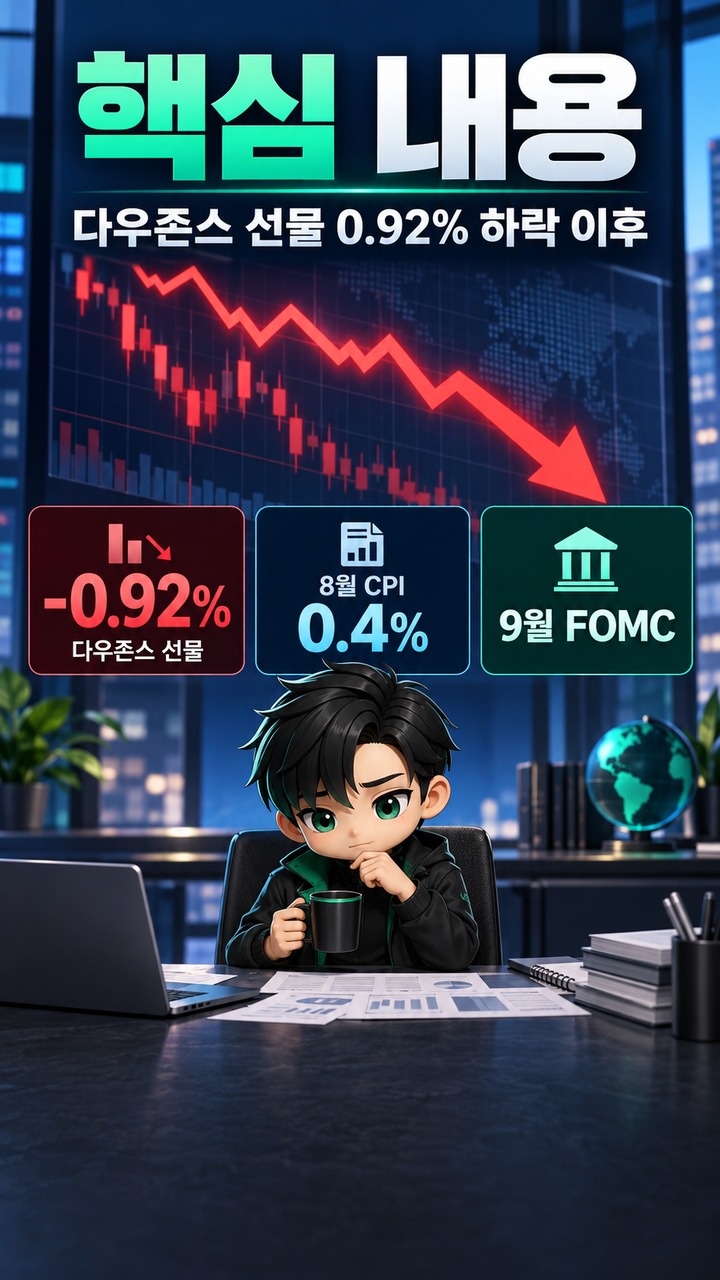
Dow Jones futures fell 0.92% during European trading hours on September 8, slipping to around 52,950, but that figure alone is not enough to determine the current direction of the U.S. stock market. The subsequently released U.S. August Consumer Price Index (CPI) rose 0.4% month over month. Nevertheless, during the September 11 regular trading session, the Dow Jones Industrial Average actually gained 0.98% to close at 52,573.29. The market's next major event is now the Federal Open Market Committee (FOMC) meeting scheduled for September 15–16.
Therefore, the initial news about falling Dow futures is more accurately understood as a record of market conditions at that particular time. As of September 12 Korea time, both producer and consumer inflation figures had been released, and Canada's retaliatory tariffs against the United States had already taken effect. With previously anticipated developments now reflected in actual data, investors should focus less on the size of the earlier futures decline and more on how inflation, interest rates, Treasury yields, and trade policy interact.
Why Did Dow Jones Futures Fall 0.92% on September 8?
At the time on September 8, Dow Jones futures were trading around 52,950, down 0.92%. S&P 500 futures declined 0.41%, while Nasdaq 100 futures fell 0.24%. Because the U.S. August Producer Price Index and Consumer Price Index had not yet been released, markets were pricing in rising oil prices, the possibility of an interest rate increase, and escalating U.S.–Canada trade tensions rather than actual inflation figures.

In particular, U.S. nonfarm payroll employment increased by 16 million 2,000 people in August, while the unemployment rate remained at 4.1%. Stronger-than-expected employment data reinforced expectations that an interest rate increase could occur in September. At the time the September 8 article was written, market pricing reflected estimates that the probability of a rate increase exceeded 60%.
The implementation date for Canada's retaliatory tariffs also coincided with these developments. Beginning at 0:1 on September 8, the Canadian government started applying tariffs of 15%, 25%, and 50% to U.S. products worth 276 billion Canadian dollars. Affected products included steel, dairy products, household appliances, agricultural equipment, pulp and paper, and electronics. Exceptions apply to certain U.S. goods already in transit.
However, futures prices on September 8 merely reflect the uncertainty surrounding the market that day. Since inflation data were subsequently released and the cash market moved, those earlier figures must now be interpreted alongside updated information as of September 12.
What Did the Subsequently Released Inflation Figures Actually Show?

The U.S. Consumer Price Index rose 0.4% month over month in August. This represented a larger monthly increase than the 0.1% recorded in July. The year-over-year CPI inflation rate was 3.4%, unchanged from July, while core CPI, excluding food and energy, rose 0.3% month over month and 2.4% year over year.
Energy prices played a major role in the monthly CPI increase. Gasoline prices rose 3.9% month over month in August, accounting for more than 1/3 of the overall monthly CPI increase. Food prices rose 0.1%.
The August Producer Price Index (PPI), released one day before the consumer inflation report, also increased 0.4% month over month. Final-demand prices rose 5.4% year over year, while goods prices increased 1.1% and services prices rose 0.1% over the month. More than 3/4 of the increase in final-demand goods prices was linked to higher energy prices, while producer prices for diesel fuel jumped 24.1%.
Taken together, these indicators suggest that the inflation pressures markets feared on September 8 did not completely disappear after the data were released. In particular, both energy prices at the production stage and gasoline prices at the consumer level recorded substantial increases.
Why Did the Dow Rise on September 11 Despite Higher Inflation?
Higher inflation and falling stock prices do not necessarily occur on the same day. On September 11, the Dow Jones Industrial Average gained 0.98% to close at 52,573.29, the S&P 500 rose 0.86% to 7,656.98, and the Nasdaq Composite advanced 0.96% to finish at 26,333.04. Oil prices retreated that day, while strong gains in certain technology stocks helped lift the major stock indexes.

It would be misleading to compare 'Dow futures -0.92% on September 8' and 'Dow cash index +0.98% on September 11' as though they were identical indicators moving in opposite directions. The former represents a futures price change at a specific point in time, while the latter represents the daily percentage change in the cash index during a regular trading session three days later.
Nevertheless, the figures confirm that market sentiment changed over those several days. On September 8, uncertainty was the central concern because CPI and PPI had not yet been released. By September 11, investors had reviewed the actual inflation figures and moved into a phase of repricing different asset classes ahead of the Federal Reserve's interest rate decision.
The weekly performance also shows that risks had not disappeared. Although the S&P 500 rose during the September 11 session, it declined 0.8% over the full week, while the Nasdaq fell 0.7% for the week. A single day's gains therefore provide insufficient evidence that inflation and interest rate pressures have ended.
How Much Has the Probability of an Interest Rate Increase Risen Since September 8?
On September 8, interest rate futures markets were pricing in a probability exceeding 60% for a rate increase in September. Following the CPI release, the probability of a 0.25%-point increase climbed to around 90% at one point during trading on September 11 and subsequently remained above 80%. These figures represent probabilities implied by financial market futures prices, not an actual Federal Reserve decision.
The Federal Reserve's current policy interest rate is within the 3.50–3.75% range. The September FOMC meeting will take place over two days, 15 and 16, with the official interest rate decision scheduled to be announced after the meeting concludes. A rate increase has not yet been confirmed.
A simple comparison between 'above 60%' on September 8 and 'above 80%' on September 11 suggests an increase of at least approximately 20% percentage points. However, because these market probabilities were measured at different times and under different data-provider standards, the comparison should be interpreted as a shift in market expectations rather than a definitive economic indicator.
U.S. Treasury yields are another important factor alongside interest rates. On September 11, the yield on the 10-year U.S. Treasury note climbed to 4.9915% during the session before retreating toward 4.92%. Long-term yields approaching 5% can affect not only corporate borrowing costs but also equity valuations, making them an important variable to monitor even after the FOMC meeting.
Canada's Tariff Dispute Has Not Ended: The Measures Are Already in Effect
The Canadian tariffs mentioned in the September 8 article are not merely proposals. The Canadian government's retaliatory tariffs of 15%, 25%, and 50% against the United States took effect on September 8, covering U.S. imports worth 276 billion Canadian dollars.
The same tariff rate does not apply to every U.S. product. Rates of 15%, 25%, and 50% are assigned according to product category and apply to goods designated by the Canadian government. There is also an exception for U.S. goods already being transported to Canada on the implementation date, which are not subject to the retaliatory measures.
Additional U.S. trade measures are also scheduled. Through separate measures announced on September 8, the U.S. government introduced import restrictions on certain Canadian products, with some affected categories scheduled to become prohibited imports beginning September 29. The U.S.–Canada trade dispute is therefore not simply a one-day news event from September 8 but an ongoing issue with subsequent implementation dates.
This distinction also matters when assessing inflation. The extent to which tariffs are passed on to final consumer prices depends on the product, inventories, supply chains, exchange rates, and other factors. Tariff rates therefore cannot simply be converted directly into increases in U.S. consumer inflation. What can currently be confirmed is that measures by both countries have entered the implementation stage.
What Should Investors Check First When Following the Dow Jones Now?
As of September 12, the September 16 FOMC outcome is a more immediate market factor than the futures prices recorded on September 8. Markets have already received the August employment, PPI, and CPI data, and interest rate futures are pricing in a substantial probability of a rate increase. The Federal Reserve's actual rate decision, along with its assessment of inflation and economic conditions in the accompanying statement, could provide the basis for the next round of market repricing.
The second factor is long-term Treasury yields. Watching whether the 10-year yield tests the 5% level again or stabilizes after the inflation reports can provide a clearer understanding of current financial market conditions than following a stock index alone.
The third factor is energy prices. Gasoline prices rose 3.9% in the August CPI report, while final-demand energy prices in the August PPI increased 4.2%. Further movements in energy prices will remain important when evaluating subsequent inflation reports.
Finally, investors should monitor additional trade measures between the United States and Canada. The issue did not end with Canada's retaliatory tariffs taking effect on September 8. U.S. measures affecting certain Canadian products also have subsequent implementation dates, including September 15 and 29. Any additional changes in trade policy should be assessed by distinguishing official announcement dates from actual implementation dates.
The decline in Dow futures on September 8 was an important market signal at the time, but four days later, on September 12, new information had already accumulated. The August CPI rose 0.4% month over month, the PPI also increased 0.4%, Canada's retaliatory tariffs took effect, and U.S. stocks rebounded during the September 11 session. The next turning point will come when the Federal Reserve announces its actual interest rate decision at the September FOMC meeting on 15–16.
Market-implied probabilities and single-day index movements do not guarantee future returns. When evaluating U.S. stocks or index-linked investment products, considering the interest rate decision, long-term Treasury yields, inflation, and energy prices together provides a more accurate picture of current conditions than focusing solely on futures movements at one particular moment.
※ This article is provided for informational purposes to help readers understand market developments and does not constitute investment advice or a recommendation to buy or sell any particular security or asset. Final investment decisions and responsibility rest with the individual investor.