

During August 7 Trading, Watch Both the 6,238 Level and Foreign Investors' Semiconductor Trading
이 포스팅은 쿠팡 파트너스 활동의 일환으로, 이에 따른 일정액의 수수료를 제공받습니다.
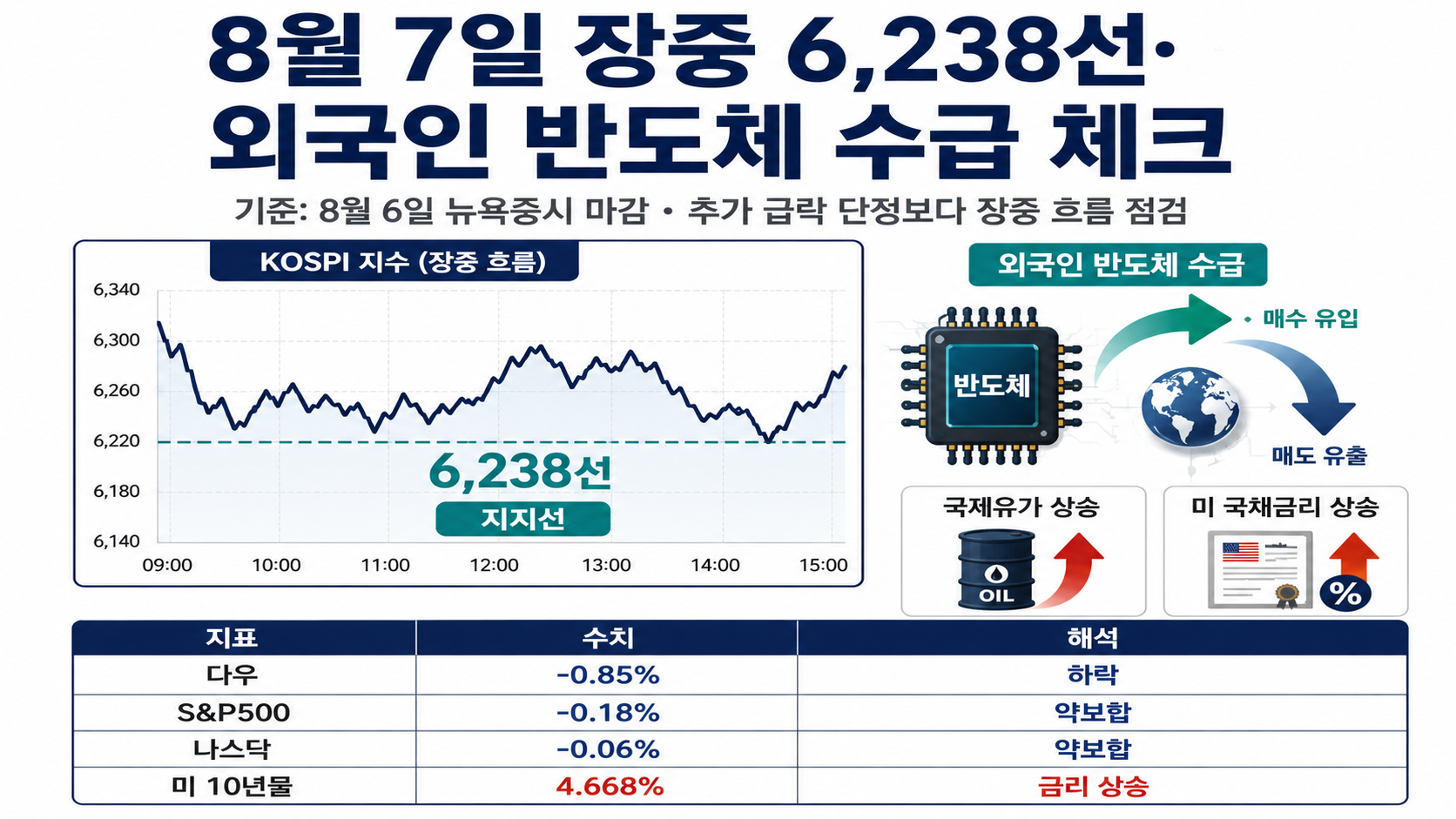
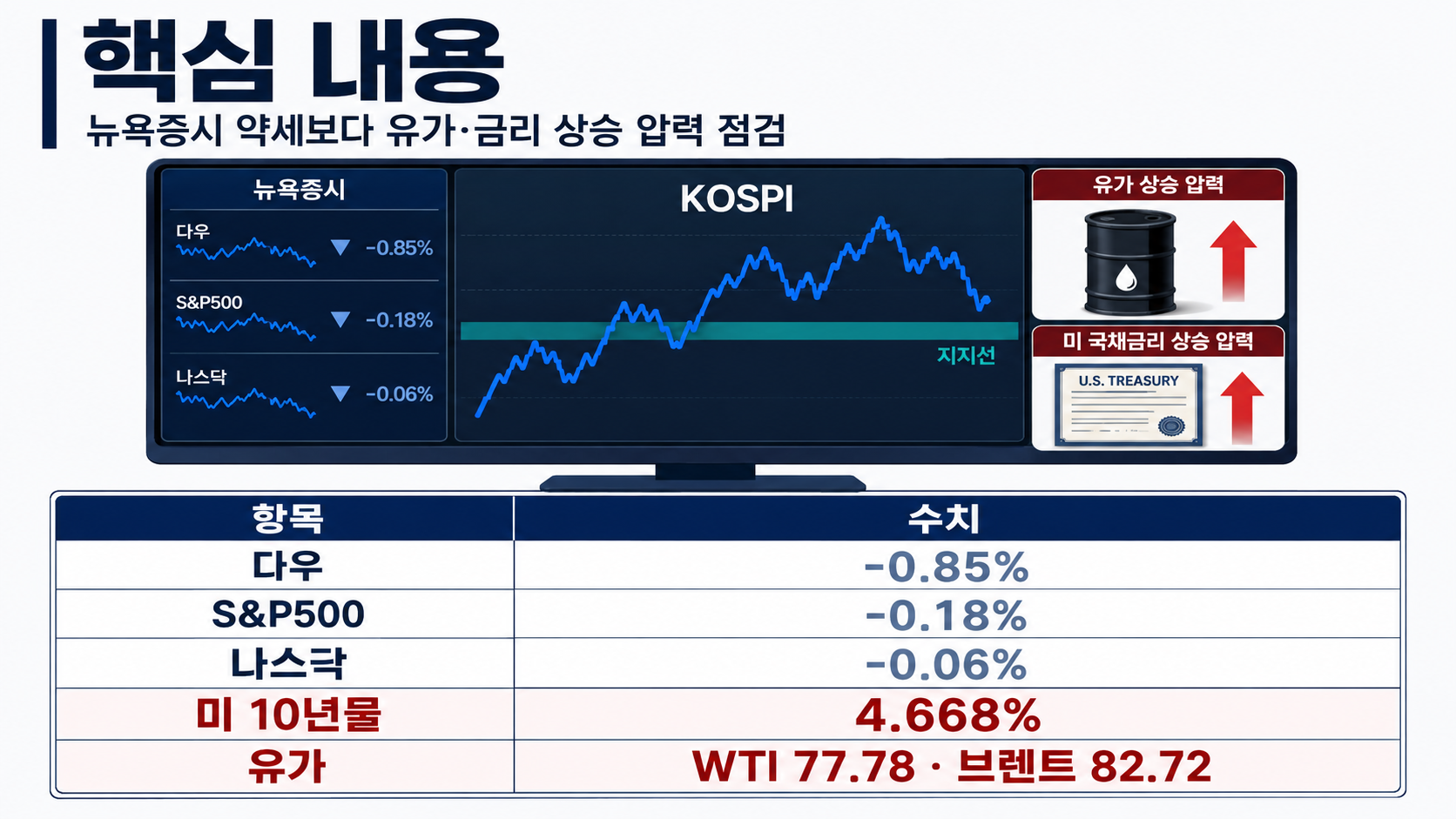
The modest decline in U.S. stocks alone is not enough to conclude that the KOSPI is headed for another sharp drop. However, rising international oil prices and U.S. Treasury yields are not creating a favorable environment for risk assets either. On August 6, the Dow Jones Industrial Average closed down 0.85%, the S&P500 fell 0.18%, and the Nasdaq Composite declined 0.06%, while the yield on the 10-year U.S. Treasury rose to 4.668%. West Texas Intermediate crude climbed to USD 77.78 per barrel, while Brent crude reached USD 82.72, with both gaining more than 3%.
Immediately After the Opening Bell, Check Whether the 6,300 Level Is Recovered
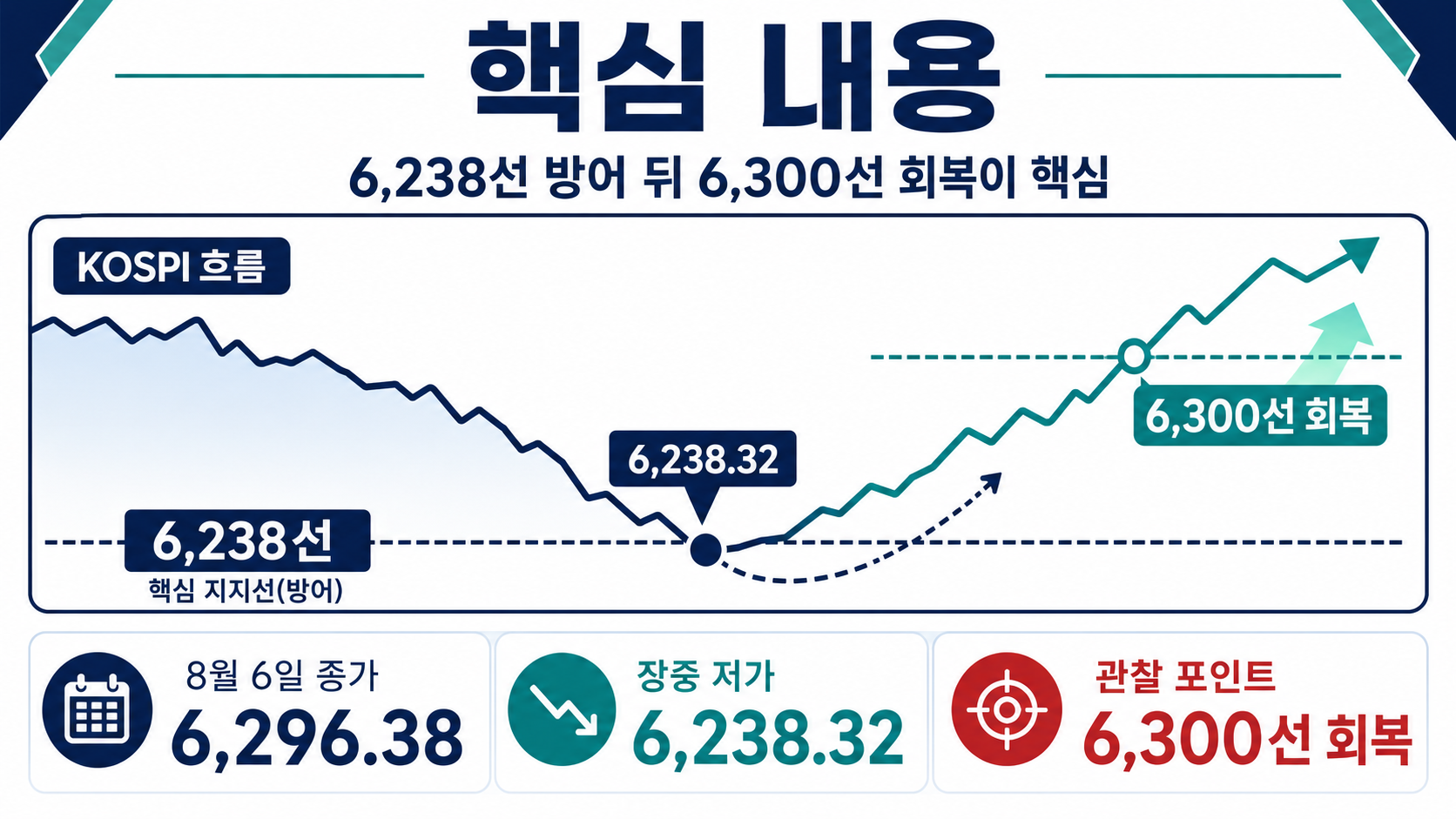
On August 6, the KOSPI closed at 6,296.38 after reaching an intraday low of 6,238.32. Even if the KOSPI opens weaker on August 7, holding the 6,238 level and subsequently recovering the 6,300 level would suggest that some of the previous day's excessive selling pressure is easing.
Conversely, if the 6,238 level breaks while foreign investors continue selling shares in the electrical and electronics sector, the risk of further declines should take priority over interpreting the move as ordinary opening-price volatility.
According to the author's calculations, the distance between 6,296.38 and 6,238.32 is 58.06 points, or approximately 0.92%. Because the previous day's closing level was close to its intraday low, whether the 6,238 level holds is a practical benchmark for assessing short-term volatility.
For Samsung Electronics and SK Hynix, Foreign Investors' Net Trading Matters More Than Share Prices
On the previous trading day, foreign investors recorded net sales of KRW 3,349,200,000,000 on the KOSPI market, including KRW 3,180,500,000,000 in the electrical and electronics sector alone. Foreign investors' net selling amounted to KRW 1,693,600,000,000 in SK Hynix and KRW 726,800,000,000 in Samsung Electronics. Samsung Electronics fell 6.30%, while SK Hynix declined 10.37%.
U.S. semiconductor stocks did not move in a single direction overnight. Nvidia fell 0.10%, while Broadcom and Qualcomm gained, but Micron showed weakness in the 1% range. SanDisk and Western Digital suffered double-digit declines amid assessments that they had failed to meet elevated expectations. This suggests that broad-based panic selling across U.S. semiconductor stocks has eased, but investor sentiment toward memory and storage-related companies remains unsettled.
Therefore, even if Samsung Electronics and SK Hynix rebound by 1\~2% in early trading, it would be premature to interpret the move as a trend reversal if foreign investors continue to sell both stocks on a net basis. Rather than focusing on the size of their price gains, it is better to check how much cumulative foreign net selling around 10 a.m. has decreased compared with the previous day.
Three Market Scenarios Can Help Define Trading Responses
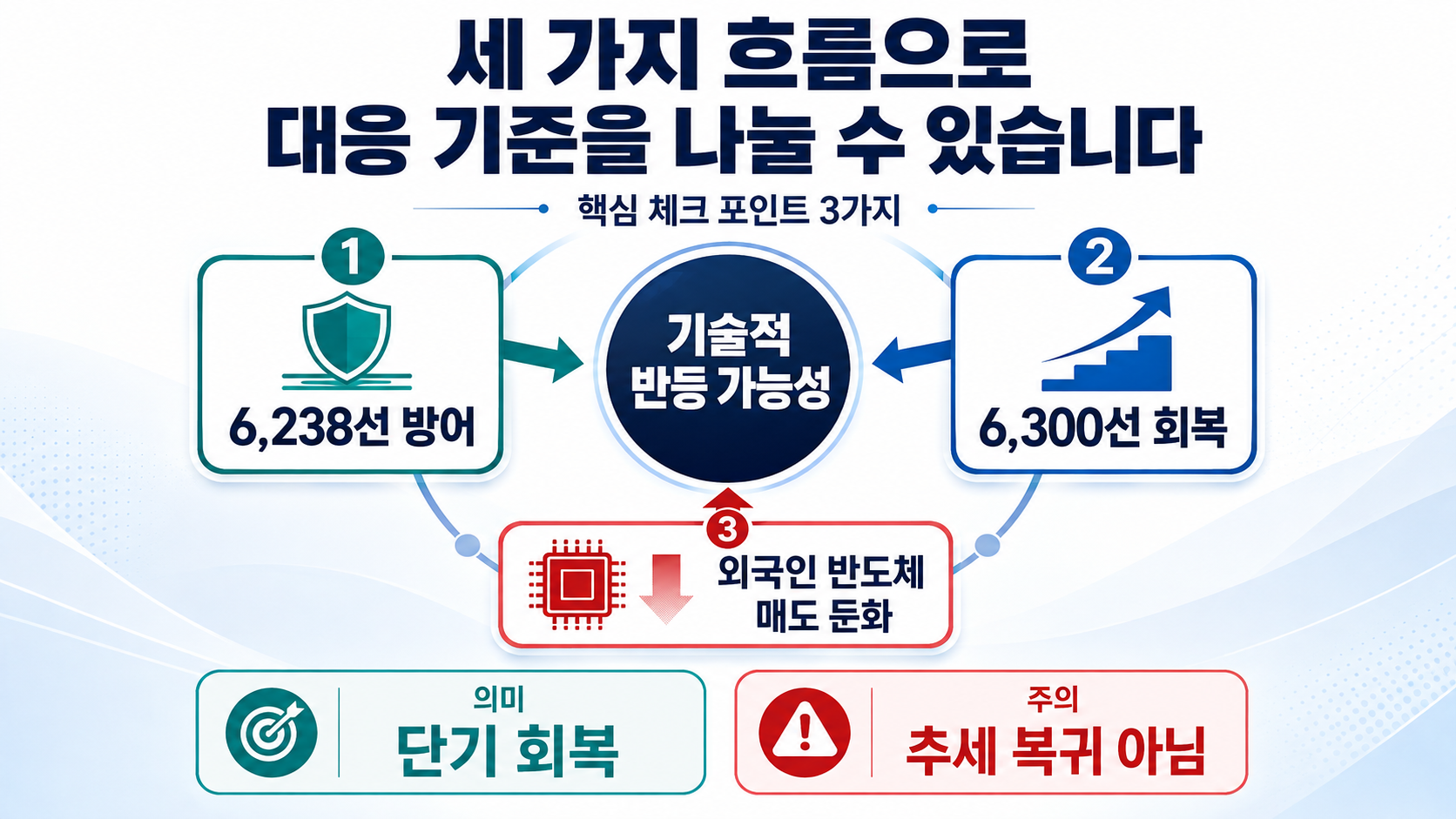
If the KOSPI holds the 6,238 level, recovers 6,the 300 level, and foreign investors' semiconductor selling slows, the likelihood of a technical rebound increases. A technical rebound refers to a short-term recovery following a sharp decline and does not necessarily mean that an upward trend has resumed.
If the 6,238 level breaks while the won-dollar exchange rate and international oil prices rise together, a defensive approach is warranted. In particular, if Samsung Electronics and SK Hynix fall below their previous day's lows, the index's losses could widen rapidly.
If the KOSPI recovers 6,478.75, the previous day's opening level, and foreign investors turn into net buyers of semiconductor stocks, that would be a stronger sign of stabilization than a simple oversold rebound. According to the author's calculations, moving from 6,296.38 to 6,478.75 would require a gain of 182.37 points, or approximately 2.90%, making this a demanding rebound condition that needs to be confirmed during trading hours.
Watch for Position Adjustments Ahead of the U.S. Employment Report in the Afternoon
The U.S. July Employment Situation report is scheduled for release on August 7 at 8:30 a.m. U.S. Eastern Time, equivalent to 9:30 p.m. Korea Standard Time. Because the results will be released after the Korean stock market closes, afternoon trading may see investors reducing risk ahead of the employment data rather than initiating new purchases.
If employment is stronger than expected, concerns about U.S. interest rate increases and upward pressure on Treasury yields could intensify. If employment is excessively weak, concerns about an economic slowdown could come to the forefront even if interest rate pressures ease. This is an economic release for which a higher or lower figure cannot simply be classified as good or bad news.
For the KOSPI on August 7, whether foreign investors continue selling after the previous day's 4.58% plunge matters more than the modest decline in U.S. stocks. A practical approach is to check, in order, whether the 6,238 level holds, whether the 6,300 level is recovered, and how foreign investors are trading Samsung Electronics and SK Hynix, while remaining prepared for afternoon volatility ahead of the U.S. employment report.
This outlook is a market interpretation based on publicly available information verified through 6:30 a.m. on 2026-08-07. It does not guarantee that any particular index level or stock will rise or fall. Actual trading decisions should also take into account intraday exchange rates, investor trading flows, corporate disclosures, and individual risk tolerance.
※ This article is provided for informational purposes to help readers understand market trends and does not constitute an investment recommendation for any particular stock or asset. Final investment decisions and responsibility rest with the individual investor.
이 포스팅은 쿠팡 파트너스 활동의 일환으로, 이에 따른 일정액의 수수료를 제공받습니다.