

August 12 KOSPI Outlook: 3 Key Factors to Watch After the Recovery Above 6,345
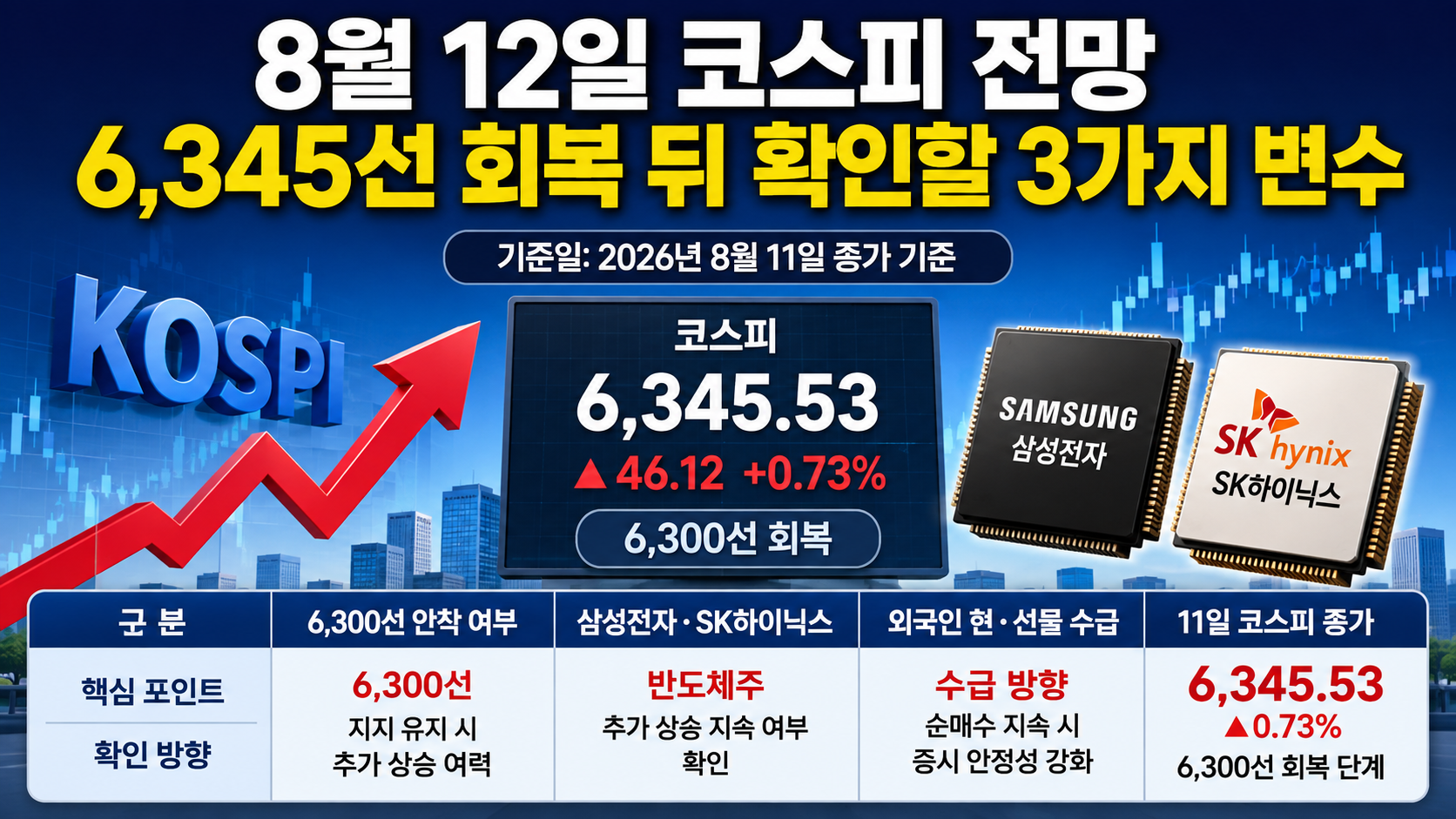
For the August 12 KOSPI, the first things to watch are whether the index can hold above 6,300, whether Samsung Electronics and SK Hynix can extend their gains, and foreign investor flows in the cash and futures markets. On 11, the KOSPI rose 0.73% to 6,345.53. However, judging by trading value and the scale of foreign buying, the market appears to have regained the 6,300 level rather than confirmed a strong upward trend.
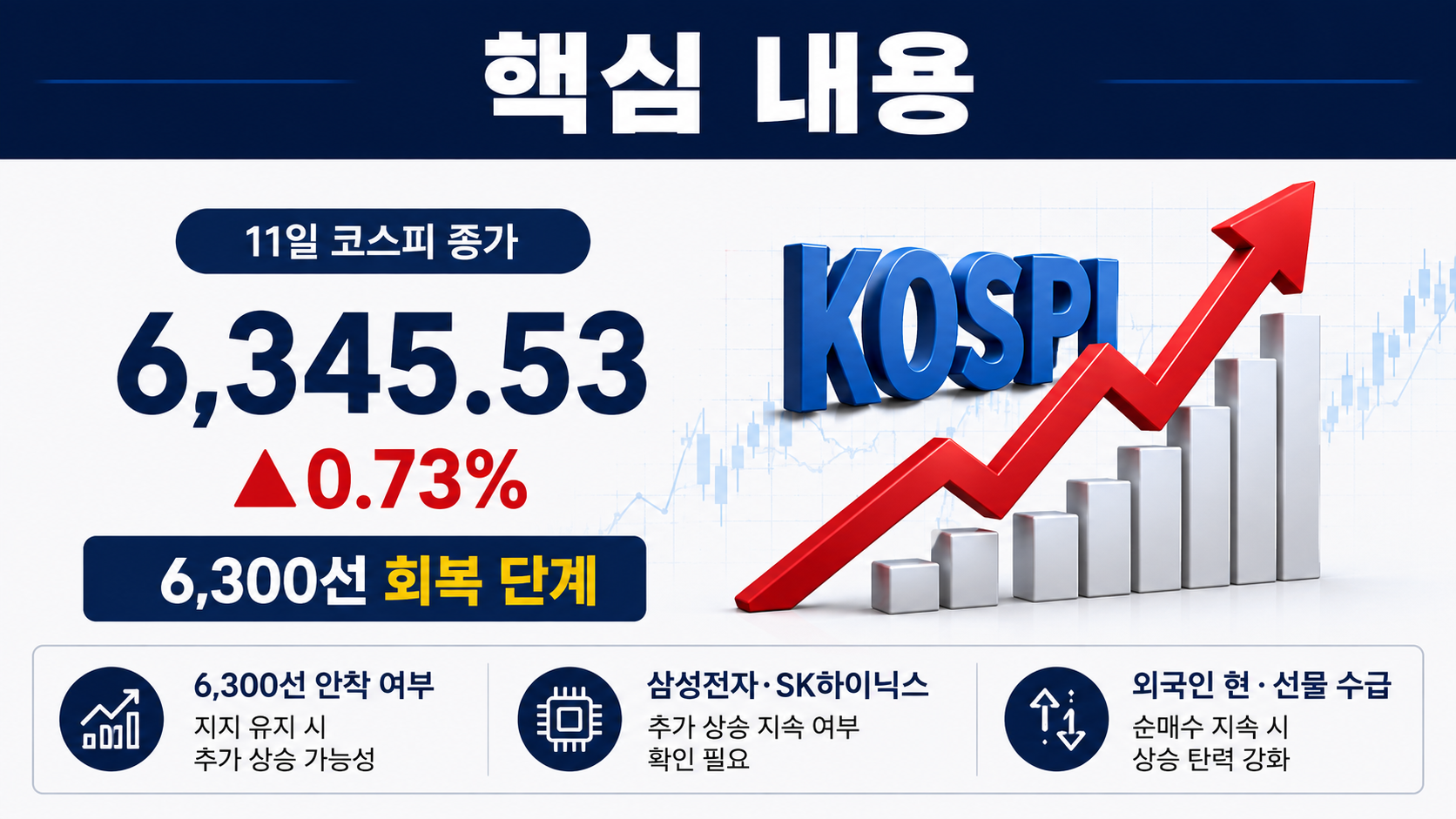
In particular, the U.S. July Consumer Price Index (CPI) is scheduled for release on 12. However, the release time is 8:30 a.m. U.S. Eastern Time, or August 12 at 9:30 p.m. Korea time. Because the data will be released after the Korean stock market closes, the KOSPI session on 12 should not be viewed as a reaction to the CPI results. Instead, it should be viewed as a session that reveals how much risk investors are willing to take ahead of the CPI release.
The KOSPI's August 11 Gain: Why the Rebound Matters More Than the Numbers
On 11, the KOSPI closed at 6,345.53, up 45.87 points from the previous trading session. The gain was 0.73%, while the KOSDAQ also rose 0.39% to finish at 857.84. The Korea Exchange likewise reported a KOSPI closing level of 6,345.53 and a KOSPI 200 reading of 987.40.
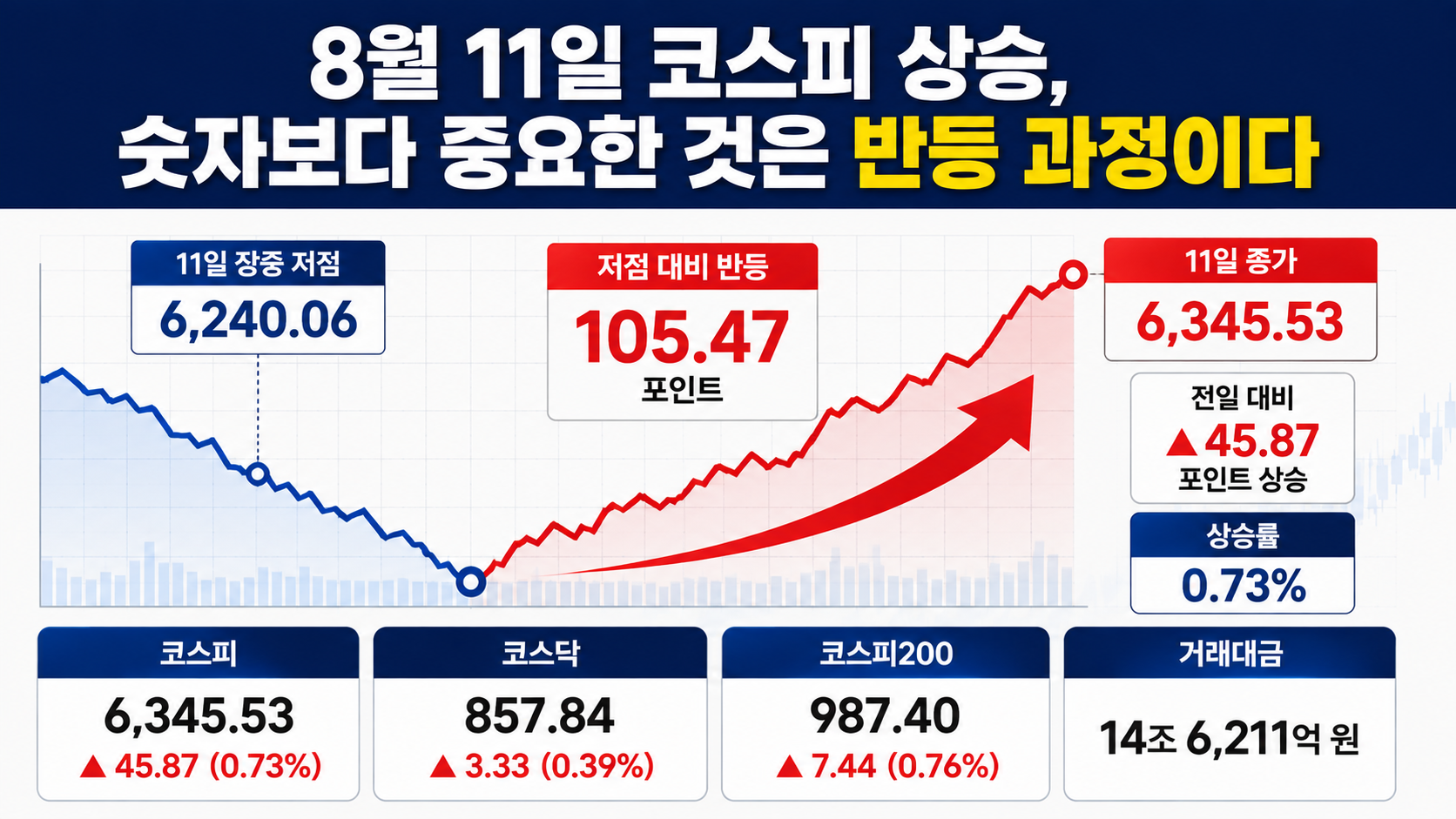
The intraday movement is more revealing than the simple fact that the index gained 0.73%.
The KOSPI fell as low as 6,240.06 early in the session before closing at 6,345.53. The difference between the intraday low and the closing level was 105.47 points.
Author's calculation
6,345.53 - 6,240.06 = 105.47 points
The rebound from the intraday low to the close was approximately 1.69%.
105.47 ÷ 6,240.06 × 100 = approximately 1.69%
In other words, the market on 11 was not strong from the opening bell. It initially faced selling pressure before buying interest concentrated in major semiconductor stocks and reversed the market's direction.
This provides the first benchmark for assessing August 12: whether the index can hold near the previous closing level of 6,345 and attract additional buying, or whether it falls back below 6,300 after just one day.
If the market holds on to the previous day's gains, the short-term rebound may continue. Conversely, if the index opens with a gap higher but quickly retreats toward 6,300 as Samsung Electronics weakens and foreign buying fades, it would still be premature to interpret the previous day's rise as a trend reversal.
Samsung Electronics Rises 4.13%: Why Semiconductors Remain the Most Important Factor on 12
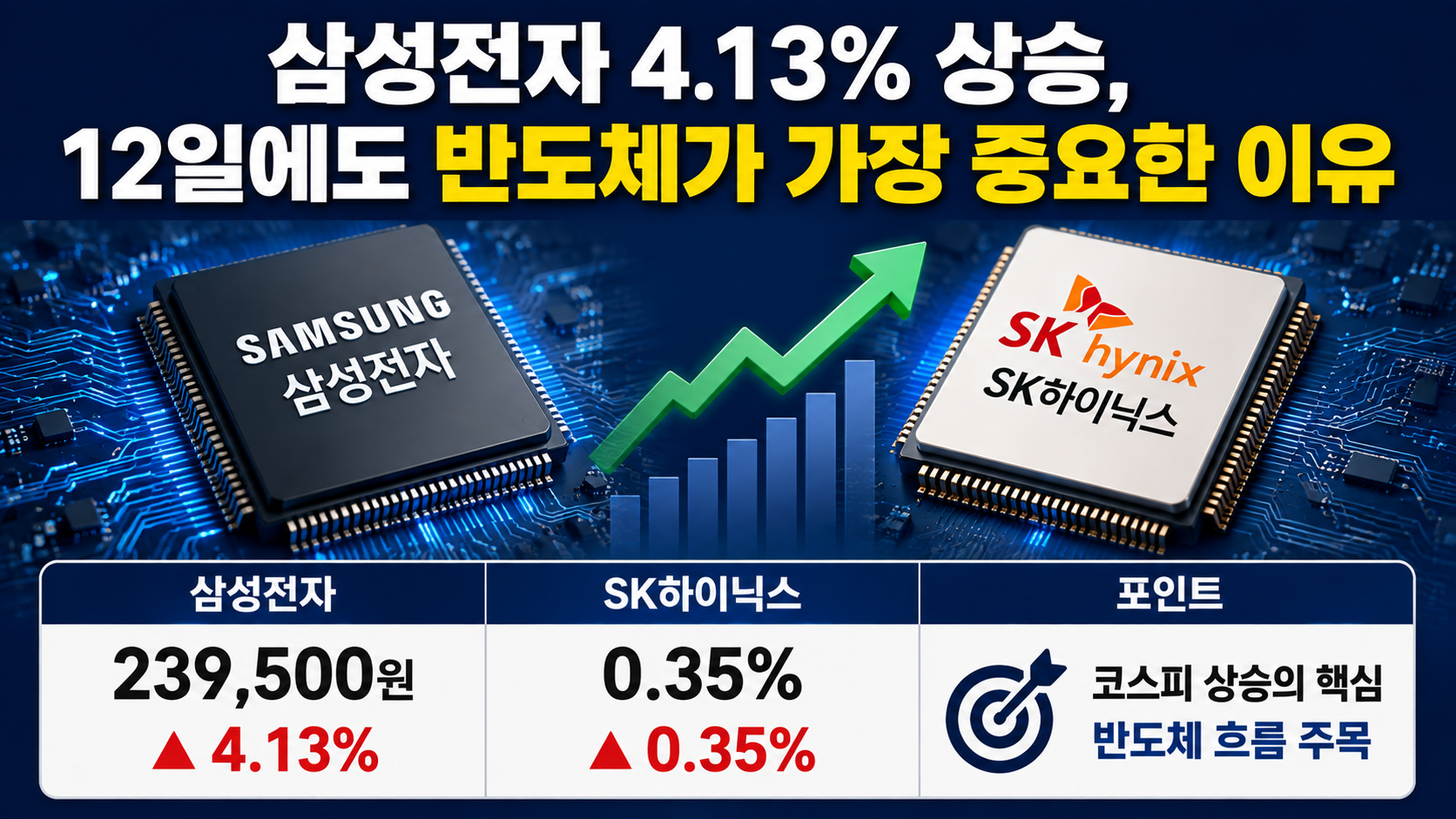
On August 11, Samsung Electronics rose 4.13% to KRW 239,500, while SK Hynix also gained 0.35%. Because Samsung Electronics contributed significantly to the index's advance, it is difficult to assess the KOSPI's direction on 12 without examining semiconductor stocks.
However, the considerable difference in the strength of the two stocks' gains deserves attention.
While Samsung Electronics surged more than 4%, SK Hynix managed a gain in the 0% range. This suggests that the rebound was driven more heavily by Samsung Electronics than by a broad, simultaneous rally across the semiconductor sector.
Therefore, on 12, investors should look beyond whether Samsung Electronics simply opens in positive territory. It is better to assess whether the stock can absorb profit-taking and hold above its previous closing price, while also checking whether strength spreads to SK Hynix.
If both stocks strengthen and foreign net buying increases, it will become much easier for the KOSPI to move beyond 6,345 and attempt further gains.
Conversely, if Samsung Electronics retreats as investors take profits following the previous day's surge and SK Hynix also weakens, the index becomes more likely to retest 6,300.
The key is not to declare an upward trend for the entire market based solely on one day's gain in Samsung Electronics. Following a one-day increase in the 4% range, both additional buying and profit-taking may intensify. As a result, trading flows on the second day may provide more useful clues about the market's direction.
Foreign Buying Has Returned, but Its Scale Is Not Yet Particularly Strong
On August 11, foreign investors recorded net purchases of approximately KRW 44,500,000,000 in the KOSPI market, while institutions recorded net purchases of approximately KRW 30,600,000,000. Individual investors were net sellers of approximately KRW 71,000,000,000. Figures may differ by several hundred million won depending on the reporting time and rounding method, but the overall direction is consistent: both foreign and institutional investors were net buyers.
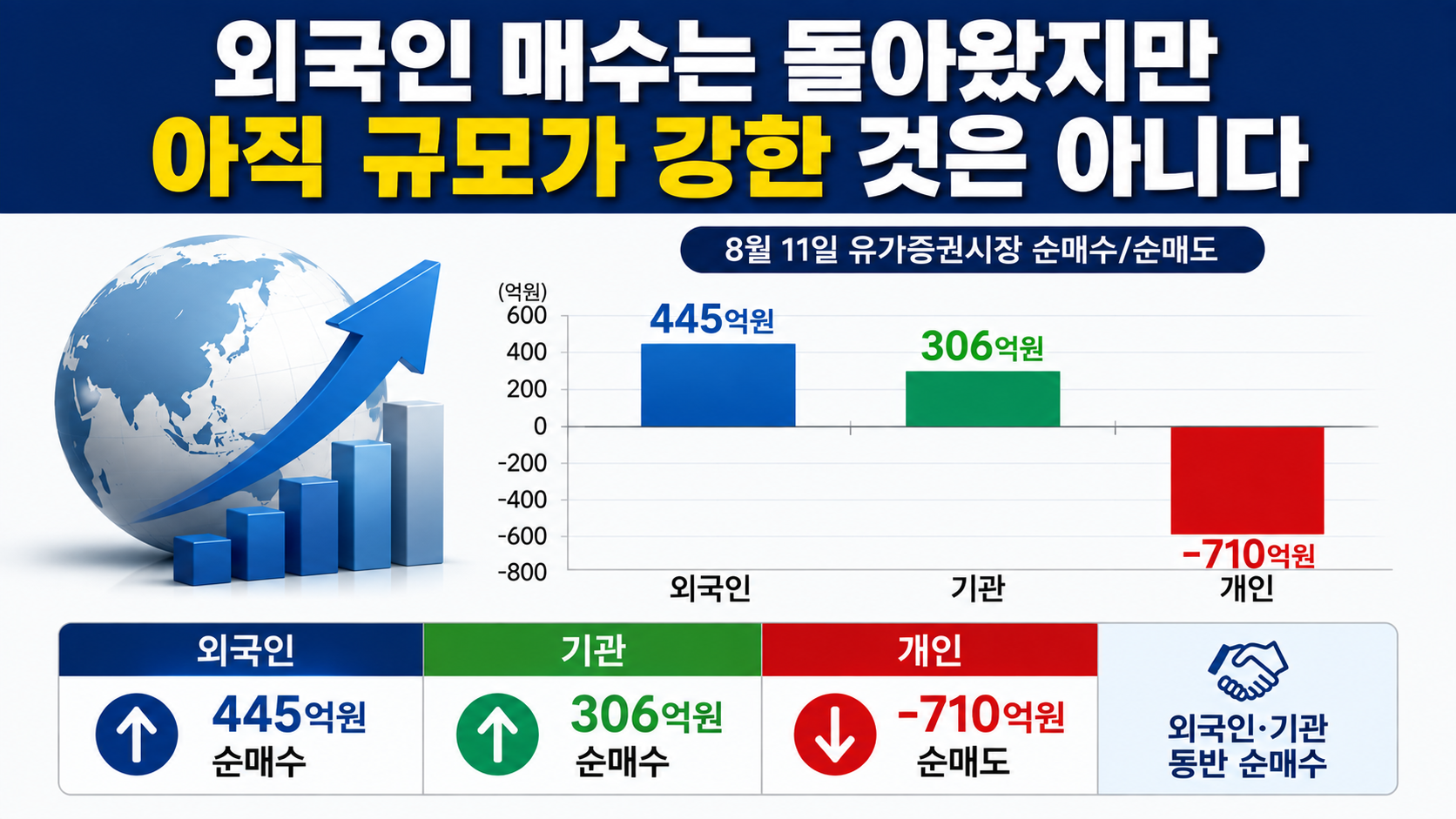
These figures are meaningful, but their scale should not be overstated.
With the KOSPI moving above 6,300, a single day of foreign net buying amounting to only several tens of billions of won is insufficient evidence that foreign investors have begun aggressively accumulating Korean equities.
For August 12, whether the scale of foreign net buying expands matters more than the simple question of whether foreigners are net buyers.
For example, if foreign buying flows into Samsung Electronics and SK Hynix from the morning and both KOSPI cash equities and futures move in the same direction, the likelihood of the previous day's rebound continuing increases.
Conversely, if the index rises while foreign investors continue selling cash equities or switch to selling futures, the risk of chasing the rally grows as the index advances.
When the index is trading at elevated levels, as it has recently, checking who is driving the index higher is more useful in practice than focusing only on the index level.
Won-Dollar Exchange Rate in the KRW 1,415 Range: How the Direction of KRW 1,400 Relates to Foreign Investor Flows
On August 11, the won-dollar exchange rate in the Seoul foreign exchange market closed at around KRW 1,415.9 during daytime trading. It declined by approximately KRW 2.5 from the previous day, indicating a slight strengthening of the Korean won.
If the exchange rate remains stable in the KRW 1,410 range or declines further on 12, it would place relatively less pressure on foreign investor flows.
On the other hand, if the dollar strengthens overnight and the won-dollar exchange rate rises rapidly again, this could weigh on the Korean stock market by increasing pressure on foreign capital flows.
Especially when major semiconductor stocks such as Samsung Electronics and SK Hynix are determining the index's direction, it is better to examine semiconductor share prices and the exchange rate together rather than separately.
The most positive combination for the morning of 12 would be:
Samsung Electronics and SK Hynix rising → Foreign net buying → Stable or declining won-dollar exchange rate.
Conversely, if semiconductor weakness → Foreign net selling → Rising exchange rate occur simultaneously, the KOSPI's ability to hold 6,300 could weaken rapidly.
It is far more important to determine whether all three indicators are moving in the same direction than to focus on just one.
U.S. CPI Will Be Released After the KOSPI Closes on 12
The most widely discussed overseas factor for August 12 is the U.S. July CPI. However, Korean investors first need to understand the timing of the announcement.
According to the official schedule of the U.S. Bureau of Labor Statistics, the July CPI is scheduled for release at August 12, 8:30 a.m. U.S. Eastern Time. That corresponds to 9:30 p.m. Korea time on the same day, after the regular KOSPI trading session has ended.
Therefore, it would be chronologically incorrect to explain a rise or fall in the KOSPI during the morning of 12 as a reaction to the U.S. CPI results.
Instead, caution ahead of the CPI announcement may influence the Korean market on 12.
The actual CPI results are expected to be reflected more fully in the Korean stock market on August 13, after U.S. equities, bonds, and the dollar have reacted to the data.
This distinction is significant.
Even if Korean stocks remain strong during the 12 session, investors may reduce their risk exposure as the afternoon progresses because a major event, the CPI release, is scheduled for that night. Conversely, morning weakness cannot, by itself, be interpreted as confirmation that unfavorable CPI news has already emerged.
The previous U.S. June CPI increased 3.5% year over year. The July figures have not yet been released, so their outcome should not be assumed in advance.
In South Korea, the July 2026 Employment Trends report is also scheduled for release at 8 a.m. on the same day. Although it provides useful information for assessing domestic economic conditions, investors should monitor whether U.S. financial markets, exchange rates, semiconductor stocks, and foreign investor flows exert a greater influence on the KOSPI's short-term direction during trading. The statistical release is scheduled for August 12 at 8 a.m.
How to Assess the August 12 KOSPI Step by Step
Rather than trying to predict the KOSPI's direction on 12 with a single number before the market opens, a more realistic approach is to use the previous day's confirmed prices to determine which scenario the market is following.
The first reference point is 6,345.53.
If the index moves above the previous closing level and holds there, investors can assess whether buying momentum is continuing. In particular, if Samsung Electronics and SK Hynix rise together while foreign buying increases, confidence in an attempt at further gains will strengthen.
The second reference point is 6,300.
6,300 is both a psychological price level and the area that the previous day's closing price managed to reclaim. Even if the market fluctuates early in the session, recovering and holding 6,300 would mean there is no need to immediately conclude that a downward trend has begun.
The third reference point is the August 11 intraday low of 6,240.06.
The previous day, the index fell to this level before rebounding by more than 105 points. Therefore, if the market experiences significant volatility on 12, the area around 6,240 can serve as an objective comparison point for determining whether buying interest returns at the previous day's levels.
These three figures are not definitive forecasts of future support and resistance levels. They are reference points based on the previous day's closing price and intraday low, where actual market trading took place.
During the session, investors can combine these levels with foreign investor flows and the won-dollar exchange rate.
Above 6,345 + Broad semiconductor gains + Expanding foreign net buying would favor a continuation of the rally.
Fluctuations around 6,300 + Mixed foreign investor flows would be better interpreted as a period in which the market's direction remains undecided.
A break below 6,300 + Broad semiconductor weakness + Foreign net selling + A rising exchange rate would make it reasonable to consider the possibility of a correction that retraces a substantial portion of the previous day's rebound.
Looking at 12 alone, the session is less about predicting how many points the KOSPI might gain and more about identifying who is supporting the index at 6,300.
Samsung Electronics rose 4.13% the previous day and helped lift the KOSPI, but foreign net buying amounted to only several tens of billions of won. Therefore, to determine whether further gains can be sustained on 12, investors should examine not only Samsung Electronics' share price but also whether SK Hynix participates in the rally and whether foreign buying expands.
Furthermore, the actual U.S. CPI results will not yet be available during Korean trading hours on 12. It is chronologically accurate to assess caution ahead of the CPI release on 12 separately from the reactions of U.S. equities, interest rates, and the dollar to the CPI results on 13.
Investment decisions may vary depending on an individual's holding period and tolerance for losses. The index levels discussed above are not forecasts guaranteeing buying or selling prices. They are reference points for the next trading session based on actual market prices on 2026-08-11.
---
※ This article is provided for informational purposes to help readers understand market trends and does not constitute investment advice or a recommendation to buy or sell any particular stock or asset. Final investment decisions and responsibility for those decisions rest with the individual investor.