

August 10 KOSDAQ Outlook: Another Attempt at 800 from 798.81…3 Key Factors That Will Determine the Rally
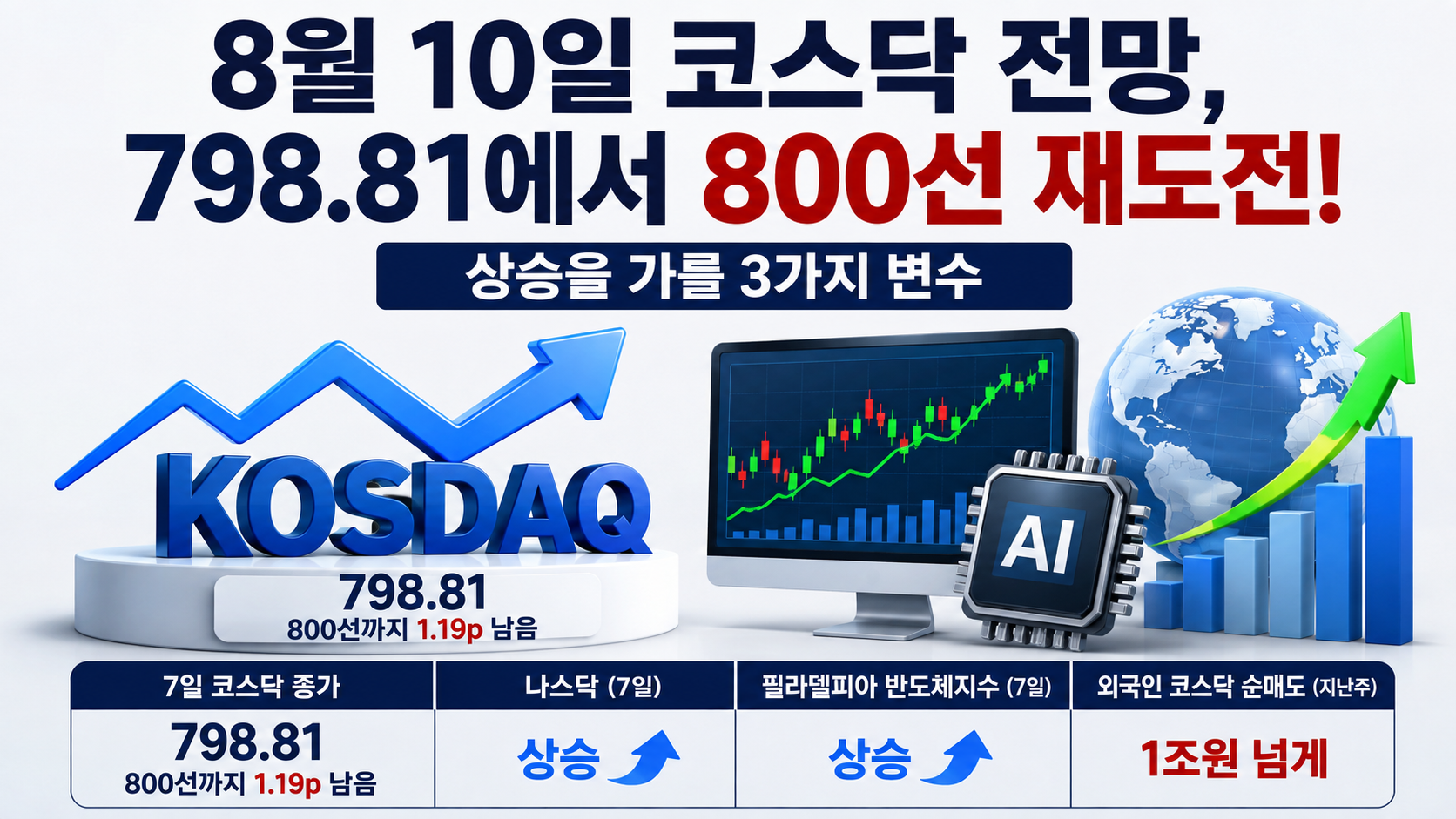
The KOSDAQ enters August 10 with a favorable overseas market backdrop that could support another attempt to break above 800. On 7, the KOSDAQ closed at 798.81, leaving it just 1.19 points short of 800, while the U.S. Nasdaq and Philadelphia Semiconductor Index also rose ahead of the weekend. However, with foreign investors having net sold more than KRW 1,000,000,000,000 on the KOSDAQ last week, whether the index can hold above 800 with support from foreign investor flows matters more than simply crossing that level.
Rather than trying to predict the direction of August 10 with certainty, investors should examine three factors in sequence. These are whether the index can establish itself above 800, changes in the intensity of foreign selling, and whether sector rotation continues across biotechnology, robotics, and semiconductor materials, components, and equipment.
KOSDAQ at 798.81: How Far Is It Really from 800?
The KOSDAQ finished trading at 798.81 on August 7. It needs to gain only 1.19 points to reach 800. According to the author's calculation, the required increase from 798.81 to 800 is approximately 0.15%.
The formula is `(800-798.81)÷798.81×100`.
Therefore, crossing 800 in early trading on August 10 would not require a substantial increase. The real question is not whether the index briefly touches 800, but whether it can remain near that level after selling pressure emerges during the session.
Last week's KOSDAQ performance illustrates why this distinction matters.
As of August 7, the KOSDAQ had gained 79.05 points, or 10.98%, over the week, recovering to 798.81. After surging 11.63% on July 31, it continued rising for 5 consecutive trading days through August 6, bringing its short-term gain to 24.33%.
However, on 7, the index declined slightly as profit-taking and caution ahead of the weekend emerged, causing it to surrender the 800 level.
In other words, the current 800 level is less a resistance level encountered for the first time after a prolonged decline and more a price zone where buying demand and profit-taking supply are competing following a rebound of more than 20% over a short period.
For that reason, on August 10, it would be better to check whether trading remains sustained after the index reclaims 800 rather than interpreting a simple breakout above 800 as a bullish signal.
Are U.S. Stocks Providing a Favorable Backdrop for Monday's KOSDAQ Session?
Judging solely by U.S. market performance immediately before the weekend, there are more positive factors for domestic growth stocks on August 10.
In U.S. trading on August 7, the Dow Jones 30 Industrial Average gained 0.28%, the S&P500 rose 0.62%, and the Nasdaq Composite advanced 1.30%. The S&P500 reached an all-time closing high of 7,757.64.
Indicators associated with technology stocks, which are closely linked to the KOSDAQ, were also strong. The Philadelphia Semiconductor Index rose 2.56%, while the Russell 2000 gained 1.10%. The MSCI Korea ETF advanced 1.20%, the MSCI Emerging Markets ETF climbed 0.95%, and overnight KOSPI 200 futures also rose 0.89%.
Based on these developments alone, initial investor sentiment in the domestic market on Monday appears reasonably favorable.
One factor behind the U.S. market rally was weaker-than-expected employment data for July. U.S. nonfarm payrolls for July fell by 2 ten-thousand 3 thousand jobs from the previous month. Because the market had expected an increase, the difference was substantial.
Investors did not interpret the deterioration in employment solely as a sign of recession. Instead, markets initially responded to the increased possibility that the Federal Reserve would become more cautious about further interest rate increases.
Expectations of easing interest rate pressure are generally positive for the growth-stock-heavy KOSDAQ. Biotechnology, robotics, and technology growth stocks, whose valuations depend heavily on the present value of future earnings, face greater discounting pressure as market interest rates rise.
However, the situation would change if U.S. employment conditions continued to deteriorate. The possibility that interest rates may not rise further can be positive, but growing concerns that the economy is weakening rapidly would weigh on risk assets overall.
Therefore, deteriorating U.S. employment figures should not automatically be treated as a bullish catalyst for the KOSDAQ.
Why a 2.56% Rise in the Semiconductor Index Does Not Tell the Whole Story for KOSDAQ Semiconductor Stocks
Individual stocks within the U.S. semiconductor market moved in different directions. This divergence is also important for the KOSDAQ on August 10.
On August 7, Nvidia gained 2.27%, Qualcomm rose 4.66%, Intel advanced 1.84%, and Broadcom climbed 1.71%. Major companies associated with AI and system semiconductors were generally strong.
By contrast, the mood in memory and storage was different. Micron fell 0.44%, SanDisk declined 3.68%, Western Digital lost 3.81%, and Seagate dropped 4.71%. SK Hynix ADRs also fell 3.92%.
Therefore, it would be overly simplistic to conclude that all domestic semiconductor-related stocks should perform strongly merely because the Philadelphia Semiconductor Index rose 2.56%.
Many semiconductor equipment, materials, and components companies are listed on the KOSDAQ. On Monday, rather than focusing only on the Philadelphia Semiconductor Index's gain, investors should examine whether the domestic market responds more strongly to the strength in AI and system semiconductors or the weakness in memory stocks.
If semiconductor materials, components, and equipment stocks start strongly and maintain their gains, they could support the broader index. Conversely, if domestic semiconductor-related stocks decline despite the U.S. semiconductor index's advance, it could indicate that recent concerns about the memory industry and profit-taking pressure are more influential.
Why Foreign Investor Flows Matter Most for the KOSDAQ on August 10
Looking only at last week's KOSDAQ rally, it might seem that investor sentiment has completely recovered. However, trading flows by investor category tell a somewhat different story.
From August 3 through 7, institutional investors recorded net purchases of KRW 657,600,000,000 on the KOSDAQ, while individual investors bought a net KRW 592,100,000,000. Foreign investors, meanwhile, recorded net sales of KRW 1,284,300,000,000.
In other words, foreign investors continued selling heavily even as the KOSDAQ gained 10.98% over the week.
This is why both index performance and foreign investor trading activity need to be monitored on August 10.
The most favorable combination would be a recovery above 800 accompanied by a noticeable reduction in foreign selling or a shift to net buying. If institutional buying also continues and trading activity spreads across biotechnology, robotics, semiconductor materials, components, and equipment, and other sectors, the rebound could broaden.
Conversely, even if the index crosses 800, renewed foreign selling and trading concentrated in only a few themes would warrant caution about profit-taking following the recent sharp rally.
The KOSDAQ has already risen substantially over a short period. If a strong opening gap occurs on Monday, it will be important to assess how effectively the market absorbs subsequent selling pressure rather than focusing only on the size of the initial gain.
Watch Whether Biotechnology and Robotics Stocks Start Moving Again
Recently, the domestic market has shown signs of funds shifting away from major semiconductor stocks such as Samsung Electronics and SK Hynix toward other industries.
On the KOSDAQ, sector rotation into robotics and pharmaceuticals and biotechnology emerged while semiconductor stocks paused. Following financial regulators' supplementary measures concerning leveraged products, trading value in single-stock leveraged products tied to Samsung Electronics and SK Hynix declined, and some funds were also observed returning to the KOSDAQ.
Whether this trend continues on August 10 is important.
For the sustainability of the KOSDAQ rally, it would be more favorable for buying interest to spread across biotechnology, robotics, semiconductor equipment and materials, and other sectors than for gains to depend on just a few large-cap stocks.
Conversely, even if the index breaks above 800, the broader market may feel weaker than the headline index suggests if gains remain concentrated in a few themes while other stocks fail to participate.
Particularly in a volatile market like the current one, monitoring which sectors attract trading value may be more useful for actual investment decisions than simply observing an 1% rise in the index.
How to Monitor the KOSDAQ During the August 10 Trading Session
The overseas market backdrop before the opening bell is relatively favorable for a KOSDAQ rebound attempt. This is because the Nasdaq rose 1.30%, the Philadelphia Semiconductor Index gained 2.56%, the MSCI Korea ETF advanced 1.20%, and overnight KOSPI 200 futures increased 0.89% at the same time.
However, the KOSDAQ has already risen 10.98% over the past week, and its short-term gain has exceeded 24%. This is why a higher opening does not necessarily guarantee further gains.
The first thing to watch in early trading is whether the index reclaims 800.
If the index holds its ground after crossing 800, the next step is to examine foreign investor flows. The key question is whether selling pressure eases among foreign investors, who recorded net sales of KRW 1,284,300,000,000 last week.
Next, investors should assess whether buying interest is spreading across sectors. If two or three sectors among biotechnology, robotics, and semiconductor materials, components, and equipment move higher together, there would be stronger grounds to interpret the move as continuing sector rotation.
Conversely, if the index breaks above 800 but quickly retreats into the 790 range while foreign selling intensifies, it would be reasonable to conclude that profit-taking pressure following the recent sharp rally has not yet subsided.
Particularly if the opening price is significantly higher, investors should avoid chasing the market solely because it has crossed 800. Instead, they should monitor the highs and lows established in early trading, trading value, and foreign investor flows.
U.S. CPI on August 12 Is a Bigger Factor for This Week
Looking only at August 10, the rise in U.S. stocks and improving domestic investor sentiment may be reflected in the market first. However, the overall direction this week could be heavily influenced by the U.S. Consumer Price Index (CPI) for July, scheduled for release on 12.
The CPI is an inflation indicator that measures changes in the prices of goods and services purchased by consumers. If U.S. inflation is stronger than expected, concerns about further Federal Reserve tightening could increase again. Conversely, easing inflationary pressure could help reduce the interest rate burden on growth stocks.
The KOSDAQ, in particular, has a high proportion of growth stocks and may therefore react sensitively to changes in interest rate expectations.
South Korea's exports for August 1–10 are also scheduled for release on 11. These figures will provide insight into export trends for major products, including semiconductors, and should be considered alongside investor sentiment toward domestic technology stocks.
Therefore, even if the market rises on Monday, it would be difficult to assume that the entire week will follow the same direction. The stronger the market rises on 10, the more important it becomes to consider the possibility of renewed profit-taking and cautious sentiment ahead of the U.S. CPI release on 12.
800 Is the Most Important Number in the August 10 KOSDAQ Outlook
The KOSDAQ's opening environment on August 10 has improved compared with last Friday. U.S. technology stocks and major risk-asset indicators have risen, while the KOSDAQ finished trading at 798.81, just below 800.
According to the author's calculation, the increase required to reach 800 is also only approximately 0.15%.
However, what matters more than breaking above 800 itself is whether foreign investor flows and broader sector participation emerge together while the index holds above 800.
If the index reclaims 800, foreign selling eases, and buying interest broadens into biotechnology, robotics, and semiconductor materials, components, and equipment, the possibility of a further rebound could gain support. Conversely, if the index quickly retreats after crossing 800 while foreign selling intensifies again, investors should first remain alert to profit-taking following a short-term rebound of more than 20%.
Monday's market performance will not provide the final answer for the entire week. South Korea's export figures for 1~10 on 11 and the U.S. CPI for July on 12 are still ahead.
Currently available market information provides conditions for assessing potential direction, but it does not guarantee an increase in the index or profits from individual stocks. With volatility still elevated, a more appropriate approach on August 10 would be to observe the 800 level, foreign investor flows, and leading sectors during actual trading before making decisions, rather than deciding on a market direction in advance.
※ This article is provided for informational purposes to help readers understand market trends and does not constitute an investment recommendation for any particular stock or asset. All final investment decisions and responsibilities rest with the individual investor.