

Cheoseo August 23, 2026: This Year, 30–34°C Heat Matters More Than 'Cheoseo Magic'
이 포스팅은 쿠팡 파트너스 활동의 일환으로, 이에 따른 일정액의 수수료를 제공받습니다.
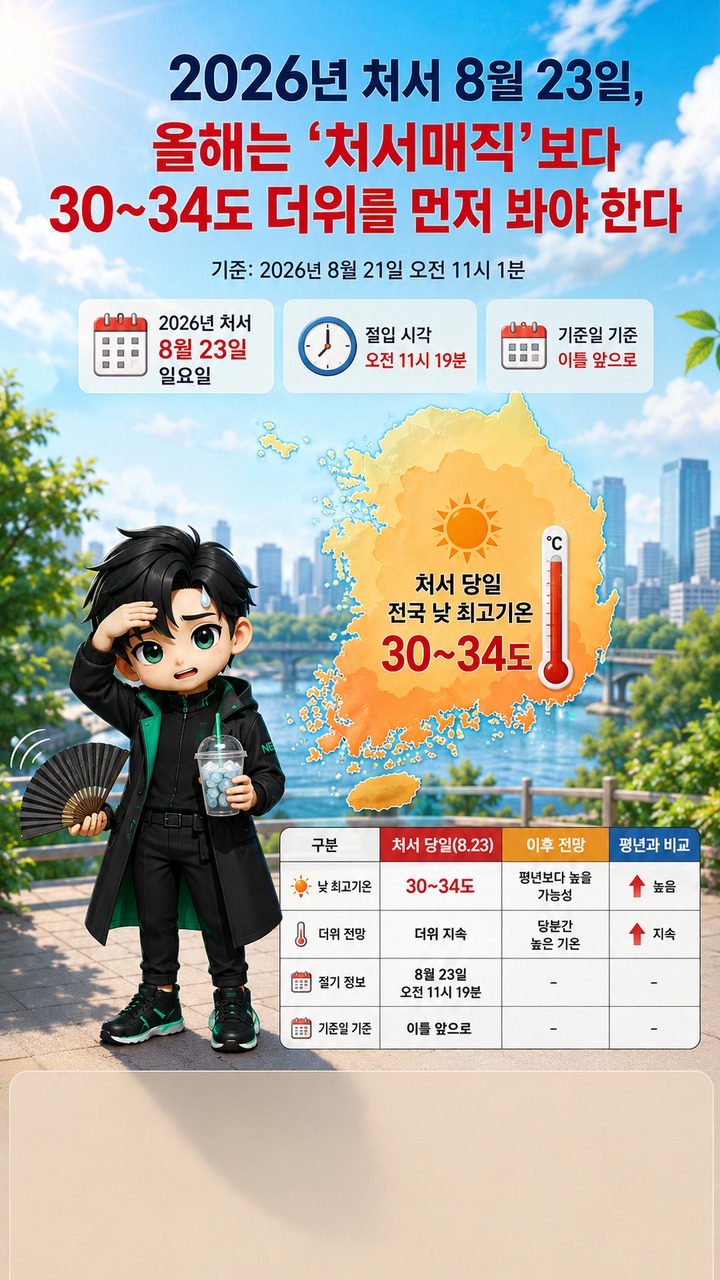
Cheoseo in 2026 falls on Sunday, August 23. The exact solar-term transition occurs at 11:19 a.m., and as of August 21 at 11:1 a.m., it is just two days away. However, it would be difficult to say that the heat will end immediately when Cheoseo arrives this year. Current forecasts predict nationwide daytime highs of 30–34°C on Cheoseo, with temperatures expected to remain above seasonal averages afterward.
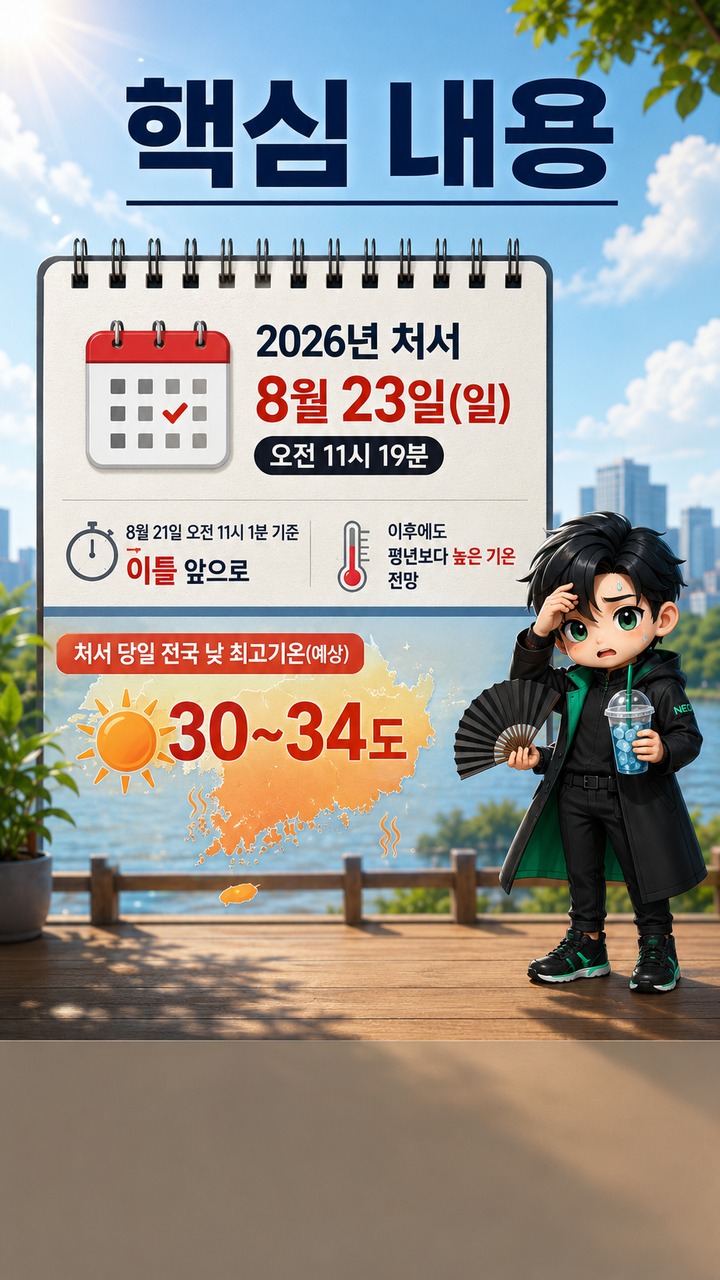
When Is Cheoseo in 2026?
This year's Cheoseo begins at 2026-08-23, 11:19 a.m. Cheoseo is the fourteenth of the 24 traditional solar terms, falling after Ipchu (Start of Autumn) and before Baengno (White Dew).
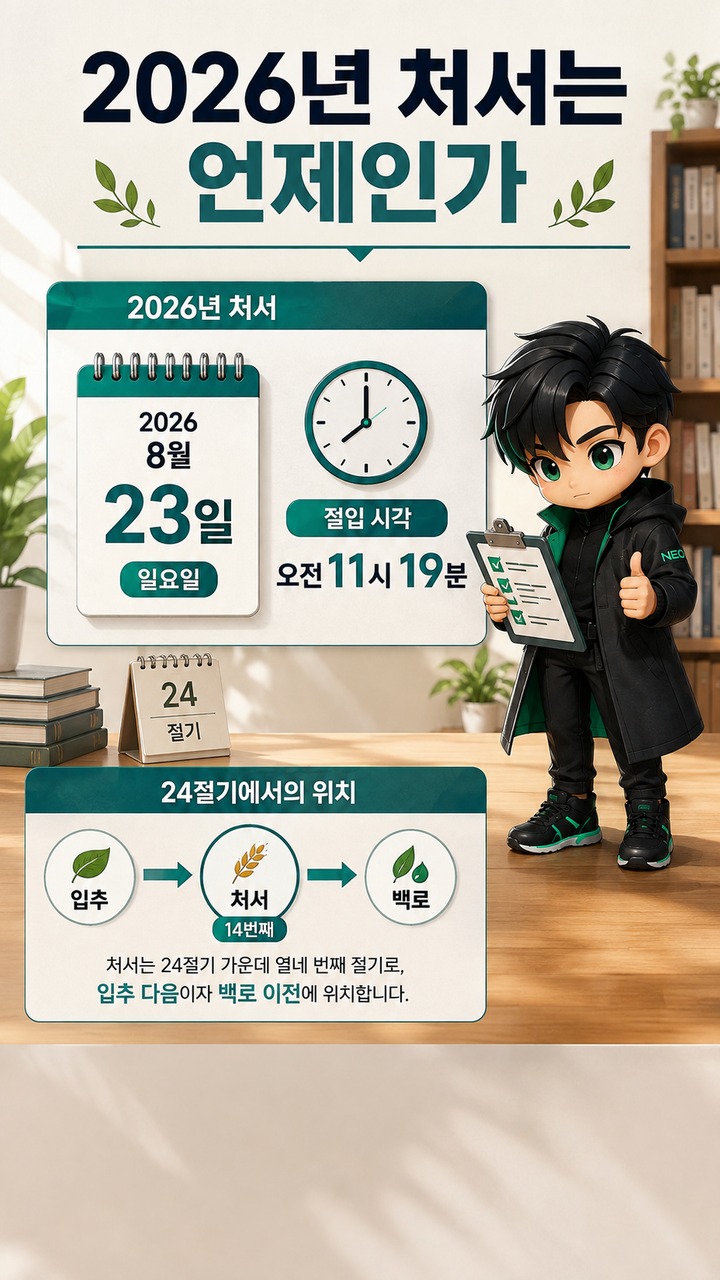
Looking at the dates of the late-summer and early-autumn solar terms in 2026 makes the seasonal progression clearer.
Ipchu (Start of Autumn): August 7 at 8:43 p.m.
Cheoseo (End of Heat): August 23 at 11:19 a.m.
Baengno (White Dew): September 7 at 11:41 p.m.
Measured by calendar dates, there are 16 days from Ipchu to Cheoseo and 15 days from Cheoseo to Baengno. These are the author's calculations, based on the respective date differences between August 7 and August 23, and between August 23 and September 7.
Cheoseo is not a commemorative day fixed to the same calendar date every year. It is a solar term determined by the position of the sun. Traditionally, Cheoseo occurs when the sun reaches an ecliptic longitude of 150 degrees.
That is why people commonly remember Cheoseo as falling on August 23, although its calendar date and exact transition time can vary slightly from year to year.
Why Does Cheoseo Mean 'The Time When the Heat Recedes'?
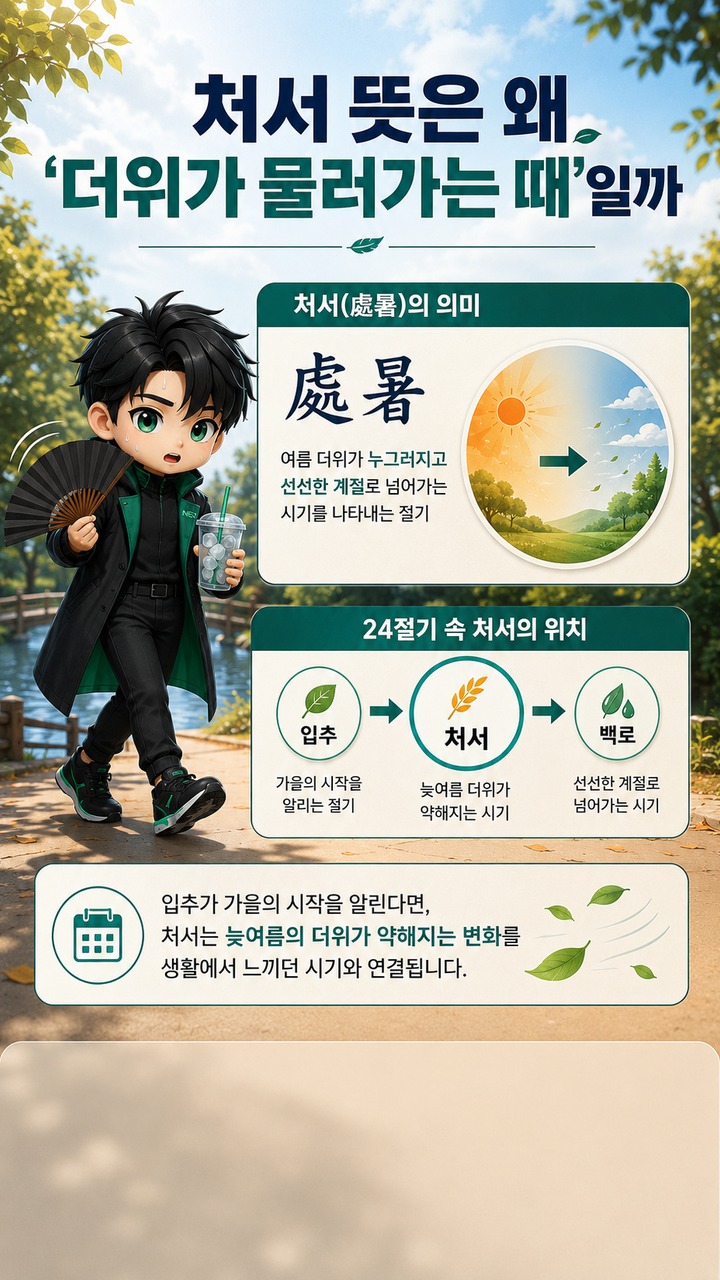
Cheoseo (處暑) is a traditional solar term marking the period when summer heat begins to ease and the seasons transition toward cooler weather. While Ipchu marks the beginning of autumn, Cheoseo is associated with the time when people traditionally began to notice the weakening of late-summer heat in everyday life.
In Korea's traditional seasonal customs, Cheoseo was more than just a date on the calendar. As the intense summer sunshine gradually weakened, people would cut grass along rice-field embankments and around ancestral graves. They also practiced poswae (曝曬), drying clothes and books that had absorbed moisture during the rainy season in the sunlight.
The familiar Korean saying, 'After Cheoseo, even mosquitoes' mouths become crooked,' also reflects this seasonal change. It figuratively describes the arrival of cooler mornings and evenings around Cheoseo and the declining activity of summer insects.
However, this proverb should not be treated as a modern weather forecast. Cheoseo is a solar term representing the progression of the seasons, while actual daily temperatures and the occurrence of extreme heat depend on atmospheric conditions in a given year.
Will It Really Become Cooler This Cheoseo?
In 2026, current forecasts do not indicate an abrupt shift to cooler weather starting on Cheoseo itself. According to the nationwide short-term forecast issued by the Korea Meteorological Administration (KMA) at 5 a.m. on August 21, morning lows on August 23 were expected to range from 21–26°C, while daytime highs were forecast at 30–34°C.
On Cheoseo, skies nationwide were forecast to be mostly cloudy before clearing in the afternoon, while Jeju Island was expected to remain mostly cloudy.
Comparing the nationwide daytime high-temperature forecasts by date makes the trend clearer.
| Date | Nationwide Daytime Highs |
|---|---|
| August 21 | 28–35°C |
| August 22 | 28–34°C |
| August 23 (Cheoseo) | 30–34°C |
| August 24 | 31–35°C |
The arrival of Cheoseo might suggest that the heat should begin to ease, but current forecasts instead indicate that many areas could continue experiencing temperatures above 30°C on 23 and 24.
The outlook after Cheoseo is particularly important. According to the medium-range forecast released at 10:30 a.m. on August 21, morning temperatures from August 25 through 31 are expected to range from 21–26°C, with daytime temperatures of 28–35°C.
During the same period, average seasonal temperatures are 19–23°C in the morning and 27–30°C during the day. Temperatures throughout the forecast period are expected to be above seasonal averages.
A simple comparison of the upper ends of the daytime temperature ranges shows that the forecast maximum of 35°C is 5°C higher than 30°C, the upper end of the seasonal average range. This is the author's calculation and does not mean that temperatures in every part of the country will be exactly 5°C above average. It compares the upper limits of two different nationwide temperature ranges.
Does This Mean There Will Be No 'Cheoseo Magic' This Year?
The popular expression 'Cheoseo Magic,' referring to the expectation that sweltering heat will disappear as soon as Cheoseo arrives, cannot confidently be interpreted as a sudden nationwide temperature drop this year.
The forecast for August 23 alone predicts daytime highs of 30–34°C, while daytime temperatures from 25 through 31 are expected to range from 28–35°C. The KMA expects some days when maximum feels-like temperatures rise to around 33°C across much of the country, with tropical nights also occurring in certain areas.
The important distinction here is between solar terms and actual weather.
Cheoseo is a solar term determined by the sun's position. By contrast, today's or tomorrow's maximum temperatures, heat-wave advisories and warnings, and the occurrence of tropical nights depend on actual weather conditions.
Rather than assuming that 'Cheoseo has arrived, so it is now safe to turn off the air conditioner or spend more time outdoors at midday,' it is better to check the latest local forecasts and heat-wave alerts.
Rain or showers may temporarily lower temperatures in some areas, but that alone does not mean the summer heat has completely ended.
What Is the Difference Between Ipchu and Cheoseo?
Both Ipchu and Cheoseo are part of the transition toward autumn, but their meanings and timing differ. Ipchu marks the beginning of autumn in the traditional 24-solar-term calendar, while Cheoseo is the fourteenth solar term, arriving later.
In 2026, Ipchu falls on August 7 and Cheoseo on August 23.
It is not unusual for midsummer-like heat to continue after Ipchu. The names of solar terms are not meteorological standards guaranteeing that temperatures nationwide will fall below a certain level from a particular date onward.
The same applies to Cheoseo. In the traditional seasonal cycle, it signifies the period when the heat begins to fade, but actual weather conditions today can vary considerably by region and year.
The next solar term, Baengno, falls this year on September 7 at 11:41 p.m. Rather than dividing summer and autumn based on Cheoseo alone, it is more natural to understand the seasonal progression through Ipchu → Cheoseo → Baengno.
What Traditional Customs Are Associated With Cheoseo?
Around Cheoseo, traditional practices such as grass cutting and poswae took advantage of late-summer weather. These customs illustrate how rural life and seasonal climate changes were directly connected to Korea's traditional solar-term culture.
People believed that grass grown during the summer began to grow more slowly around Cheoseo, so they cut grass along rice-field embankments and around ancestral graves. They also took out clothes and books that had absorbed moisture during the rainy season and dried them in the sunlight.
Weather around Cheoseo was also considered important in farming. Various regional folk beliefs and proverbs traditionally linked rainfall on Cheoseo to crop development and harvest outcomes.
However, these stories are best understood as cultural knowledge accumulated in agricultural communities at the time, rather than scientific long-range forecasts or formulas for predicting modern crop yields.
Traditional Cheoseo foods are also a popular search topic, but the traditional sources reviewed for this article provide clearer evidence of customs such as grass cutting, poswae, and agricultural practices than of any single specific food. There is no need to designate one particular dish as an essential or definitive Cheoseo food.
What Should You Check This Cheoseo?
This year, it is important to consider actual temperatures before and after Cheoseo, rather than focusing only on the solar-term date. According to forecasts available as of August 21, hot days with daytime temperatures around 30°C could continue even after Cheoseo.
If you plan to go out on August 23, it is advisable to check local morning lows, daytime highs, and heat-wave alerts first. If you expect to spend extended periods outdoors, it is also practical to consider feels-like temperatures, which account for humidity as well as air temperature.
Tropical nights may continue in areas where nighttime temperatures do not fall sufficiently. It is too early to conclude that the arrival of Cheoseo means people can abruptly stop summer precautions such as air conditioning and adequate hydration.
The clearest conclusion from the current forecast is this: Cheoseo in 2026 falls on August 23, but that does not mean the summer heat will end on August 23. At least according to the currently available outlook for late August, people should remain prepared for the possibility of continued above-average temperatures and sweltering days.
이 포스팅은 쿠팡 파트너스 활동의 일환으로, 이에 따른 일정액의 수수료를 제공받습니다.