

December 2026 Domestic Stock Dividends: Should You Buy by December 28? The Ex-Dividend Date Is 29
To receive year-end dividends from Korean-listed companies whose dividend record date is set as December 31 at the end of December 2026, you must buy shares by December 28 (Monday). December 29 (Tuesday) is the ex-dividend date, and December 30 (Wednesday) is the last trading day of the year. However, not all companies have December 31 as their dividend record date, so check each company's disclosures first. As of
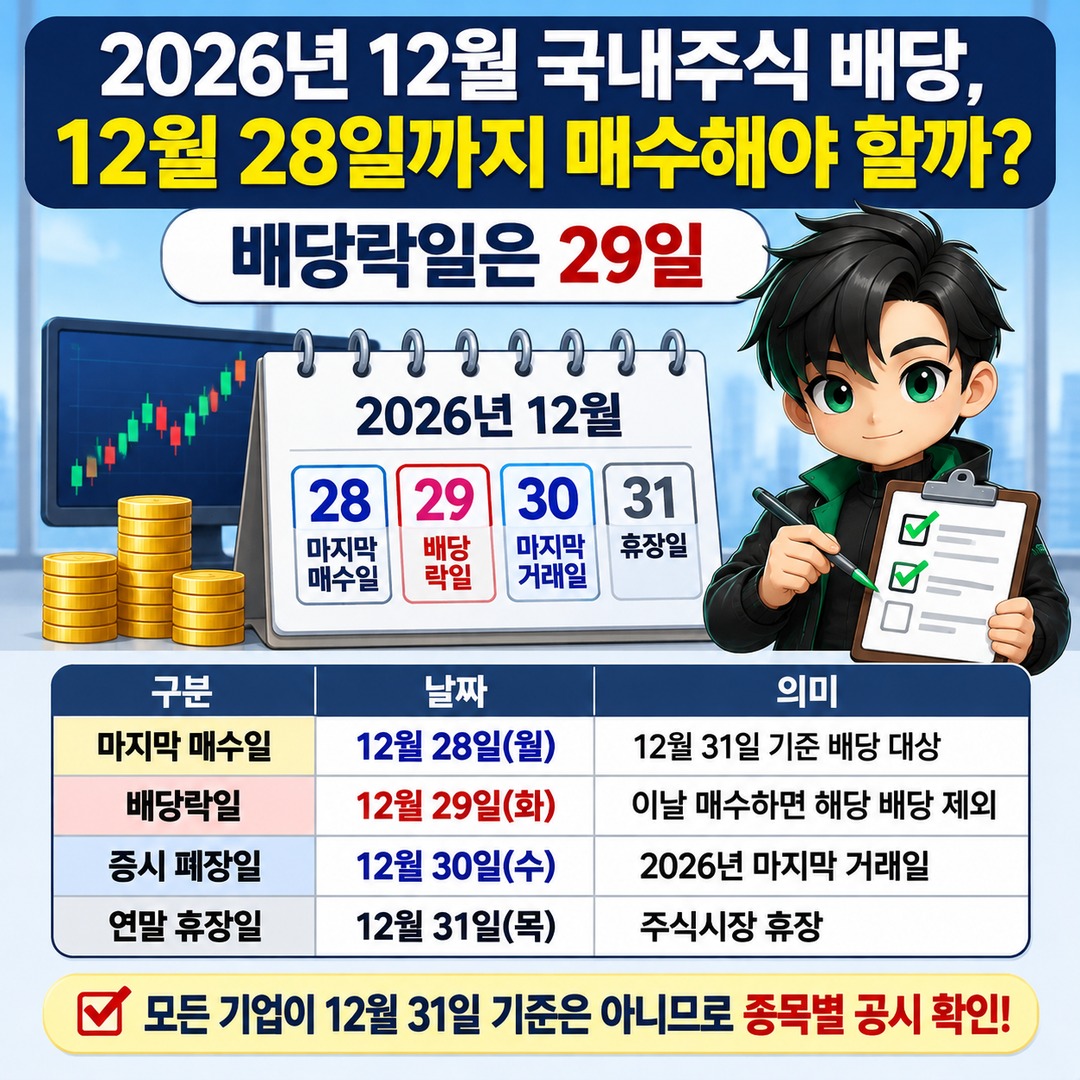
To receive year-end dividends from Korean-listed companies whose dividend record date is set as December 31 at the end of December 2026, you must buy shares by December 28 (Monday). December 29 (Tuesday) is the ex-dividend date, and December 30 (Wednesday) is the last trading day of the year. However, not all companies have December 31 as their dividend record date, so check each company's disclosures first.
Reference time: 2026-11-28 7:04 AM, Korea Standard Time
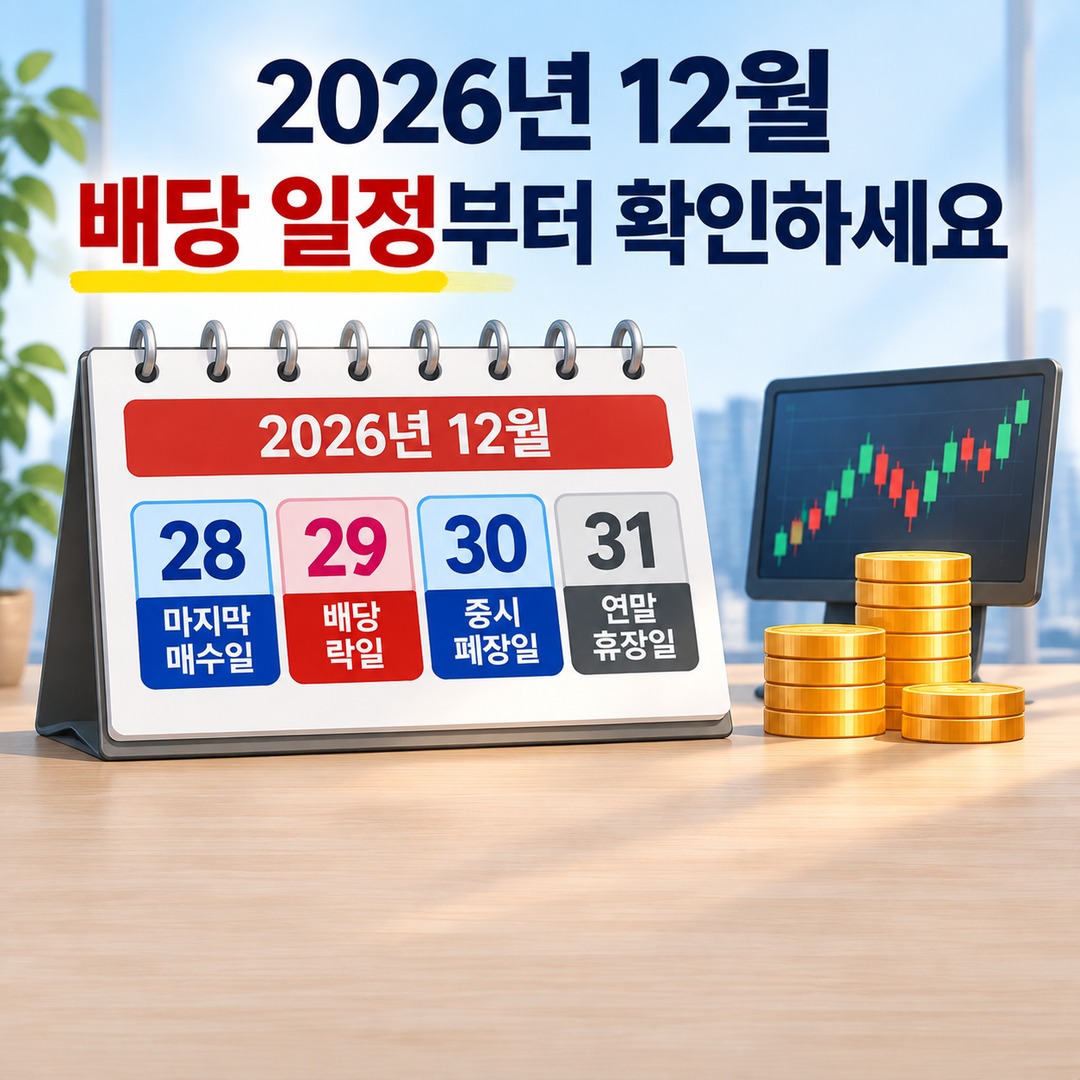
Check the December 2026 Dividend Schedule First
| Category | Date | Meaning |
|---|---|---|
| Last day to buy shares | December 28 (Monday) | Eligible for dividends based on December 31 |
| Ex-dividend date | December 29 (Tuesday) | Shares purchased on this date are not eligible for the dividend |
| Last trading day | December 30 (Wednesday) | Final trading day of 2026 |
| Year-end market holiday | December 31 (Thursday) | Stock market closed |
The schedule above assumes a year-end dividend for December, with 2026-12-31 as its dividend record date.
Why Is December 28 the Last Day to Buy Shares?
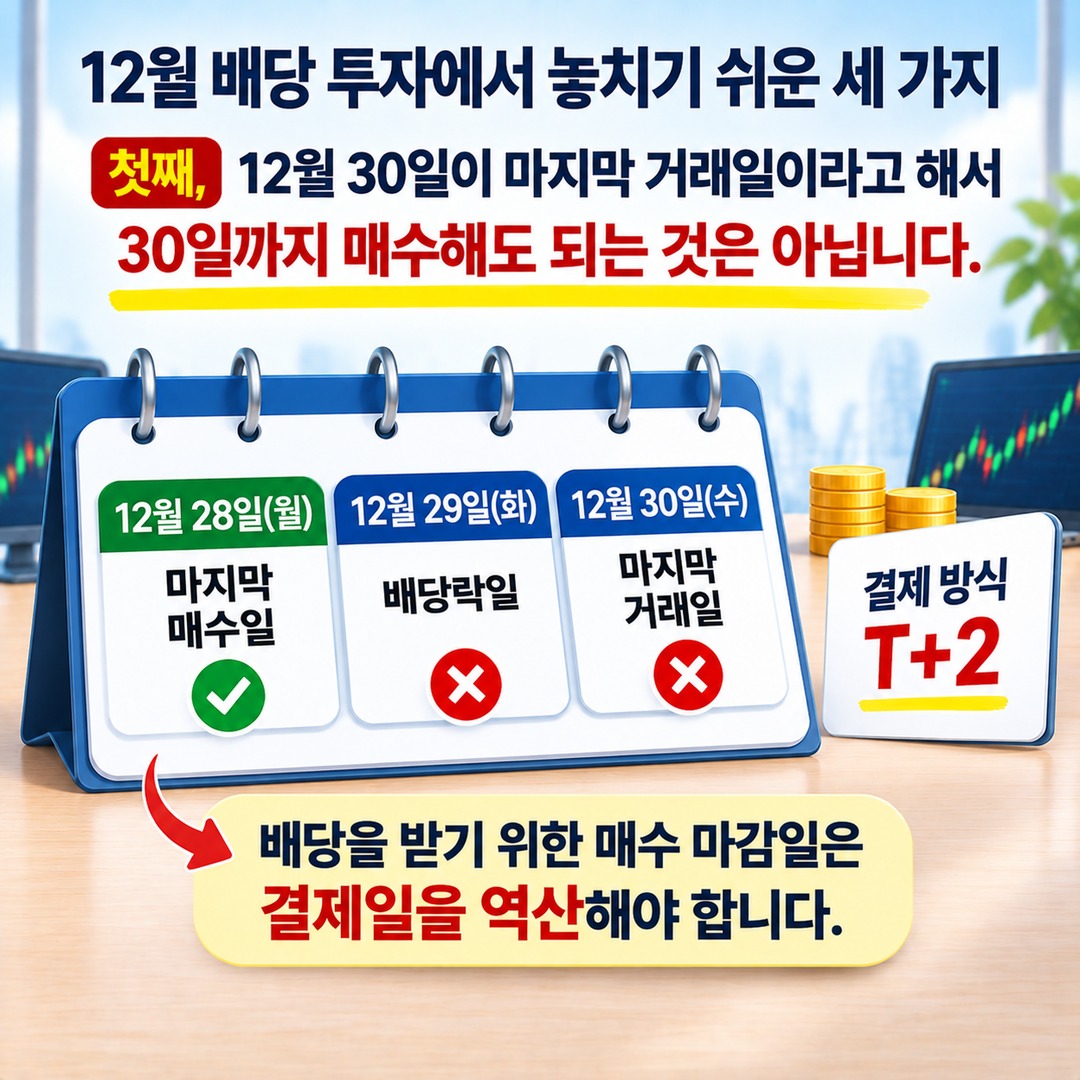
The key is T+2, the settlement method used for domestic stocks. Under T+2, settlement is completed 2 business days after the date on which the shares are purchased.
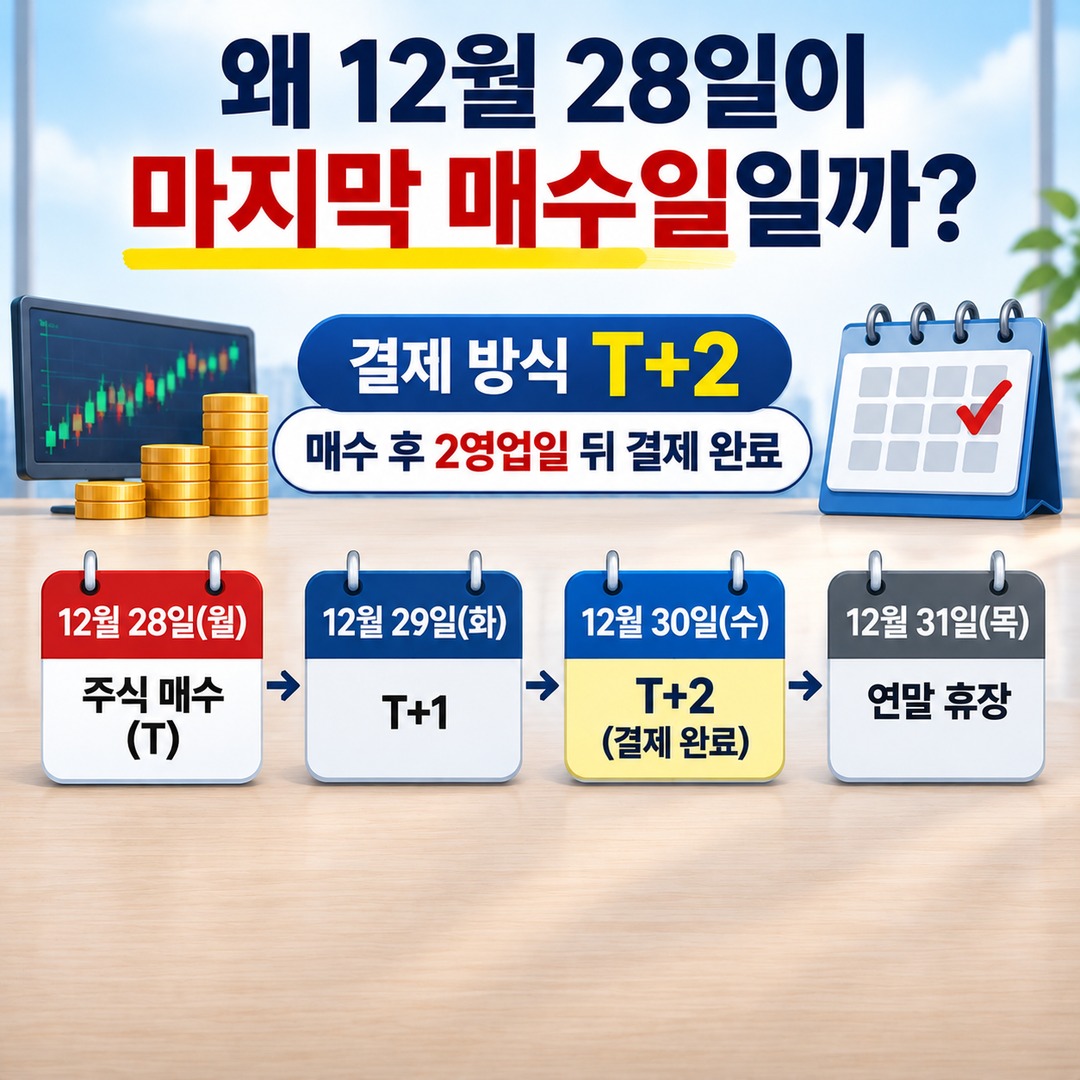
According to the Korea Exchange's securities market settlement and holiday regulations, stock trades are settled on a T+2 basis.
The final week of December 2026, calculated using actual trading days, looks like this:
| Date | Day | Settlement status |
|---|---|---|
| December 28 | Monday | Stock purchase (T) |
| December 29 | Tuesday | T+1 |
| December 30 | Wednesday | T+2 settlement completed |
| December 31 | Thursday | Year-end market holiday |
Therefore, shares purchased on December 28 will complete settlement on December 30.
By contrast, shares purchased on December 29 will have a settlement date falling in 2027, so they will not be reflected in the shareholder register as of December 31.
Author's Calculation
Record date: 2026-12-31
Settlement method: T+2
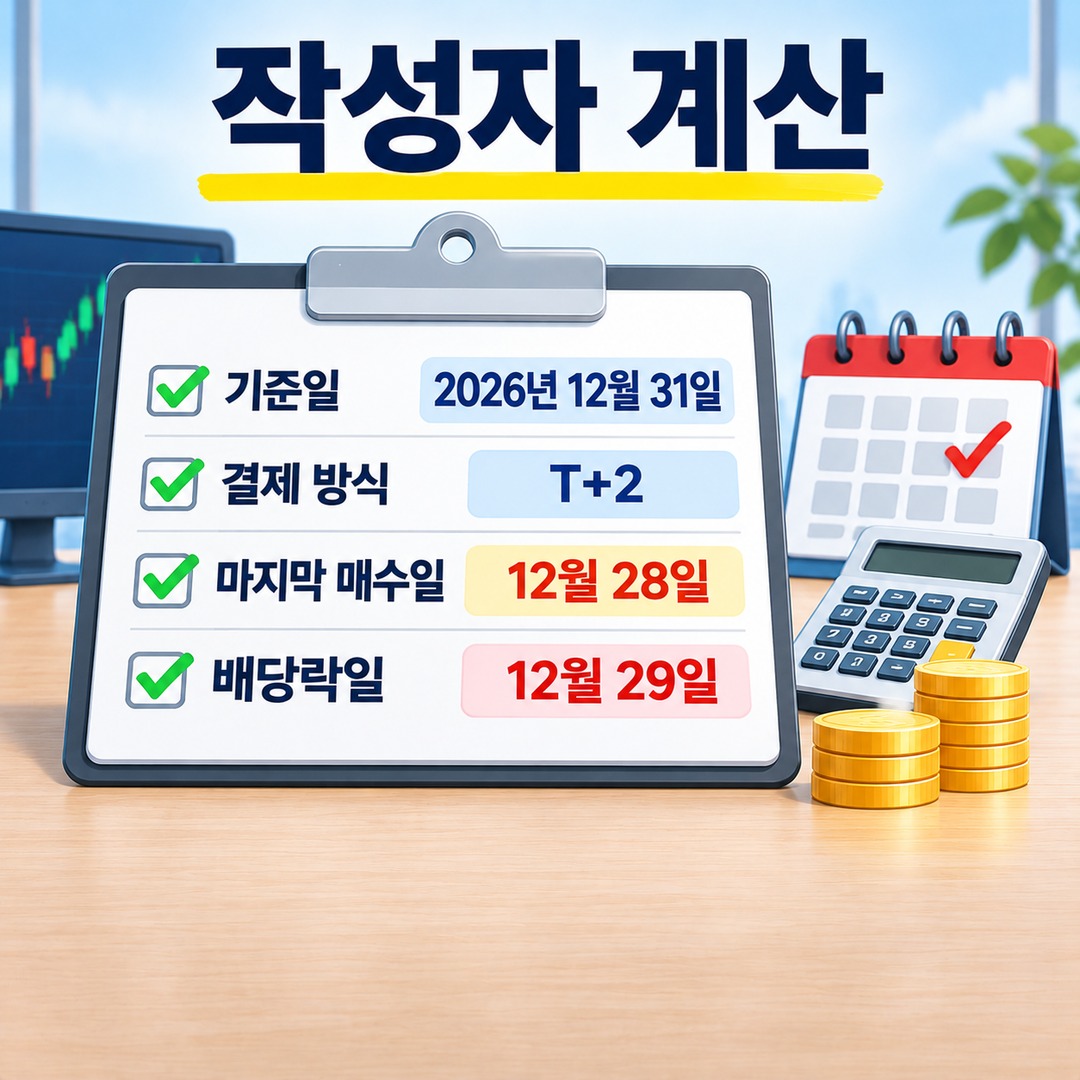
Last day to buy shares: December 28
Ex-dividend date: December 29
The Korea Exchange's 2026 KOSDAQ Market Disclosure Calendar also identifies December 29 as the ex-dividend date for December year-end dividend companies. However, it also specifies that investors must check each company's articles of incorporation and dividend record date.
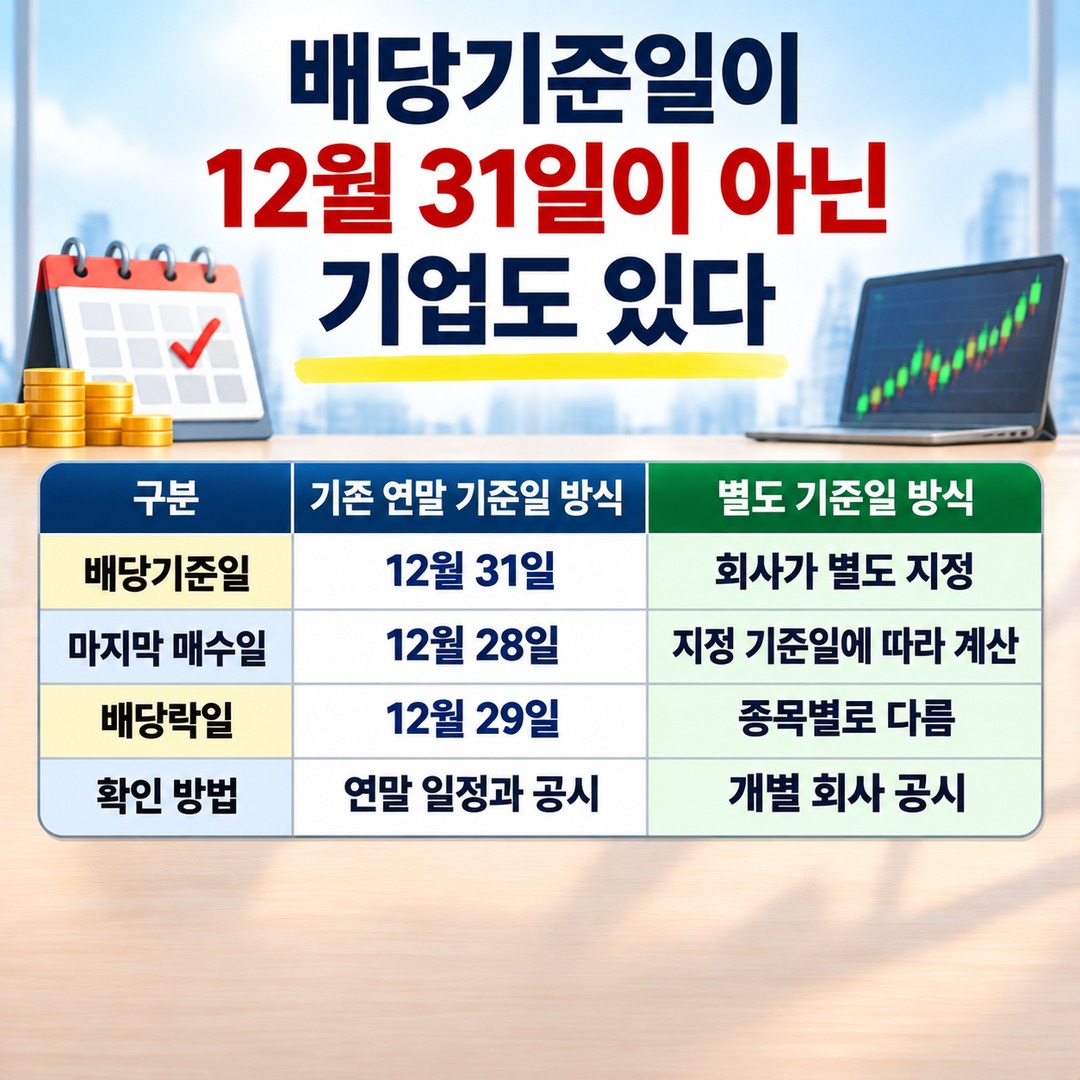
Some Companies Have a Dividend Record Date Other Than December 31
There is one particularly important point to keep in mind.
Investors seeking December 2026 dividends do not necessarily have to buy shares in every stock by December 28.
Since 2023, improvements to the year-end dividend process have allowed companies to separate the voting record date from the dividend record date.
The key feature of the dividend procedure reform announced by the Financial Services Commission in 2023-01-31 is that companies can first determine the dividend amount and then identify the shareholders entitled to receive it.
As a result, some companies can designate a separate dividend record date after their annual general meeting of shareholders.
For details about the system, see the Financial Services Commission's dividend procedure reform plan.
Because of this difference, the following two situations must be distinguished.
| Category | Traditional year-end record date | Separately designated record date |
|---|---|---|
| Dividend record date | December 31 | Separately designated by the company |
| Last day to buy shares | December 28 | Calculated according to the designated record date |
| Ex-dividend date | December 29 | Varies by stock |
| How to check | Year-end schedule and disclosures | Individual company disclosures |
In other words, if a company has designated December 31 as its dividend record date, you must buy shares by December 28. However, if a company has designated a separate record date in 2027, the purchase deadline must be recalculated according to that schedule.
What Is the Difference Between the Dividend Record Date and the Ex-Dividend Date?
Confusing these two terms can lead to an incorrect decision about when to buy shares.
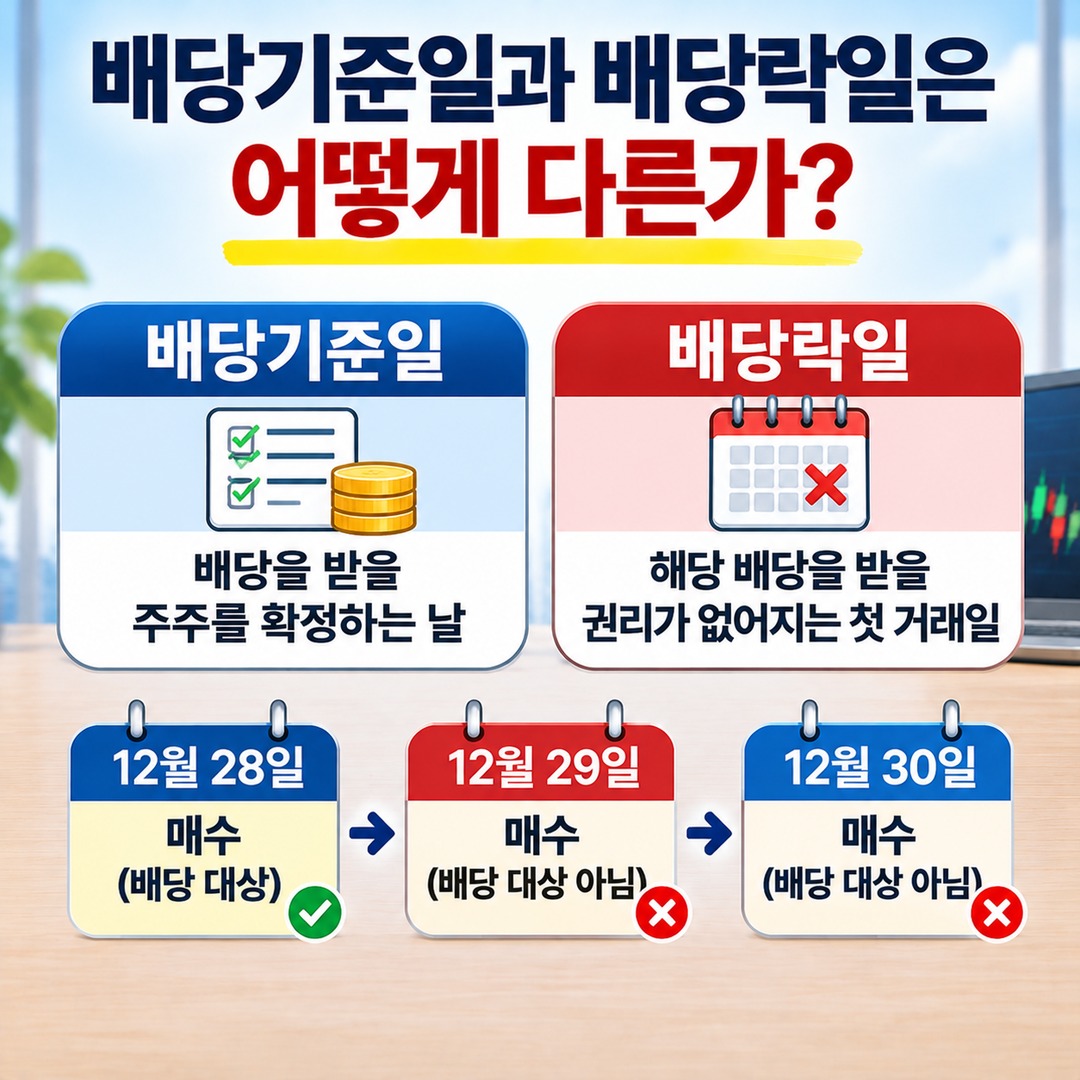
The dividend record date is the date on which the company determines which shareholders are entitled to receive a dividend. Eligible shareholders are those recorded in the shareholder register as holding dividend rights on the date designated by the company.
The ex-dividend date is the first trading day on which shares no longer carry the right to receive that dividend. Shares purchased on or after the ex-dividend date are not eligible for that particular dividend.
For example, if a company has 2026-12-31 as its dividend record date, the following applies:
Purchase executed on December 28: Eligible for the dividend
Purchase executed on December 29: Not eligible for that dividend
Purchase executed on December 30: Not eligible for that dividend
You can still become a shareholder by purchasing shares on the ex-dividend date, but you will not be entitled to the dividend for the distribution period whose eligibility date has already passed.
Which Company Disclosures Should You Check Before Buying?
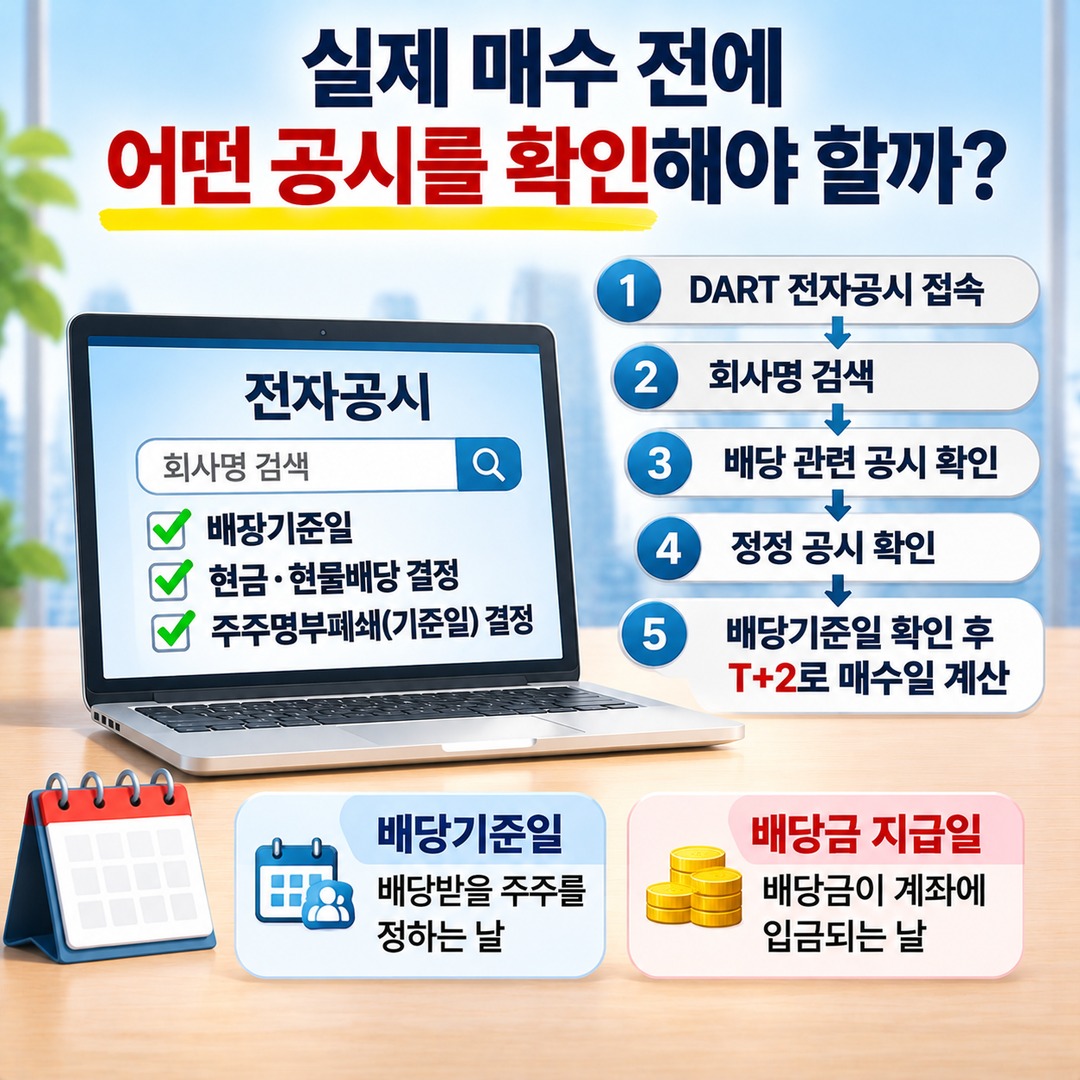
To receive December dividends, the most reliable approach is to check the record date announced by the company rather than making assumptions based solely on its name.
You can check this by following these steps.
1. Visit the Financial Supervisory Service's DART electronic disclosure system.
2. Search for the company you intend to invest in.
3. Check disclosures such as `배당기준일`, `현금·현물배당 결정`, and `주주명부폐쇄(기준일) 결정`.
4. Check whether the company has submitted a more recent amended disclosure.
5. After confirming the actual dividend record date, calculate the last day to buy shares based on the T+2 settlement cycle.
In particular, do not confuse the dividend record date with the scheduled payment date.
The dividend record date determines which shareholders are entitled to receive the dividend, while the dividend payment date is when the actual payment is deposited into their accounts.
These are two different dates.
Three Commonly Overlooked Points When Investing for December DividendsFirst, just because December 30 is the last trading day does not mean you can buy shares through 30 and still qualify for the dividend.
The purchase deadline for dividend eligibility must be calculated backward from the settlement date.
Second, the dividend record date may vary from company to company.
Not every December year-end dividend company uses December 31 as its dividend record date.
Third, receiving a dividend does not guarantee an investment profit.
On the ex-dividend date, the share price may be adjusted to reflect the loss of dividend entitlement. Actual price movements vary depending on market conditions and supply and demand for each stock. Buying shares based solely on the dividend may therefore result in unexpected losses if the share price falls.
Key Dates to Check Before Buying
For year-end dividends from Korean-listed companies that have designated 2026-12-31 as their dividend record date, December 28 (Monday) is the last day to buy shares.
However, companies that have designated a separate dividend record date under the revised dividend procedures may follow a different schedule.
Therefore, if you are investing for December dividends, there is one thing you should check first.
What Is the Actual Dividend Record Date for the Stock I Plan to Hold?
Once you have confirmed this date, you can calculate the purchase deadline by counting backward using the T+2 settlement cycle and the exchange's business days.
※ This article is provided for informational purposes to help readers understand market trends. It is not an investment recommendation for any particular stock or asset. All investment decisions and responsibility for their outcomes rest with the individual investor.