

October 2026 Electricity Bill Progressive Rates: Why You Pay More Despite Using the Same 400kWh as in August
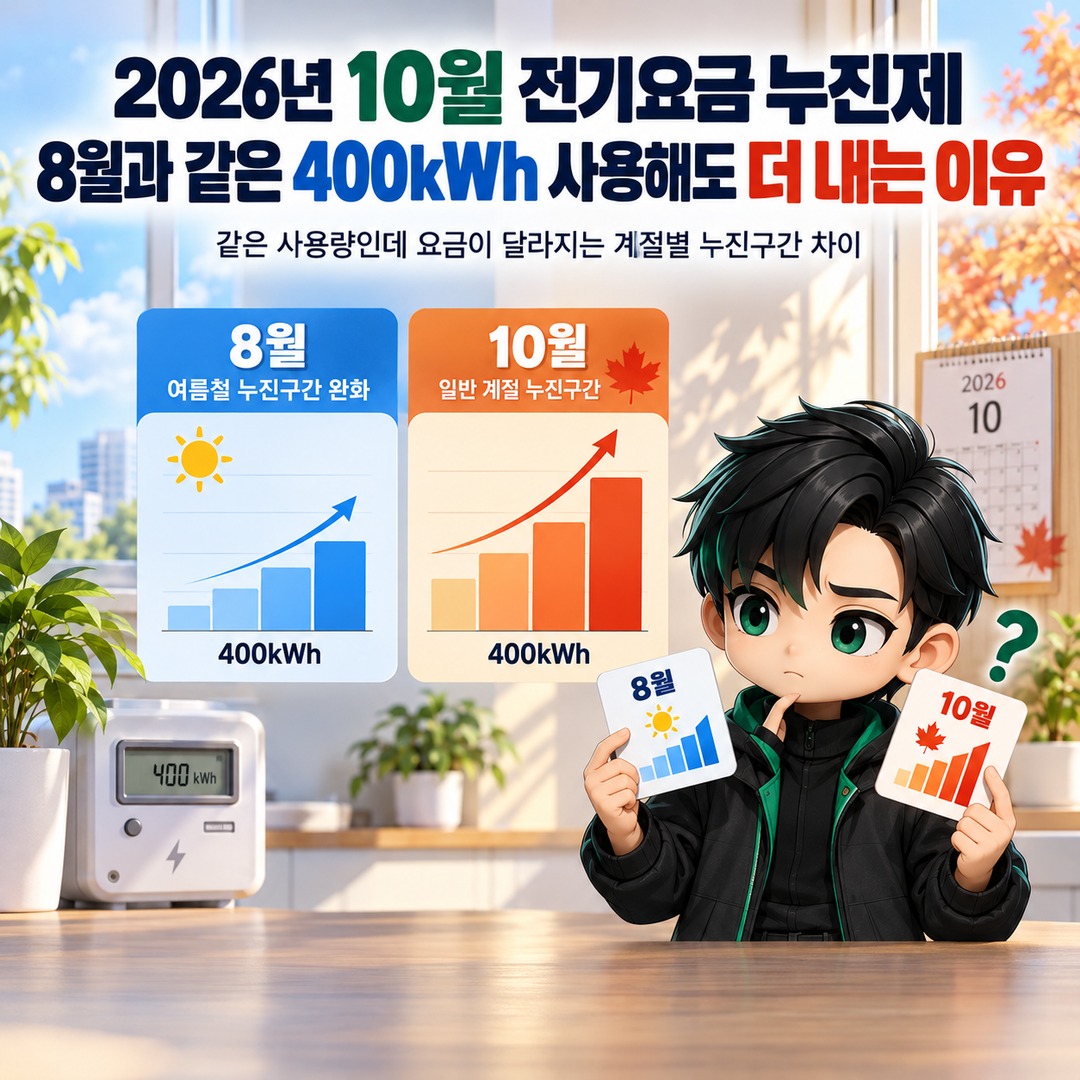
If you use 400kWh of electricity in October 2026, your electricity bill will be higher even if your consumption is the same as in August. This is because the relaxed summer progressive-rate thresholds for low-voltage residential electricity no longer apply. Even if electricity rates remain frozen for 4 quarter, the differences between seasonal progressive-rate thresholds do not disappear.
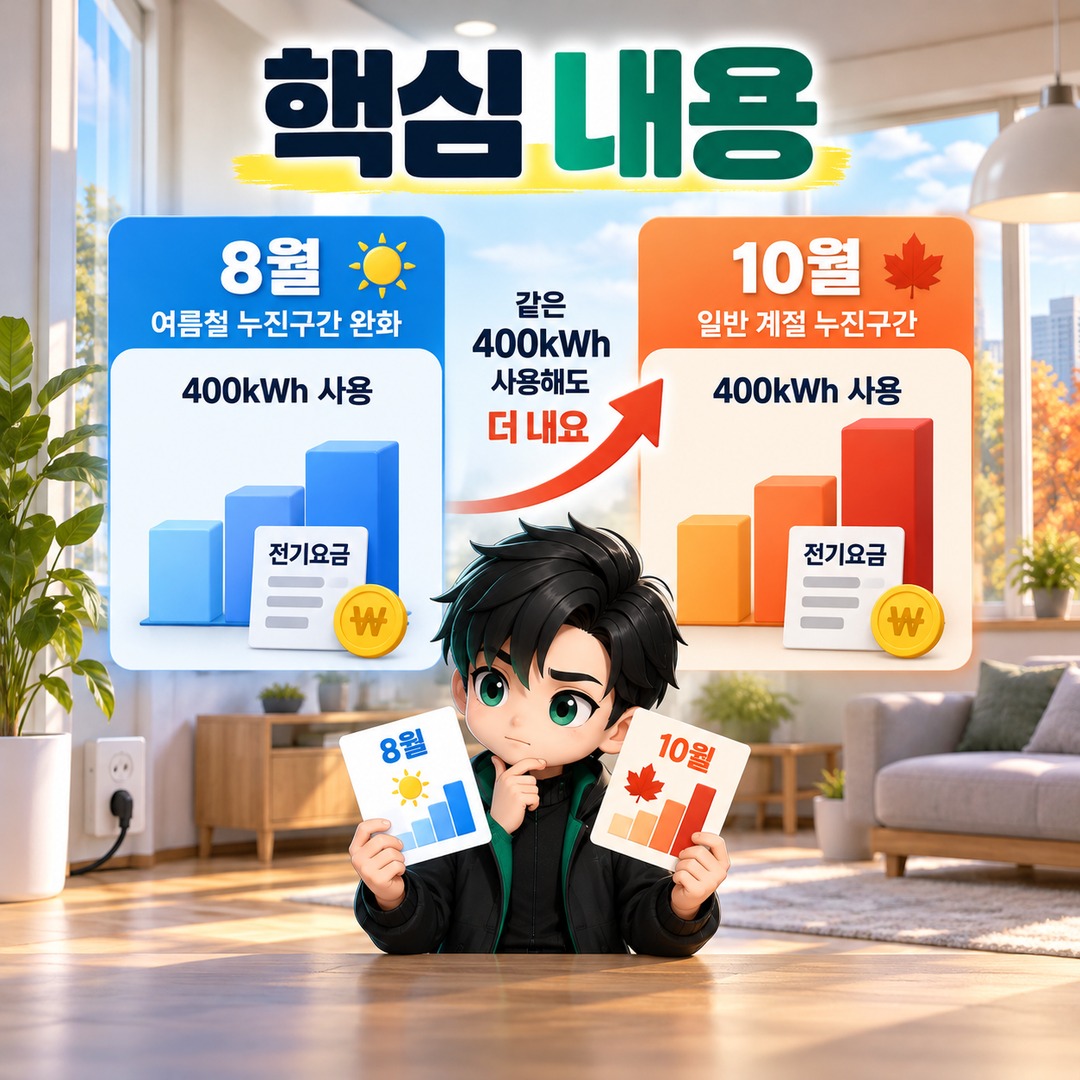
In particular, 400kWh is a useful consumption level for comparing electricity charges between summer and other seasons. Let's examine the actual calculations to understand why your bill can change even when you have not used more electricity.
How Do Progressive-Rate Thresholds Differ Between August and October?
The progressive-rate system for residential electricity applies expanded consumption thresholds from 7 through August, then returns to the standard seasonal thresholds in October.

The electricity consumption rates themselves do not change. Instead, the amount of electricity eligible for lower rates changes.
| Category | August | October |
|---|---|---|
| Tier 1 | Up to 300kWh | Up to 200kWh |
| Tier 2 | 301–450kWh | 201–400kWh |
| Tier 3 | Above 450kWh | Above 400kWh |
According to the verified rate schedule, low-voltage residential electricity consumption rates for 2026 are KRW 120.0 per kWh for Tier 1, KRW 214.6 for Tier 2, and KRW 307.3 for Tier 3.
If you use 400kWh, the Tier 2 basic charge of KRW 1,600 applies in both months. Therefore, the important factor in this comparison is not an increase in the basic charge but the difference in how electricity consumption is allocated between Tier 1 and Tier 2.
How Much Does the Electricity Consumption Charge Differ at 400kWh?
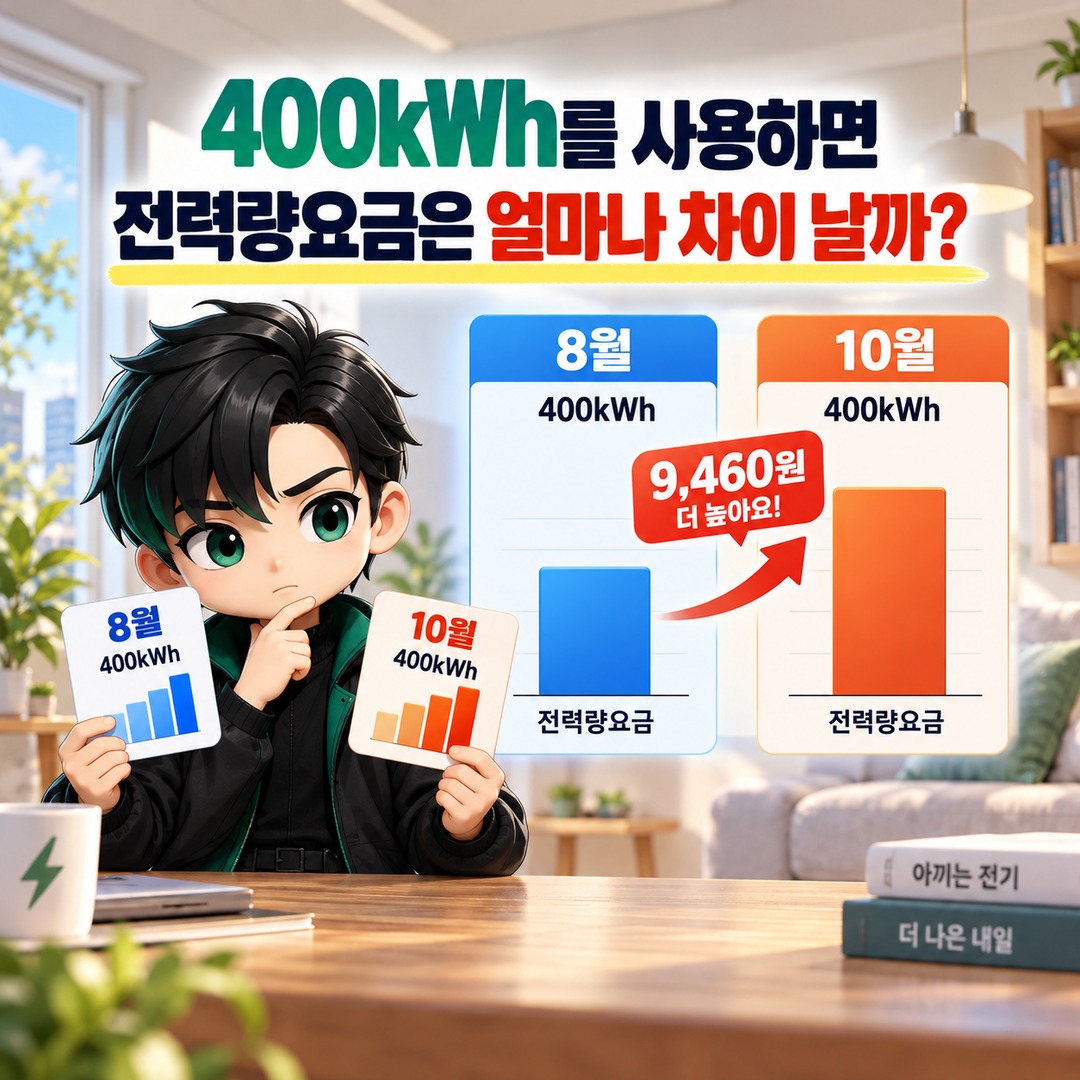
Even with identical consumption of 400kWh, the electricity consumption charge in October is KRW 9,460 higher than in August.
This is because, in August, the lower Tier 1 rate applies to the first 300kWh, whereas in October, it applies only to the first 200kWh.
August 400kWh Calculation
First 300kWh × KRW 120.0 = KRW 36,000
Remaining 100kWh × KRW 214.6 = KRW 21,460
Total electricity consumption charge = KRW 57,460
October 400kWh Calculation
First 200kWh × KRW 120.0 = KRW 24,000
Remaining 200kWh × KRW 214.6 = KRW 42,920
Total electricity consumption charge = KRW 66,920
The comparison is as follows.
August Electricity Consumption Charge
KRW 57,460
October Electricity Consumption Charge
KRW 66,920
Low-voltage residential electricity · 400kWh · Excluding the basic charge and other billing items
The difference in electricity consumption charges is KRW 9,460, approximately 16.5% higher than in August. This figure is calculated directly from the rate schedule and is not the percentage increase in the final bill.
To understand the calculation more simply, 100kWh shifts from Tier 1 to Tier 2 in October compared with August.
100kWh × (KRW 214.6 - KRW 120.0) = KRW 9,460
In other words, this difference is not caused by increased electricity consumption. It results from a different rate being applied to the same 100kWh of electricity.
Could the Actual Electricity Bill Differ by More Than Approximately KRW 10,000?
When value-added tax and the Electric Power Industry Infrastructure Fund contribution are included in the electricity consumption charge difference of KRW 9,460, the increase is approximately KRW 10,700.
This calculation assumes 400kWh of low-voltage residential electricity consumption as of 2026-10-10, with an environmental charge of KRW 9 per kWh, a fuel cost adjustment charge of KRW 5 per kWh, and an Electric Power Industry Infrastructure Fund contribution rate of 2.7%.
| Calculation Item | August | October |
|---|---|---|
| Basic charge | KRW 1,600 | KRW 1,600 |
| Electricity consumption charge | KRW 57,460 | KRW 66,920 |
| Environmental charge | KRW 3,600 | KRW 3,600 |
| Fuel cost adjustment charge | KRW 2,000 | KRW 2,000 |
| Electricity charge subtotal | KRW 64,660 | KRW 74,120 |
| Value-added tax 10% | KRW 6,466 | KRW 7,412 |
| Electric Power Industry Infrastructure Fund 2.7% | Approximately KRW 1,740 | Approximately KRW 2,000 |
| Estimated total | Approximately KRW 72,860 | Approximately KRW 83,530 |
Estimated increase with identical consumption of 400kWh
Approximately KRW 10,670
Approximately 14.6% increase compared with August · Author's calculation
This is an illustrative comparison based on the standard rate structure for low-voltage residential households. It does not account for welfare discounts, large-family discounts, differences in meter-reading periods, apartment building electricity contract arrangements, or separately billed items.
Actual bills may differ because of rounding to whole currency units and household-specific discounts.
Is the Higher Electricity Bill in October Caused by a Rate Increase?
The fuel cost adjustment rate for 4 quarter of 2026 remained at +KRW 5 per kWh. Therefore, the difference in this 400kWh comparison is not caused by an increase in the quarterly fuel cost adjustment rate.

In addition to the basic charge and electricity consumption charge, electricity bills include environmental charges and fuel cost adjustment charges.
If the same 400kWh is consumed and identical additional rates apply in both months, the environmental charge and fuel cost adjustment charge will be the same. The actual difference comes from the electricity consumption charge resulting from changes in the progressive-rate thresholds.
The relaxed summer thresholds apply through August 31, and the standard seasonal thresholds return from September 1.
Therefore, a new progressive-rate system did not suddenly begin in October. It is also important to distinguish this from the fact that the standard seasonal thresholds have already been in effect since September.
How Much Does the Bill Change If Consumption Slightly Exceeds 400kWh?
In October, electricity consumption exceeding 400kWh enters the Tier 3 progressive-rate bracket.
For low-voltage residential electricity, the basic charge is KRW 1,600 for consumption up to 400kWh, but it changes to KRW 7,300 when consumption reaches 401kWh.
That means the basic charge alone increases by KRW 5,700.
In addition, electricity consumption above 400kWh is charged at the Tier 3 rate of KRW 307.3 per kWh.
Importantly, consuming 401kWh does not mean that the KRW 307.3 rate applies to the entire 401kWh. The first 200kWh and the next 200kWh are calculated at their respective tier rates, while the Tier 3 consumption rate applies only to the excess 1kWh.
By contrast, in August, consumption up to 450kWh falls within Tier 2.
Therefore, households managing their consumption around 400kWh should also pay attention to the progressive-rate thresholds in October.
What If Your Household's Electricity Bill Differs From the Calculation?
If your bill differs from the calculated amount despite identical electricity consumption, it is best to check your contract category and meter-reading period first.
Residential electricity has different rate schedules for low-voltage and high-voltage service. Apartments may use high-voltage residential rates or other electricity contract arrangements, so applying a low-voltage calculation directly may produce discrepancies.
Also, the billing month shown on an electricity bill does not necessarily match the actual consumption period. If the meter-reading period spans summer and the standard-rate season, you need to verify the periods to which the rates actually apply.
The verification process is straightforward.
1. Check the contract category on your electricity bill, such as low-voltage or high-voltage residential service.
2. Compare the actual electricity consumption and meter-reading periods for August and October.
3. Examine the basic charge and electricity consumption charge separately.
4. Check whether any discounts or separately billed items apply.
You can also use the electricity bill calculator on Korea Electric Power Corporation's KEPCO ON platform to check charges based on your contract category and electricity consumption.
How Much Can You Save by Reducing Electricity Consumption in October?
If you reduce electricity consumption from 400kWh to 300kWh in October, the electricity consumption charge alone decreases by KRW 21,460.
This is because the entire 100kWh reduction from 400kWh to 300kWh falls within the Tier 2 electricity consumption bracket.
Environmental charges, fuel cost adjustment charges, taxes, and fund contributions also change as consumption decreases, so the reduction in the actual bill may exceed the difference in electricity consumption charges alone.
However, because electricity usage patterns vary by household, it is not possible to state exactly how much money will be saved by switching off a particular appliance.
There are two important factors to understand about electricity bills in October 2026. First, even if consumption is identical to August, charges can change when the relaxed summer progressive-rate thresholds end. Second, during the standard-rate season, exceeding 400kWh can also result in a substantial change in the basic charge.
When comparing electricity bills for August and October, it is more accurate to examine consumption, progressive-rate brackets, and contract categories together rather than looking only at the amount payable.