

2026 Perseid Meteor Shower Viewing Times: Why You Should Watch Before Dawn on 13 Even Though the Peak Occurs During the Day
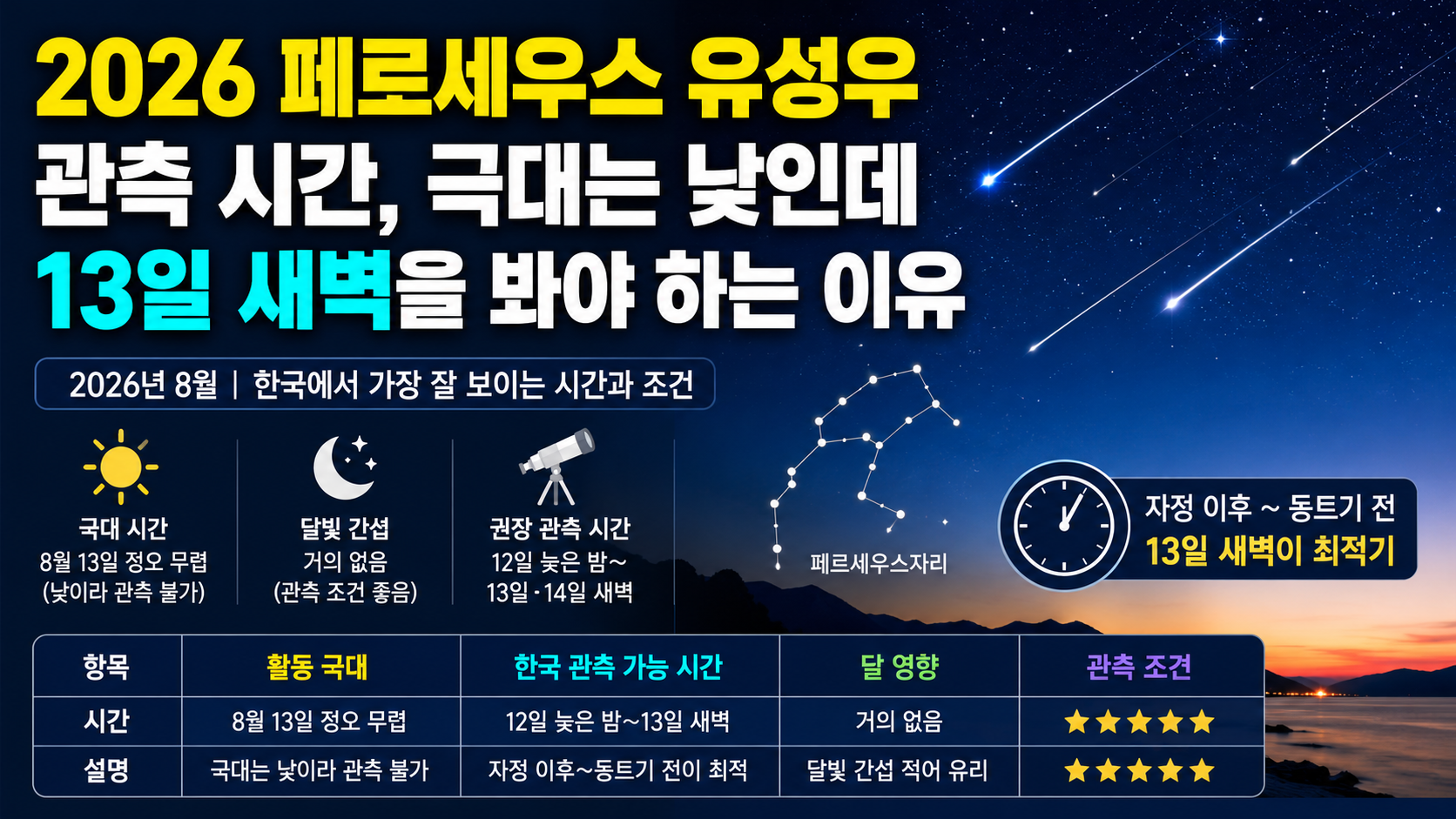
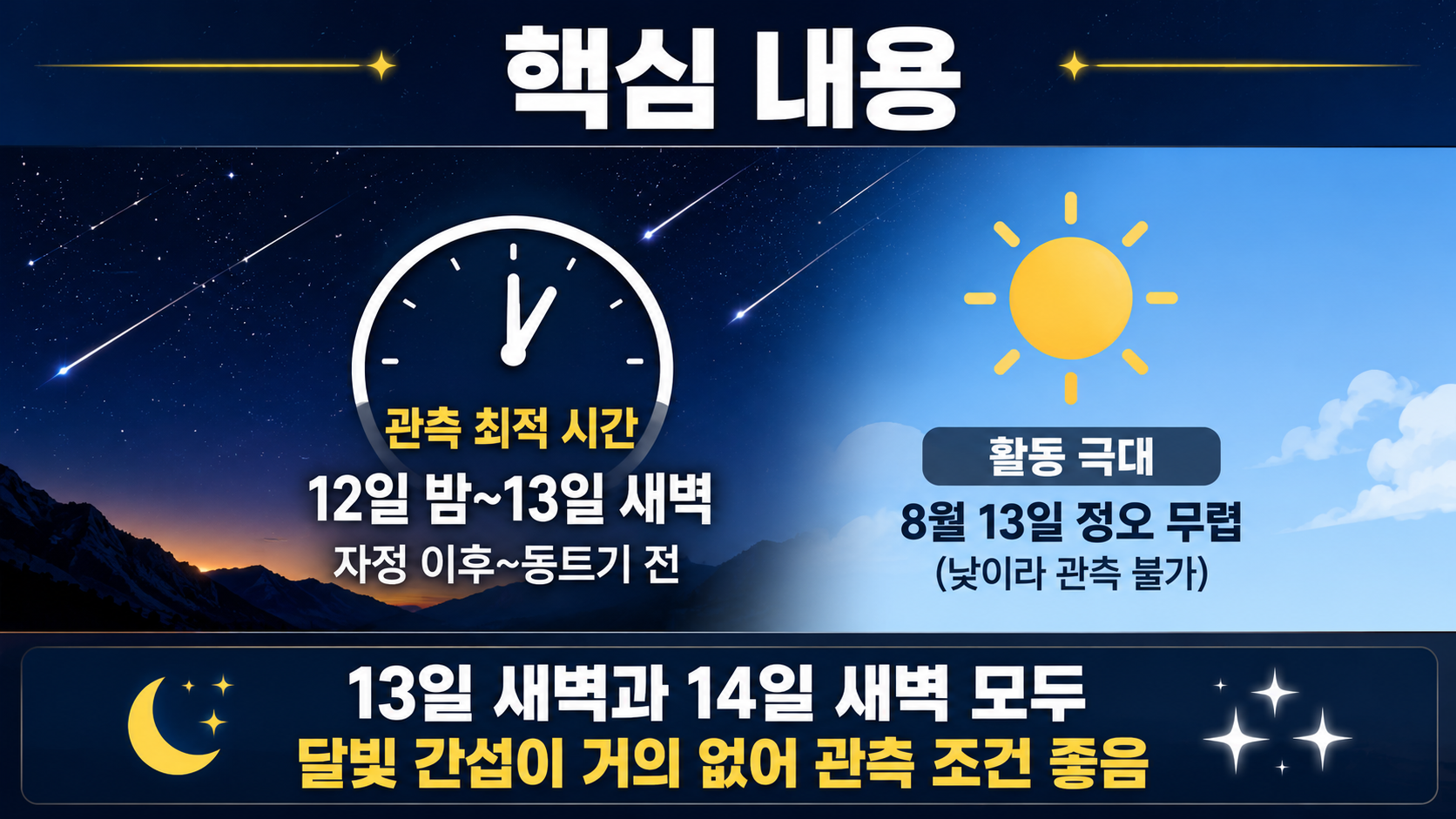
To see the 2026 Perseid meteor shower in Korea, the most practical viewing window is from late at night on August 12 until dawn on 13, especially between midnight and sunrise. Although the official peak occurs around noon on August 13, it will be daylight in Korea, making the meteors impossible to see. Fortunately, both the early morning of 13 and the early morning of 14 offer favorable viewing conditions this year, with almost no interference from moonlight.
However, the absence of moonlight does not mean meteors will be visible everywhere. As of the night of August 12, the Seoul metropolitan area and Jeolla region are expected to be mostly clear before clouds increase. Many other areas will be cloudy, with rain forecast for parts of the east coast. Cloud cover and light pollution may therefore be more important factors in determining whether you can successfully observe the shower.
What Is the Best Time to Watch in Korea?
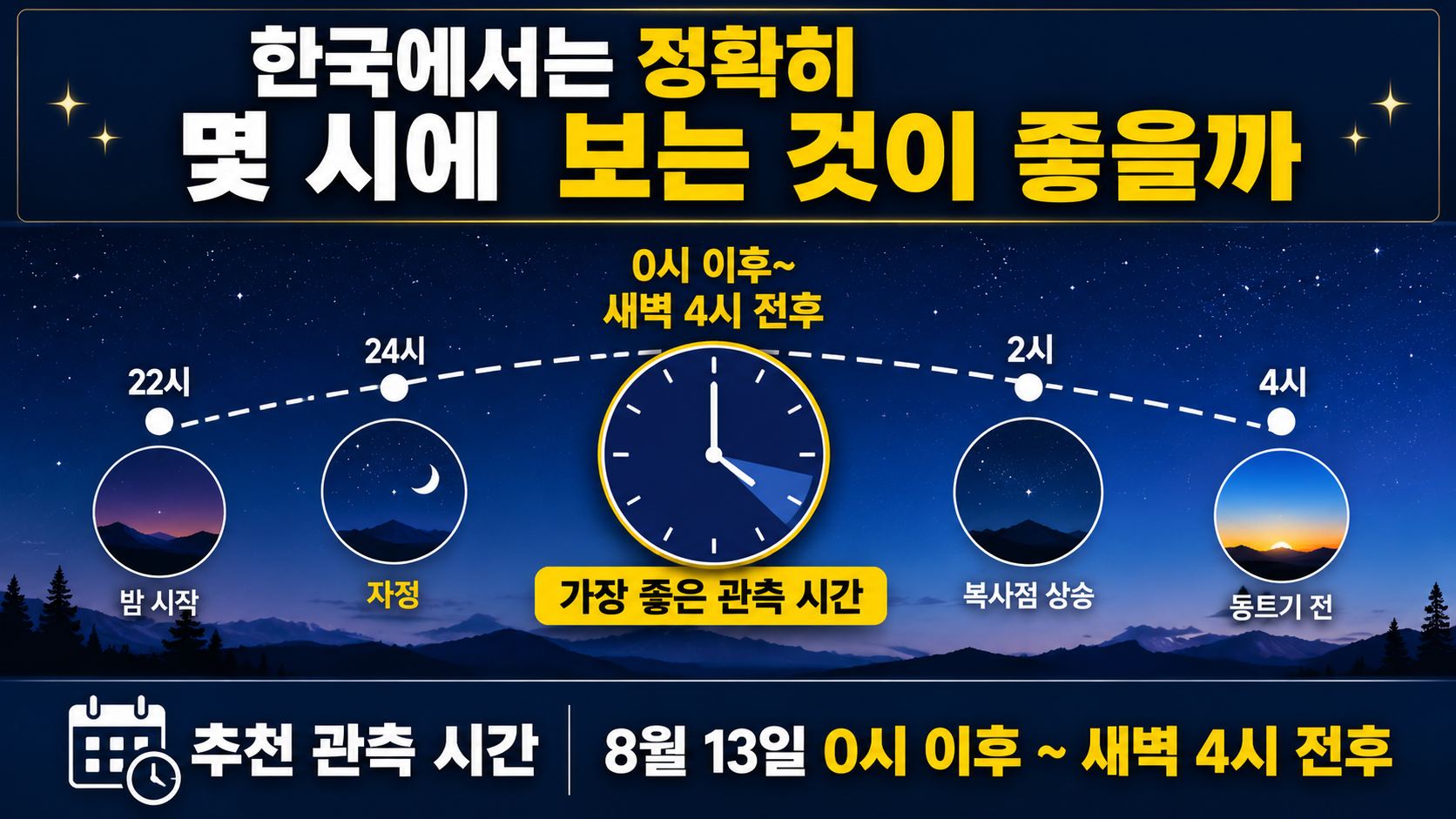
The most practical viewing period is from 0:00 on August 13 until around 4:00 in the early morning. As the night progresses, the radiant near the constellation Perseus rises higher in the sky. This makes the hours after midnight, particularly toward dawn, more favorable than the hours before midnight.
The official peak of the 2026 Perseid meteor shower occurs around noon on August 13, Korea Standard Time. The Korea Astronomy and Space Science Institute also explains that because the peak falls during daylight hours, the early mornings of 13 and 14 are better for actual observation in Korea.
This is where many people get confused.
The statement that the peak occurs at noon on 13 does not mean you should go outside at noon to watch it. The peak is the calculated time when Earth passes through the densest part of the meteoroid stream. Because the Sun is above the horizon in Korea at that time, the meteors cannot be seen with the naked eye.
For observers in Korea, the practical approach is therefore to choose the hours of darkness closest to the predicted peak.
More specifically, some astronomical observation resources identify favorable viewing windows beginning at 0:00 on August 13 and continuing until approximately 4:30 in Seoul, 4:20 in Busan, and 4:45 in Jeju. Exact ending times may vary because sunrise and the beginning of twilight differ slightly by location.
If it is currently the night of August 12, you do not necessarily have to wait until dawn to begin watching. Some meteors may be visible once the sky becomes sufficiently dark, but the hours after midnight generally offer better viewing efficiency.
Which Is Better: The Early Morning of 13 or 14?
If you can choose only one, the early morning of 13 should be your first choice because it is closer to the center of the meteor shower's activity. However, if clouds interfere on 13, the early morning of 14 is still well worth another attempt. The Korea Astronomy and Space Science Institute identifies both mornings as favorable viewing periods.
The Perseid meteor shower is not an astronomical event that suddenly switches on and off at a particular moment. This year's activity extends from mid-July through late August, with meteor rates increasing toward the peak and gradually declining afterward. International meteor observation resources also list the activity period of the 2026 Perseids as running from July 17 to August 24.
A simple way to decide when to watch is:
Night of August 12 to early morning of 13: The highest-priority viewing period.
Night of August 13 to early morning of 14: A second opportunity if the weather is poor on the first morning or you want to watch again.
Noon on 13: Meteor activity is strong, but naked-eye observation is impossible in Korea because it is daytime.
One particularly favorable factor this year is that the new moon coincides with the meteor shower's peak period. During a new moon, almost none of the Moon's illuminated surface is visible from Earth, so there is very little moonlight to brighten the night sky. The International Meteor Organization's 2026 calendar also explains that the new moon on August 12 creates favorable conditions for observing the Perseids.
This is a clear contrast with years when a bright Moon interferes with meteor observations. NASA also notes that the new moon in 2026 will create favorable conditions for viewing the shower under dark skies.
Does 100 Meteors per Hour Mean You Will Actually See That Many?
The frequently quoted estimate of 50–100 meteors per hour does not mean everyone will actually see that many meteors in a single hour. It represents a rate associated with nearly ideal conditions, including a completely clear sky, minimal surrounding light, and a favorable radiant position. NASA also explains that rates of 50–100 meteors per hour may be possible near the peak under good conditions.
Actual viewing results can vary considerably.
In urban areas filled with apartment buildings, streetlights and building lights can overwhelm fainter meteors. If buildings or mountains obstruct half the sky, the observable area becomes smaller. Thin clouds or high humidity that makes the sky appear hazy can also leave only the brightest meteors visible.
Therefore, seeing a prediction of 100 meteors per hour should not lead you to expect a meteor to appear regularly every 36 seconds.
A simple calculation by the author gives 100 meteors ÷ 60 minutes = an average of 1 meteor every 36 seconds, but meteor showers do not occur at fixed intervals. Several minutes may pass without a single meteor, followed by several appearing in quick succession.
This is why limiting your observation session to just 5 or 10 minutes could leave you returning home without seeing anything. It is better to watch the sky for at least 30 minutes, or preferably around 1 hour. NASA also recommends allowing approximately 30 minutes for your eyes to adjust to the darkness.
Which Direction Should You Look for the Best View?
At first, the northeastern sky, where the constellation Perseus rises, is a useful reference direction. However, it is better not to stare continuously at a single point. Meteors appear to radiate from the area around Perseus, but they can appear across a wide area of the sky.
Understanding the term 'radiant' makes this easier to visualize.
The radiant is the point from which meteors appear to originate when their paths are traced backward across the sky. The Perseid meteor shower gets its name because its radiant lies in the direction of the constellation Perseus.
However, you do not need to stare directly at the radiant.
In fact, narrowing your field of view may cause you to miss meteors that leave long trails. Use the northeast as a general reference, then look upward and comfortably observe a broad area of the sky.
You do not need a telescope or binoculars for basic meteor observation. Telescopes magnify a narrow section of the sky, which actually limits your field of view when trying to spot meteors that can appear unpredictably. Watching with the naked eye is the simplest and most effective method.
A picnic mat or reclining chair can help reduce neck strain while you watch. It is also best to avoid looking at your phone as much as possible. A bright screen can disrupt your eyes' adaptation to darkness, making faint meteors harder to detect.
Check Cloud Cover and Light Pollution Before Choosing a Location
When looking for a good viewing spot, it is more important to check whether the sky is relatively cloud-free, surrounding lights are limited, and the horizon is unobstructed than to choose a famous observatory or viewpoint. Even a dark mountain or rural location will offer no view if the sky is covered by clouds.
According to the latest forecast issued at 17:00 on August 12, clouds are expected to increase at times over the Seoul metropolitan area and Jeolla region from that night, while many other areas will be mostly cloudy. Rain is also forecast for parts of the Gangwon east coast and mountainous areas, as well as the northern Gyeongsang east coast. On 13, occasional cloud cover is expected nationwide, with a possibility of rain along the east coast and in some southern regions.
This means it is difficult to classify the entire country as either suitable or unsuitable for observing this meteor shower.
Even within Gyeonggi Province, sky conditions may differ depending on where cloud bands move, and conditions can change within a few hours. The most practical approach is to check the hourly cloud forecast and precipitation conditions for your exact location immediately before leaving.
A good observation site should ideally meet all three conditions:
1. Minimal streetlights and building illumination.
2. A broad view of the sky without major obstructions from trees, buildings, or mountains.
3. Limited cloud cover and a low chance of rain.
You should also make sure the location is safe for parking or staying for an extended period. Avoid stopping on road shoulders or entering restricted mountain roads or private property just to watch the stars.
If you cannot leave the city entirely, there is no need to insist on perfect conditions. You may still have a chance to see bright meteors by positioning yourself away from direct streetlight glare and finding a relatively dark park or open space with a clear view of the sky.
Why Does the Perseid Meteor Shower Occur Every August?
The Perseid meteor shower occurs when dust and small particles left behind by Comet 109P/Swift–Tuttle collide with Earth's atmosphere. Because Earth passes through this stream of debris at roughly the same time every year, the same meteor shower can be observed again around 7–August.
The bright streaks visible in the night sky are not actual stars falling from space.
They are produced when tiny particles enter Earth's atmosphere at extremely high speeds, heating the surrounding air and producing light. Although they are commonly called 'shooting stars,' the astronomical term is 'meteors.'
The Perseids are known for producing relatively frequent bright meteors and fireballs. A fireball is a meteor that shines much more brightly than an ordinary meteor.
Seeing a meteor during this period does not necessarily mean it belongs to the Perseid shower. Other meteor showers and sporadic meteors are also active around the same time. Tracing the apparent paths of several meteors backward to see whether they converge toward Perseus can help distinguish Perseids from other meteors.
If You Are Going Out Tonight, Follow These Steps
If you are reading this on the night of 2026-08-12, there is no need for complicated preparations.
First, check the cloud conditions at your location. If the sky is clear, plan to observe after midnight. Choose a location with as little surrounding light as possible. Use the northeast as your general reference direction, but do not focus exclusively on a single constellation.
It is also important not to leave immediately if you cannot see many stars when you arrive.
Your eyes will not yet be adapted to the night sky if you have just come from a brightly lit room or vehicle. Turn off your phone screen or reduce its brightness to the minimum, then wait approximately 20–30 minutes before scanning the wide sky. You should begin to notice significantly more stars than you could see at first. NASA also recommends approximately 30 minutes of dark adaptation.
Even if clouds prevent you from seeing the shower on the early morning of 13, you have not completely missed this year's opportunity. The Korea Astronomy and Space Science Institute also identifies the early morning of 14 as a favorable viewing period. However, meteor rates change from moment to moment, and weather conditions also vary, so it is impossible to guarantee that a specific number of meteors will appear at a particular time.
The key takeaway can be summarized in one sentence.
For the 2026 Perseid meteor shower in Korea, the most practical plan is to prioritize the hours after midnight on August 13 until dawn, and use the early morning of 14 as a second opportunity if clouds interfere.
---
※ This article is provided for reference purposes to help readers understand market trends and does not constitute investment advice regarding any specific stock or asset. Final investment decisions and responsibility rest with the individual.