

2026 Small Business Policy Loans: Is a Credit Guarantee Certificate Required? Application Routes and Cost Differences Between Unsecured and Guarantee-Backed Loans

When applying for a small business policy loan through a participating bank in 2026, a credit guarantee certificate from a regional credit guarantee foundation is not always required. The process depends on which financing method is available: an unsecured loan based on the bank's own credit assessment, a secured loan backed by real estate or other collateral, or a guarantee-backed loan supported by a credit guarantee institution.

In particular, guarantee-backed loans may incur guarantee fees in addition to bank interest, so comparing only loan interest rates can lead to an inaccurate assessment of the actual financial burden.
Information verified as of: 2026-10-15 · Small Business Policy Loans Through Participating Banks
1. Can Small Business Owners Apply for Policy Loans Without a Guarantee Certificate?
Yes. Policy loans provided through participating banks under the Korea SMEs and Startups Agency for Market Development (SEMAS) are divided into loans backed by guarantee certificates and loans for which banks directly assess creditworthiness or collateral.

The Ministry of SMEs and Startups' 2026 support program guidance also distinguishes between guarantee-backed loans and credit- or collateral-backed loans in its application procedures.
The biggest difference between these two methods is who assesses the lending risk and what form of security is used.
| Category | Guarantee-Backed Loan | Unsecured or Collateral-Backed Loan |
|---|---|---|
| Guarantee certificate | Required | Generally not required |
| Primary assessment | Guarantee institution and bank | Bank |
| Security method | Guarantee certificate issued by a guarantee institution | Creditworthiness or physical collateral |
| Guarantee fee | May apply | No guarantee certificate fee |
| Final loan disbursement | Bank | Bank |
An important distinction is that not needing a guarantee certificate does not automatically mean approval for an unsecured loan.
If a bank determines that a borrower does not qualify under its own credit assessment, the applicant may need to explore the possibility of obtaining a loan through a guarantee certificate.
Conversely, even after a guarantee certificate has been issued, the bank's final lending procedures must still be completed.
2. Which Business Owners May Need a Credit Guarantee Certificate?
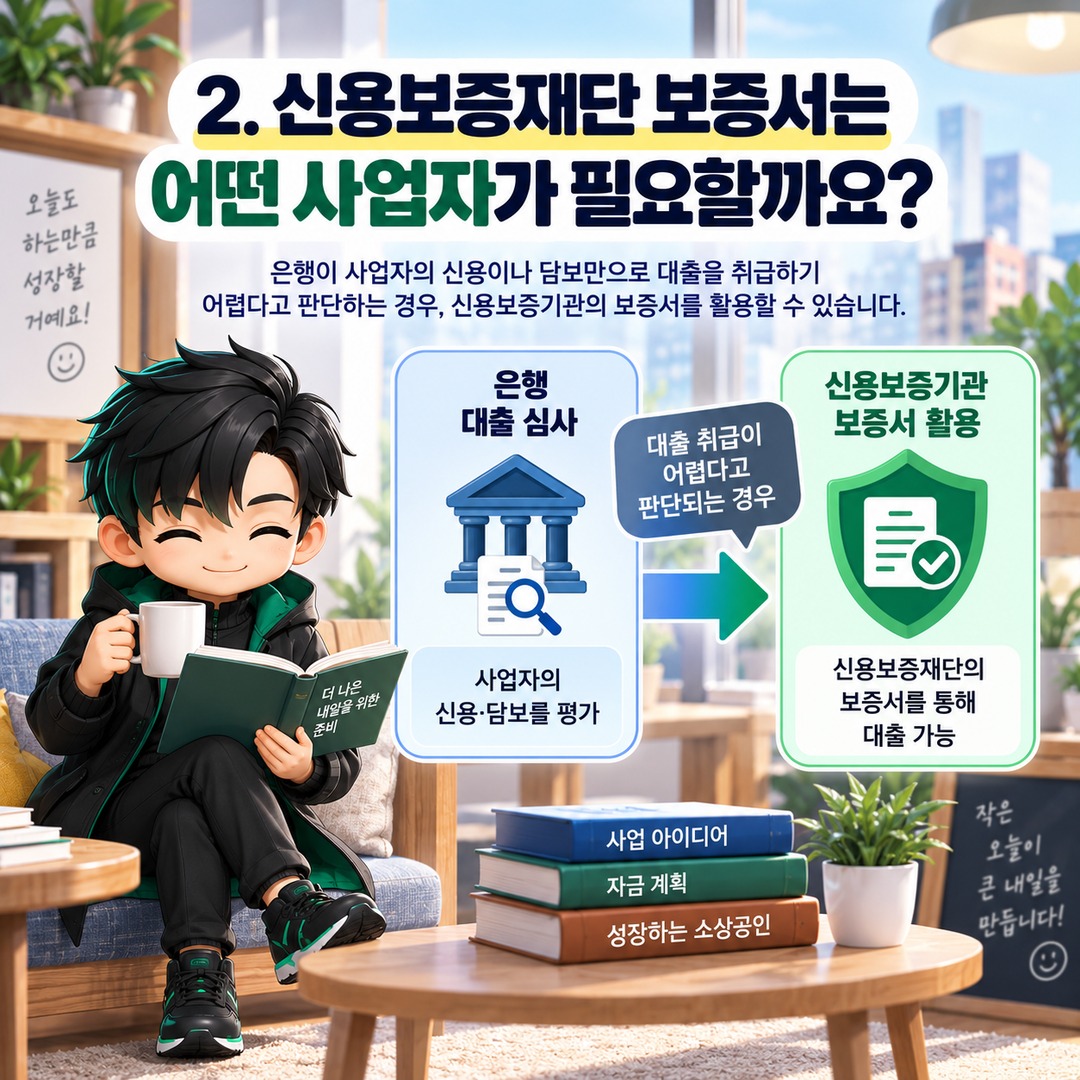
When a bank determines that it would be difficult to approve a loan based solely on a business owner's creditworthiness or collateral, a guarantee certificate issued by a credit guarantee institution may be used.
A credit guarantee certificate is part of a system in which a guarantee institution provides a guarantee covering loan obligations within a specified scope.
It is not a grant paid directly to the business owner, but rather a guarantee instrument used to obtain a bank loan.
For example, consider a sole proprietor who operates a business but does not own real estate that can be pledged as collateral.
If this business owner cannot obtain a loan based solely on the bank's credit assessment, they may consider a guarantee-backed loan after undergoing a guarantee assessment by a regional credit guarantee foundation.
However, the following factors may be important in the guarantee assessment:
The business owner's credit status and existing debts
Sales and current business operations
Financial transaction history, including overdue payments
Existing guarantee arrangements and outstanding guarantee balances
Eligibility requirements and restrictions imposed by each guarantee institution
Because guarantee institutions evaluate the business owner's overall circumstances, a guarantee certificate is not automatically issued simply because the applicant qualifies for small business policy funding.

3. How Do the Application Steps Differ Between Guarantee-Backed and Unsecured Loans?
For policy loans arranged through participating banks, the next steps depend on the financing method after the applicant completes the eligibility verification process conducted by SEMAS.
Application Steps for Guarantee-Backed Loans
1. Visit the Small Business Policy Funding Portal.
2. Check which policy loan programs are available for application.
3. Complete the eligibility verification process.
4. Apply for a guarantee assessment from the relevant guarantee institution.
5. If the guarantee is approved, proceed with the guarantee certificate issuance process.
6. Complete the participating bank's loan assessment and agreement procedures before receiving the loan.
Some banks offer online application services in partnership with regional credit guarantee foundations, so not every applicant must visit a guarantee foundation in person.
Application Steps for Unsecured or Collateral-Backed Loans
1. Apply for a policy loan through the Small Business Policy Funding Portal.
2. Complete the policy funding eligibility verification process.
3. Apply for a loan at a bank that handles the relevant policy funding program.
4. The bank assesses the applicant's creditworthiness or collateral.
5. If approved, sign the loan agreement and receive the loan.
Both methods ultimately involve loan disbursement by a bank.
However, guarantee-backed loans require an additional assessment by a guarantee institution.
In addition, when selecting the security type on the policy funding portal, applicants who choose a credit guarantee certificate must designate the credit guarantee foundation that will handle their application.
The appropriate guarantee institution should be determined based on factors such as the location of the business establishment.
4. Must Guarantee Fees Be Paid Separately From Loan Interest?
Guarantee-backed loans may involve guarantee fees in addition to the interest charged by the bank.
A guarantee fee is the cost charged by a guarantee institution for guaranteeing the borrower's loan obligations.
Therefore, even when the interest rate is identical, the actual financing cost may differ depending on whether a guarantee fee applies.
What Is the Cost Difference When Borrowing KRW 30,000,000?
The following is a hypothetical calculation intended to illustrate the cost structure, not a confirmed interest rate for an actual 2026 policy loan product.
Hypothetical calculation · Loan principal KRW 30,000,000
Annual interest at 4%
KRW 1,200,000
Assuming the principal remains unchanged for 1 year
Hypothetical annual guarantee fee at 1%
KRW 300,000
Assuming full guarantee coverage for 1 year
Hypothetical Total Annual Cost
KRW 1,500,000
Calculated by the author. Actual costs vary depending on the guarantee fee rate, guarantee coverage ratio, guarantee period, principal repayments, and availability of guarantee fee subsidies.
Under the same conditions, if the borrower can obtain an unsecured loan at an annual rate of 4% without a guarantee certificate, the guarantee fee of KRW 300,000 would not apply.
However, there is no guarantee that the actual interest rates for unsecured loans and guarantee-backed loans will be identical.
Therefore, the following three factors should be compared when determining which option is more affordable:
The actual applicable loan interest rate
The total guarantee fee and any available subsidies or reductions
The loan term and principal repayment method
It is also advisable to ask the guarantee institution whether the guarantee fee must be paid upfront when the loan is disbursed and whether part of the fee is refundable if the loan is repaid early.
5. Can a Bank Reject a Loan Even After a Guarantee Certificate Has Been Issued?
Yes.
This is because the guarantee institution's assessment and the bank's loan assessment are separate procedures.
Issuance of a guarantee certificate means that the guarantee institution agrees to provide a guarantee within a specified scope. It does not mean that the bank is obligated to disburse the loan.
Before disbursing the loan, the bank may review the applicant's credit status, financial transaction information, and eligibility to enter into a loan agreement according to its own criteria.
In addition, the amount requested by the applicant may differ from the amount ultimately approved.
For example, applying for KRW 50,000,000 does not mean that the guarantee institution and the bank will necessarily approve the same amount.
The final disbursement amount is determined by the amount recognized by the guarantee institution, the bank's assessment results, and the limits applicable to the specific policy funding program.
6. Should You Visit a Bank First or Contact a Credit Guarantee Foundation?
For small business owners applying for the first time, checking the participating banks and available security methods for the intended policy loan program first is an efficient approach.
This is because not all banks handle every policy funding product in the same way.
Following the steps below can help reduce unnecessary visits.
What to Check Before Applying
1. Check Available Funding Programs
Visit the Small Business Policy Funding Portal to review currently open programs and their eligibility requirements.
2. Identify Participating Banks
Check which banks actually handle the relevant policy loan program.
3. Discuss Security Requirements
Ask whether the bank can offer an unsecured loan based on its own credit assessment or whether a guarantee certificate is required.
4. Identify the Guarantee Institution
If a guarantee certificate is necessary, check the application procedures of the guarantee institution responsible for the area where the business is located.
5. Check the Total Cost
Compare not only the loan interest rate but also guarantee fees and repayment methods.
KB Kookmin Bank's guidance on small business policy loans also separately explains the application requirements for online loan products that use eligibility confirmation documents and credit guarantee certificates issued by regional credit guarantee foundations.
This demonstrates that policy loans arranged through participating banks do not all follow identical conditions. Applicants need to check each bank's available products and application routes.
7. Frequently Asked Questions Before Applying for a Guarantee-Backed Loan
Q. Can I Obtain a New Guarantee Certificate if I Already Have a Loan Backed by a Regional Credit Guarantee Foundation?
Having an existing guarantee does not automatically prohibit every type of additional guarantee.
However, eligibility for an additional guarantee depends on factors such as the outstanding guarantee balance, total guarantee limit, credit status, and restrictions on overlapping support under specific programs.
Before submitting a new application, applicants should check their existing guarantee balance and the amount of additional guarantee coverage available.
Q. Does Not Having a Guarantee Certificate Mean I Cannot Apply for a Small Business Policy Loan at All?
No.
There are also policy loan application routes that rely on the bank's assessment of creditworthiness or collateral.
However, actual availability depends on the funding program being applied for and the participating bank's assessment criteria.
Q. Are Guarantee-Backed Loans Always Offered at Lower Interest Rates Than Ordinary Unsecured Loans?
No.
Although guarantee-backed loans use guarantees provided by guarantee institutions, the actual loan interest rate and guarantee fee burden vary by product.
Rather than comparing interest rates alone, applicants should examine the total cost, including guarantee fees.
Q. Can I Apply for Every Policy Funding Program in October 2026?
No.
Policy funding programs have different application schedules and budgets. Even programs operated throughout the year may restrict applications when their budgets are exhausted or when separate announcements impose limitations.
As of 2026-10-15, applicants should consult the latest application announcements on the Small Business Policy Funding Portal to verify which products are currently available and whether funding remains.
8. The Most Important Factors to Consider Before Applying
A guarantee certificate is not a mandatory document for every business owner applying for a small business policy loan through a participating bank.
If the bank can approve an unsecured or collateral-backed loan based on its own assessment, the applicant may proceed without a guarantee certificate. If a guarantee from a guarantee institution is required, a separate guarantee assessment must be completed.
Rather Than Choosing a Loan Solely Based on Whether a Guarantee Certificate Is Required, It Is Important to Compare Approval Prospects, Actual Interest Rates, Guarantee Fees, and Repayment Burdens.
In particular, it is advisable to prepare the following questions before consulting a bank.
Checking these two points can help applicants better understand the application procedures they need to follow and their expected financing costs.
---
Official Information Sources
Small Business Policy Funding Portal — Policy loan applications through participating banks, funding-specific application announcements, and user guidance
Korea SMEs and Startups Agency for Market Development (SEMAS) — Policy funding program information
Ministry of SMEs and Startups — 2026 policy funding loan plans and amendment announcements
KB Kookmin Bank Small Business Policy Loan Guide — Guarantee-backed loan application requirements and assessment-related FAQs
Government Civil Service Information Call Center Policy Funding FAQ — Procedures for guarantee-backed loans and credit- or collateral-backed loans
For policy funding inquiries, applicants can contact the Integrated SME Call Center at 1357 or the Policy Funding Call Center at 1533-0100.