

2026 Earned Income Tax Credit Payment of KRW 0 in December? How to Check the KRW 150,000 Threshold, Asset Requirements, and Payment Deferrals
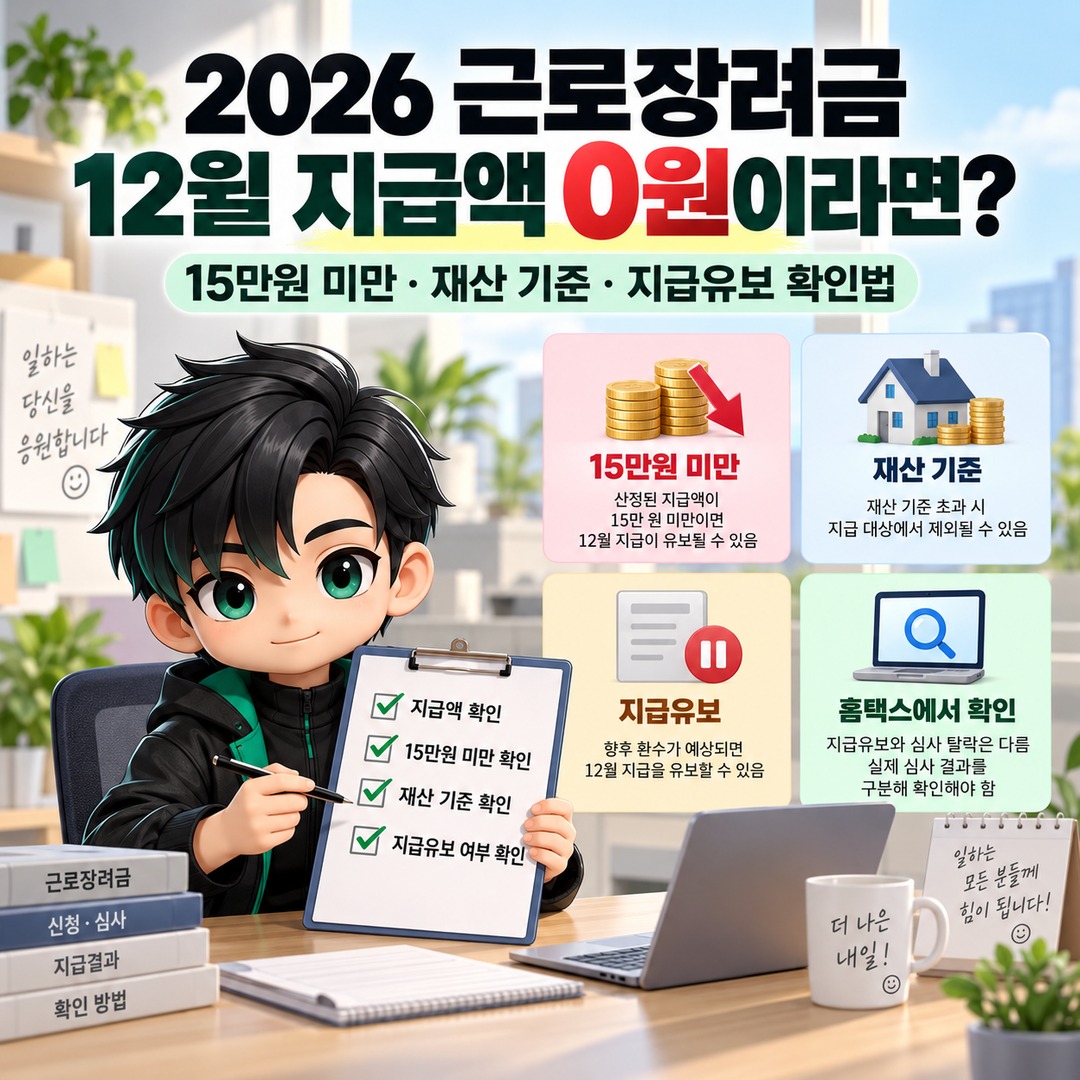
Even if you applied for the Earned Income Tax Credit in September 2026, your payment for December may be determined as KRW 0. This is because payment in December may be deferred if the calculated amount is less than KRW 150,000 or if repayment is expected later. However, a payment deferral is different from an application rejection, so you should check your actual review results through Hometax.

In particular, the timing of asset data collection used to review first-half Earned Income Tax Credit applications has also changed this year. You should not conclude that you are ineligible for the credit simply because no payment was deposited in December.
*Information verified as of 2026-10-16 / Based on National Tax Service guidance for the 2026 tax year*
1. Why Does the Earned Income Tax Credit Payment for December Show KRW 0?
Under the first-half Earned Income Tax Credit system for 2026, 35% of the estimated annual credit is paid first, with a final reconciliation in June 2027 reflecting annual income, asset requirements, and other eligibility conditions.

The National Tax Service identifies two main reasons for deferring payment.
Less than KRW 150,000: The amount payable in December is less than KRW 150,000.
Expected repayment: There is a possibility that an advance payment made in December would have to be repaid during the following year's reconciliation.
In either case, payment may be withheld in December, with the final amount determined through the review in June 2027.
The important point is that a displayed payment amount of KRW 0 does not always mean permanent exclusion from payment.
An application still under review, a decision to defer payment, and a decision to deny payment because income or asset requirements were not met are three different situations.
Therefore, you need to check not only whether your application was submitted but also the details of the payment decision.
2. Does an Amount Below KRW 150,000 Mean You Will Receive No Credit at All?
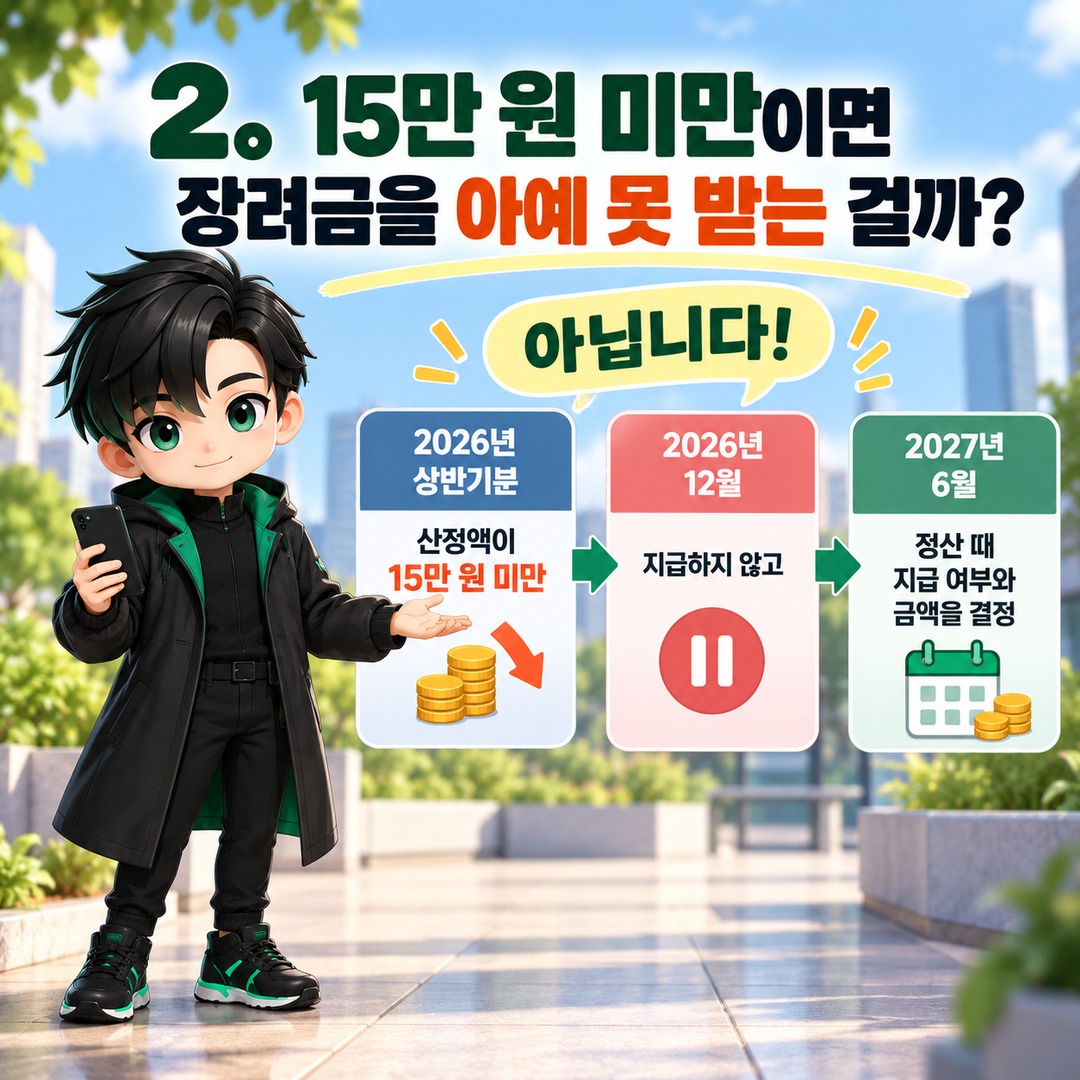
No. If the first-half payment for 2026 is less than KRW 150,000, it will not be paid in December. Instead, eligibility for payment and the amount will be determined during the following year's June reconciliation.
For example, if the estimated annual Earned Income Tax Credit is KRW 400,000, the calculation is as follows.
| Calculation Item | Amount |
|---|---|
| Estimated annual credit | KRW 400,000 |
| First-half payment percentage | 35% |
| Calculated payment for December | KRW 140,000 |
| Payment status for December | Payment may be deferred because the amount is below KRW 150,000 |
The calculation is:
KRW 400,000 × 35% = KRW 140,000
In this example, KRW 140,000 is not immediately deposited in December. Instead, payment is deferred.
Conversely, if the estimated annual amount is KRW 1,000,000, 35% corresponds to KRW 350,000. However, the actual payment may vary depending on asset requirements, review results, and whether payment is deferred.
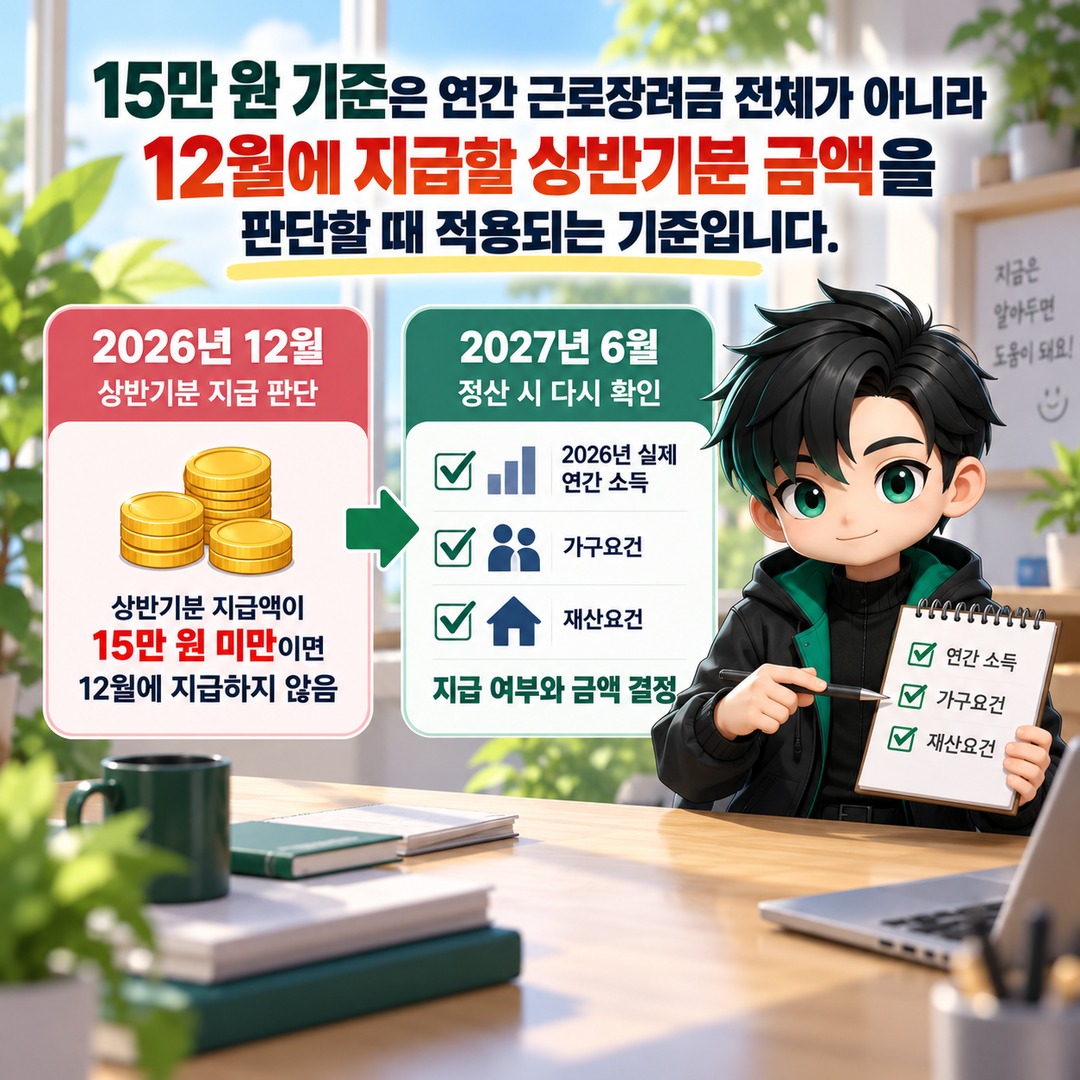
The KRW 150,000 Threshold Applies to the First-Half Amount Payable in December, Not the Entire Annual Earned Income Tax Credit.
During the June 2027 reconciliation, actual annual income for 2026 and the household and asset requirements applicable to that year are reviewed again.
Therefore, even if you received no payment in December, you may still receive the credit depending on the final calculation.
3. How Much Is the Credit Reduced if Assets Exceed 1 Hundred Million and 7 Ten Million Won?
Eligibility for the Earned Income Tax Credit depends not only on income but also on the combined assets of all household members.
First-half applications for 2026 are initially reviewed using household asset requirements and other information as of 2025-06-01.
| Total Household Assets | Applicable Rule |
|---|---|
| Below 1 hundred million and 7 ten million won | No asset-related 50% reduction |
| From 1 hundred million and 7 ten million won to less than 2 hundred million and 4 ten million won | 50% of the calculated credit is paid |
| 2 hundred million and 4 ten million won or more | Ineligible for payment |
Assets include not only homes and land but also passenger vehicles, rental deposits, bank deposits, stocks, and other property. Debts are not deducted from total assets.
For example, assume the estimated annual credit is KRW 1,000,000 and an asset-related 50% reduction applies.
Estimated credit before reduction: KRW 1,000,000
Amount after applying asset requirements: KRW 500,000
Calculated first-half amount at 35%: KRW 175,000
Compared with the first-half calculated amount of KRW 350,000 when no asset-related reduction applies, the difference is KRW 175,000.
This example illustrates the calculation method. Actual payments are determined by the National Tax Service's review results.
It is also important to distinguish cases where total assets reach 2 hundred million and 4 ten million won or more. Such cases may result in exclusion for failing to meet eligibility requirements rather than a simple payment deferral.
4. What Has Changed in Payment Deferral Reviews Starting in 2026?
The National Tax Service announced an improvement to the semiannual Earned Income Tax Credit application and payment system for 2026, bringing forward the collection of local tax assessment data.
Previously, local tax assessment data for the current year was collected in November, making it difficult to use the information sufficiently when reviewing first-half payments in December.
Under the improved system, the data is collected in August and used to assess potential payment deferrals during the first-half review stage.
The purpose of this change is to reduce situations in which recipients must repay credits during the following year's reconciliation.
For example, someone might receive an advance credit payment in December but later discover that their actual entitlement is lower based on finalized income or asset requirements the following year. In that situation, they may have to return part of the credit already received.
The National Tax Service has improved the system so that it can assess this possibility in advance and defer certain payments.
Therefore, a payment deferral in December 2026 does not, by itself, mean that the applicant submitted an incorrect application.
It is important to distinguish the reasons for payment deferral from the reasons for final payment exclusion.
5. How to Check Your Earned Income Tax Credit Review Results on Hometax
If your payment for December differs from what you expected or has not been deposited, you can check the review status through the National Tax Service's Hometax website.
Follow these steps:
1. Visit National Tax Service Hometax
2. Complete identity verification and log in
3. Select the 'Tax Credits, Year-End Tax Settlement, and Donations' menu
4. Go to 'Regular/Semiannual Earned Income Tax Credit Applications'
5. Select 'Check Review Progress'
6. Review your application details and assessment results
When checking your results, it is useful to distinguish the following three points.
First, Has the Review Been Completed?
If the application is still under review, it is difficult to determine final payment eligibility based solely on the amount displayed.
Second, Is the Payment Deferred or Denied?
A payment deferral postpones the payment date, while a payment denial means the applicant did not meet the eligibility requirements following the review.
Third, Does the Approved Amount Match the Actual Deposit?
If you have outstanding national tax liabilities, up to 30% of the refund may be applied toward those liabilities, reducing the amount actually deposited.
If the specific reason is not shown on the screen, you can contact the National Tax Service's tax credit consultation center or your local tax office for clarification.
6. If You Receive Nothing in December, Do You Need to Apply Again in March 2027?
If you successfully applied for the first-half Earned Income Tax Credit in September 2026, you generally do not need to submit another application for the second half in March 2027.
This is because first-half applicants are deemed to have applied for the second half as well.
The main schedule is as follows.
| Category | Schedule |
|---|---|
| First-half application for 2026 | September 2026 1–15 |
| First-half payment | Expected in 2026-12-17 |
| Second-half application period for 2027 | March 2027 1–15 |
| Reconciliation for the 2026 tax year | End of June 2027 |
December 17 is the scheduled payment date stated in the relevant National Tax Service application guidance, while the payment deadline under the program's rules is December 30. The scheduled date and statutory payment deadline should be distinguished.
In addition, if you have business income or religious worker income alongside employment income in 2026, your application may be processed under the regular application system, which could change the payment schedule.
You should also check whether your household has only employment income or receives other types of income as well.
7. How to Distinguish Earned Income Tax Credit Payment Deferrals From Payment Denials
The first thing to check is not simply whether money was deposited in December, but the details of the National Tax Service's review decision.
| Confirmed Situation | What to Check |
|---|---|
| Payment for December is below KRW 150,000 | Whether the payment is subject to the following year's June reconciliation |
| Payment deferred due to expected repayment | Reason for deferral and reconciliation schedule |
| Assets of 2 hundred million and 4 ten million won or more | Asset calculation details and reasons for payment denial |
| Review still in progress | Whether the review has been completed |
| Actual deposit is smaller than the approved amount | Whether the refund was applied toward outstanding national taxes |
In particular, the estimated amount provided when you applied may differ from the amount determined after the final review.
The amount shown in an application notice is not a confirmed payment. Actual entitlement is determined after the National Tax Service reviews income, household composition, and asset requirements.
Therefore, if your Earned Income Tax Credit has not been deposited in December 2026, it is advisable to check the following in order.
Check Your Hometax Review Status → Distinguish Payment Deferral From Payment Denial → Verify Asset and Income Requirements → Check Whether You Are Eligible for June 2027 Reconciliation
Even if the payment for December is KRW 0, you may still receive money during the subsequent reconciliation. However, if you do not meet the eligibility requirements, you may receive no payment even at the reconciliation stage.
The final determination must be based on your individual review results.