

2026 Year-End Tax Settlement: What If Your Credit Card Spending Exceeds 25%? The Deduction Difference When Switching KRW 2,000,000 in Spending to a Debit Card
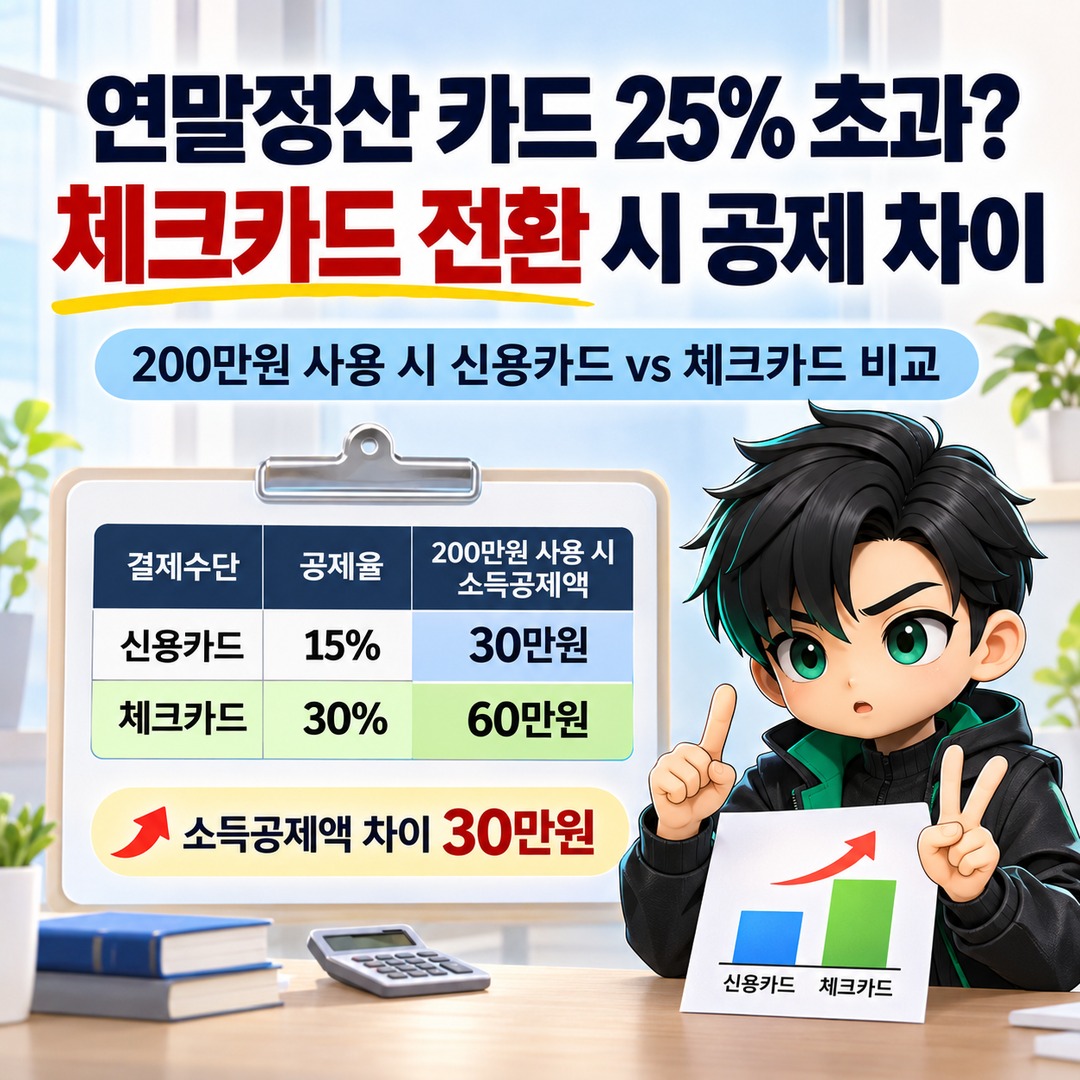
As of 2026-10-31, there are three things to check: your estimated gross annual salary for this year, your eligible card spending to date, and your remaining income deduction limit.
What Does It Actually Mean to Exceed the 25% Credit Card Spending Threshold?
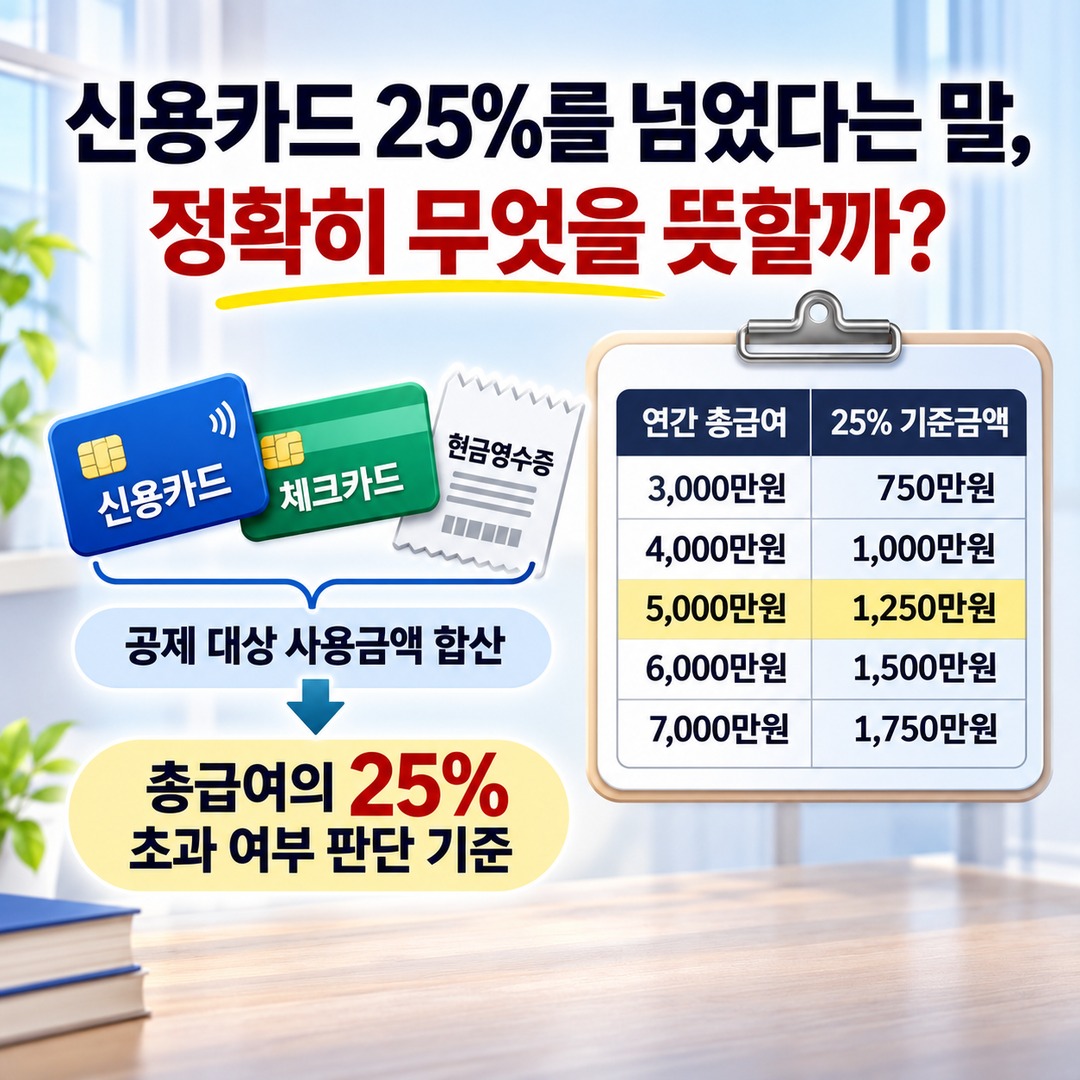
For the card spending income deduction in year-end tax settlement, 25% does not refer exclusively to the proportion spent on credit cards. Instead, the threshold is based on whether the combined eligible spending on credit cards, debit cards, cash receipts, and other qualifying payment methods exceeds 25% of your gross annual salary.
Under Article 126-2 of the Restriction of Special Taxation Act, which took effect on 2026-09-18, deduction rates and limits for each payment method apply to spending above this threshold.
The 25% thresholds for different gross annual salaries are calculated as follows.
| Gross Annual Salary | 25% Threshold Amount |
|---|---|
| KRW 30,000,000 | KRW 7,500,000 |
| KRW 40,000,000 | KRW 10,000,000 |
| KRW 50,000,000 | KRW 12,500,000 |
| KRW 60,000,000 | KRW 15,000,000 |
| KRW 70,000,000 | KRW 17,500,000 |
*Author's calculation: Gross annual salary × 0.25*
For example, if an employee earning a gross annual salary of KRW 50,000,000 has recorded KRW 15,000,000 in eligible card spending by October, their spending has already exceeded the KRW 12,500,000 threshold by KRW 2,500,000.
From that point onward, it is worth comparing which payment method to use for the rest of the year's purchases.
However, you do not need to reach the 25% threshold through credit card spending alone. The actual deduction calculation also takes into account spending by payment method and the legally prescribed order in which amounts are deducted.
Spending KRW 2,000,000 Over the Final Two Months: The Difference Between Credit and Debit Cards Is KRW 300,000
If you have already exceeded 25% of your gross annual salary and still have sufficient deduction capacity for ordinary card spending, using a debit card for an additional KRW 2,000,000 in purchases during 11–December produces an income deduction that is KRW 300,000 higher than using a credit card.
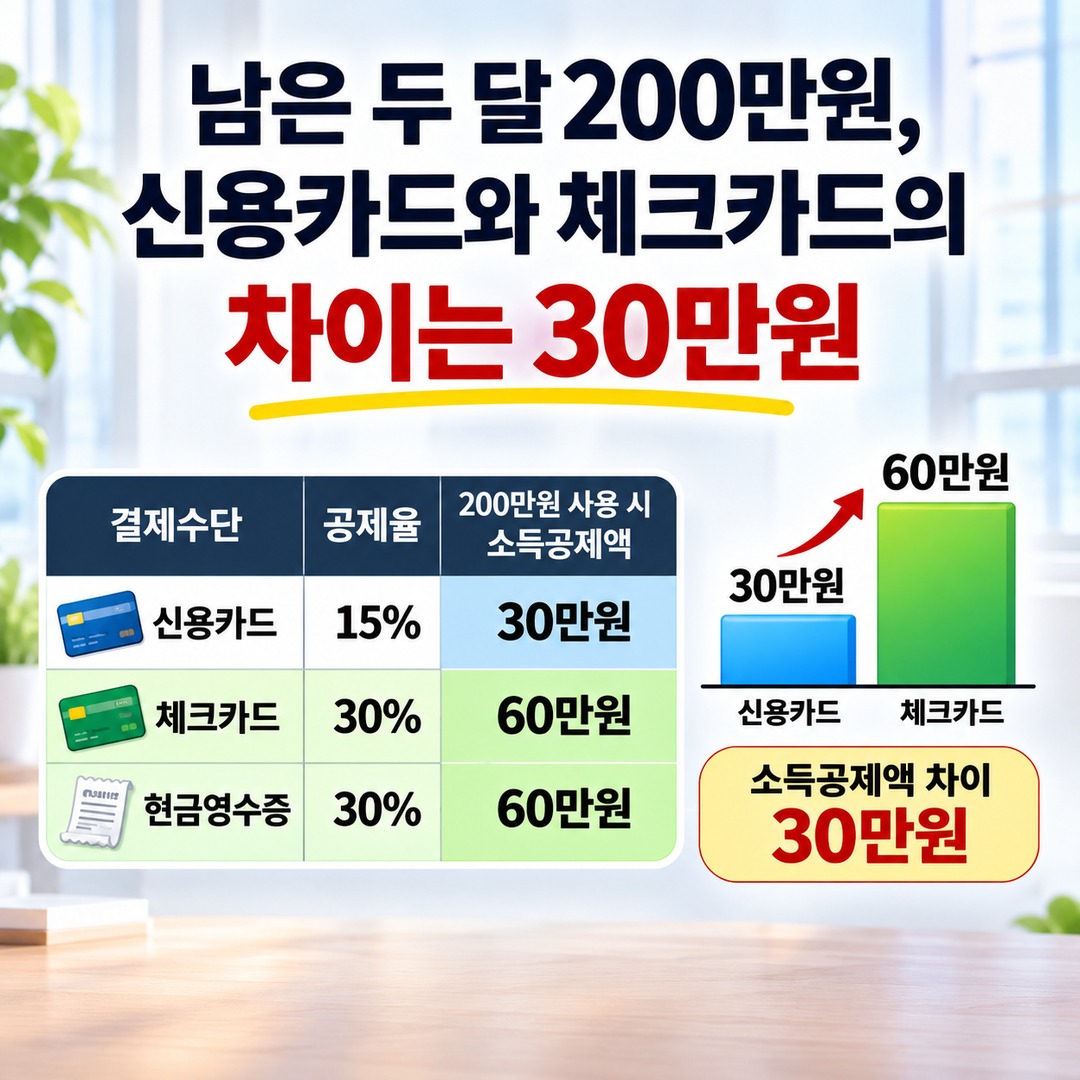
The standard deduction rates confirmed under current law and the National Tax Service's guidance on card spending deductions are as follows.
| Payment Method | Deduction Rate | Deduction on KRW 2,000,000 in Spending |
|---|---|---|
| Credit Card | 15% | KRW 300,000 |
| Debit Card | 30% | KRW 600,000 |
| Cash Receipt | 30% | KRW 600,000 |
*Author's calculation. Assumes that the entire KRW 2,000,000 in eligible ordinary spending exceeds the 25% threshold and that sufficient deduction capacity remains.*
The calculation is straightforward.
Credit card: KRW 2,000,000 × 15% = KRW 300,000
Debit card: KRW 2,000,000 × 30% = KRW 600,000
Difference in income deductions: KRW 600,000 - KRW 300,000 = KRW 300,000
The important point here is that KRW 300,000 is not an amount that will be refunded directly to your bank account.
An income deduction does not reduce your tax bill itself by KRW 300,000. Instead, it reduces the amount of income used to calculate your taxes.
For example, assuming an income tax rate of 15% applies to the additional income deduction of KRW 300,000, the resulting reduction in national income tax would be KRW 45,000.
KRW 300,000 × 15% = KRW 45,000
This is a simplified calculation based on an assumed tax rate, not an actual refund amount. The result will vary depending on other deductions and tax credits, calculated tax liability, taxes already paid, and other factors.
What If an Employee Earning KRW 50,000,000 in Gross Annual Salary Switches Cards Starting November?
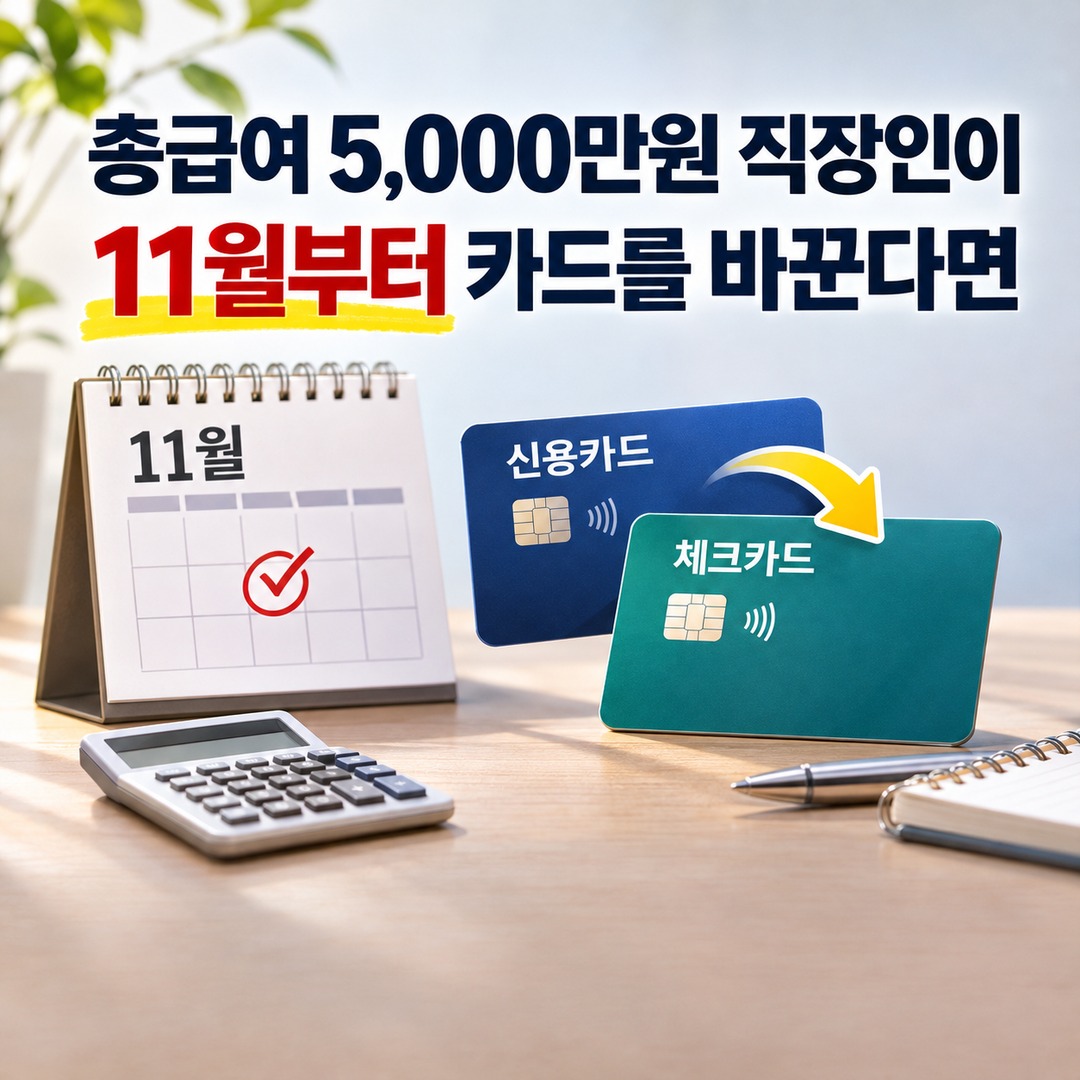
Let's compare card spending through the end of the year using a hypothetical example.
The following is not a real taxpayer's case. It is a hypothetical scenario designed to explain how the calculation works.
Hypothetical Scenario Assumptions
Gross Annual Salary
KRW 50,000,000
25% Threshold
KRW 12,500,000
Credit Card Spending from 1 to October
KRW 15,000,000
Additional Spending During 11–December
KRW 2,000,000
Assume that all spending consists of ordinary eligible purchases, with no additional deduction limits for children or other dependents and no separately preferentially treated spending categories.
Subtracting KRW 12,500,000, which represents 25% of gross annual salary, from the KRW 15,000,000 spent on credit cards through October leaves KRW 2,500,000 in ordinary spending that already qualifies for the deduction.
KRW 2,500,000 × 15% = KRW 375,000
Applying different payment methods to spending during the remaining two months produces the following results.
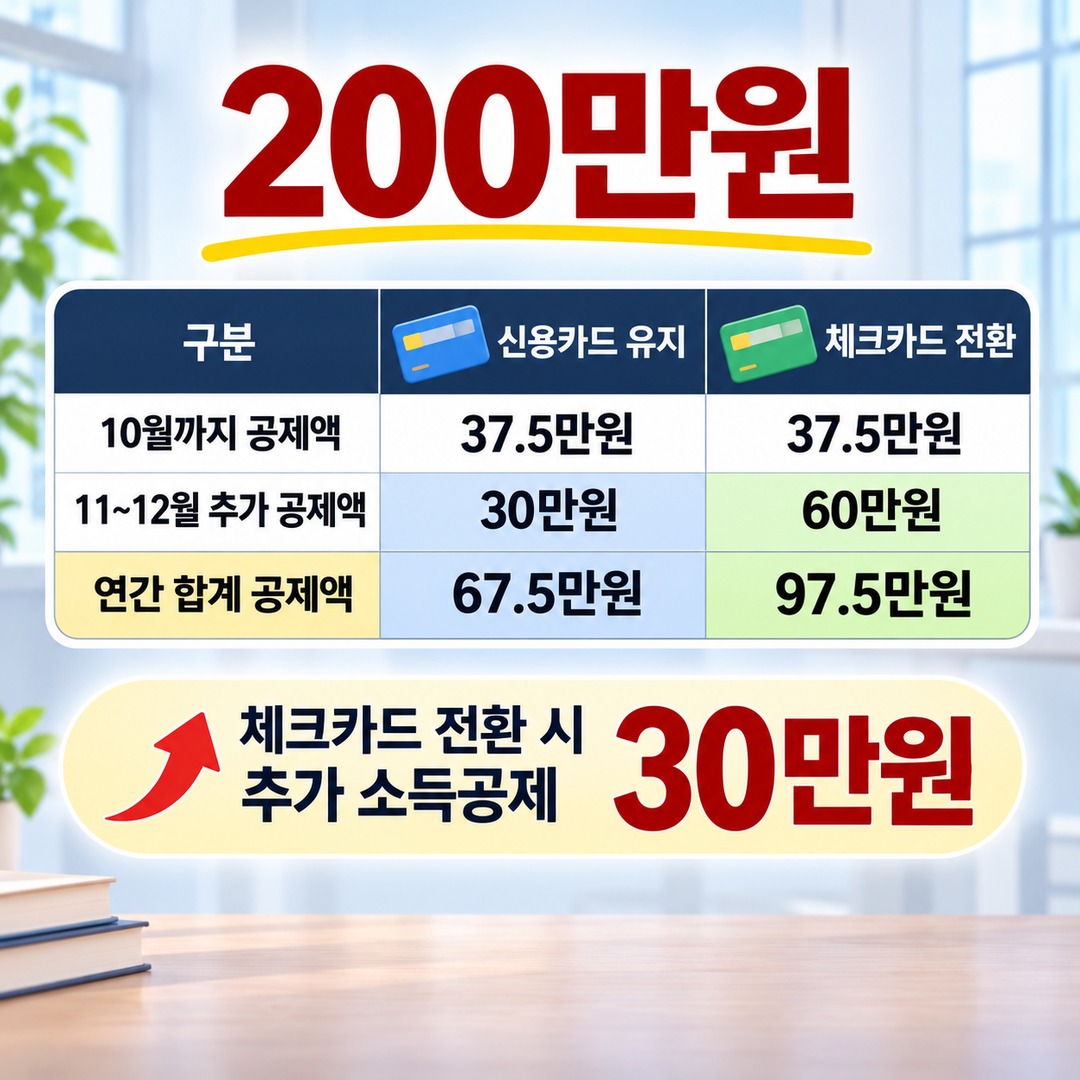
| Category | Continue Using a Credit Card | Switch to a Debit Card |
|---|---|---|
| Deduction Amount Through October | KRW 375,000.0 | KRW 375,000.0 |
| Additional Deduction for 11–December | KRW 300,000 | KRW 600,000 |
| Total Annual Deduction | KRW 675,000.0 | KRW 975,000.0 |
Additional Income Tax Deduction When Switching to a Debit Card
KRW 300,000
Continue Using a Credit Card
KRW 675,000.0
Switch to a Debit Card
KRW 975,000.0
Calculated by the author. This compares income tax deduction amounts, not actual tax refunds.
In this hypothetical example, the income tax deduction differs depending on the payment method, even when the total amount spent is the same.
Conversely, if you have no plans to spend money during the remaining two months, there is no reason to deliberately spend KRW 2,000,000 just to increase your deduction.
Should You Switch to a Debit Card If You Have Already Reached the Deduction Limit?
If you have already exhausted the deduction limit for ordinary card spending, simply switching to a debit card will not increase your income tax deduction.

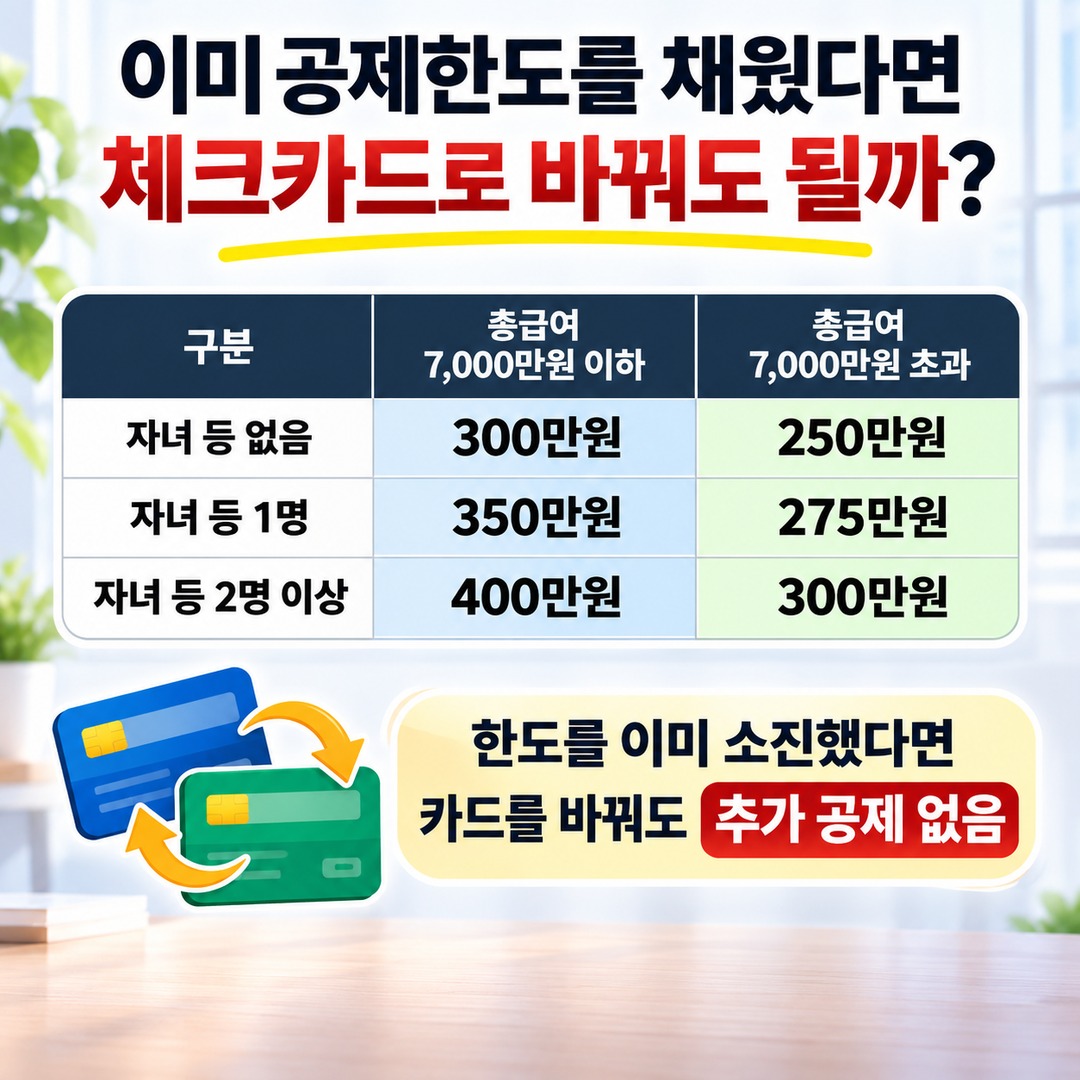
Paragraph 10 of Article 126-2 of the Restriction of Special Taxation Act, in effect as of 2026-10-31, sets different basic deduction limits according to gross salary and the number of qualifying dependents, including children.
| Category | Gross Salary of KRW 70,000,000 or Less | Over KRW 70,000,000 |
|---|---|---|
| No Qualifying Children or Other Dependents | KRW 3,000,000 | KRW 2,500,000 |
| 1 Qualifying Children or Other Dependents | KRW 3,500,000 | KRW 2,750,000 |
| 2 or More Qualifying Children or Other Dependents | KRW 4,000,000 | KRW 3,000,000 |
Here, children and other dependents refer to family members who meet the eligibility requirements specified in the law and its Enforcement Decree. You should not determine the deduction limit simply by counting the number of family members.
Separate deduction rates and additional deduction limits may also apply to spending at traditional markets, on public transportation, and on certain cultural and sports activities.
Therefore, even if ordinary card spending has reached the basic deduction limit, you cannot automatically assume that all other deduction categories have also been exhausted.
Could Credit Card Rewards Change Which Option Is Better?
A higher income tax deduction rate does not necessarily make debit cards the better choice for every purchase.
For example, suppose that, on the same KRW 2,000,000 in spending, a credit card provides an effective benefit that is 2% percentage points higher than a debit card.
The additional card benefit would be KRW 2,000,000 × 2% = KRW 40,000.
Applying an assumed tax rate of 15% to the previously calculated income tax deduction difference of KRW 300,000 gives a difference in national income tax savings of KRW 45,000.
Under these assumptions, the debit card provides KRW 5,000 more in tax savings.
However, a real-world comparison must also account for card spending requirements, reward and discount caps, applicable tax rates, local income tax, and deduction limits.
In particular, if the deduction limit has already been exhausted, there may be no further tax savings. In that case, the actual benefits offered by the credit card become a more important factor in deciding which card to use.
Three Things to Check Before Switching Cards in November
With two months remaining in the year, it makes more sense to check your eligible spending and deduction limits before considering any increase in spending.
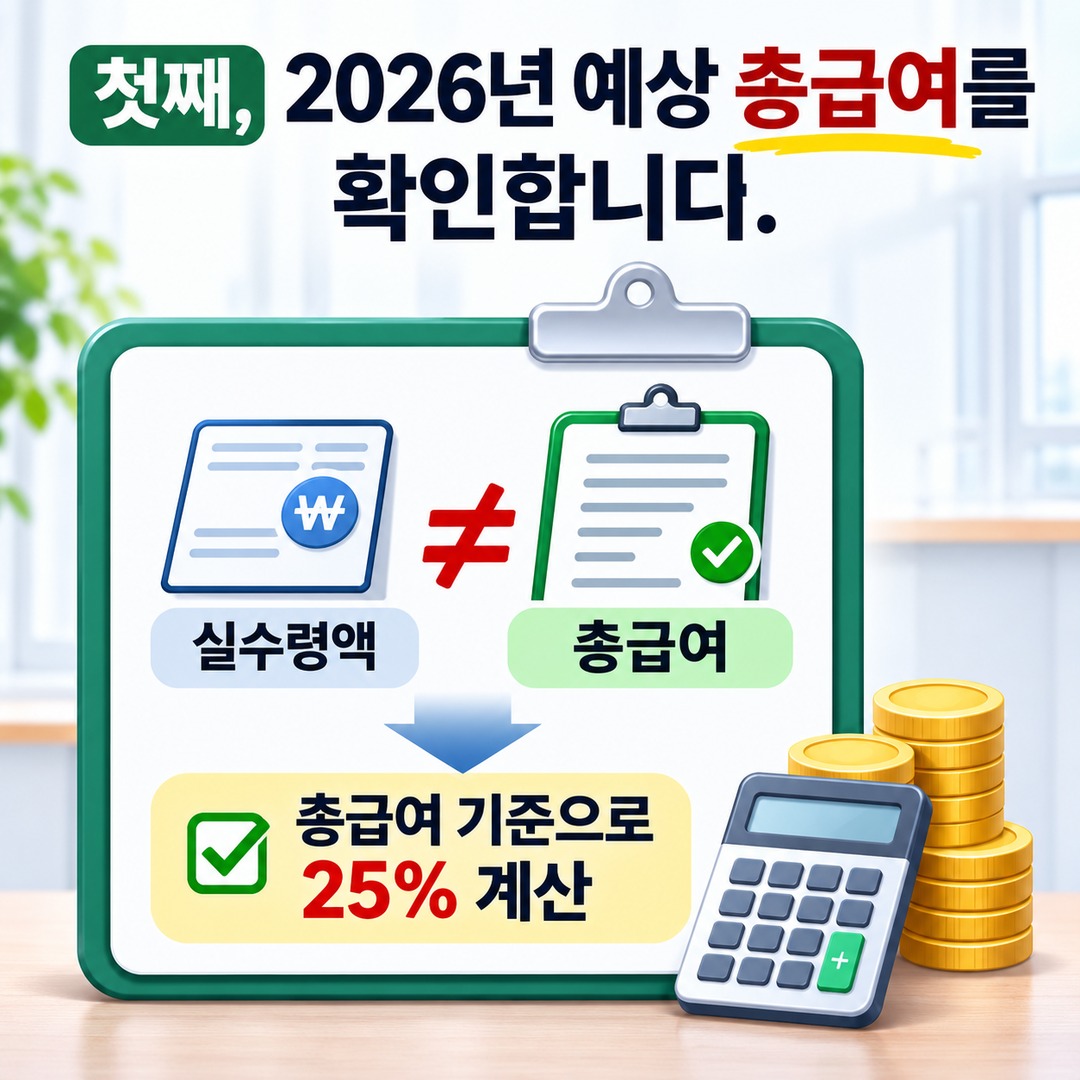
First, Check Your Expected Gross Salary for 2026.
Gross salary is not the same as the take-home pay deposited into your bank account. You must calculate 25% based on your gross salary as defined under tax law, excluding non-taxable employment income and other applicable exclusions.
Second, Identify Which Card Transactions Qualify for the Deduction.
Not every payment made by card qualifies for an income tax deduction.
Article 126-2 of the Restriction of Special Taxation Act and its related Enforcement Decree specify excluded expenses, including business-related costs, certain vehicle purchases, and spending outside South Korea.
As a result, treating the annual payment total shown in your card issuer's app as the amount eligible for an income tax deduction may lead to discrepancies in the actual calculation.
Third, Compare the Deduction Limit With Your Card Benefits.
If your eligible spending has exceeded 25% and you still have deduction capacity remaining, you may benefit from the debit card deduction rate of 30%.
On the other hand, if you have already reached the basic deduction limit, comparing practical spending benefits such as card discounts and reward points may be more appropriate.
You can review your year-end tax settlement information through the National Tax Service's Hometax service. The extent to which information has been reflected may vary depending on when you check, so you should confirm the final deduction amount again during the year-end tax settlement process.
Year-End Tax Settlement for 2026: How to Choose During the Final Two Months
Whether to switch to a debit card in November 2026 and December cannot be decided solely on whether your card spending has exceeded 25% of your gross salary.
For eligible spending above 25%, debit cards generally qualify for a higher deduction rate than credit cards. However, the actual financial advantage may differ if you have already reached the deduction limit or your credit card offers sufficiently valuable benefits.
Therefore, before planning your year-end spending, first check the 25% threshold based on your gross salary, your current eligible spending, and your remaining deduction limit.