

2026 Year-End Dividend Record Dates: Why Some Stocks Won’t Qualify Even If You Buy on December 28
Buying stocks by 2026-12-28 does not guarantee that you will receive year-end dividends from every company listed in the Korean stock market. This schedule applies only to companies that have designated December 31 as their dividend record date. If a company sets a different dividend record date in 2027, the final purchase deadline will also differ. When preparing for year-end dividends, rather than focusing on the date December 28, first check the actual dividend record date of the stocks you hold
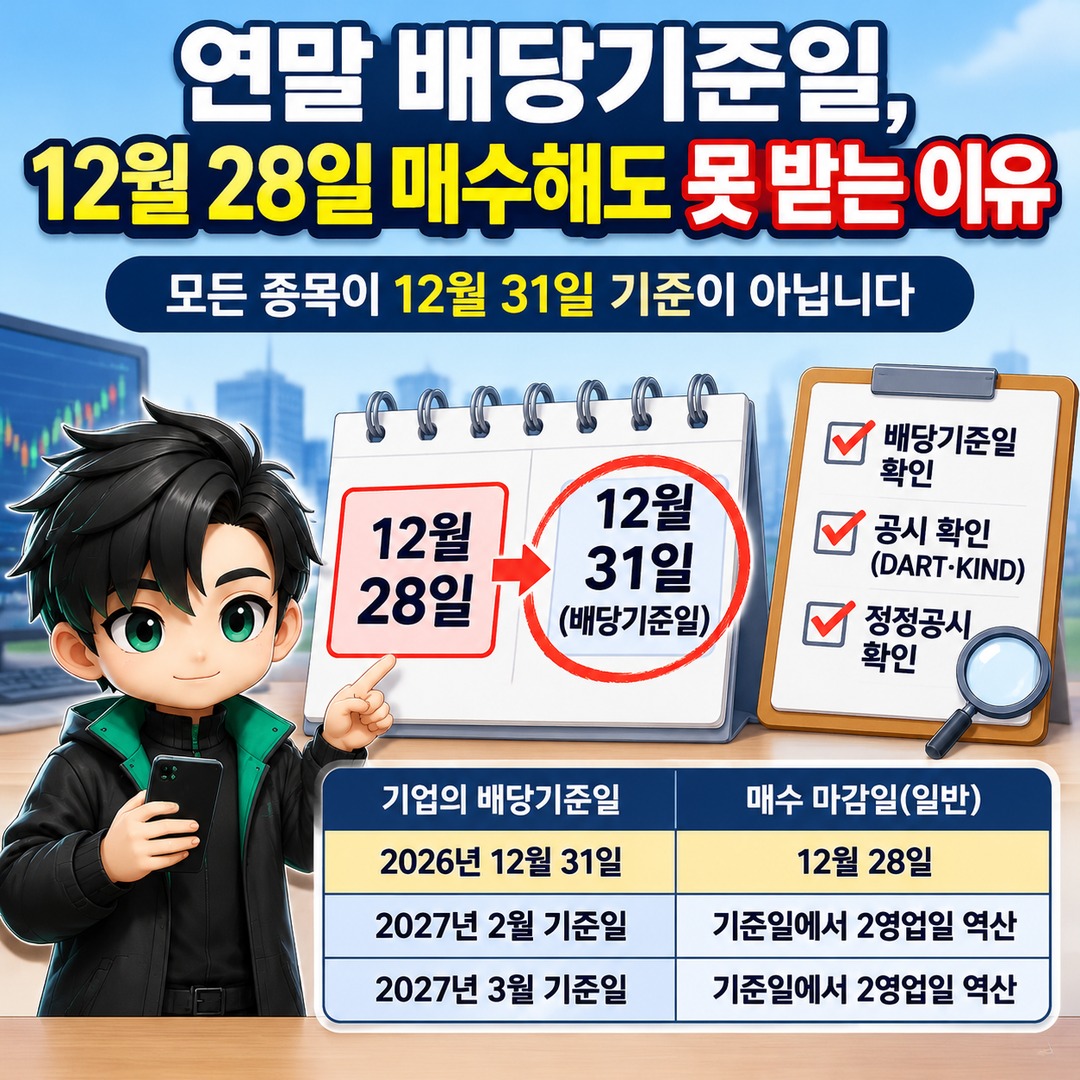
Buying stocks by 2026-12-28 does not guarantee that you will receive year-end dividends from every company listed in the Korean stock market. This schedule applies only to companies that have designated December 31 as their dividend record date. If a company sets a different date in 2027 as its dividend record date, the final purchase deadline will also differ.
When preparing for year-end dividends, you should first check the actual dividend record date of the stocks you hold rather than focusing on the date December 28.
1. Not Every Company Uses December 31 as Its Dividend Record Date
The dividend record date is the date a company designates to determine which shareholders are entitled to receive dividends. The fiscal year-end date and the dividend record date do not necessarily have to be the same.
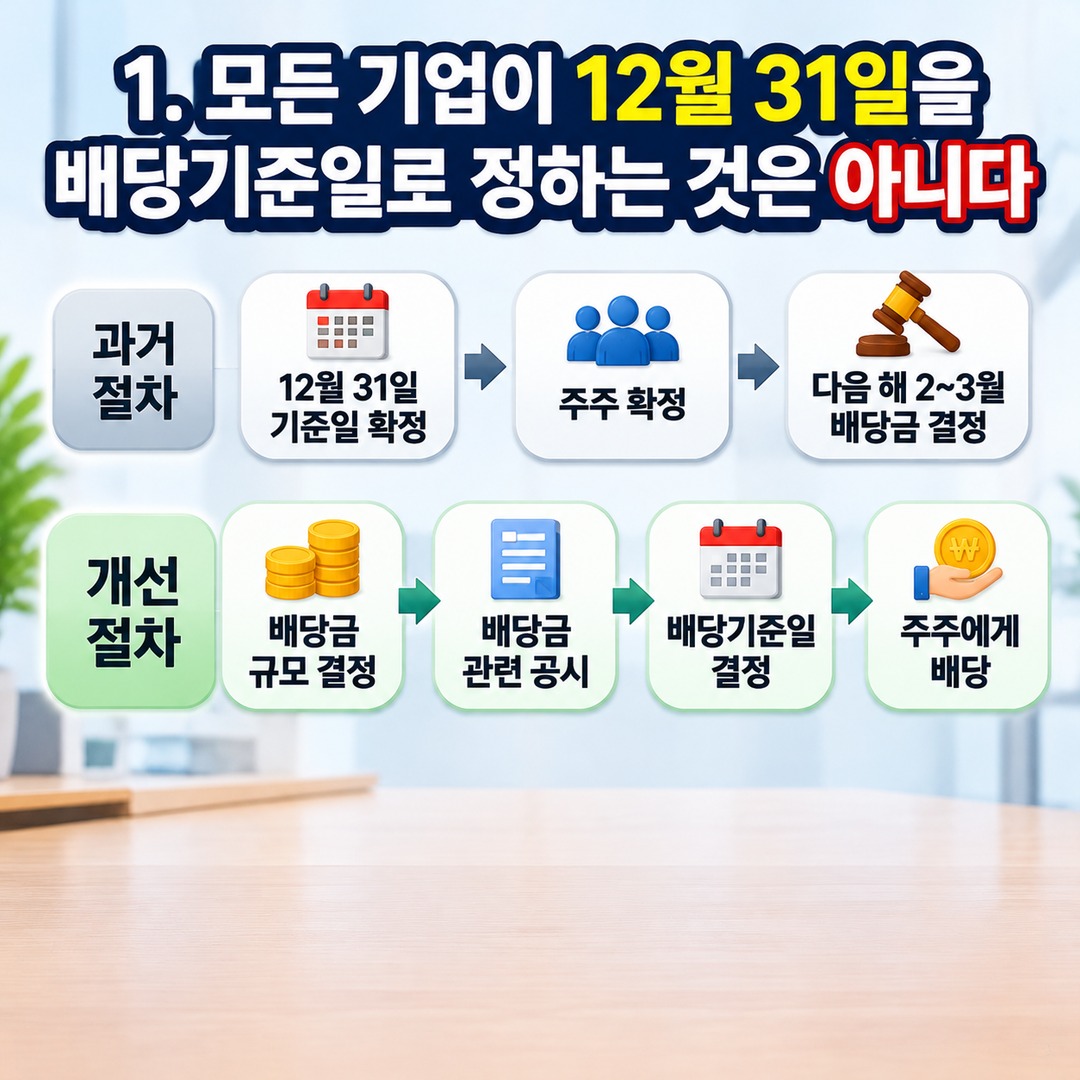
This difference emerged against the backdrop of dividend procedure reforms introduced starting in 2023.
In the past, the following sequence was standard:
1. December 31 Dividend record date finalized
2. Shareholders determined
3. Dividends decided at the shareholders' meeting held between 2 and March in the following year
Under this approach, investors had to secure their entitlement to dividends without knowing how much they would receive.
The improved approach follows a different sequence.
1. The company determines the amount of the dividend
2. Disclosure of dividend information
3. Dividend record date is determined
4. Investors who hold shares on that record date receive the dividend
With this approach, investors can check the dividend amount first and then decide whether to invest.
However, there is an important point to keep in mind.
Amending the Articles of Incorporation Does Not Mean Every Company Actually Uses the New Dividend Procedure.
According to an analysis by the Korea Capital Market Institute of disclosures from December listed companies that held their annual shareholders' meetings in 2025, the companies that improved their procedures to allow the board of directors to determine the dividend record date were as follows.
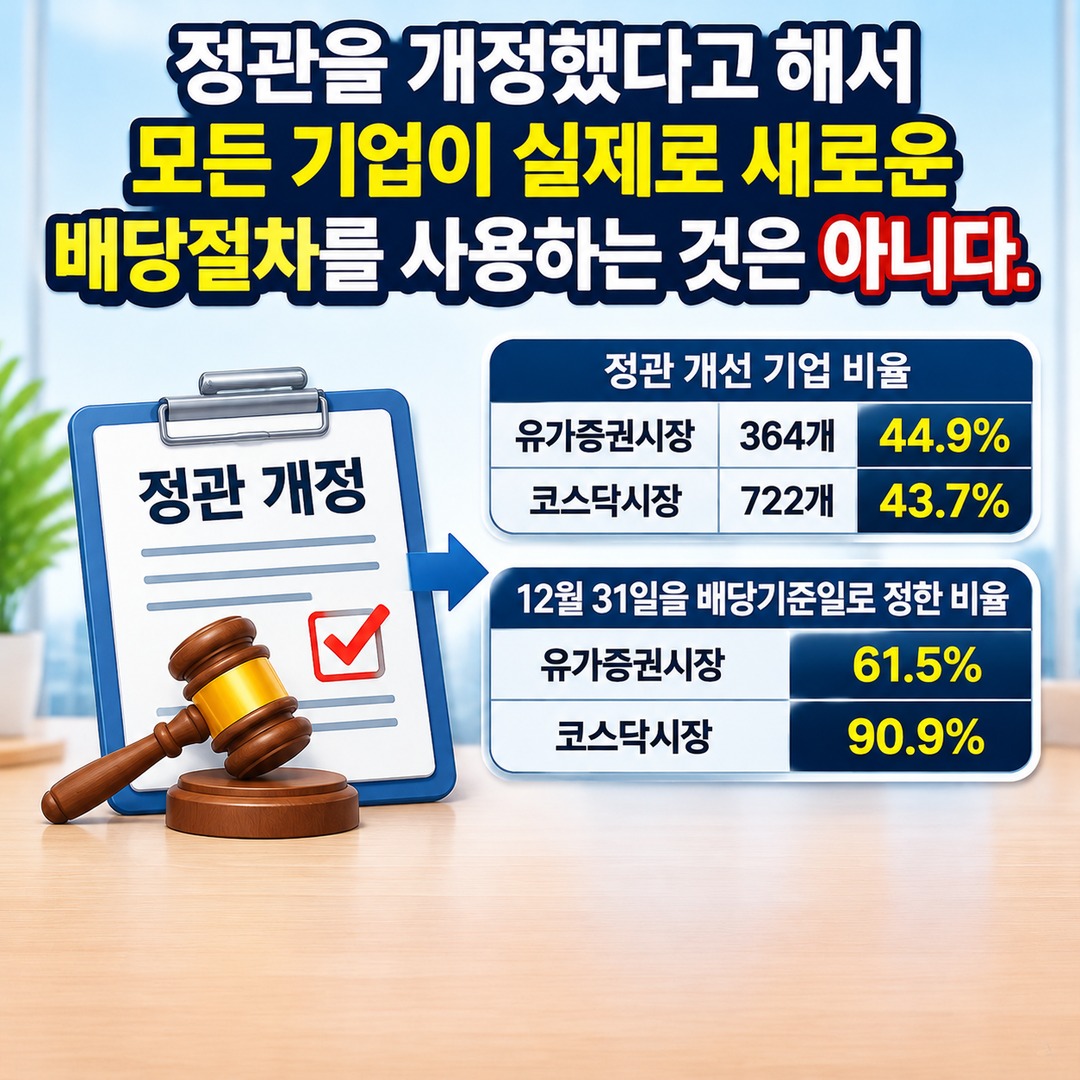
| Market | Companies That Amended Their Articles of Incorporation | Percentage |
|---|---|---|
| KOSPI Market | 364 companies | 44.9% |
| KOSDAQ Market | 722 companies | 43.7% |
This means that the company established a provision in its articles of incorporation allowing it to set a new record date. It does not mean that every company actually adopted a different date.
In fact, among the companies that paid dividends in 2025, the number that designated December 31 as their dividend record date was 61.5% on the KOSPI market and 90.9% on the KOSDAQ market.
2. How Do You Distinguish Between Buying on December 28 and Buying on Another Date?
The most important reference is the dividend record date disclosed by the company.
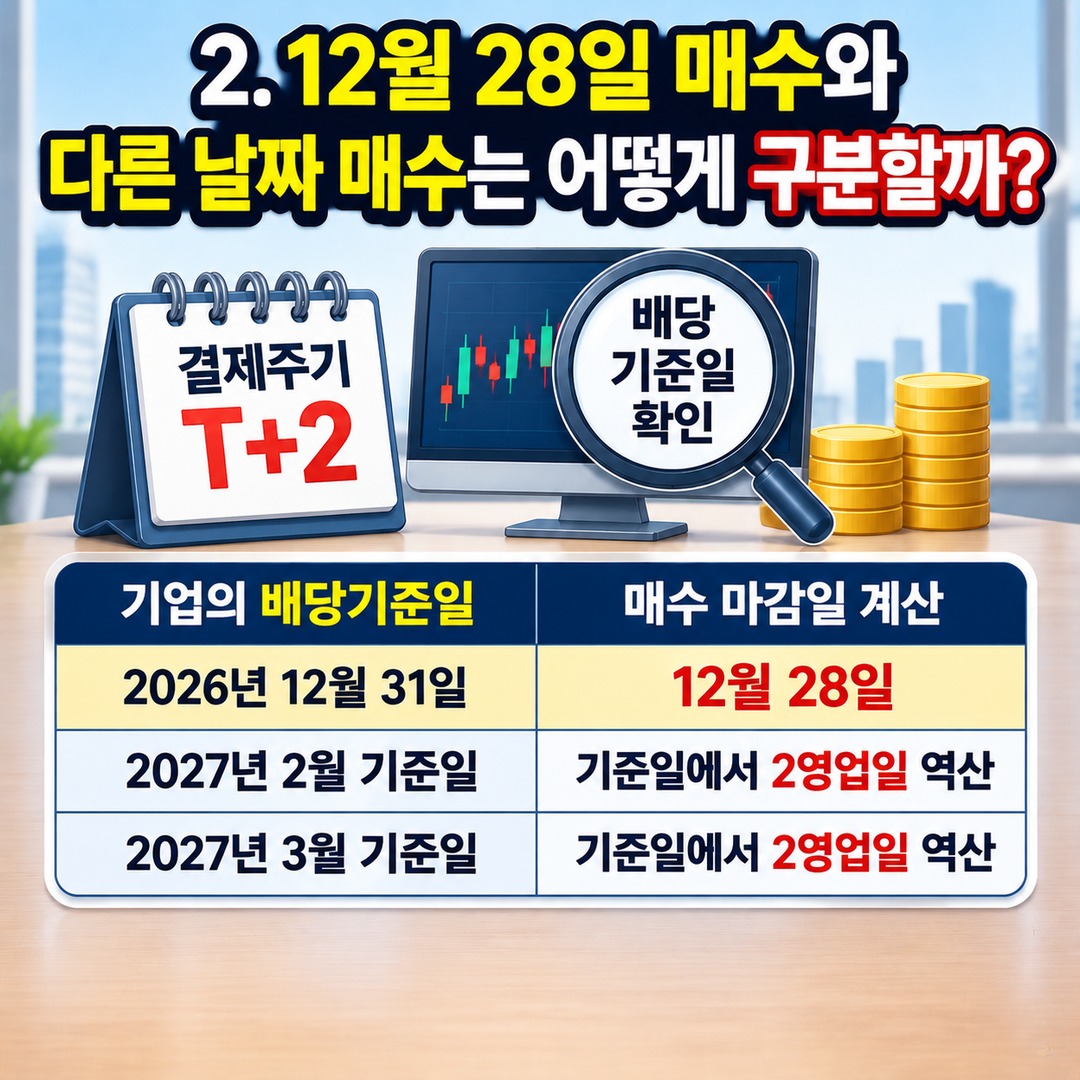
If a company has designated 2026-12-31 as its record date, you must purchase the shares by December 28. However, if the company has designated a separate dividend record date of February 2027 or March, you must recalculate the deadline based on that date.
The standard settlement cycle for listed Korean stocks is T+2.
T+2 means that settlement is completed 2 business days after the stock purchase date, excluding the day of purchase.
For example, if a company has designated 2027-03-31 as its dividend record date, you must count backward using exchange business days to determine when to buy in order to secure shareholder rights on March 31.
However, the calculation depends on whether the record date falls on a weekend or market holiday and whether any public holidays occur in between.
The following table provides a simple way to distinguish between the cases.
| Company's Dividend Record Date | How to Calculate the Purchase Deadline |
|---|---|
| 2026-12-31 | December 28 |
| February 2027 Separate Record Date | Count backward 2 business days from the designated record date |
| March 2027 Separate Record Date | Count backward 2 business days from the designated record date |
The separate record dates in the table above are examples intended to explain the calculation method. They are not confirmed schedules for actual companies.
In particular, remember that the 2026-12-28 purchase deadline applies only to dividends based on December 31.
3. Where Can You Check the Dividend Record Date for Your Stocks?
The first places investors should check are the Financial Supervisory Service's Electronic Disclosure System (DART) and the Korea Exchange's KIND corporate disclosure channel.
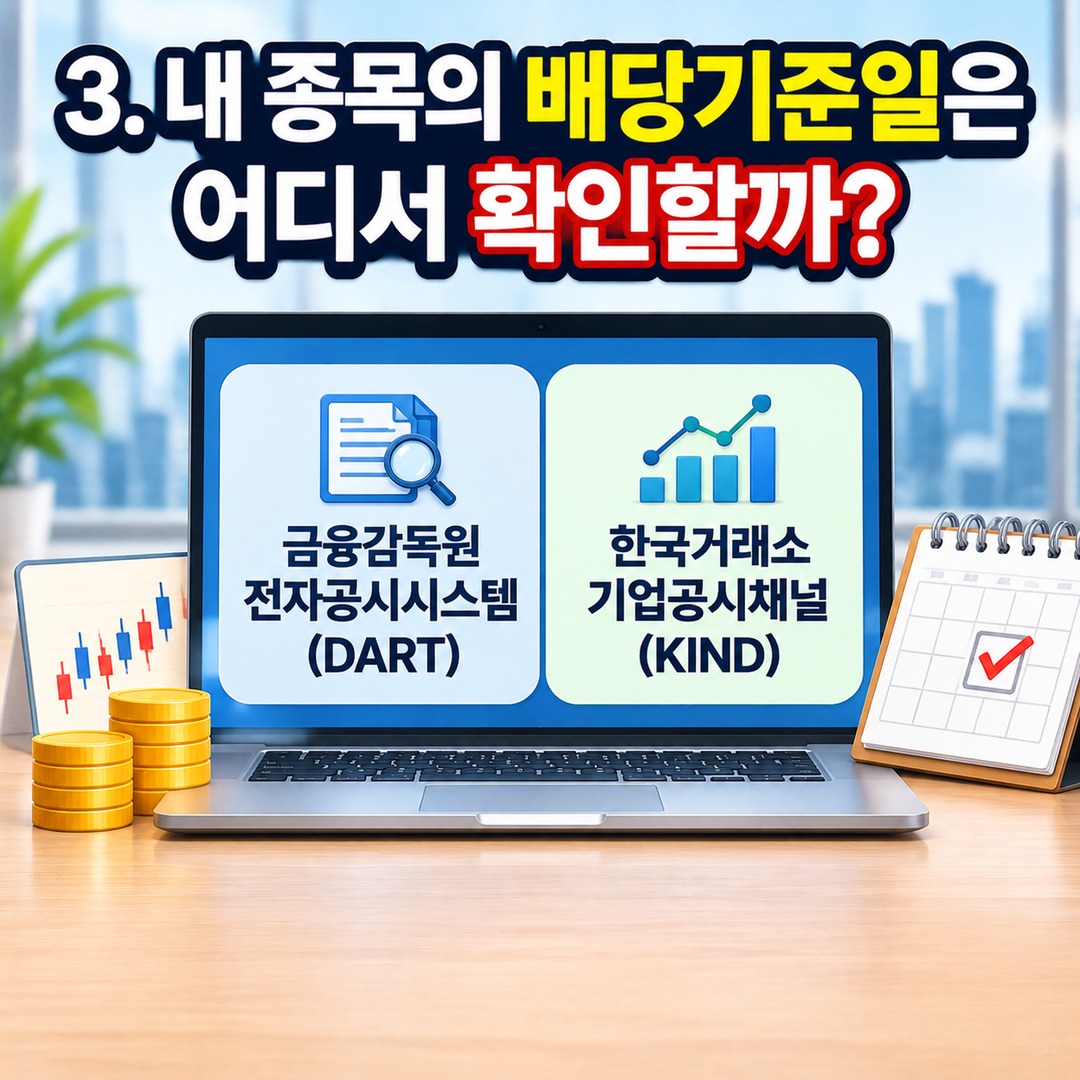
Rather than relying solely on estimated dividend dates displayed in a securities firm's app, it is more accurate to check the original disclosures submitted by the company.

First, Search for Company Disclosures on DART.
Visit the Financial Supervisory Service's DART electronic disclosure system and search for the company whose shares you hold.
Focus on the following disclosures:
Cash and in
Resolution to close the shareholder register (record date)
Corrective disclosure
Notice of the shareholders' meeting concerning dividends
The important point here is not to confuse the scheduled dividend payment date with the dividend record date.
The dividend record date determines which shareholders are entitled to receive dividends, while the dividend payment date is when the cash is actually deposited.
These are two different dates.
Second, Check Dividend-Related Disclosures on KIND.
Company disclosures and dividend-related information can also be found through the Korea Exchange's KIND corporate disclosure channel.

If a company's corporate governance report mentions improvements to its dividend procedures, distinguish between the following two points:
Incorporation into the articles of incorporation: Has the company amended its articles of incorporation to allow it to set a new dividend record date?
Actual implementation: Has the company used the improved procedure in its actual dividend process?
You should not assume that the actual dividend record date has been established solely because the change has been incorporated into the articles of incorporation.
Third, Compare the Latest Disclosure with Any Corrective Disclosures.
The date initially announced by a company may be changed later, so check both the disclosure filing date and whether a corrective disclosure has been issued.
This is particularly important for companies that have designated a separate dividend record date. Always base your decision on the most recently filed disclosure.
4. Three Things That Are Easy to Overlook Even After Checking the Dividend Record Date
Checking only the dividend record date may lead to a difference between your expectations and the actual outcome.
You should also check the following three points.
① Has the Dividend Record Date Actually Been Confirmed?
A company's historical dividend record dates or an estimated dividend calendar do not establish this year's actual dividend record date.
Even if a company used December 31 as its record date last year, it may choose a different date this year.
② Has the Company Decided to Pay a Dividend?
The fact that a dividend record date has been established does not mean that the dividend amount has been finalized.
You must check the dividend record date and the dividend decision disclosure separately.
③ Have You Considered That the Stock Price May Fall on the Ex-Dividend Date?
On the ex-dividend date, the right to receive the dividend is lost, and the value of the dividend may be reflected in the stock price.
However, actual stock price movements are influenced by various factors, including market conditions, company performance, and supply and demand.
If you buy shares based solely on the dividend payment, a subsequent price decline after the ex-dividend date could result in a loss greater than the dividend income.
Dividends are not guaranteed additional returns. They are an investment factor that must be evaluated alongside stock price fluctuations and taxes.
5. The Most Important Criteria for Making Investment Decisions About 2026 Year-End Dividends
2026-12-28 is not a universal purchase deadline for all dividend-paying stocks listed in Korea.
It applies to companies that have designated December 31 as their dividend record date. For companies with a separate dividend record date, the schedule disclosed by each company takes precedence.
Therefore, if you are preparing for year-end dividends, it is best to check the following in order:
1. Check the latest dividend-related disclosures from the companies whose shares you hold
2. Confirm the actual dividend record date
3. Check whether any corrective disclosures have been issued
5. Check whether a dividend will be paid and review the dividend decision
6. Consider the risk of stock price fluctuations caused by the ex-dividend date
The key point about dividend procedure reform is that amending the articles of incorporation and actually implementing the new procedure are two different things.
It is important not to apply the same purchase deadline to every stock simply because it is the end of December.
Frequently Asked Questions Q. If I buy stocks on December 28, am I guaranteed to receive 2026 year-end dividends?
No. For companies that have designated December 31 as their dividend record date, that date determines the final purchase deadline. Companies with a separate record date follow their own schedules.
Q. If a company has designated March as its dividend record date, do I not need to hold its shares on December?
If the company has actually designated March as its dividend record date, holding the shares on December does not determine your entitlement to that dividend. However, you should still confirm whether a dividend will be paid and verify the specific record date.
Q. Can I find out the dividend amount in advance if a company has incorporated dividend procedure improvements into its articles of incorporation?
Not necessarily. Amending the articles of incorporation provides the basis for adopting the new procedure, but the actual dividend decision and the method used to designate the record date must be checked separately.
Q. What should I do if a company has not yet announced its dividend record date?
It is best not to estimate this year's record date based solely on previous dividend schedules. Check subsequent dividend-related disclosures and any corrective disclosures filed by the company.
※ This article is provided for informational purposes to help readers understand market trends. It is not an investment recommendation for any specific stock or asset. All final investment decisions and responsibility rest with the individual investor.