
2026 Small Business General Management Stabilization Fund: Business Operating History, Revenue Requirements, and Application Availability on November 29

As of 2026-11-29, the Small Business General Management Stabilization Fund may be available to businesses regardless of how long they have been operating, from newly established businesses to existing businesses. There is no separate revenue ceiling specifically for the General Management Stabilization Fund, but applicants must meet the statutory small business criteria, including industry-specific revenue and number of full-time employees requirements. However, the fact that an amended notice was issued on November 24 does not necessarily mean that new applications are being accepted.
The key point of Ministry of SMEs and Startups Notice No. 2026-616 is not that the operating-history restriction for the General Management Stabilization Fund has been newly abolished. Rather, the existing loan program was amended to introduce separate preferential conditions for small businesses affected by Homeplus.
Therefore, there are three things you need to check now.
Does the business meet the small business criteria, regardless of how long it has been operating since business registration?
Do its average revenue and number of full-time employees fall within the statutory limits for its industry?
Is the General Management Stabilization Fund actually accepting applications, and is funding still available?
What Actually Changed in the 2026-11-24 Amended Notice
The Ministry of SMEs and Startups amended the small business policy loan program through Notice No. 2026-616, 2026-11-24.
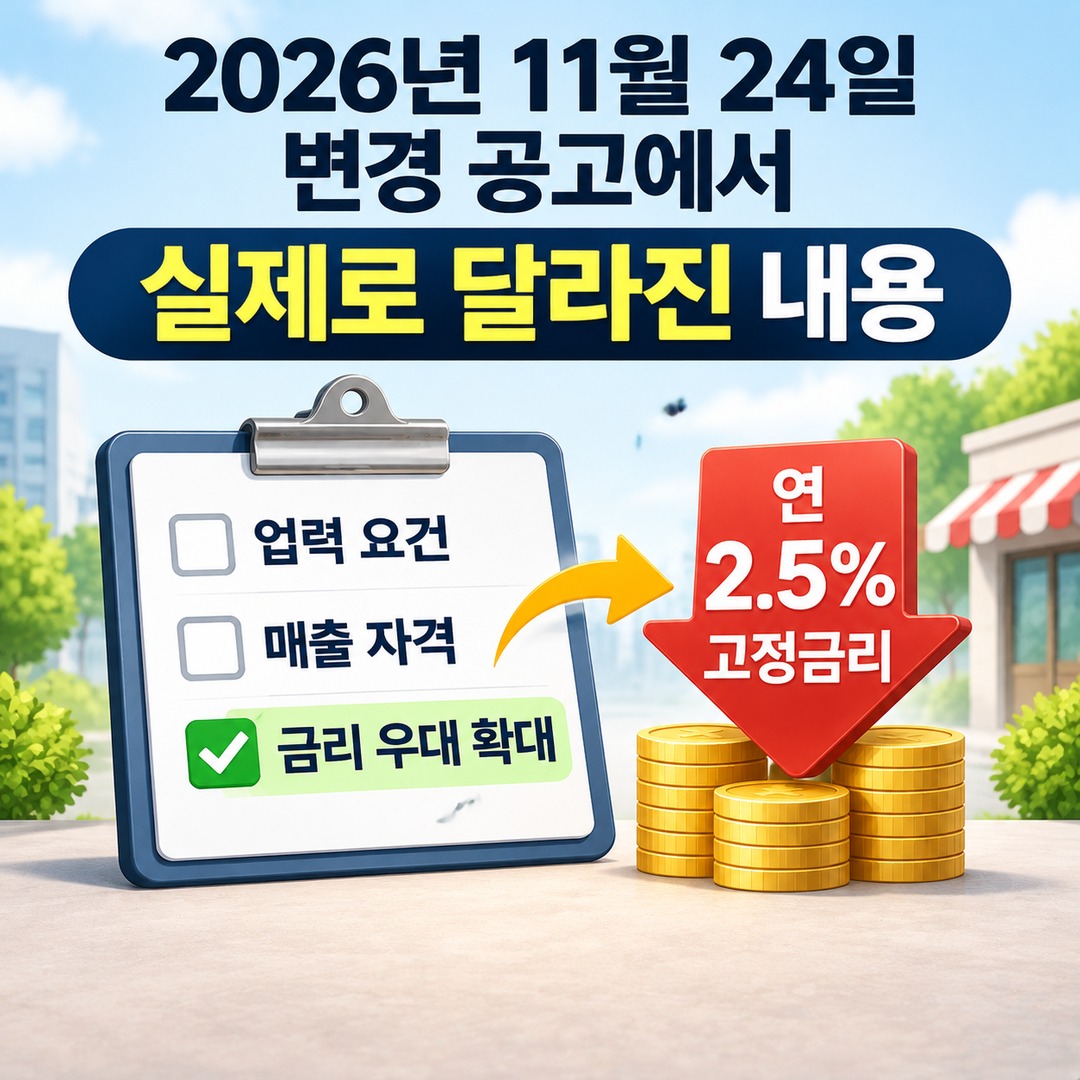
The main change does not involve revisions to the operating-history or revenue eligibility requirements for the General Management Stabilization Fund.
Instead, preferential interest rates were expanded for the Temporary Business Difficulties Fund, which supports small businesses affected by Homeplus.
| Category | Changes |
|---|---|
| Date of amended notice | 2026-11-24 |
| Notice number | No. 2026-616 |
| Eligible for preferential terms | Small businesses affected by Homeplus |
| Revised interest rate | 2.5% annual fixed rate |
| Previous preferential rate | Policy fund base rate - 0.5%p |
| Existing preferential-rate recipients | May also receive the same interest rate reduction |
This 2.5% interest rate does not apply to the General Management Stabilization Fund as a whole.
These terms apply to the Temporary Business Difficulties Fund for small businesses affected by Homeplus. They should not be interpreted to mean that all small businesses automatically qualify for this interest rate.
The changes can be confirmed in the official 2026-11-24 notice issued by the Ministry of SMEs and Startups.
How Many Years Must a Business Have Been Operating to Apply for the General Management Stabilization Fund?
The 2026 General Management Stabilization Fund has no business operating-history requirement.
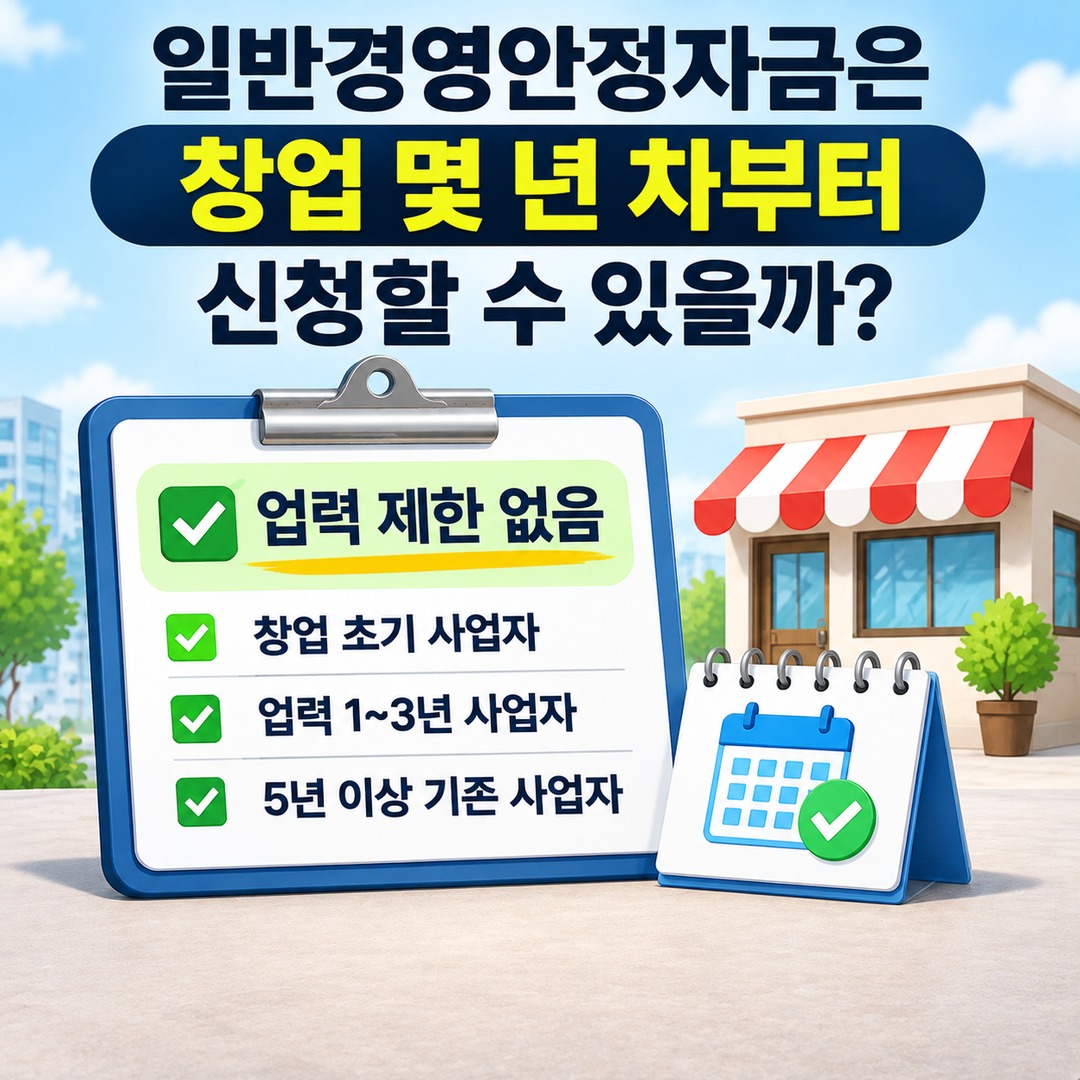
The attached documents to the Ministry of SMEs and Startups' amended notice define eligible applicants as small businesses under the Framework Act on Small Business, explicitly stating that the business operating period is irrelevant.
Accordingly, the following businesses may also qualify if they meet the other eligibility requirements.
Newly established businesses that have only recently started operating
Small businesses with an operating history of 1 to 3 years
Existing businesses that have been operating for 5 years or longer
Long-established businesses that have been operating for 10 years or longer
The important distinction is between how long a business has been operating and whether it qualifies as a small business.
The General Management Stabilization Fund does not impose a separate requirement that a business must have operated for at least 1 years or 3 years after starting up.
However, small business eligibility is assessed based on the revenue of the business's primary industry and its number of full-time employees.
In other words, a business is not automatically disqualified simply because it is newly established, nor is it automatically selected just because it has been operating for a long time.
What Is the Maximum Eligible Revenue? Industry-Specific Small Enterprise Criteria Matter
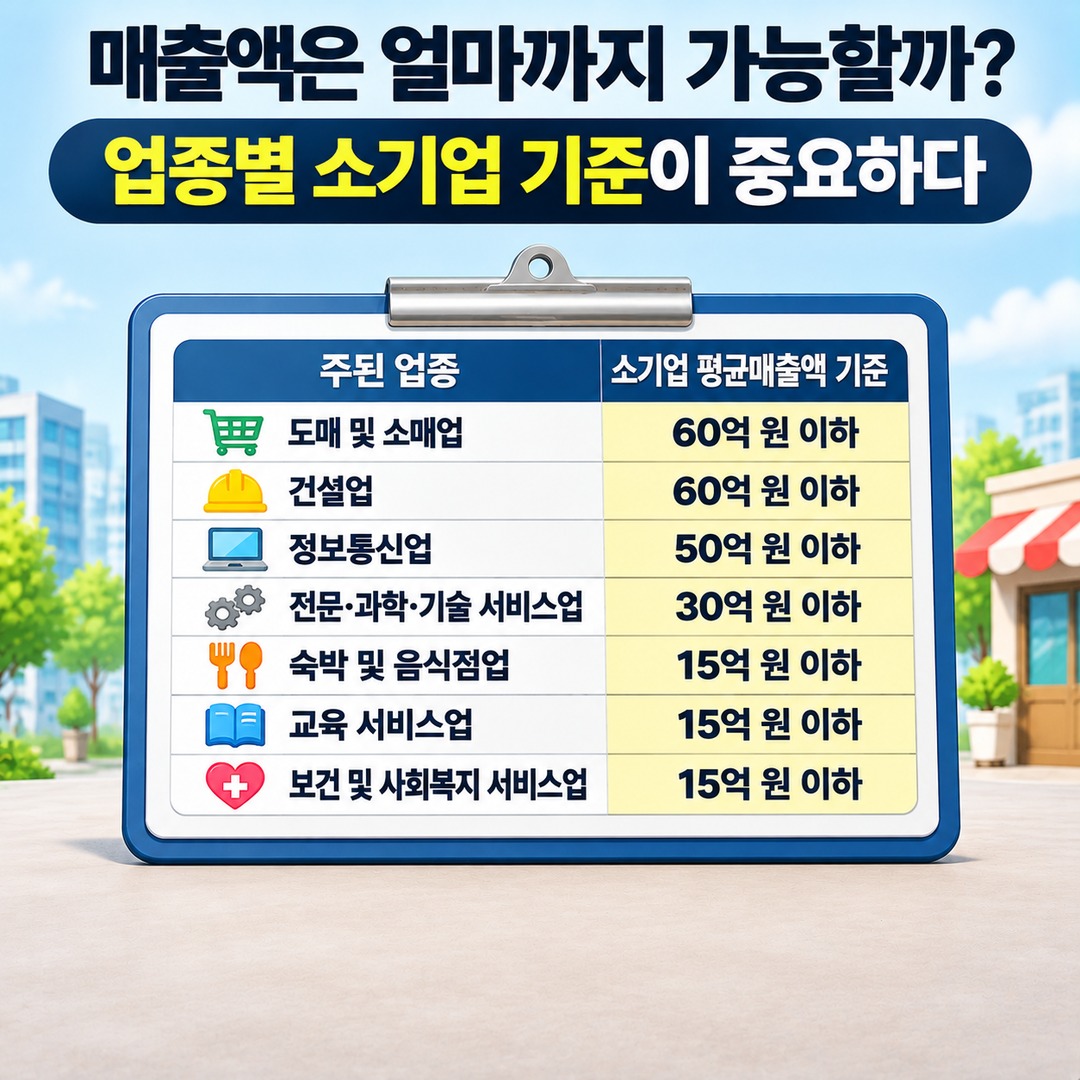
The General Management Stabilization Fund does not specify a single, uniform revenue ceiling.
However, small businesses must legally qualify as small enterprises and therefore meet the average revenue threshold for their primary industry.
According to the 2026 SME Classification Criteria published by the Ministry of SMEs and Startups and Appendix 3 of the Enforcement Decree of the Framework Act on Small and Medium Enterprises, the revenue thresholds for small enterprises vary by industry.
The thresholds for major industries are as follows.
| Primary Industry | Average Revenue Threshold for Small Enterprises |
|---|---|
| Wholesale and retail trade | KRW 6,000,000,000 or less |
| Construction | KRW 6,000,000,000 or less |
| Information and communications | KRW 5,000,000,000 or less |
| Professional, scientific, and technical services | KRW 3,000,000,000 or less |
| Accommodation and food services | KRW 1,500,000,000 or less |
| Education services | KRW 1,500,000,000 or less |
| Health and social welfare services | KRW 1,500,000,000 or less |
These figures are industry-specific revenue thresholds used to determine whether a business qualifies as a small enterprise. They are not loan limits for the General Management Stabilization Fund.
These thresholds are also not determined solely by looking at revenue for the current year. The Ministry of SMEs and Startups' 2026 SME Classification Criteria explain that eligibility is assessed based on the average revenue over 3 years in the business's primary industry.
Therefore, the same revenue threshold should not be applied to a restaurant and a wholesale or retail business.
How Is Eligibility Assessed in Practice?
For example, let's assume there is a business operating a restaurant.
Industry: Accommodation and food services
Average annual revenue over 3 years: KRW 1,000,000,000
Full-time employees: 3
Operating history: 2 years
In this hypothetical example, the revenue falls within the small enterprise threshold for accommodation and food services, which is KRW 1,500,000,000 or less.
The number of full-time employees also falls below the general threshold of 5 employees for the restaurant industry.
However, this is a hypothetical example that compares only revenue and employee requirements. Actual small business eligibility assessments may also take into account additional factors, including revenue calculations based on the business's operating period, its primary industry, and the company's independence.
In particular, if a business operates in multiple industries, it must identify its primary industry, meaning the industry listed on its business registration certificate that accounts for the largest share of its revenue.
Fewer Than 5 or 10 Full-Time Employees, Depending on the Industry
Even if a business meets the revenue threshold, it may have difficulty qualifying as a small business if it does not meet the full-time employee requirement.
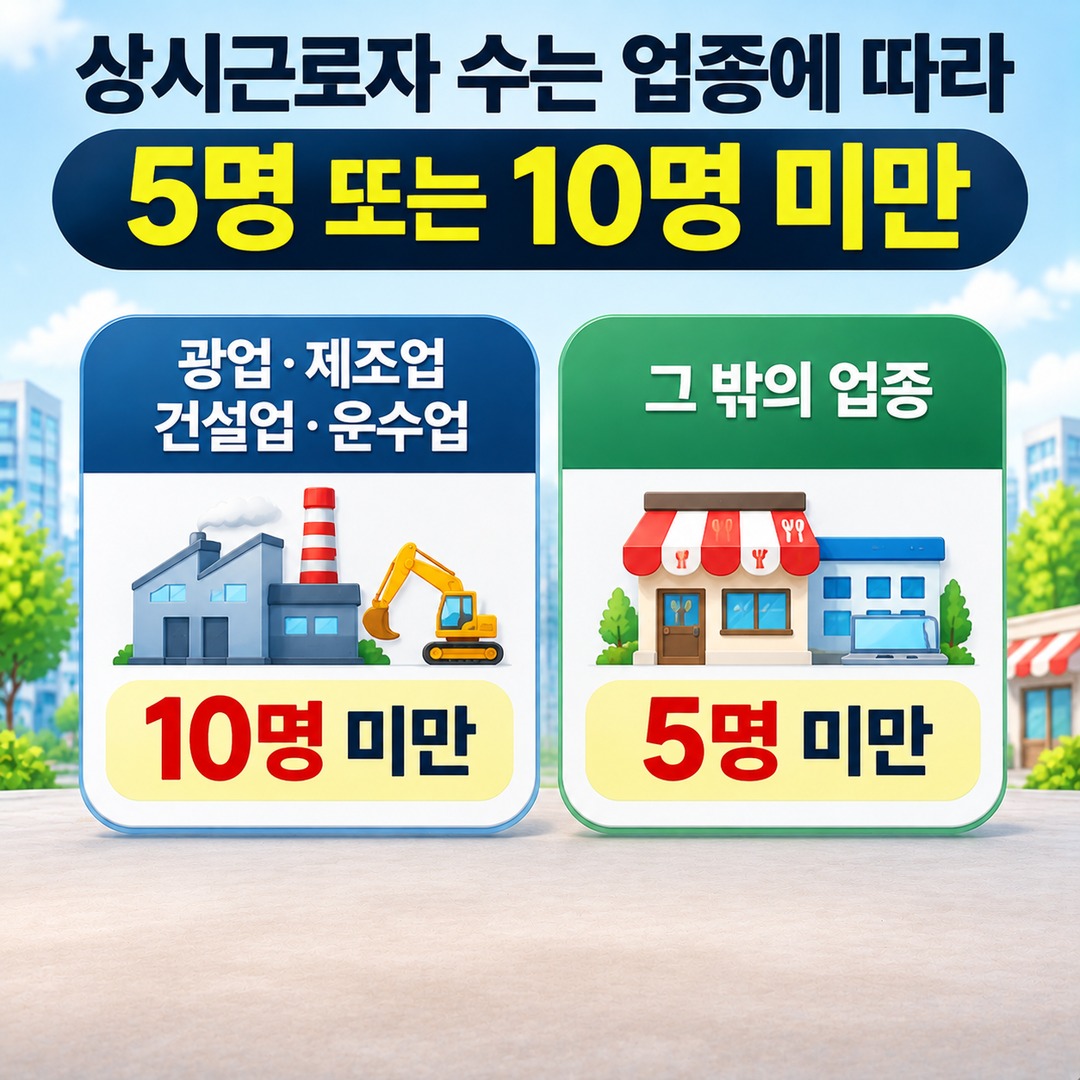
The basic criteria under the Framework Act on Small Business and its Enforcement Decree are as follows.
| Industry Category | Full-Time Employee Requirement |
|---|---|
| Mining, manufacturing, construction, and transportation | Fewer than 10 employees |
| All other industries | Fewer than 5 employees |
For example, a general restaurant falls under the category of all other industries, so the requirement is fewer than 5 full-time employees.
By contrast, the requirement for manufacturing businesses is fewer than 10 employees.
One important point is that eligibility is not determined simply by adding the business owner and full-time employees together.
Certain individuals are excluded from the statutory employee count, including executives, daily workers, and employees who have worked for less than a specified period. Part-time employees are also counted under separate rules based on their working hours.
For an accurate calculation, refer to Article 3 of the Enforcement Decree of the Framework Act on Small Business.
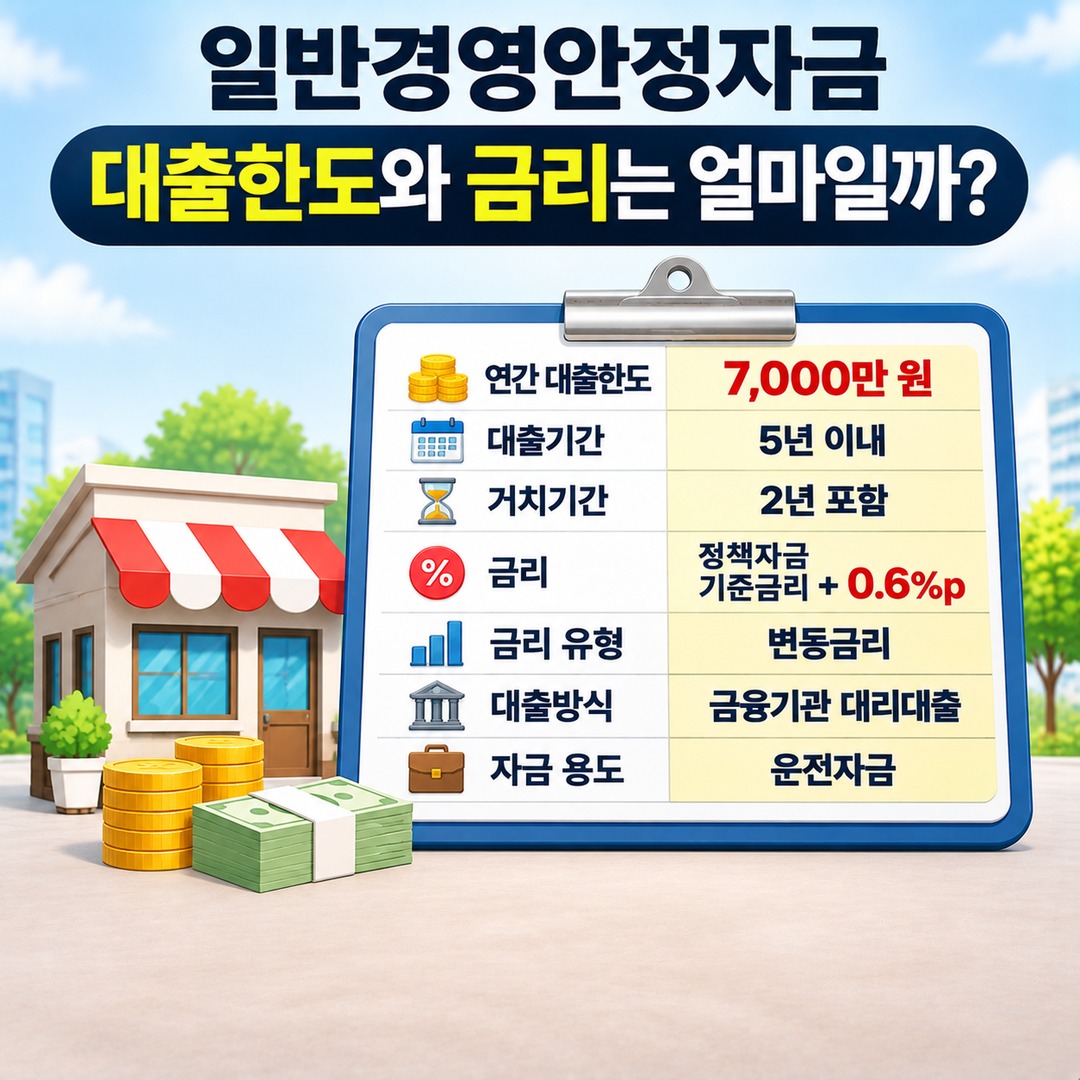
What Are the Loan Limits and Interest Rates for the General Management Stabilization Fund?
According to the 2026 announcement, the General Management Stabilization Fund operates with a total budget of approximately KRW 1,220,000,000,000.
The loan terms are as follows.
| Category | 2026 General Management Stabilization Fund |
|---|---|
| Annual loan limit | KRW 70,000,000 |
| Loan term | Up to 5 years |
| Grace period | Includes 2 years |
| Interest rate | Policy fund base rate + 0.6%p |
| Interest rate type | Variable rate |
| Loan method | Indirect lending through a financial institution |
| Purpose of funding | Working capital |
It is also important to understand that this is an indirect lending program.
The Korea SMEs and Startups Agency (KOSME) determines whether applicants qualify for support, while the actual loan is reviewed and issued by a financial institution.
Therefore, even if an applicant qualifies for policy funding, the loan may not be approved or disbursed depending on the financial institution's assessment.
In addition, KRW 70,000,000 is the maximum annual application limit, not an amount that every applicant automatically receives.
Interest rates may change according to the quarterly policy fund base rate, so applicants should check the actual rate applicable when they apply.
Can You Apply Now on November 29?
The application period stated in the currently published November 24 amended notice runs until the budget is exhausted.

The corresponding program announcement on Bizinfo also states that applications will be accepted until the budget is exhausted.
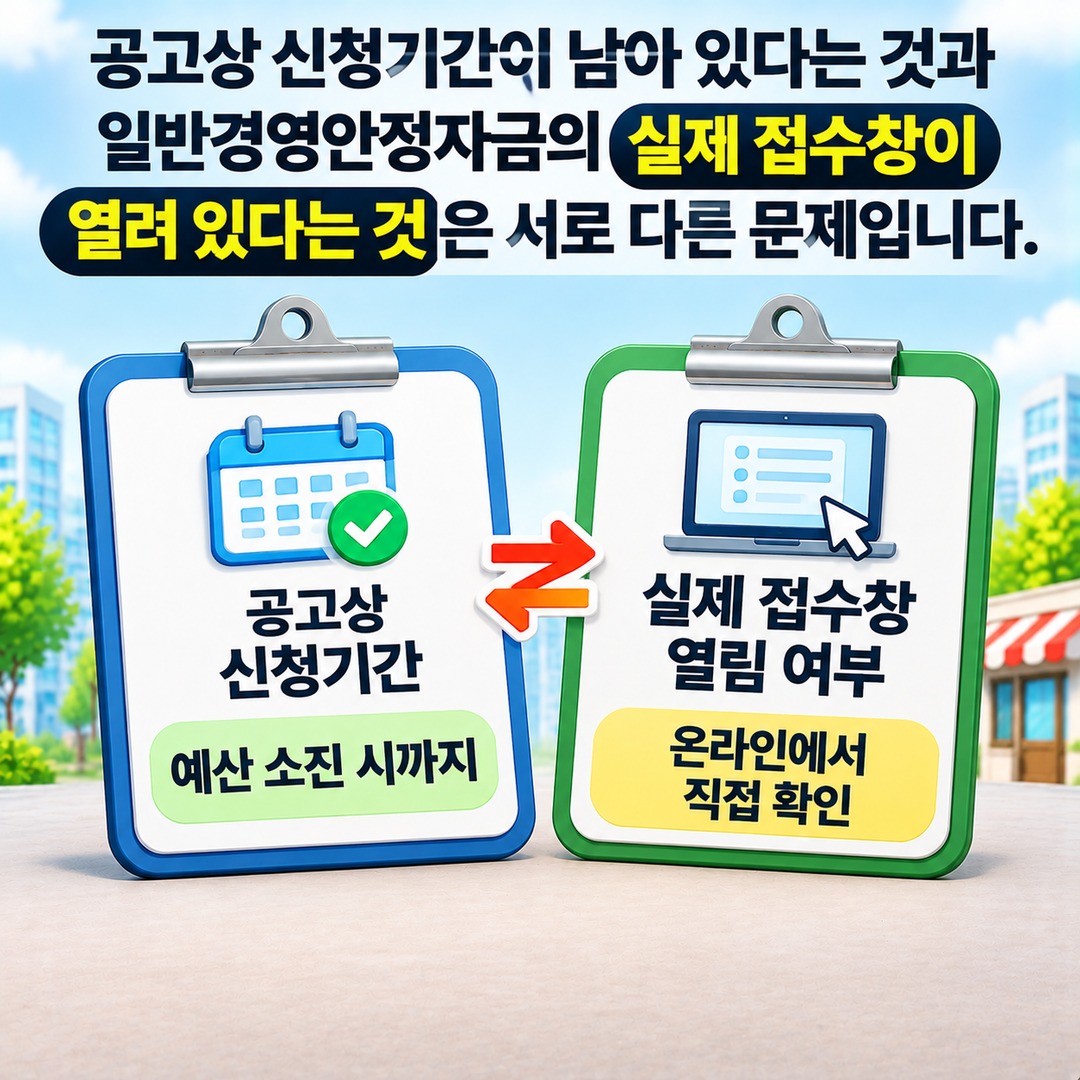
However, there is an important distinction.
An application period that remains open according to the announcement does not necessarily mean that the actual application window for the General Management Stabilization Fund is currently open.
As of 2026-11-29, the remaining budget for the General Management Stabilization Fund and whether the new application button is active in the online application system have not been confirmed.
Therefore, it cannot be stated with certainty that applications are currently available.
The most reliable way to check actual application availability is to follow these steps:
1. Access the online application system for Small Business Policy Funds.
2. Log in and check the application menu for indirect loans.
3. Check whether new applications for the General Business Stabilization Fund are being accepted.
4. If applications are available, proceed with the eligibility verification and application process.
5. After submitting the application, check the financial institution's review and loan disbursement procedures.
If online applications are unavailable or the application status is unclear, you can contact the Small Business Integrated Call Center at 1533-0100.
What to Check Before Applying
For the General Business Stabilization Fund, eligibility as a small business and the outcome of the loan review are more important than how long the business has been operating.
It is advisable to check the following before applying:
Business registration status and whether the business is actually operating
The Korean Standard Industrial Classification of the business's primary industry
The average revenue threshold for small enterprises in the relevant industry
The calculated number of regular employees
Whether the business belongs to an industry excluded from policy fund lending
The outstanding balance of existing Small Enterprise and Market Service policy loans
Application availability and remaining budget at the time of application
The financial institution's credit assessment and loan approval prospects
In particular, although the annual working capital limit for the General Business Stabilization Fund stated in the notice is KRW 70,000,000, the overall lending limit and any outstanding loan balances must also be taken into account.
Final Assessment as of 2026-11-29
The General Business Stabilization Fund is available for application regardless of how long a business has been operating. Revenue is assessed using industry-specific thresholds for small enterprise eligibility, rather than a uniform revenue ceiling specifically imposed for this loan.
It is important to distinguish that this amended notice, November 24, did not introduce new eligibility requirements for the General Business Stabilization Fund based on business operating history or revenue. Instead, it expanded the interest rate benefits for temporary business hardship loans available to small businesses affected by Homeplus.
Therefore, newly established businesses can also review their eligibility, but actual application availability as of November 29 must be checked separately through the online policy fund application system.