

How Much Can You Reduce Your Capital Gains Tax by Realizing Losses on Overseas Stocks in 2026? Year-End Sale Dates and Settlement Date Rules

To reduce capital gains tax on overseas stocks, you must combine stock capital gains and capital losses realized within 2026. For ordinary foreign-listed stocks, annual gains and losses are offset against each other, then KRW 2,500,000 is deducted, and the basic 20% capital gains tax rate is applied to the remaining taxable income. The important point is that you must check not simply whether you placed a sell order on December, but the actual transfer date and settlement date.
Reference Date: 2026-11-27
How Does Realizing Losses on Overseas Stocks Reduce Taxes?
Realizing a loss means actually selling a stock that is showing an unrealized loss to establish a capital loss, which can then be deducted from capital gains on other stocks in the same tax year.

According to the National Tax Service's guidance on overseas stock taxation and its stock capital gains tax calculation rules, the calculation of capital gains on ordinary foreign-listed stocks follows this structure:
Deduct the acquisition cost and eligible selling expenses from the sale proceeds.
Combine eligible capital gains and losses from stocks within the same tax year.
Deduct the annual basic exemption KRW 2,500,000, which applies to both domestic and foreign stocks.
For ordinary foreign-listed stocks, apply the 20% tax rate to the taxable income.
This calculation structure can be verified in the National Tax Service's guidance on overseas stocks and taxation, as well as its instructions for calculating stock capital gains tax.
By What Date in 2026 Must You Sell Loss-Making Stocks?
For U.S. stocks to be treated as income for 2026, you must check not only the trade execution date but also the settlement date on which the transaction is reflected in your domestic brokerage account.

Article 98 of the Income Tax Act generally defines the transfer date of an asset as the date on which payment is settled. Therefore, simply placing a sell order on December 31 does not mean that the capital gain is automatically included in 2026.
Expected Year-End U.S. Stock Sale Schedule for 2026

These dates are estimates based on calculations as of 2026-11-27. They are not confirmed until the brokerage firm issues its final announcement.
| Category | U.S. Local Trading Date | Expected Domestic Settlement Date |
|---|---|---|
| Expected Last Trading Day for Year-End Settlement | December 29 (Tue) | December 31 (Thu) |
| Next Trading Day | December 30 (Wed) | Expected 2027-01-04 (Mon) |
These dates are calculated based on the U.S. market's T+1 settlement cycle and the domestic brokerage firms' T+2 settlement processing structure.
The U.S. Securities and Exchange Commission (SEC) changed the standard settlement cycle for U.S. stocks to T+1, effective 2024-05-28. KB Securities has also officially announced that it applies T+1 for U.S. local settlement and T+2 for domestic settlement.
SEC announcement on the settlement cycle change
KB Securities notice on changes to U.S. stock settlement dates
The official NYSE trading calendar for 2026 also specifies the early market close on December 24 and the market closure on December 25.
Therefore, based on current calculations, trades executed on December 29 in the U.S. are the last candidates for settlement to be reflected within the year. However, you should separately check each brokerage firm's final year-end trading date and order cutoff time for 2026.
Three Things to Check Before Actually Selling
1. Your brokerage firm's guidance on the tax year to which overseas stock capital gains belong in 2026
2. The final trading date in the U.S. market and the order cutoff time in Korean Standard Time
3. The expected domestic settlement date of the sale

Stocks traded in markets outside the U.S., including Japan, Hong Kong, China, and Europe, have different settlement cycles and market holidays. Therefore, you should not apply the U.S. schedule to these markets.

How Much Can You Actually Save in Taxes by Realizing Losses?
Capital gains tax on ordinary foreign-listed stocks is calculated by combining annual gains and losses and then deducting KRW 2,500,000.
For ordinary shares in foreign corporations, 22% applies, consisting of national tax at 20% plus 2% in local individual income tax.
The following calculation assumes that no other tax credits or special provisions apply.
Hypothetical Example: A Net Profit of KRW 10,000,000 from Overseas Stocks in 2026 — Before Realizing Losses
Realized Capital Gains
KRW 10,000,000
Basic Exemption
KRW 2,500,000
Taxable Income
KRW 7,500,000
Estimated Tax (22%)
After Realizing Losses on KRW 3,000,000 from KRW 1,650,000
Existing Gains
KRW 10,000,000
Realized Losses
-KRW 3,000,000
Net Capital Gains
KRW 7,000,000
Basic Exemption
-KRW 2,500,000
Taxable Income
KRW 4,500,000
Estimated Tax (22%)
Tax Savings: KRW 990,000
KRW 660,000
Author's calculation · Hypothetical example
The calculation formulas are as follows.
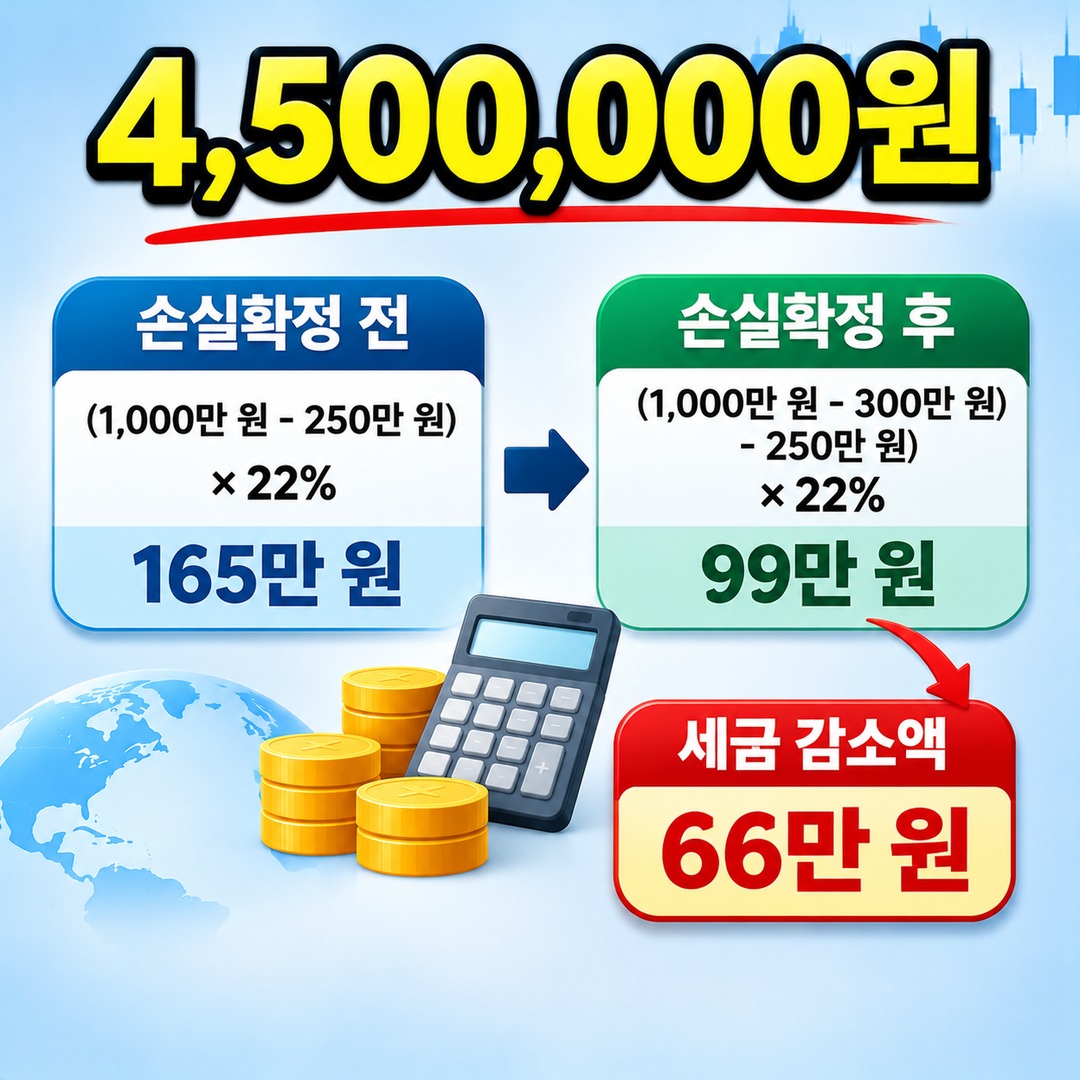
Before realizing losses: (KRW 10,000,000 - KRW 2,500,000) × 22% = KRW 1,650,000
After realizing losses: (KRW 10,000,000 - KRW 3,000,000 - KRW 2,500,000) × 22% = KRW 990,000
Tax savings: KRW 3,000,000 × 22% = KRW 660,000
The calculation above assumes that taxable income is sufficiently higher than the basic exemption. Actual tax filing results may vary depending on exchange rates, trading fees, acquisition costs, deductible expenses, and the applicable tax rate.
Every KRW 1,000,000 in realized losses does not automatically reduce your taxes by KRW 220,000. Tax savings of that amount are possible only if your taxable income already exceeds the basic exemption KRW 2,500,000.
How Much of Your Loss-Making Stocks Should You Sell to Your Advantage?
Rather than automatically realizing the largest possible loss, it is more reasonable to determine the amount based on your annual realized gains and the basic exemption.
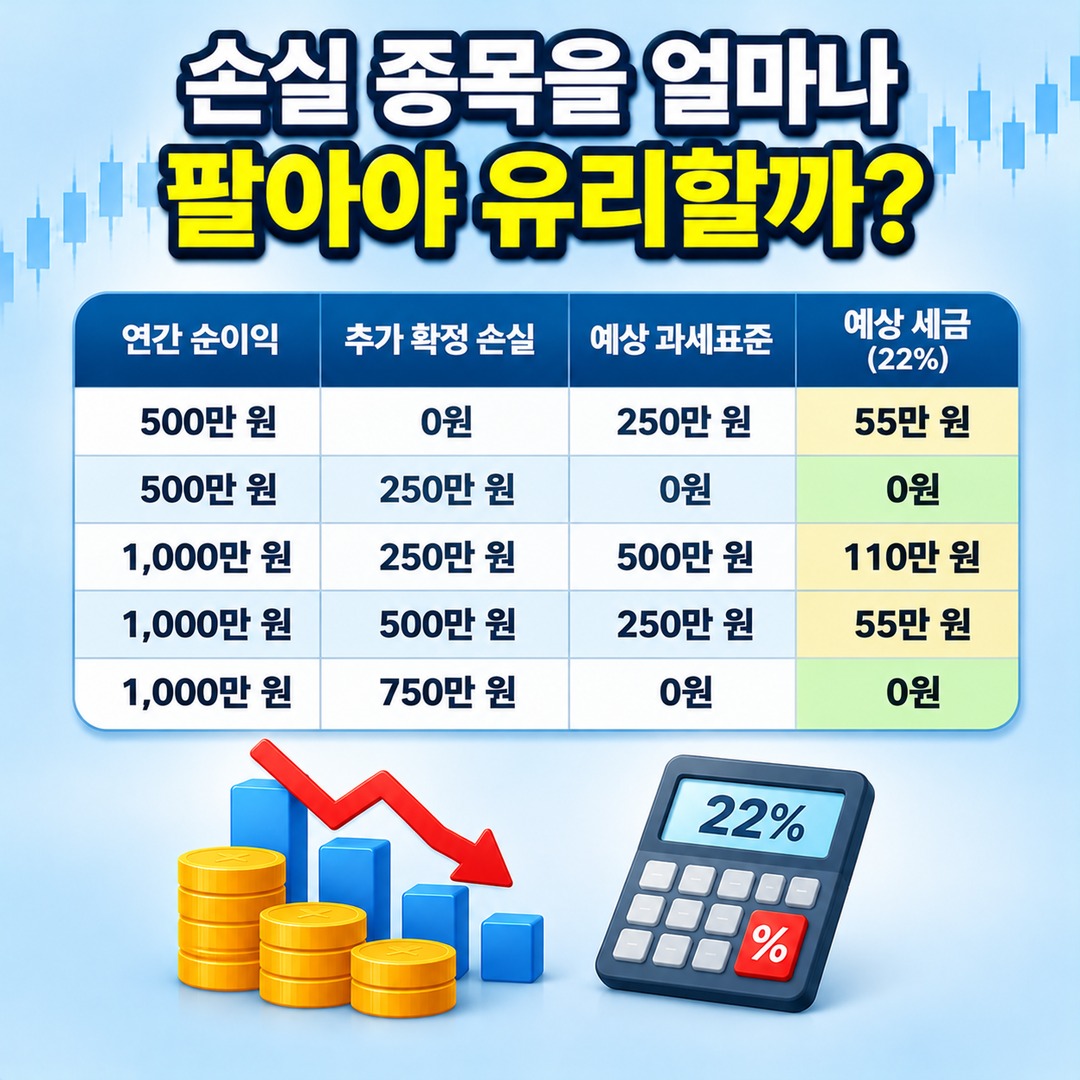
The following is a simplified calculation applying the 22% tax rate to ordinary foreign-listed stocks.
| Annual Net Profit | Additional Realized Loss | Estimated Taxable Income | Estimated Tax |
|---|---|---|---|
| KRW 5,000,000 | KRW 0 | KRW 2,500,000 | KRW 550,000 |
| KRW 5,000,000 | KRW 2,500,000 | KRW 0 | KRW 0 |
| KRW 10,000,000 | KRW 2,500,000 | KRW 5,000,000 | KRW 1,100,000 |
| KRW 10,000,000 | KRW 5,000,000 | KRW 2,500,000 | KRW 550,000 |
| KRW 10,000,000 | KRW 7,500,000 | KRW 0 | KRW 0 |
Unit: KRW. This calculation assumes there are no gains or losses from other stock transactions and no additional deductible expenses.
There is an important point to keep in mind here.
If your annual net profit is KRW 5,000,000, only the amount remaining after deducting the basic exemption KRW 2,500,000, namely KRW 2,500,000, is taxable.
Therefore, if you realize a loss of KRW 2,500,000, your taxable income becomes KRW 0.
Conversely, if you are already in an annual net-loss position, realizing additional losses may not reduce your taxes immediately.
Can Losses on Domestic Stocks Also Be Deducted from Gains on Overseas Stocks?
Yes. However, not all domestic stock transactions qualify.
The National Tax Service allows capital gains and losses from taxable domestic stocks to be offset against those from foreign stocks for transfers made from 2020 onward.
Domestic stock transactions that are not subject to capital gains tax, such as exchange-traded shares held by ordinary minority shareholders, cannot be offset against gains or losses from overseas stocks.
| Type of Domestic Stock | Eligible for Offsetting Against Overseas Stock Gains and Losses |
|---|---|
| Gains from Sales of Listed Shares by Major Shareholders | Eligible |
| Taxable Gains from Sales of Unlisted Shares | Eligible |
| Exchange-Traded Shares Held by Ordinary Minority Shareholders | Not Eligible |
| Domestic Stock Transactions Not Subject to Capital Gains Tax | Not Eligible |
In addition, the basic exemption for domestic and foreign stocks is not applied separately as KRW 2,500,000 each; instead, the combined annual exemption is limited to KRW 2,500,000.
The National Tax Service's tax calculation guidelines also provide an example of offsetting losses from domestic unlisted stocks against gains from overseas stocks when calculating combined domestic and foreign stock gains and losses.
Therefore, if you traded both domestic and overseas stocks, you should review your entire transaction history for the year.
Three Things That Are Easy to Overlook Before Realizing Losses
1. Unrealized Losses and Realized Losses Are Different
Even if a stock's price falls below its purchase price, a capital loss is generally not established unless you actually sell the stock.
You must actually sell the stock and incur a capital loss before it can be offset against capital gains from the same tax period.
2. Losses Cannot Be Carried Forward to the Following Year
According to the National Tax Service, capital gains and losses from stock transactions in the first and second halves of the same year can be offset against each other. However, capital losses incurred cannot be carried forward to the following year for deduction.
For example, even if you incur a net loss of KRW 5,000,000 on overseas stocks in 2026 and a net profit of KRW 10,000,000 on overseas stocks in 2027, you cannot deduct the KRW 5,000,000 loss from 2026 against the gains earned in 2027.
Therefore, the year in which you realize a loss matters.
3. Dollar-Based Returns and Tax Calculation Results May Differ
Capital gains on overseas stocks are not calculated solely on the basis of dollar-denominated returns.
The National Tax Service's guidance on overseas stock taxation explains that the applicable base exchange rate or cross rate is the rate on the date the sale proceeds are deposited into the account and the date the acquisition costs and other amounts are withdrawn.
Therefore, even a stock showing a loss in dollar terms may produce a different result when converted into Korean won.
It is advisable to verify the final gains and losses using your brokerage firm's overseas stock capital gains calculation statement.
Steps for Realizing Losses at Year-End in 2026
The following items should be checked at year-end.
1. Check the estimated capital gains from overseas stocks provided by each brokerage firm.
2. Separate realized gains from unrealized losses for 2026.
3. Check the estimated capital loss in Korean won from the loss-making stocks you plan to sell.
4. Calculate the amount of loss you need to realize, taking the basic exemption KRW 2,500,000 into account.
5. Check each brokerage firm's year-end trading cutoff date and domestic settlement date.
6. After selling, review the actual transaction records and settlement date again.
7. File your capital gains tax return for 2026 through the National Tax Service's Hometax system at May 2027.
The National Tax Service advises taxpayers who earn capital gains from overseas stocks to file an annual final tax return in the following year. For income attributable to 2025, the filing and payment deadline was 2026-06-01. The exact filing deadline for income attributable to 2026 must be confirmed through the National Tax Service's announcement in 2027.
**Frequently Asked Questions
Q. If I sell U.S. stocks on December 31, will the loss qualify for 2026?**
You should not determine this based on the sale date alone. Since the transfer date is determined by the date payment is settled, if the settlement date falls in 2027, the transaction may be attributed to 2027 instead.
Q. Can I buy the stock again after selling it to realize a loss?
Buying the stock again after selling it is a separate investment decision. The repurchase price may differ, and trading fees and exchange rate fluctuations may also arise. Rather than repeatedly trading solely for tax reasons, you should first consider your actual investment objectives and the associated risks.
Q. Can gains and losses from multiple brokerage firms be combined?
Taxable capital gains and losses from domestic and foreign stocks in the same tax year can be combined when filing the final tax return, even if the transactions were made through different brokerage firms. However, you must review all transaction records and each brokerage firm's calculation statements.
Q. If realizing losses reduces your tax to KRW 0, can you skip filing a tax return?
You should also check whether you have other taxable transactions or circumstances that require filing. Do not assume that you have no filing obligation simply because you incurred a loss through one brokerage firm.
What to Actually Check at Year-End in 2026
The key to realizing losses on overseas stocks is not to sell loss-making stocks indiscriminately. Instead, calculate the capital gains and losses attributable to 2026 and execute the transactions on trading dates that allow settlement within the year.
In particular, December 29 for U.S. stocks is an estimated cutoff date based on the current settlement structure, not a final date officially confirmed by each brokerage firm.
Before selling loss-making stocks, first check both the estimated capital gains information for 2026 provided by your brokerage firm and its year-end trading announcements.
※ This article provides information for understanding market trends and does not constitute an investment recommendation for any specific stock or asset. All final decisions and investment responsibility rest with the individual investor.