

If Stocks Plunge After an FTD, Is the Bull Market Confirmation Invalid? 1-Day Low and Failure Criteria
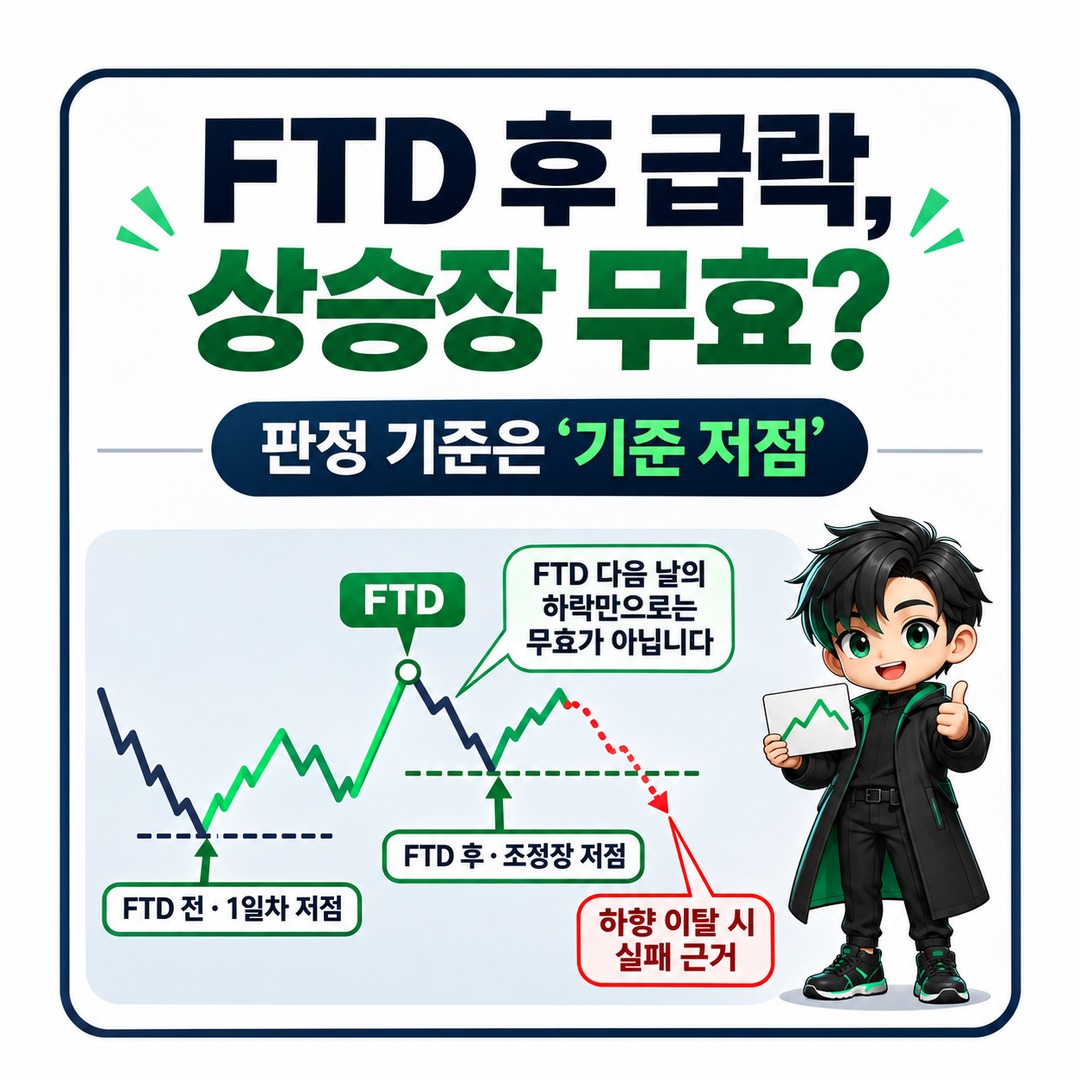
An FTD (Follow-Through Day) in the stock market does not confirm that a bull market is underway. The key is whether the index holds the reference low of its rally attempt afterward. Before an FTD, watch the 1-day low; after an FTD, check whether the market undercut the low of the correction.
2026-11-05 In a public IBD Live Q&A, it was also emphasized that the preceding rally should not be interpreted as a definitive FTD and that market stabilization needs to be confirmed. So if the market plunges after an FTD, when should the previous confirmation of an uptrend be considered invalid?
1. An FTD Is Not Determined by a Single Day’s Gain
An FTD is a technical signal that helps confirm whether a rally attempt that began after a market correction may develop into an actual uptrend.
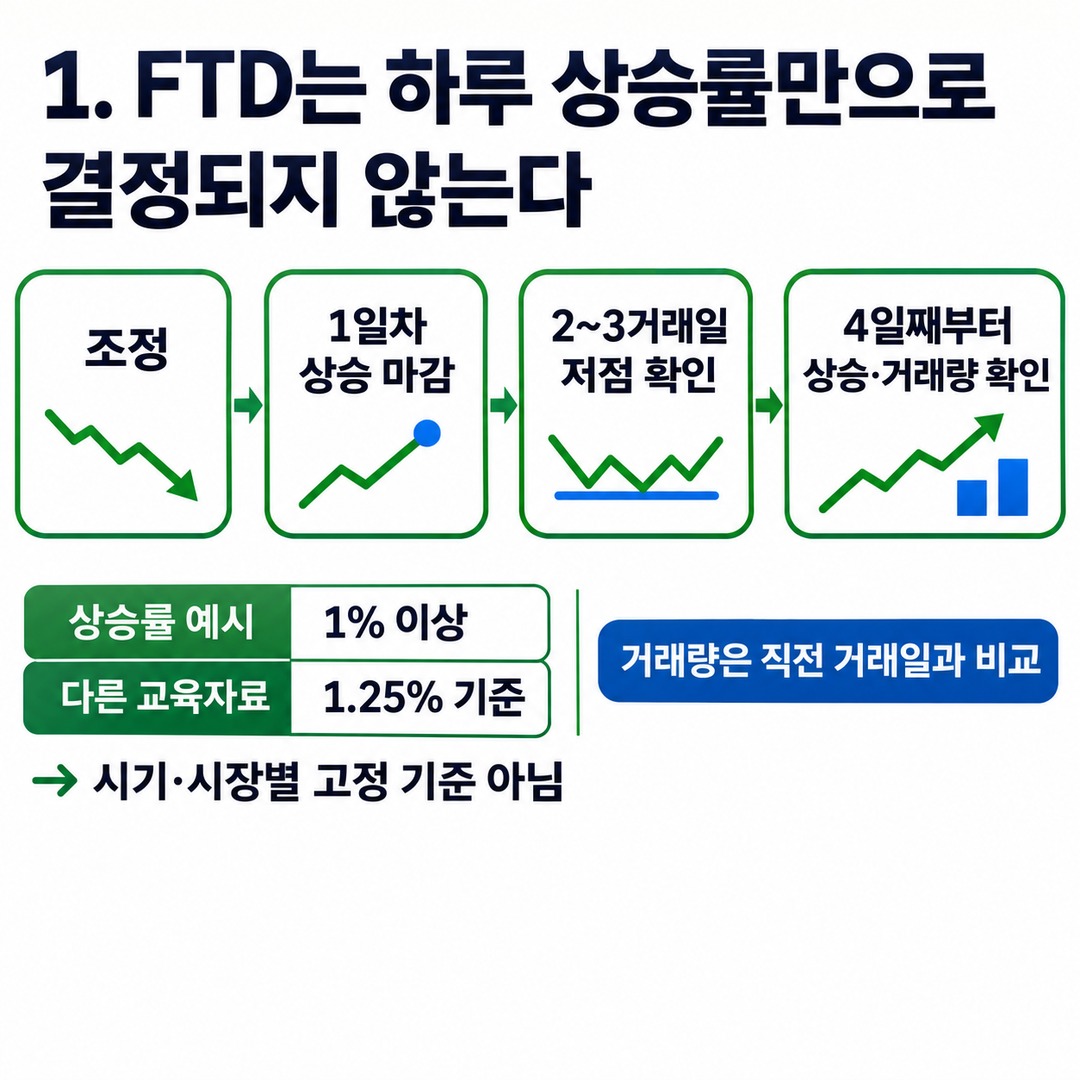
A one-day gain of 2~3% in the Nasdaq or S&P500 alone does not make it an FTD. You need to consider the rally attempt’s starting point, the number of trading days elapsed, the index’s percentage gain, and trading volume.
The basic confirmation process is as follows.
1. The market enters a correction or downtrend.
2. When a major index stops falling and closes higher, record that day as rally attempt 1.
3. Over the next 2~3 trading days, check whether the 1-day low holds.
4. Starting on 4, check whether a major index rises strongly.
5. Check whether trading volume on the up day increased from the previous trading day.
General explanations of an FTD sometimes cite an index gain of 1% or more. However, Investor's Business Daily educational materials also include the 1.25% threshold, so a single fixed figure should not be assumed to apply to every market and period.
Volume does not necessarily have to exceed average volume. The basic comparison is with volume on the previous trading day. Volume above average is an additional factor to consider when assessing the strength of buying pressure.
2. What Happens If the 1-Day Low Breaks Before an FTD?
If the 1-day low is undercut while a rally attempt is underway, the existing rally attempt is considered failed, and the count starts over.
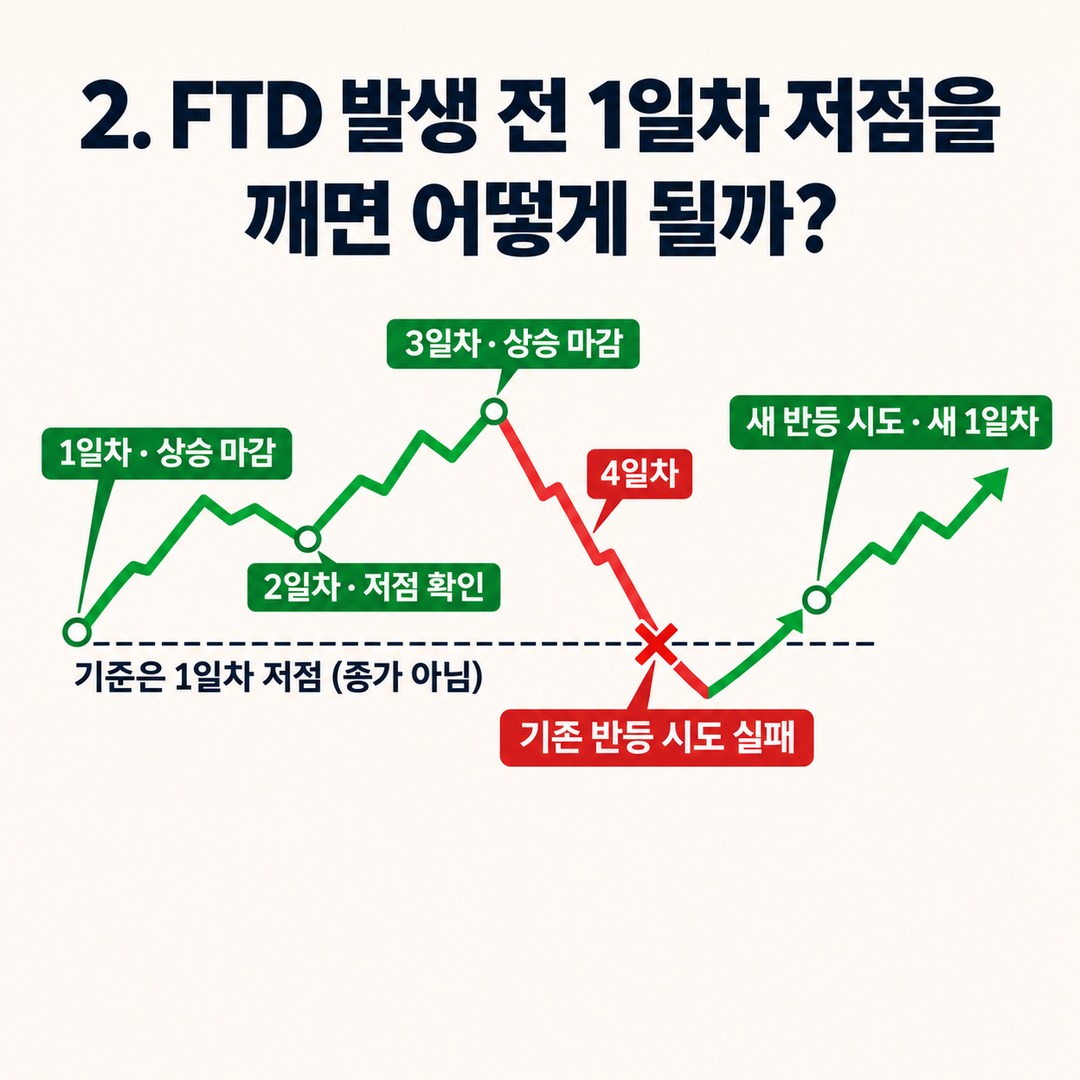
The important point here is the index's low on 1, not its closing price that day.
Consider the following hypothetical example.
| Trading day | Index movement | Assessment |
|---|---|---|
| 1 | Closed higher | Rally attempt begins |
| 2 | Fell slightly | Low remains intact |
| 3 | Closed higher | Rally attempt continues |
| 4 | 1-day low undercut | Existing attempt fails |
| Afterward | A new higher close | New rally attempt begins |
Even if the index rises again on 4, once it has undercut the 1-day low, you do not continue counting the dates of the existing rally attempt.
When a new rally attempt begins, record a new 1.
The point beginners most often misunderstand is that they simply count up days to calculate when an FTD might occur.
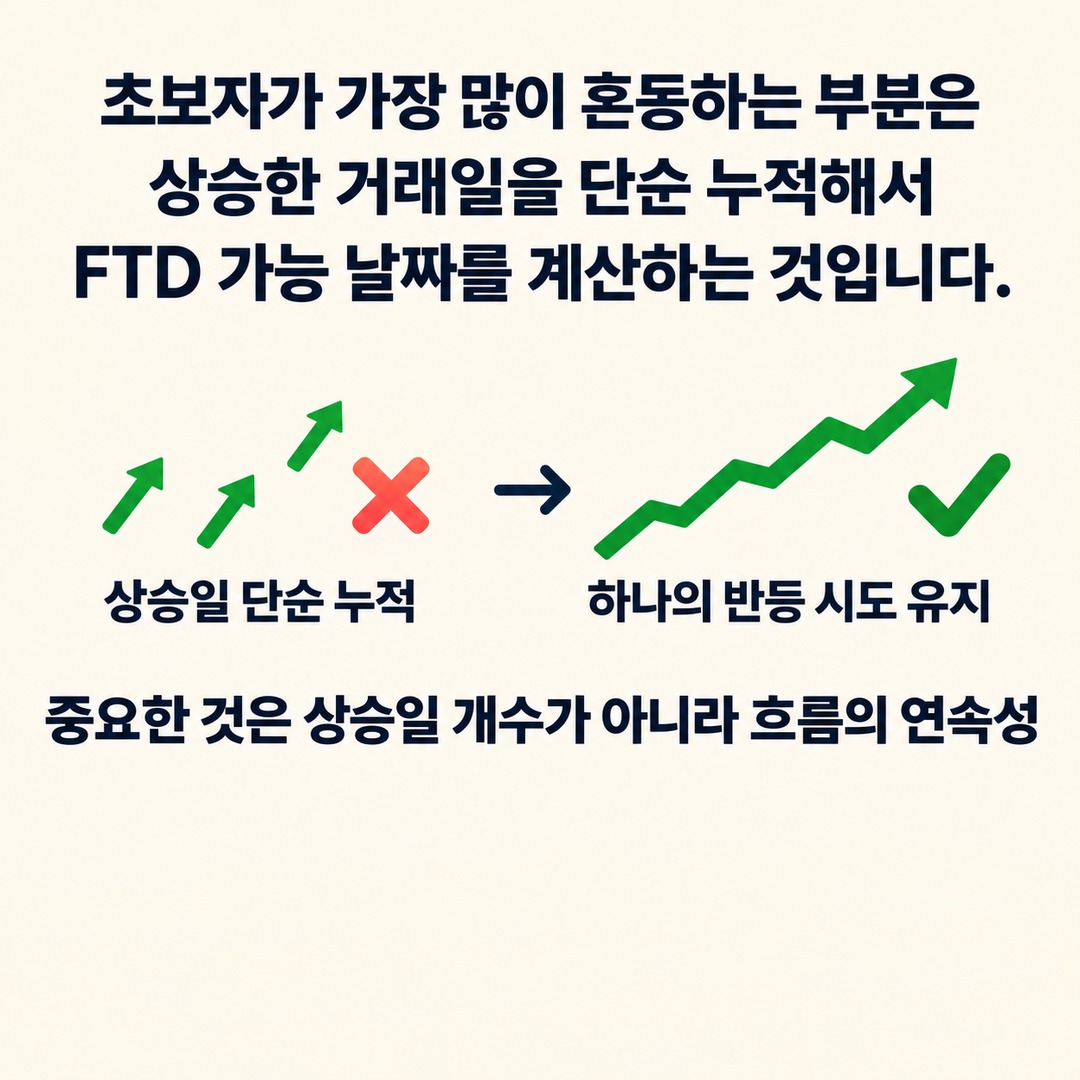
What matters for an FTD is whether a single rally attempt remains intact, not how many up days have been recorded.
3. Does a sharp drop after an FTD always mean the rally has failed?
No. An index decline the day after an FTD does not immediately invalidate the FTD.
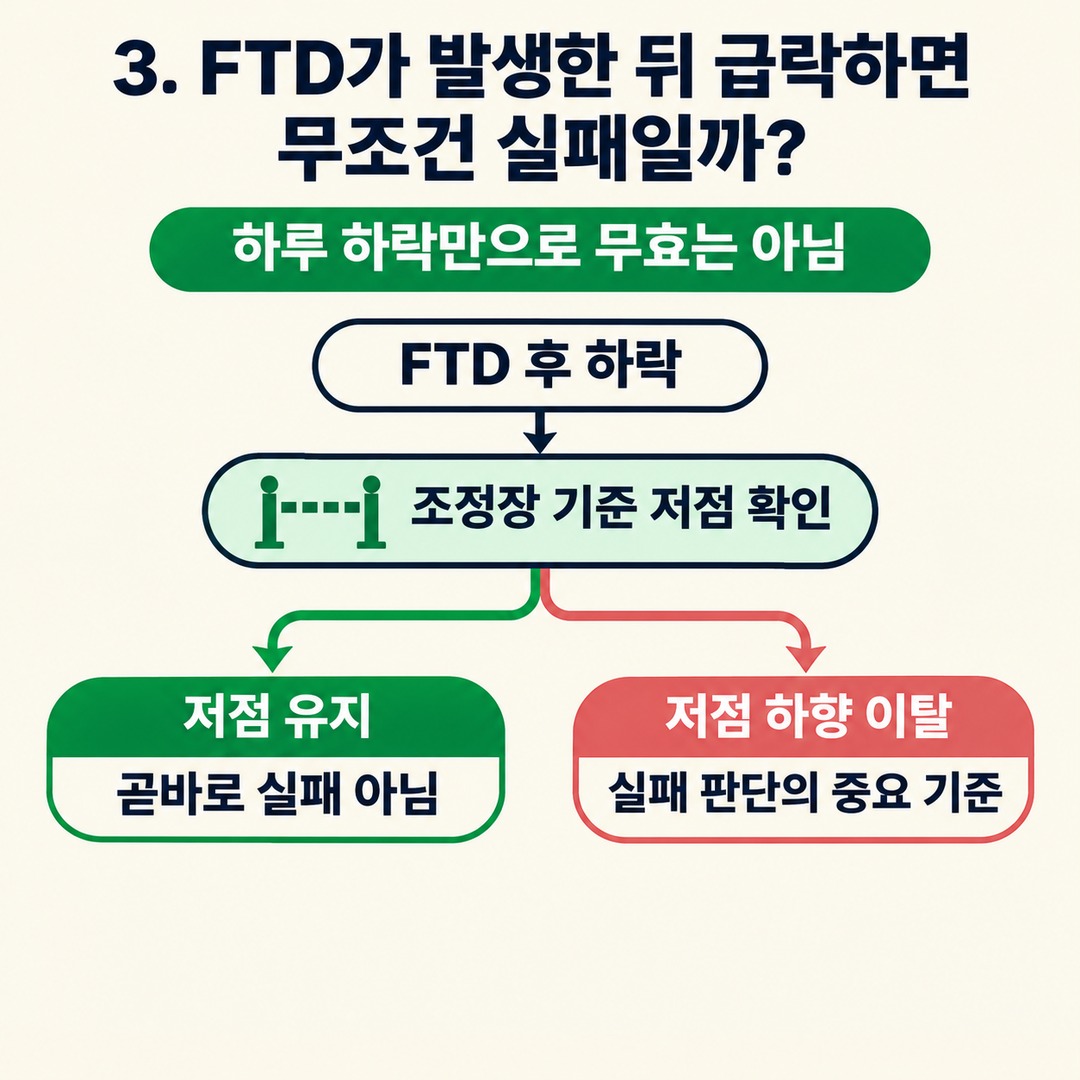
After an uptrend is confirmed, the market's reference low for the correction needs to be checked again. An undercut of that low is an important criterion for determining whether the existing FTD has failed.
It is useful to distinguish among these three situations.

① A modest decline the day after an FTD
A single down day is not enough to confirm that an FTD has failed. Check whether the index is holding its reference low and whether the price action of leading stocks is stable.
② An increase in distribution days after an FTD
A distribution day is one on which a major index declines and trading volume is higher than on the previous trading day. Under the IBD approach, it is also generally checked whether the index fell by 0.2% or more.
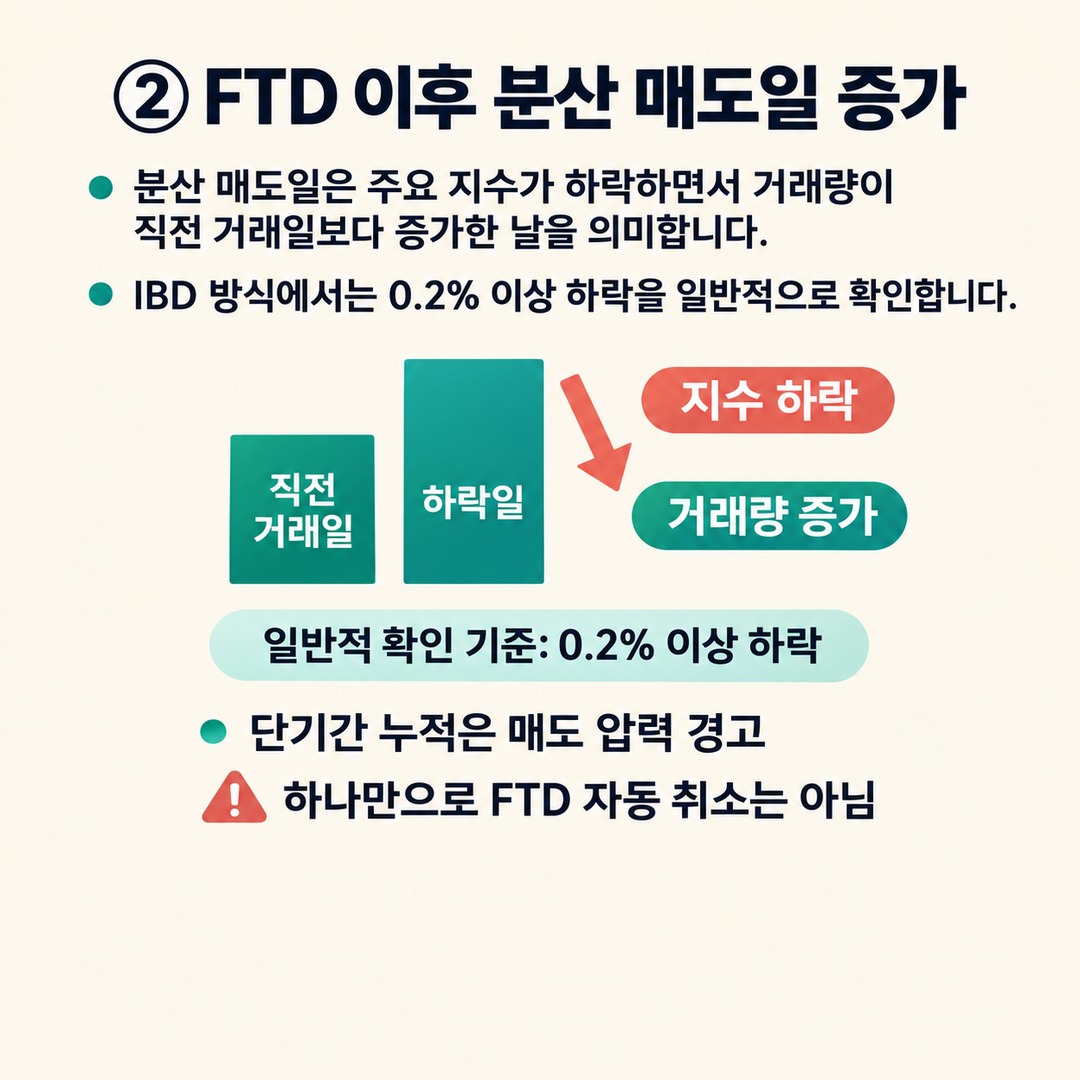
When distribution days accumulate over a short period, this can be interpreted as a warning that institutional selling pressure is increasing.
However, a single distribution day does not automatically cancel an FTD.
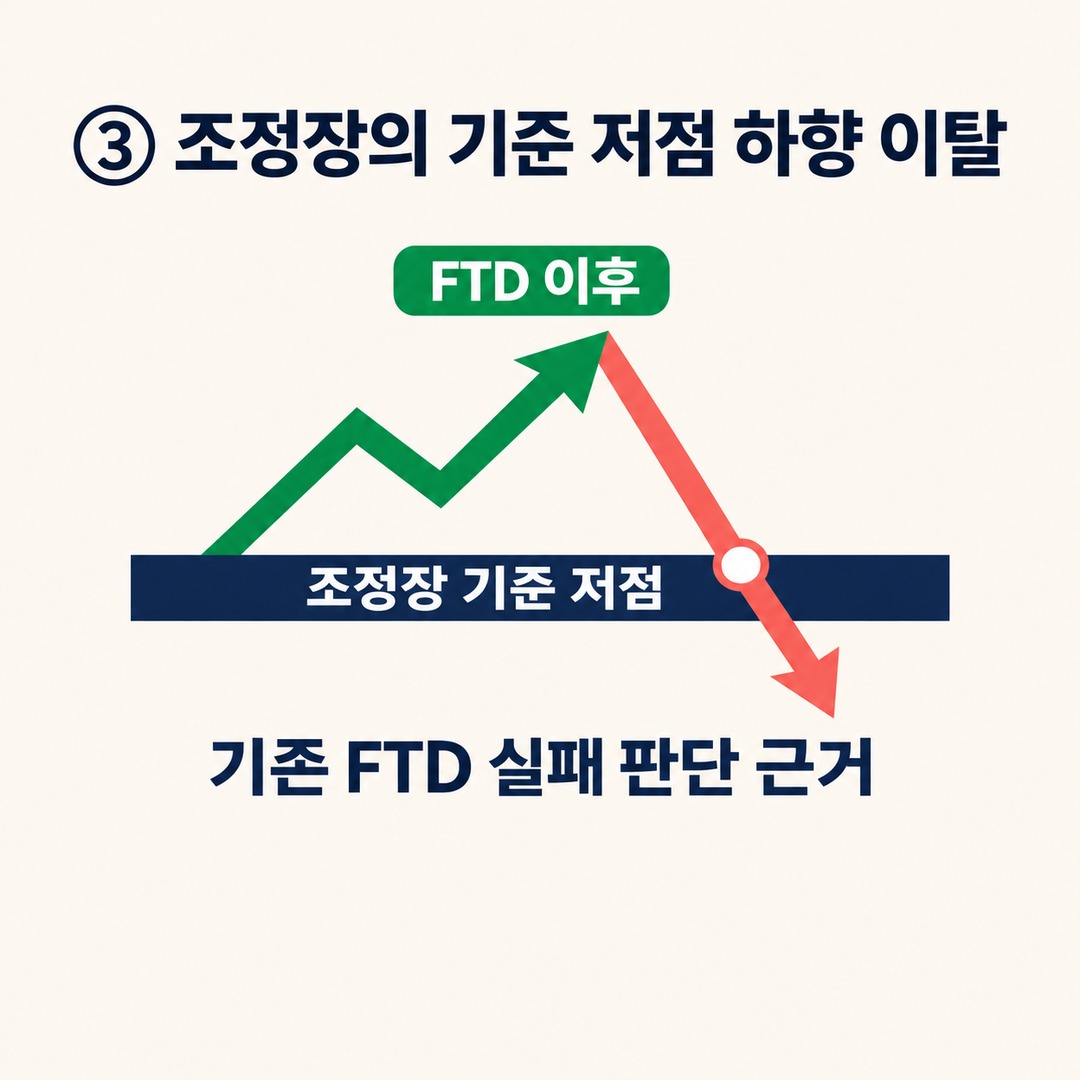
③ The market undercuts the correction's reference low
If the market undercuts the low of the previous correction after an FTD, that is an important basis for judging that the uptrend confirmation has failed.
At that point, it is difficult to continue treating the existing FTD as a valid bull market signal.
IBD's educational materials also explain that an FTD has failed if, after the FTD, the market undercuts the low of the downtrend again.
4. What Else Should You Check After an FTD?
If an FTD occurs, don't stop at checking the index. You should also see whether the stocks actually leading the market are participating in the rally.
It is useful to look at these four factors together.
Nasdaq and S&P500: Are the major indexes holding their reference lows?
Volume: Does buying volume increase on up days?
Distribution days: Are increases in volume on down days recurring?
Market leaders: Do strong stocks continue to rise after breaking out?
The important point is that index movements and individual stock movements do not necessarily match.
Even if the index rallies, if market leaders cannot recover above the 50-day moving average or breakout stocks fail one after another, it is difficult to conclude that buying across the market has recovered sufficiently.
An FTD is therefore a signal for checking the overall market's buying environment, not an instruction to buy every CAN SLIM stock immediately.
5. How to Check Whether an FTD Has Failed on an Actual Chart
There is no need to overcomplicate it. Record the information in this order.
1. Mark the correction low for the major index.
2. Find the first day the index closes higher and record it as 1.
3. Check whether the 1-day low holds.
4. Check whether a strong rise and increased volume appear from 4 onward.
5. Check whether the market undercuts the correction's reference low again after an FTD.
6. Watch distribution days and the movements of market leaders together.
In particular, in the U.S. stock market, it is useful to check both the Nasdaq Composite and the S&P500.
If one index rallies while another continues to weaken, it is more reasonable not to overinterpret that as a recovery across the whole market.
Also distinguish between an index's intraday low and its closing price. Recording whether it briefly undercut the low during the session and whether it recovered by the close can make the basis for your assessment clearer.
6. An FTD Failure Does Not Mean You Will Miss the Next Rally
An FTD does not guarantee future gains. A false rally signal can occur, and the market may fall again.
So there is no need to give up on the next rally just because an FTD has failed.
Instead, if the existing rally attempt has been invalidated, it is important to record a new reference low and the start date of a new rally attempt.
In actual investing, keep these principles in mind.
Before an FTD, check whether the rally attempt's low is holding.
After an FTD, check the correction's reference low again.
Use distribution days as a supporting measure when assessing the risk to the uptrend.
Check whether individual stocks are breaking out successfully alongside the market's direction.
Do not determine position size based solely on a market confirmation signal.
The key to an FTD is not a single strong up day, but whether the market holds its reference low and sustains actual buying pressure after the rally.
Acknowledge that market confirmation signals can be wrong, and manage individual stocks' stop-loss levels and account risk limits separately.
This educational information explains CAN SLIM's principles for assessing market direction. It is not a recommendation to buy or sell any particular stock or ETF.
※ This article is for reference in understanding market trends and is not an investment recommendation regarding any particular stock or asset. You are responsible for your own final decisions and investments.