

How to Calculate Share Quantity Based on a Stock Stop-Loss Price: How Many Shares Should You Buy Within Your Account’s Loss Limit?
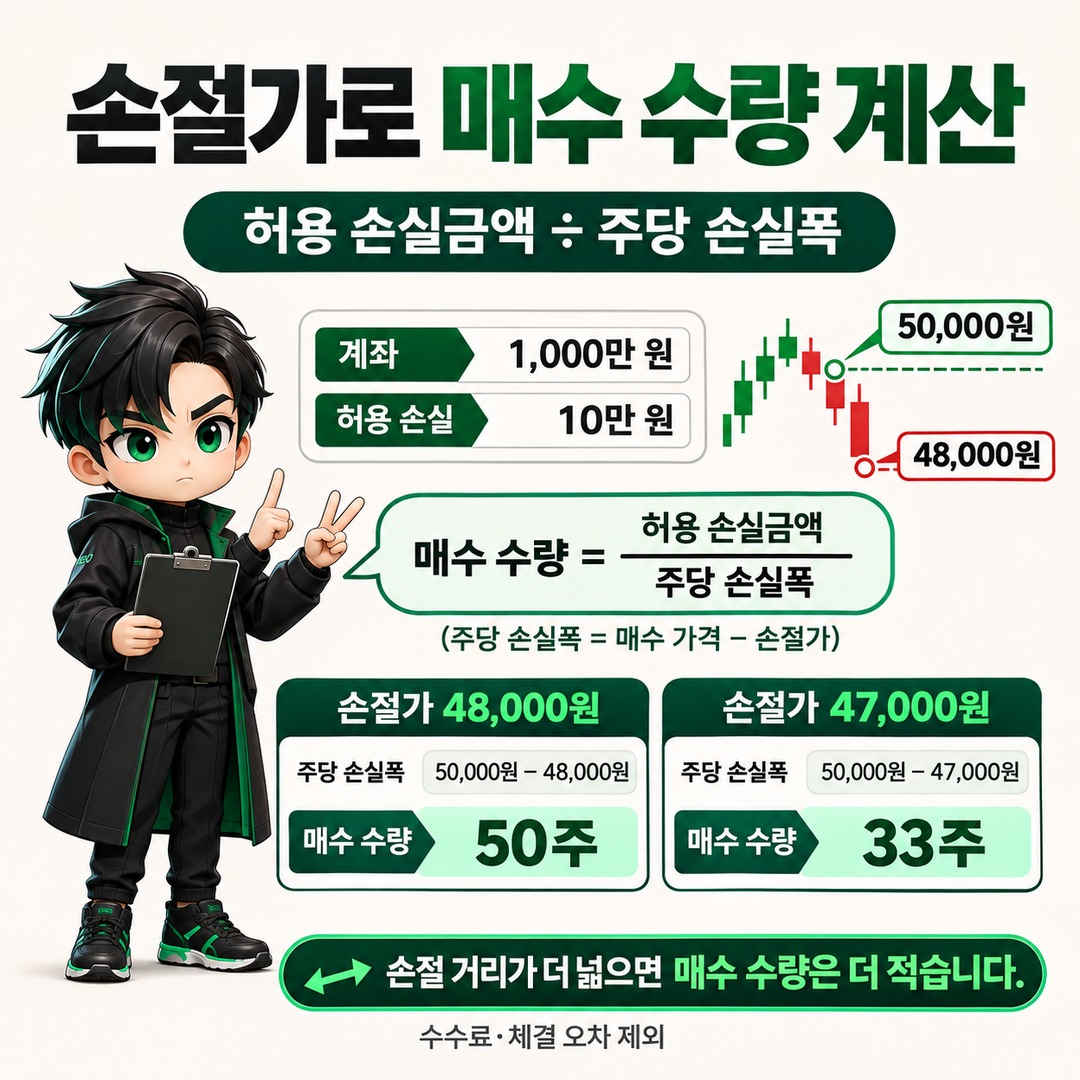
Rather than setting the number of shares to buy based on the investment amount, it is reasonable to first set the loss amount the account can absorb, then divide it by the difference between the purchase price and the stop-loss price. For example, if the account value is KRW 10,000,000 and the loss limit per trade is KRW 100,000 across 1 trades, with a purchase price of KRW 50,000 and a stop-loss price of KRW 48,000, the number of shares that can be purchased is 50 shares. However, the actual loss may be greater because of fees and differences in execution prices.
The Key Formula for Determining Share Quantity
Calculate the number of shares based on a stock stop-loss price using this formula:
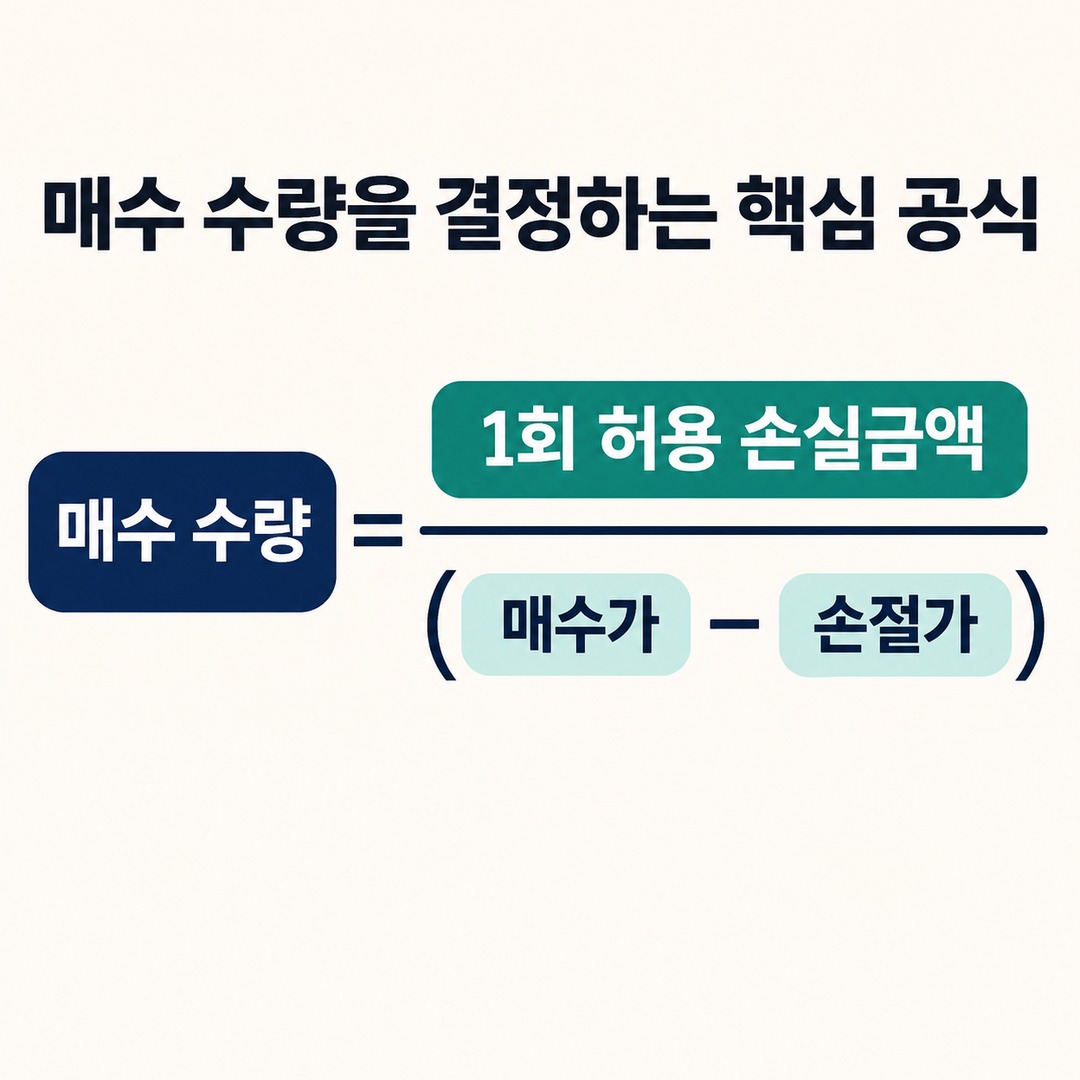
Number of Shares = 1 allowable loss per trade ÷ (purchase price - stop-loss price)
Round the result down to a whole number of shares.
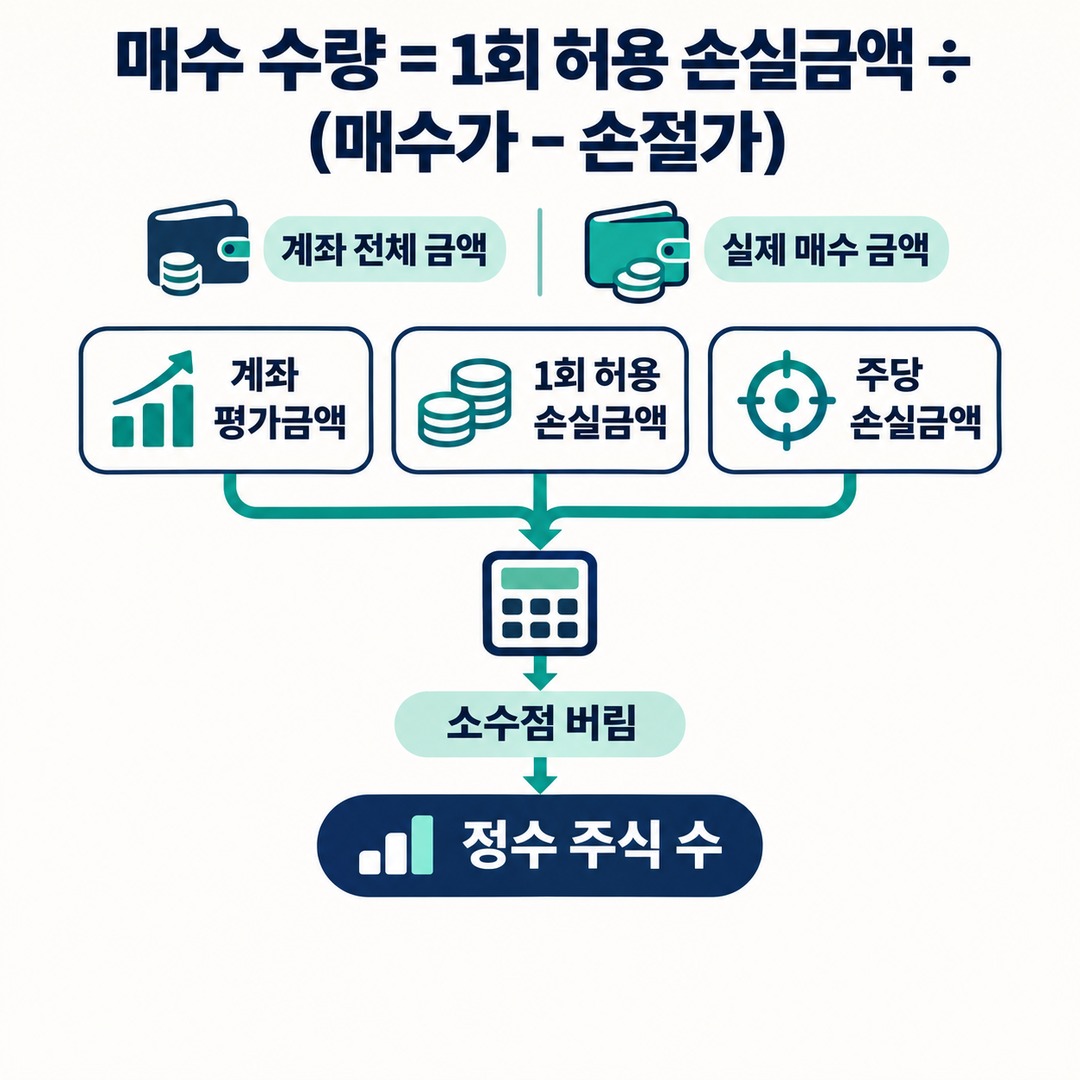
First, determine these three values:
Account value: the reference assets in the current investment account
1 allowable loss per trade: the maximum loss budget for a single trade
Loss per share: the purchase price minus the stop-loss price
The important point is to distinguish the total account value from the amount actually used for the purchase. Even if you have enough funds to buy, you should reduce the number of shares if doing so would exceed your loss limit.
How Does the Number of Shares Change in an Actual Calculation?
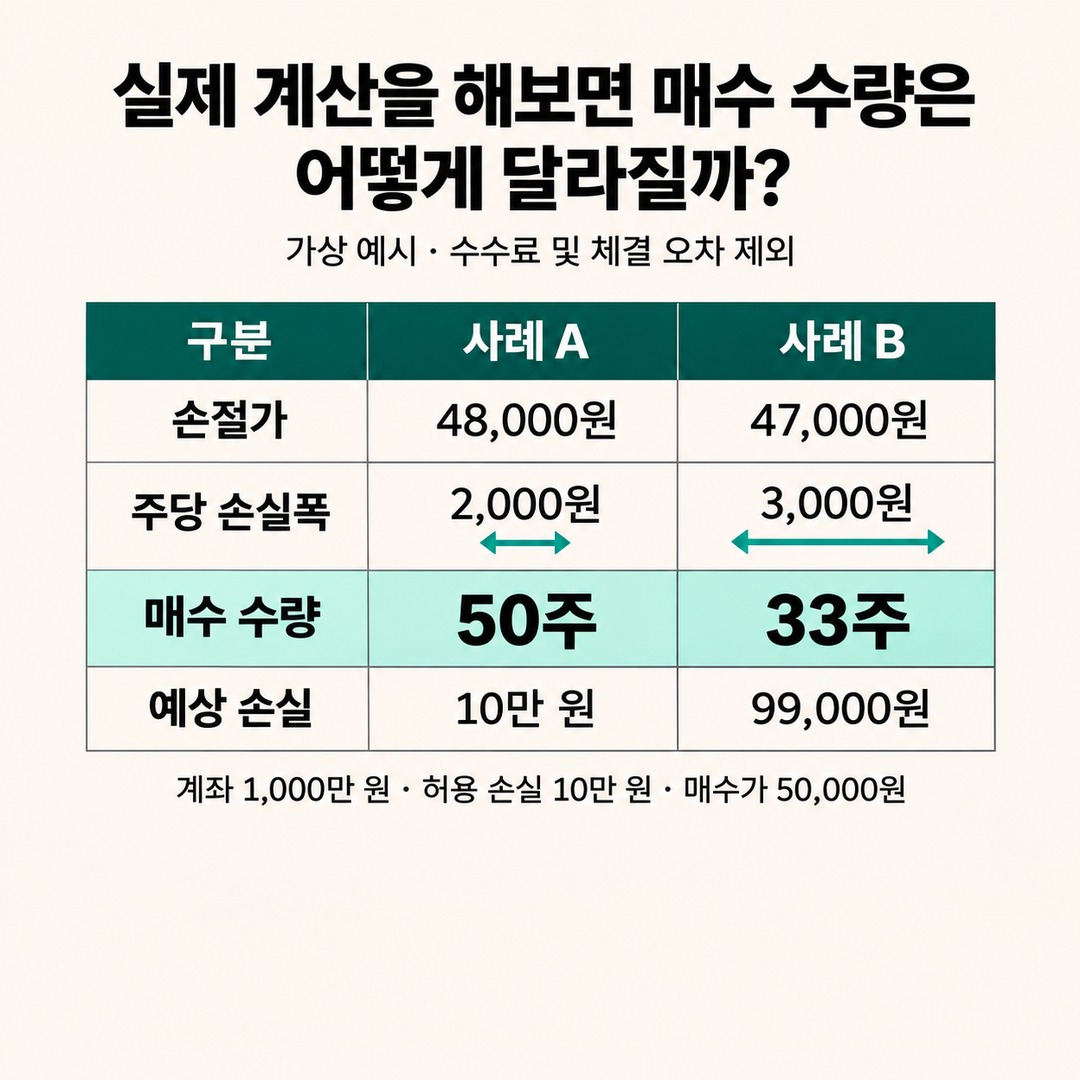
The following is a hypothetical example to illustrate how the calculation works. We will keep the account value at KRW 10,000,000, the allowable loss rate per 1 trades at 1%, and the purchase price at KRW 50,000, while changing only the stop-loss price.
Hypothetical example · Author’s calculation · Fees and execution slippage excluded
| Item | Case A | Case B |
|---|---|---|
| Account value | KRW 10,000,000 | KRW 10,000,000 |
| Allowable loss rate | 1% | 1% |
| Allowable loss amount | KRW 100,000 | KRW 100,000 |
| Purchase price | KRW 50,000 | KRW 50,000 |
| Stop-loss price | KRW 48,000 | KRW 47,000 |
| Loss per share | KRW 2,000 | KRW 3,000 |
| Number of shares to buy | 50 shares | 33 shares |
| Purchase amount | KRW 2,500,000 | KRW 1,650,000 |
| Estimated loss if the stop-loss is triggered | KRW 100,000 | KRW 99,000 |
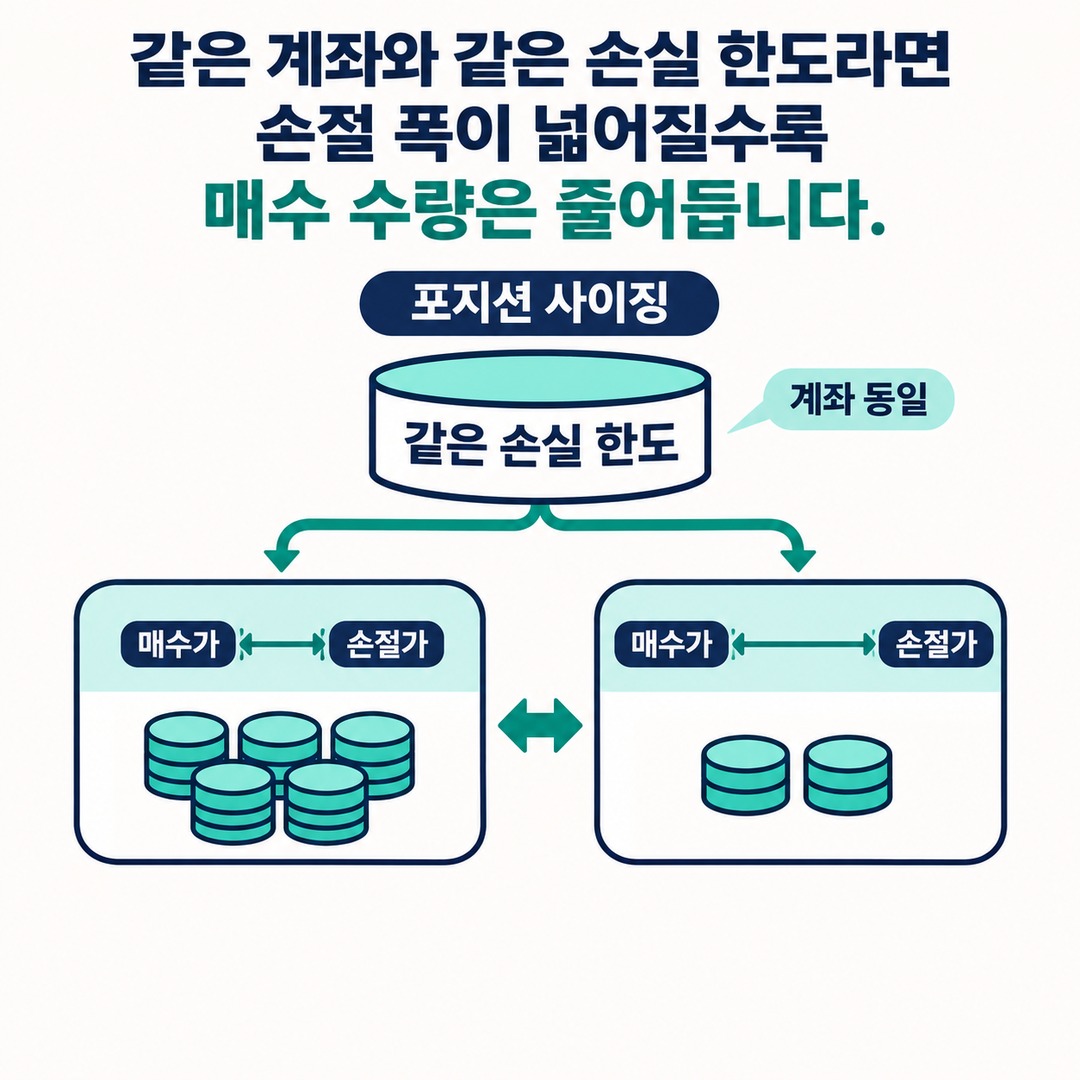
The difference between the two cases is the stop-loss distance.
In Case A, the loss is KRW 2,000 per share, so 50 shares can be purchased.
In Case B, the loss per share rises to KRW 3,000, so the purchase should be limited to 33 shares.
With the same account and loss limit, the wider the stop-loss distance, the fewer shares you can buy.
This is position sizing: adjusting the size of an investment to match the potential loss.
What Percentage of Your Account Should You Set as a Loss Limit?
1% or 2% should not be treated as a universally correct loss limit for every investor. The loss percentage you are actually willing to accept should be determined by considering your investment horizon, trading frequency, asset size, and the risks of your other holdings.
In its trading plan guidance published on 2024-10-23, Charles Schwab describes an example of putting 1–2% of an account at risk per trade. This is one general example of trade management, not a mandatory standard suitable for every investor.
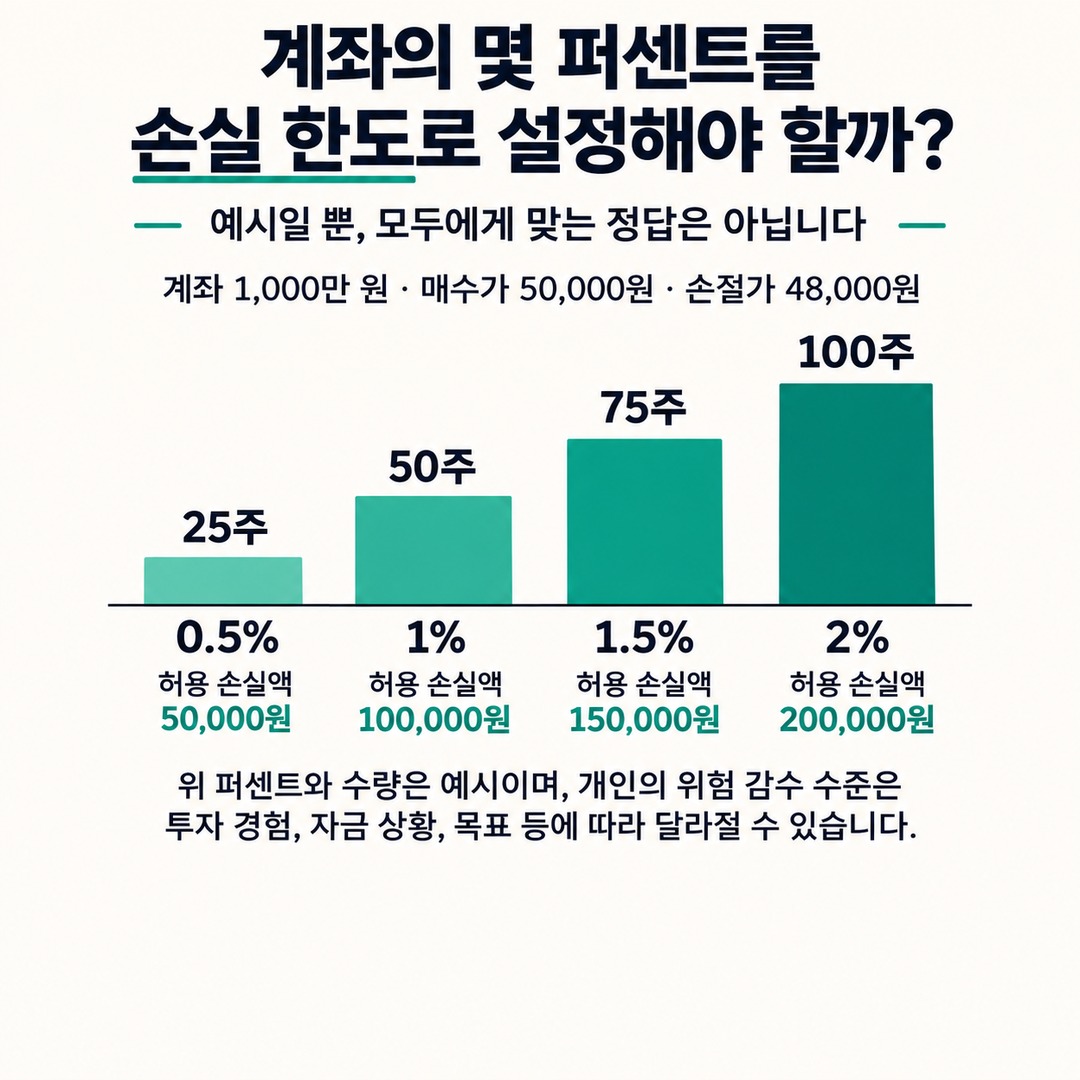
Let’s look at how the share quantity changes when the loss limit changes for the same account.
Hypothetical example · Account KRW 10,000,000 · Purchase price KRW 50,000 · Stop-loss price KRW 48,000
| Loss limit | Allowable loss amount | Calculated number of shares |
|---|---|---|
| 0.5% | KRW 50,000 | 25 shares |
| 1% | KRW 100,000 | 50 shares |
| 1.5% | KRW 150,000 | 75 shares |
| 2% | KRW 200,000 | 100 shares |
If you double the allowable loss percentage, the calculated number of shares also doubles.
However, this does not mean your investment returns will double. If stop-losses are triggered repeatedly, losses in the account will accumulate.
Therefore, use the loss limit not as a figure for increasing your position size, but as a standard for limiting potential losses in advance to an amount you can afford.
What If the Calculated Number of Shares Exceeds the Number You Can Actually Buy?
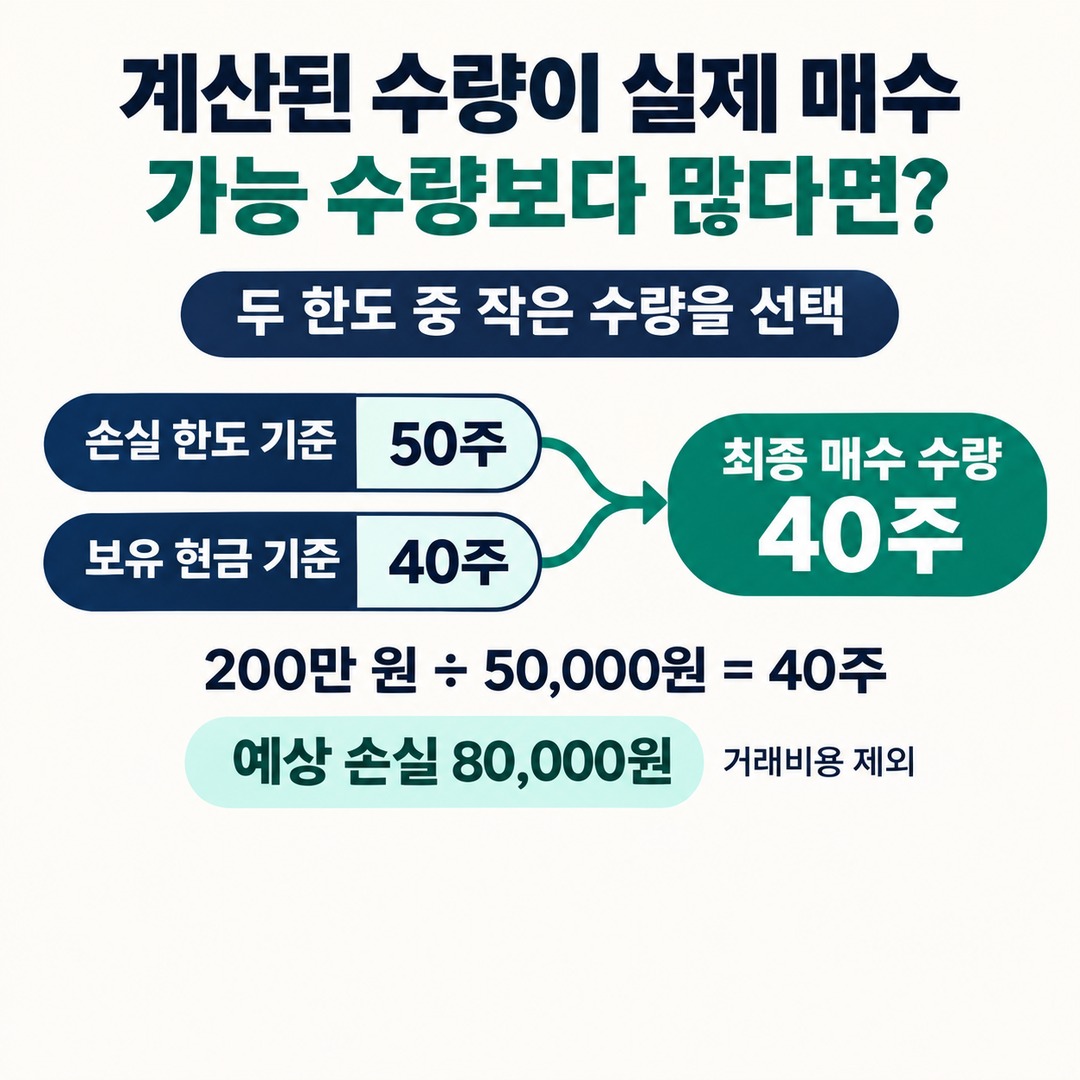
Choose the smaller of the quantity calculated from your loss limit and the quantity you can actually place an order for.
The purchase amount could exceed the cash you have available.
For example, let’s assume the following:
Allowable loss amount: KRW 100,000
Purchase price: KRW 50,000
Stop-loss price: KRW 48,000
Quantity based on the loss limit: 50 shares
Cash available for the actual order: KRW 2,000,000
The number of shares you can buy with your available cash is:
KRW 2,000,000 ÷ KRW 50,000 = 40 shares
Therefore, the final purchase quantity is 40 shares, not 50 shares.
Assuming you buy 40 shares and sell them all at KRW 48,000, the loss resulting from the price difference is KRW 80,000.
This calculation excludes transaction costs. For an actual order, you should also account for fees, taxes, and other costs.
In practice, it is best to apply both of the following limits at the same time.
1. Maximum quantity based on the account loss limit
2. Maximum quantity based on the funds available for the actual order
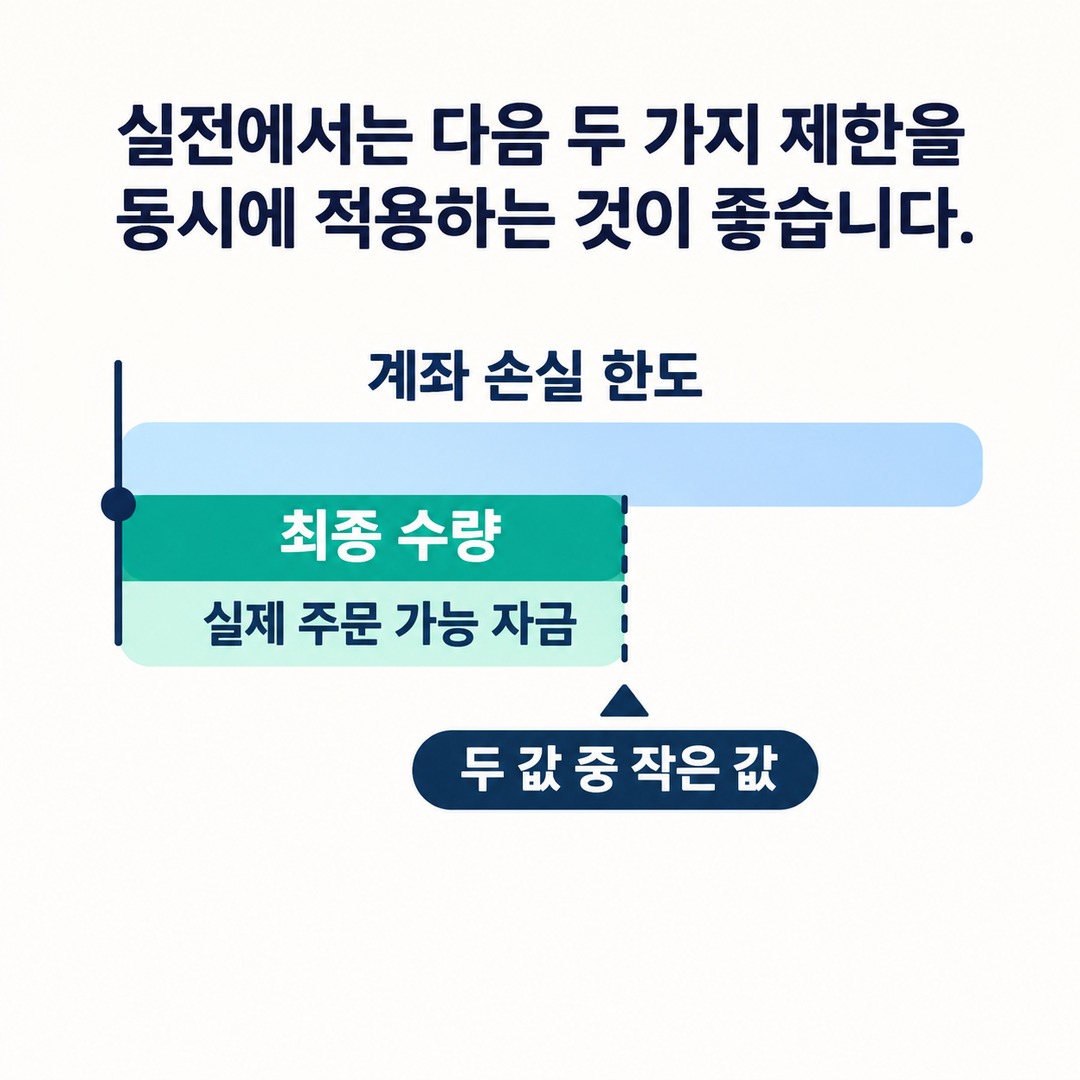
The final quantity is the smaller of the two values.
Will the Actual Loss Match the Calculated Amount When the Stop-Loss Price Is Reached?
Not necessarily. The formula gives a theoretical loss amount based on the assumption that the purchase and stop-loss orders are executed exactly at their specified prices.
In an actual market, a sale may execute below the stop-loss price.
In content updated on 2026-08-18, the U.S. Securities and Exchange Commission (SEC) explains the difference between a standard stop order and a stop-limit order in its investor guidance.
According to the stop-order guidance from SEC Investor.gov, a standard stop order becomes a market order when the specified price is reached. Therefore, the stop price does not guarantee the actual execution price.
This difference directly affects the calculated result.
The Difference Between a Standard Stop Order and a Stop-Limit Order
| Type | Standard stop order | Stop-limit order |
|---|---|---|
| How it works | Converts to a market order when the stop price is reached | Places a limit order when the stop price is reached |
| Price control | Limited | Prevents execution below the specified price |
| Main risk | May execute at a lower-than-expected price | May not execute if the price moves sharply |
For example, if a stop order is set at KRW 48,000 but the actual sale price is KRW 47,500, the loss per share is KRW 2,500.
If you held 50 shares, the calculation would be as follows:
Planned loss: 50 shares × KRW 2,000 = KRW 100,000
Hypothetical actual loss: 50 shares × KRW 2,500 = KRW 125,000
Difference: KRW 25,000
This is a hypothetical calculation to illustrate the difference in execution prices, not an actual trade example.
A stop-limit order is not a perfect solution either. It protects the price, but carries the risk that the order may not be executed.
FINRA’s guidance on order types also explains that when a stop order becomes a market order, the specified price and the actual execution price can differ significantly, and that execution of a stop-limit order is not guaranteed.
The Calculation Steps to Check Before Placing an Actual Order
Before clicking the Buy button, check the following in order.
1. Check the account value.
2. Set the loss amount you are willing to accept on this trade.
3. Set the purchase price and stop-loss price.
4. Calculate the loss per share from the difference between the two prices.
5. Divide the allowable loss amount by the loss per share.
6. Round down to a whole number.
7. Check whether you have enough cash to place an order for that number of shares.
8. Reduce the final quantity to account for fees, taxes, and expected execution slippage.
It is important to follow this order.
Do not set the number of shares first and then force the stop-loss price to fit. Set the stop-loss level first, then calculate the quantity accordingly.
Also, if you hold several stocks at the same time, calculating a separate loss limit for each trade is not enough. You should also check how much the entire account could lose if stop-losses are triggered across several holdings at once.
Common Mistakes in Calculating Share Quantity: First, Mistaking the Purchase Amount for the Loss Limit.
Buying KRW 2,500,000 worth of shares does not mean that the entire KRW 2,500,000 is exposed to risk. Conversely, having a stop-loss plan does not guarantee that the loss will be limited to the planned amount.
Second, narrowing the stop-loss distance arbitrarily to increase the number of shares.
A narrower stop-loss distance increases the calculated share quantity. However, you should separately assess whether the stop price is appropriate for your investment rationale.
Third, leaving out fees and execution slippage.
Even if the allowable loss in the calculation is KRW 100,000, transaction costs and price differences can add to the actual loss.
Fourth, focusing only on each stock’s loss limit and overlooking the risk to the account as a whole.
If several stocks fall together in the same market conditions, losses can occur at the same time.
The Key Question Is How Much You Can Afford to Lose, Not How Many Shares to Buy
You can calculate the number of shares to buy using the account value, allowable loss rate, purchase price, and stop-loss price.
The basic formula is:
Number of shares to buy = (account value × allowable loss rate) ÷ (purchase price - stop-loss price)
Round the calculated quantity down to a whole number, then check the amount you can actually order and the transaction costs before deciding on the final quantity.
However, this formula is a simple calculation model and does not guarantee execution at the stop price. You should also consider that actual losses may exceed the calculated amount if prices move sharply or the market opens with a downward gap.
Before buying, the first thing to consider is not how attractive the stock is, but how much your account can afford to lose if the plan does not go as expected.
As of: 2026-11-14 (Korea Standard Time)
※ This article is for reference to help understand market trends and is not an investment recommendation for any particular stock or asset. You are responsible for your own final decisions and investment outcomes.