

How Should the Mix of Stocks, Bonds, and Cash Change Based on When You’ll Need the Money?

The right mix of stocks, bonds, and cash depends more on your investment purpose and when you’ll actually need the money than on your age. There is no reason to manage money you must use within 5 years and money you’ll invest for 10 years or more at the same ratio. The key is to set aside the money you’ll need first, then account for the investment period and the level of loss you can tolerate with the remaining funds.
The U.S. SEC’s investor guidance and Vanguard’s asset allocation research, reviewed using 2026-11-09, also explain that investment horizon, risk tolerance, and progress toward goals should be considered together. However, there is no allocation that is right for every investor or portfolio that guarantees returns.
1. Asset allocation should start with when you’ll need the money, not with your total investment funds
Before dividing money among stocks, bonds, and cash, it is a good idea to separate funds by investment purpose.
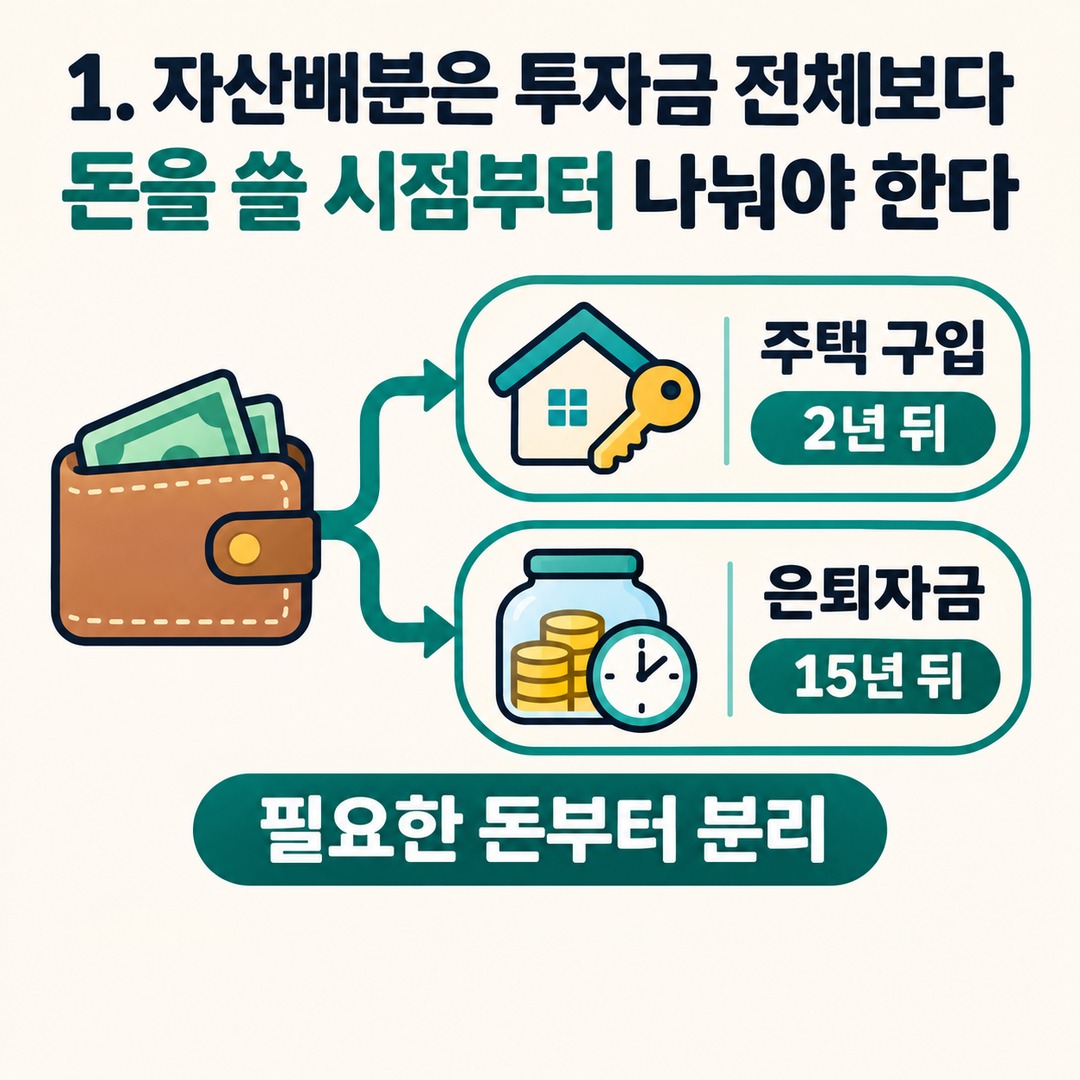
For example, even if you have the same KRW 100,000,000, money you plan to use to buy a home in 2 years and money you plan to use for retirement in 15 years should be managed differently.
The U.S. Securities and Exchange Commission’s (SEC) investor education website, Investor.gov, explains that an investment horizon is the period—measured in months, years, or decades—over which you invest funds to achieve a financial goal.
In other words, a longer investment horizon may give you more room to hold relatively volatile assets, while a shorter horizon may favor assets with smaller price fluctuations.
The key is not to think of all your investment funds as a single portfolio.
How to separate funds by investment purpose
| Investment purpose | When you’ll need the money | Assets to consider first |
|---|---|---|
| Living expenses and emergency funds | Anytime | Cash and deposits |
| Home purchase or wedding funds | Within 5 years | Cash, short-term financial products, and bonds matched to the required maturity |
| Medium-term lump sum | Depending on when the money will be used | A combination of bond-focused stability and stock growth potential |
| Long-term retirement funds | 10 years or more | A diversified mix centered on stocks and bonds |
The table above shows how to think about funds based on when they will be used; it does not recommend a personal allocation.
In particular, if you’ll need the money within 5 years, there may not be enough time to wait for a recovery after a stock market decline.
So for money with a set spending date, being able to convert it to cash when needed comes before its expected return.
2. How should you think about your stock allocation if your investment period is within 5 years?
For money you’ll need within 5 years, first consider whether a loss of principal could prevent you from meeting your goal, rather than focusing on stocks’ long-term growth potential.
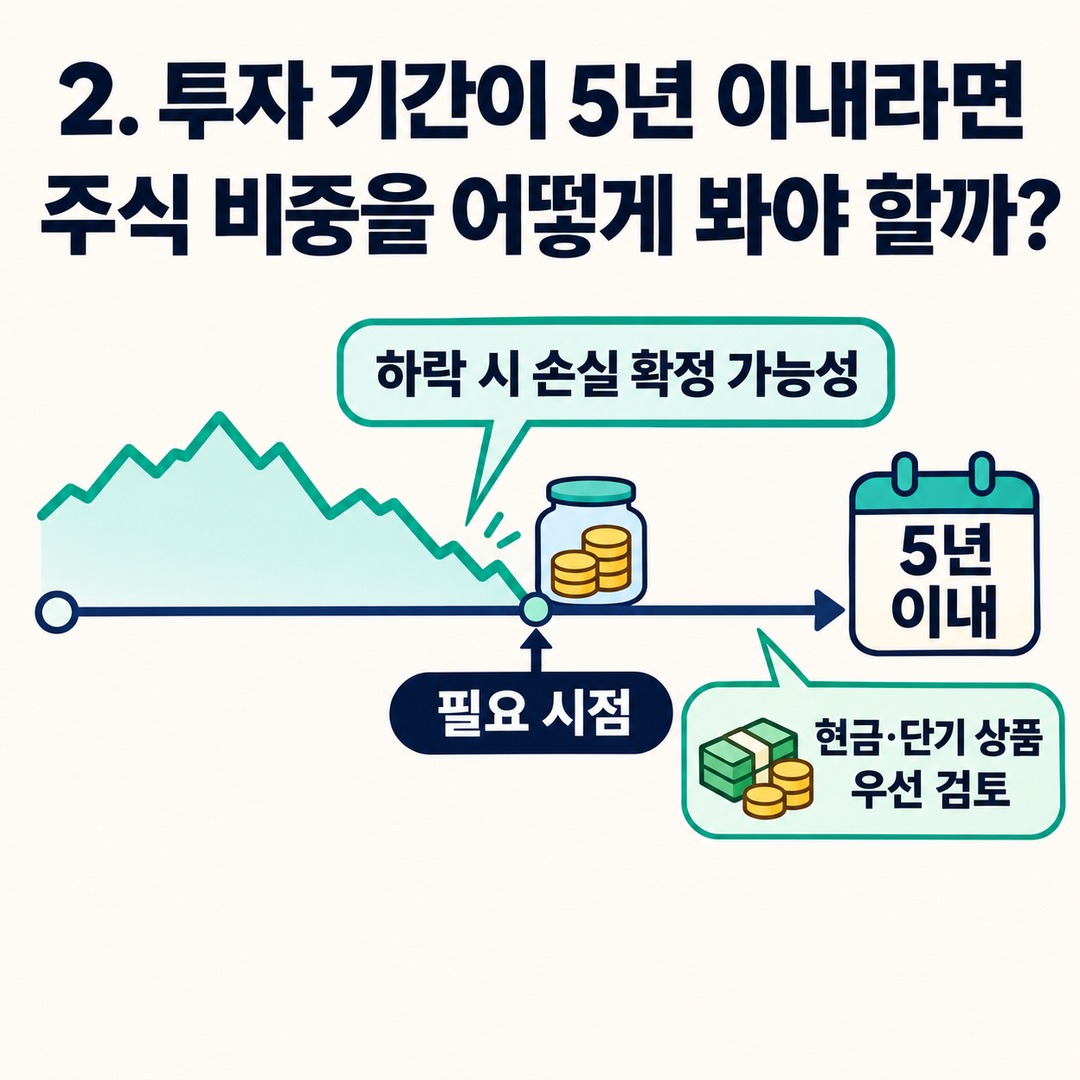
Investor.gov, an SEC resource, explains that choosing risky investments for a short-term goal of 5 years or less may mean having to realize losses when the money is actually needed.
For example, if you plan to use the money in 2 years for a rental deposit or home purchase, the following problems may arise.
If the stock market falls, the value of your investment may drop below the amount you need.
Long-term bonds can change in market price as interest rates move.
Bond ETFs can also incur losses when sold.
Cash-like assets are relatively liquid, but you should consider how inflation can erode their purchasing power.
So for short-term funds, it is generally reasonable to consider cash and short-term financial products with maturities that match when you’ll need the money.
The key distinction is not to treat bonds and cash as the same kind of safe asset.
Bonds are affected by the issuer’s creditworthiness, maturity, and interest rate changes. Unlike individual bonds with a maturity date, a bond ETF may continually replace the bonds in its fund, so it does not guarantee principal on a specific date an investor has in mind.
3. If you’re investing for 10 years or more, should you keep holding a large amount of cash?
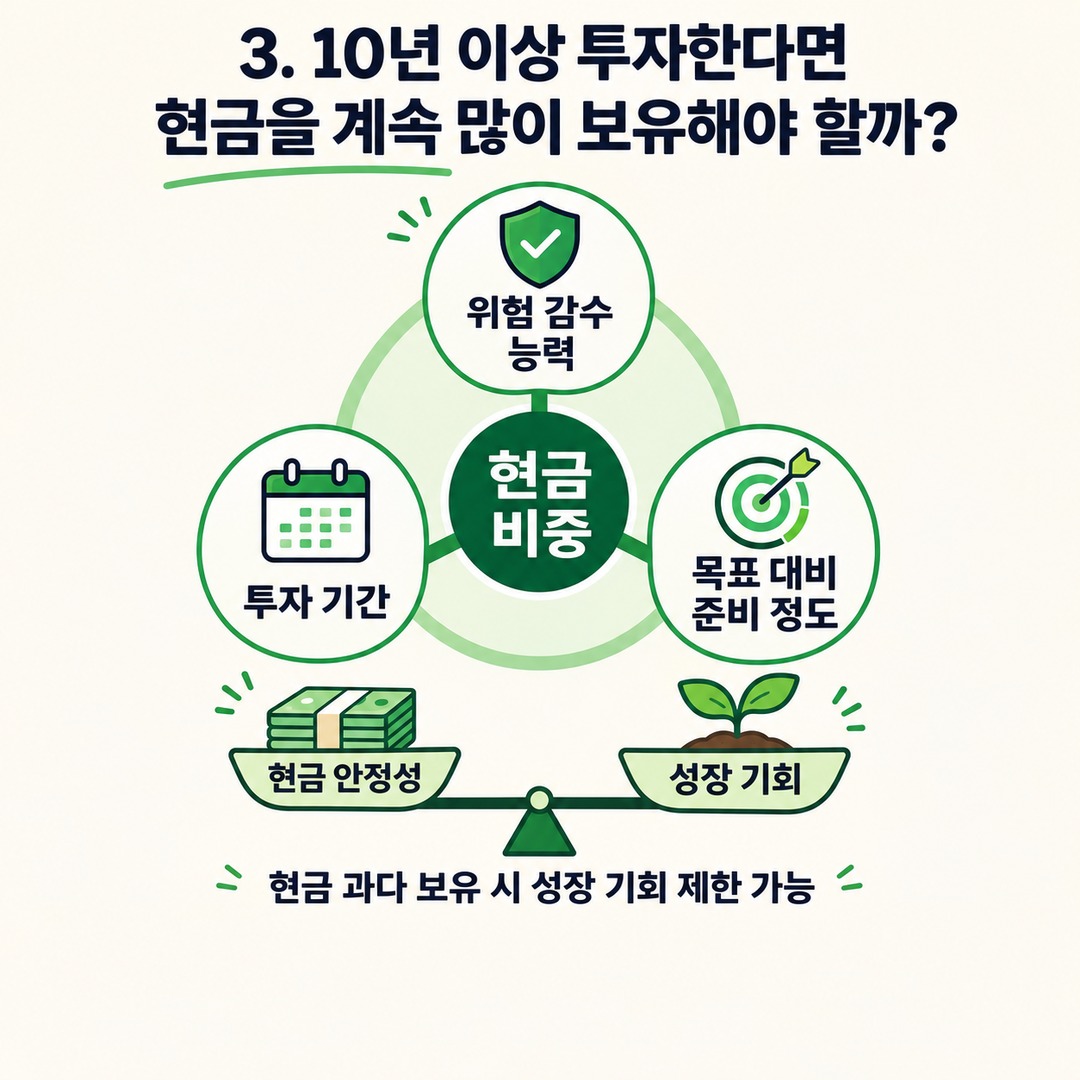
Cash can provide stability for long-term investors, but holding too much for an extended period may limit opportunities for asset growth.
In A framework for considering cash in your portfolio, a research paper Vanguard published in 2024-04-25, the company presents three factors to consider when assessing a cash allocation.
1. Risk tolerance
2. Investment period
3. How much of the target amount you have saved so far
The third factor is especially important.
Someone who has nearly saved the target amount and someone who is still far short of it may consider different cash allocations, even if their investment periods are the same.
Two Hypothetical Investment Cases Presented by Vanguard
Vanguard’s material presents hypothetical cases of two people with different investment goals.
Case A. An investor building retirement savings over the long term
Long-term investing case – people in their 50s
Retirement savings are a primary goal
High risk tolerance
Still short of the retirement target amount
For this case, Vanguard suggests an approach that does not allocate a separate cash portion to the retirement portfolio.
Case B. An investor planning to buy a home within 18 months
Short-term funds case – early in a person’s career
About 18 months until buying a home
6 months of living expenses set aside as emergency savings
Close to reaching the home down payment goal
Vanguard presents a case in which emergency savings are kept in cash and the home purchase funds are also managed in a low-risk portfolio that includes cash.
The key in both cases is not age or income, but when the money will be used, how much of the target amount has been saved, and how much additional loss the investor can tolerate.
However, these are hypothetical investment cases Vanguard presented for explanatory purposes; they are not recommended allocations for every investor.
4. How might you think about dividing up an actual investment amount of KRW 100,000,000?
Let’s use a hypothetical investment amount to understand asset allocation.
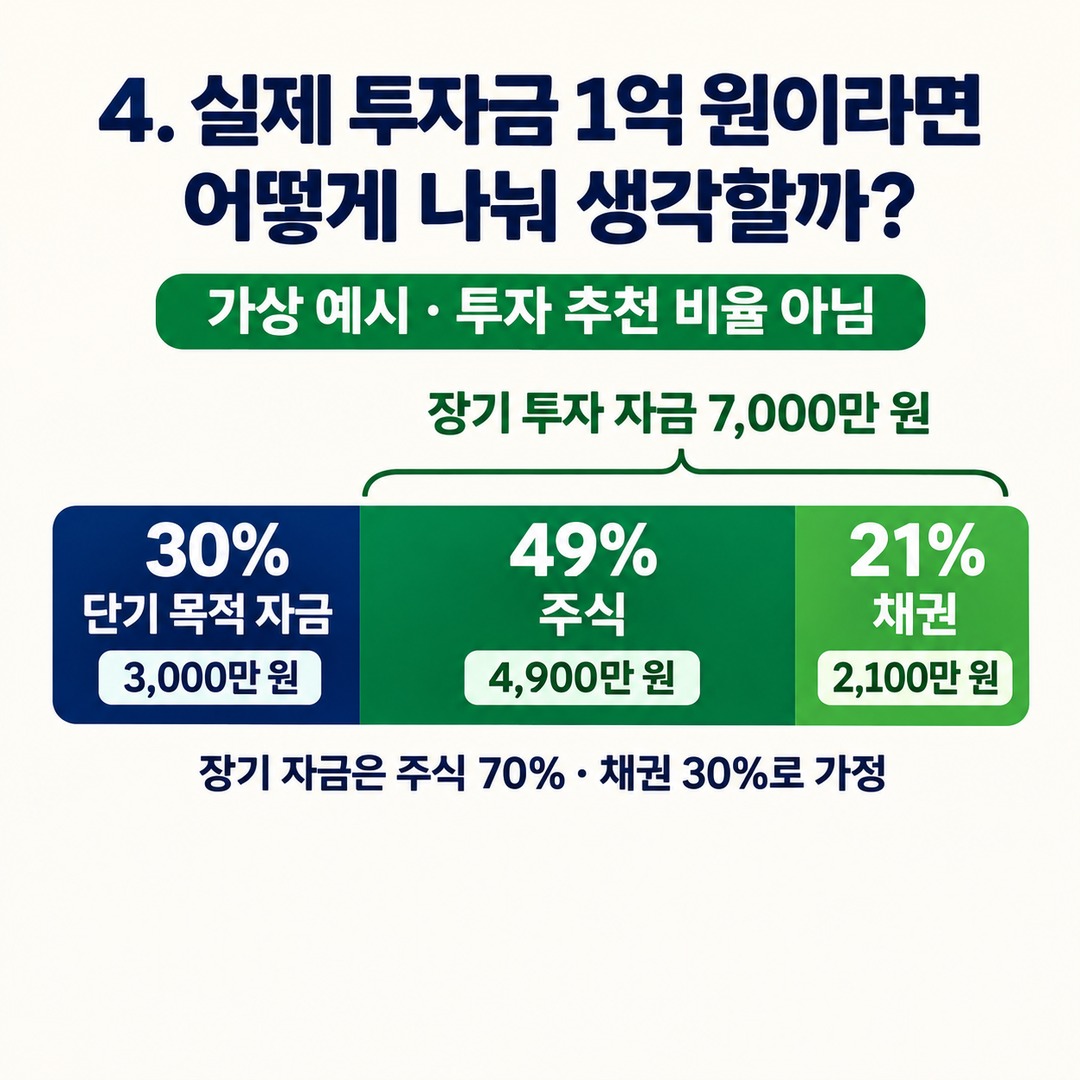
This is a hypothetical example, not a recommended investment allocation.
Total funds available to invest: KRW 100,000,000
Home purchase funds needed in 2 years: KRW 30,000,000
Long-term investment funds to be held for 10 years or more: KRW 70,000,000
The calculation is as follows.
KRW 30,000,000KRW 100,000,000×100=30%KRW 70,000,000KRW 100,000,000×100=70%Purpose-based allocation of KRW 100,000,000
Funds to be used within 2 years
30%
KRW 30,000,000 · Consider cash and financial products matched to the required maturity first
Long-term investment funds
70%
KRW 70,000,000 · Allocate between stocks and bonds according to risk tolerance
100%
Total funds: KRW 100,000,000
The author’s calculation confirms that 30% of the total funds is intended for use within 2 years, while the remaining 70% is intended for long-term investment.
This calculation alone does not determine the stock and bond allocations for the long-term funds.
For example, if you divide the long-term investment funds KRW 70,000,000 into stocks 70% and bonds 30%, the result is as follows.
Stocks: KRW 49,000,000
Bonds: KRW 21,000,000
On a total-asset basis, this gives stocks 49%, bonds 21%, and short-term-purpose funds 30%.
This is a hypothetical allocation shown to illustrate the calculation. The actual proportions depend on the investor’s risk tolerance, other financial assets, debt, living expenses, and progress toward their goals.
Separating funds by when they will be used makes investment decisions much more concrete than looking only at the proportions of total assets.
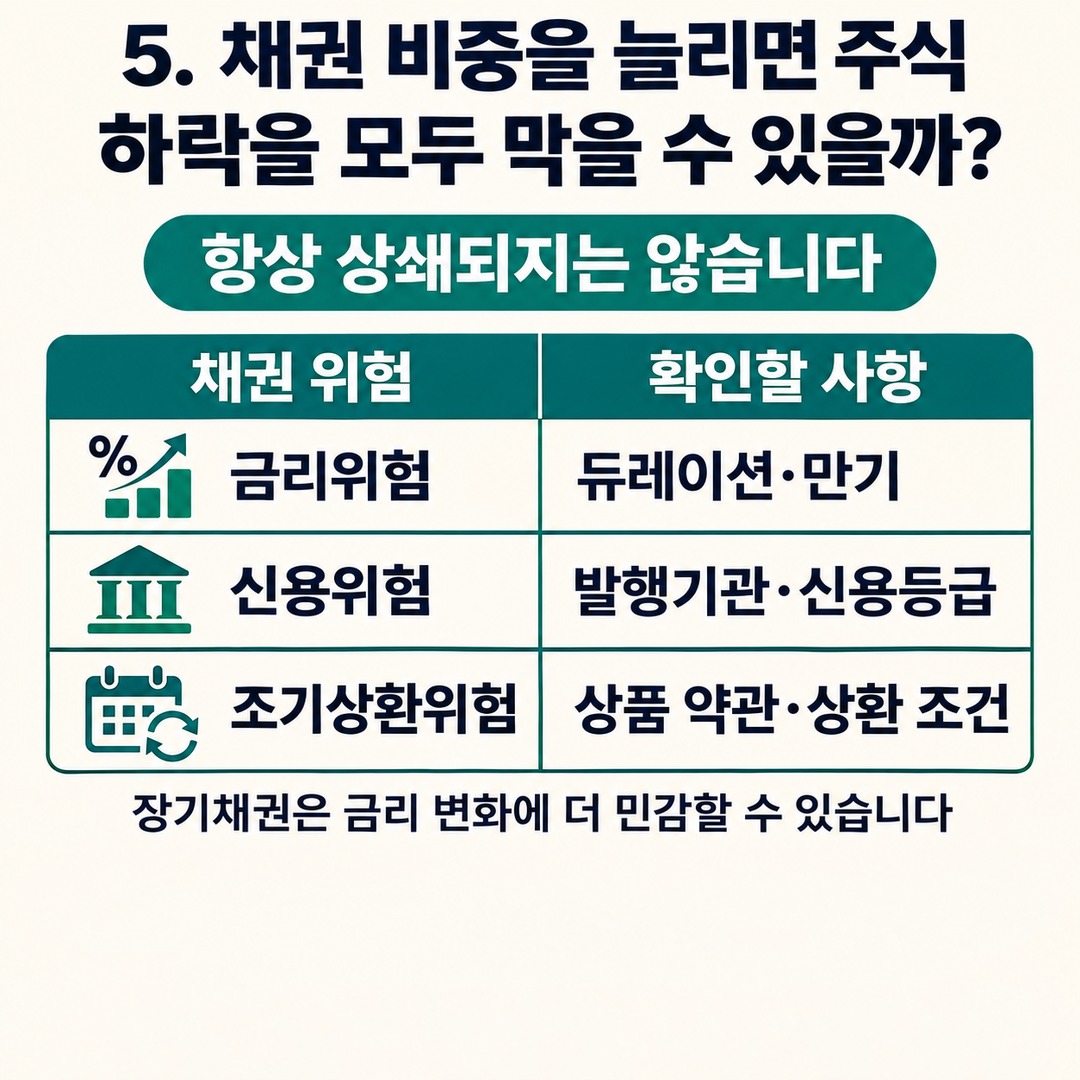
5. Can increasing your bond allocation fully protect you from stock market declines?
Bonds have a different return structure from stocks, but they do not always offset stock market declines.
In particular, interest rate risk and credit risk are risks that must be distinguished when investing in bonds.
According to the SEC’s Investor.gov guide to bond funds, bond funds may be exposed to interest rate risk, credit risk, and prepayment risk, among others.
| Type of risk | What it means | What to check |
|---|---|---|
| Interest rate risk | Bond prices may fall when market interest rates rise | Duration and maturity |
| Credit risk | The risk that the issuer will be unable to pay principal or interest | Issuer and credit rating |
| Prepayment risk | The risk that a bond will be repaid earlier than expected | Product terms and repayment conditions |
Duration is a measure that helps explain how sensitive a bond’s price is to changes in interest rates.
In general, a long-term bond is more sensitive to interest rate changes than a short-term bond with similar terms.
So putting money you’ll need in 2 years into a long-term bond ETF is not necessarily the right choice.
What kind of bonds you hold matters as much as how much of your portfolio you allocate to bonds.
6. How should you adjust your allocation as your investment period gets shorter?
Asset allocation is not a one-time decision. As the date you’ll need the money approaches, you may need to adjust the share of riskier assets to match your goal.
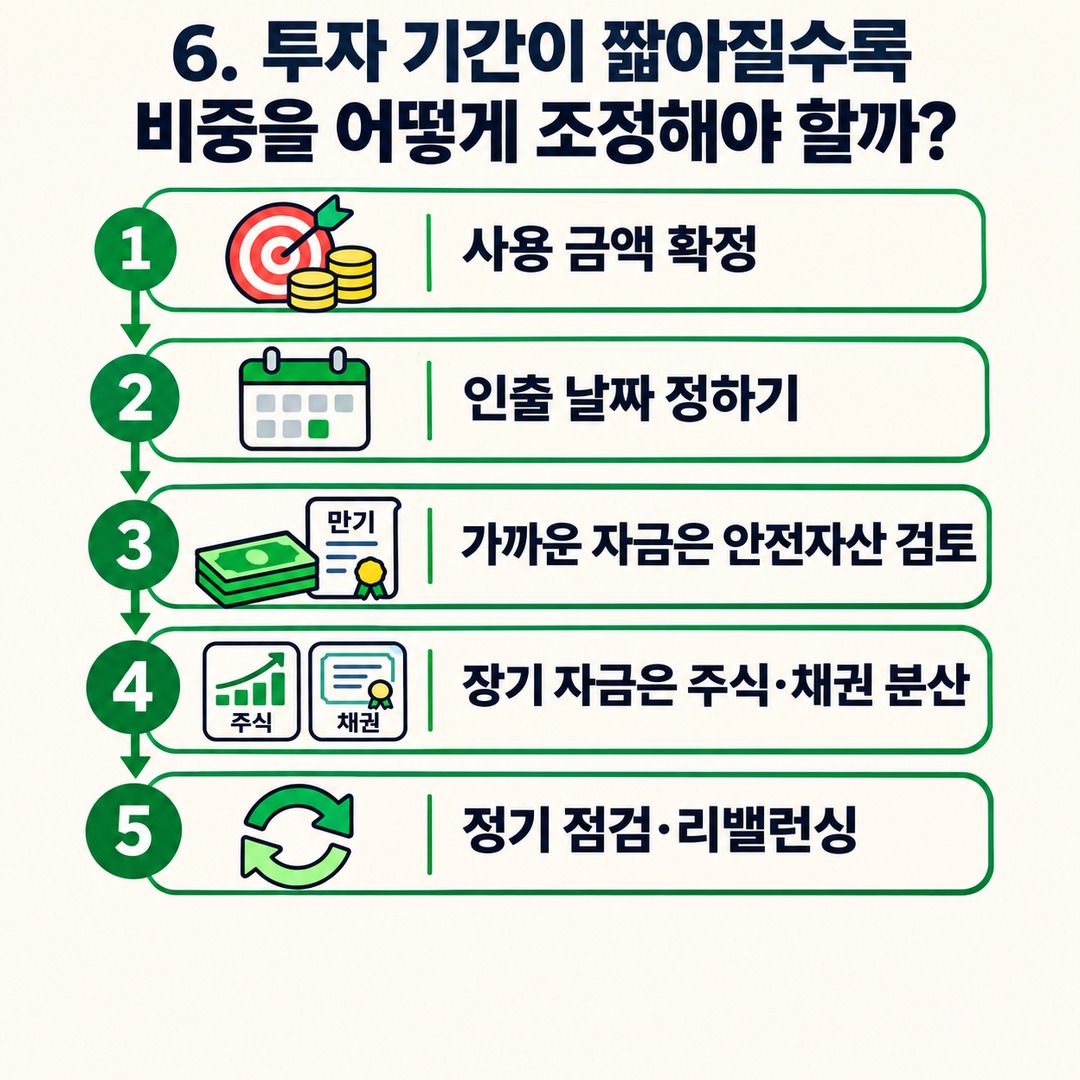
You can manage your investments in the following order.
First, determine the amount you plan to use.
Set aside the amount needed for each purpose, such as buying a home, education expenses, or retirement living costs.
Second, set the actual withdrawal date.
Instead of vaguely saying “in 5 years,” record the expected date you’ll need the money more specifically, such as November 2029.
Third, set aside safer assets to match when you’ll need the money.
For money needed soon, consider managing it in cash or in financial products with maturities that match the timing.
Fourth, diversify long-term funds across stocks and bonds.
Allocate based on your investment purpose and the losses you can tolerate, rather than changing the proportions just because of market conditions.
Fifth, rebalance regularly.
Rebalancing means adjusting asset proportions that have shifted with stock price increases or declines to bring them back in line with the original targets.
Investor.gov explains that you can use regular reviews or a preset threshold for how far allocations may drift. It advises that checking and adjusting relatively infrequently is generally more appropriate than making changes too often.
For example, if your original target was stocks at 60% and bonds at 40%, but a rise in stock prices brought the stock allocation to 80%, you could add to bonds with new investment funds or adjust some stock holdings to return to the target allocation.
This is not trading to predict short-term returns; it is a way to maintain the risk level you originally set.
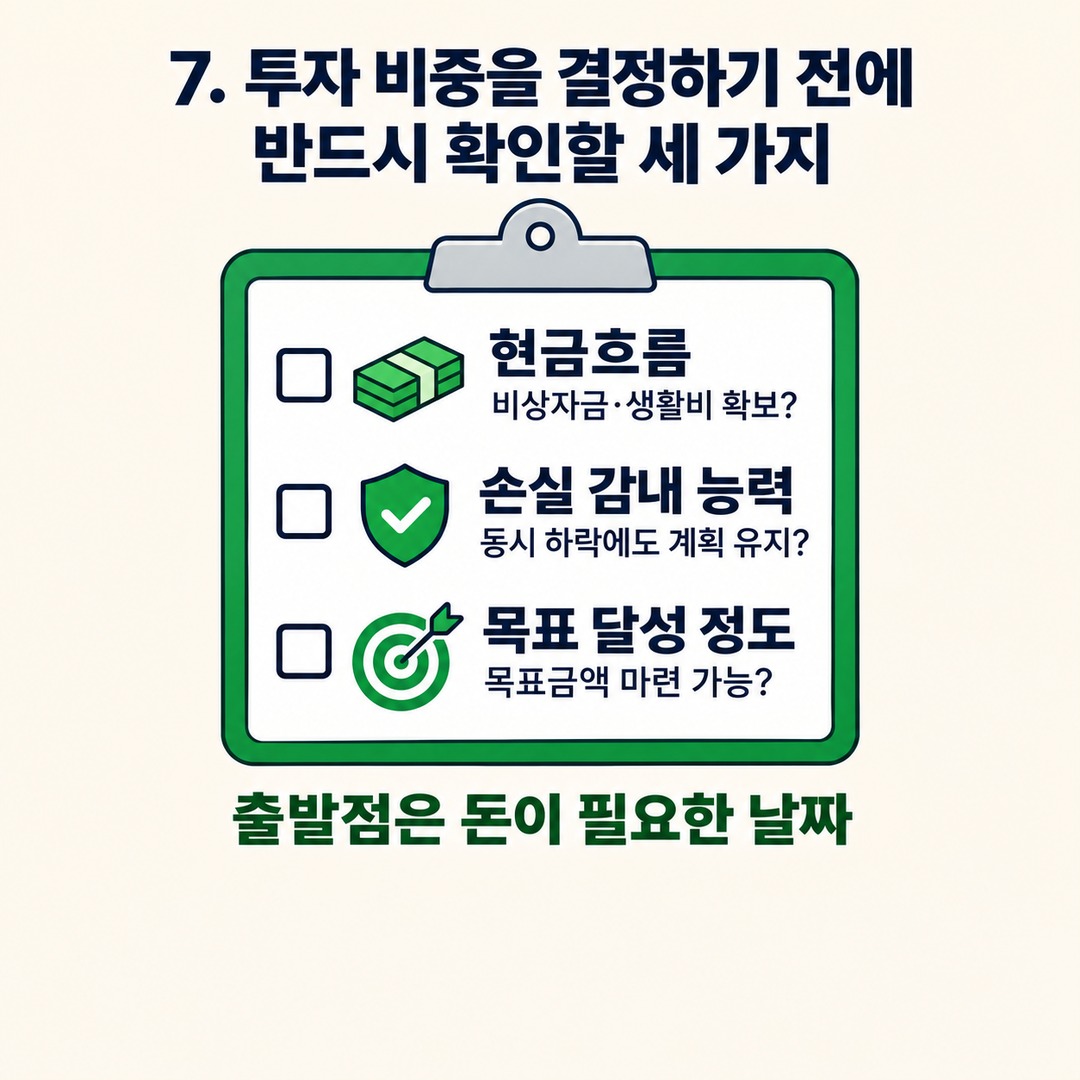
7. Three things to check before deciding on your investment allocation
Before deciding how to allocate your investment funds, check the following three things.
Cash flow: Do you have emergency savings and living expenses set aside separately from your investment funds?
Risk tolerance: Could you stick to your plan even if stocks and bonds both fell at the same time?
Progress toward your goal: Can you reach your target amount with your current assets and future savings?
For retirement funds in particular, it is difficult to assess the investment period based only on your retirement date, since you will need to use those funds for living expenses over many years after you retire.
Conversely, a down payment you must use in 2 years may need to be managed separately from long-term investment assets.
Ultimately, the starting point for deciding the mix of stocks, bonds, and cash is the date you’ll need the money, not the market outlook. A more practical approach to asset allocation is to set aside funds needed by a specific date first, then account for long-term growth potential and your risk tolerance with the remaining funds.
※ This article is for informational purposes to help readers understand market trends and is not a recommendation to invest in any particular security or asset. You are responsible for your final decisions and investments.