

NVIDIA Earnings After Jensen Huang’s Resignation: AI Chip Demand and CEO Succession Factors to Watch on November 17

Jensen Huang stepped down as 2026-11-11 NVIDIA’s CEO and as a member of its board, and CFO Colette Kress became interim CEO. The next date for investors to watch is the 2027 fiscal-year 3 quarter earnings report, due on November 17. Key questions that can be assessed now include whether AI chip demand is holding up, how closely results meet the existing revenue guidance, and how the permanent CEO appointment will proceed. The 3 quarter results and the new leadership team’s long-term strategy have not yet been disclosed.
How has NVIDIA’s leadership changed after Jensen Huang’s resignation?
This appointment is more than a simple change of titles. NVIDIA’s board accepted Jensen Huang’s resignation, appointed Colette Kress as interim CEO, and named Harvey C. Jones chairman of the board.

The following details are confirmed in 2026-11-12 NVIDIA’s official announcement and Form 8-K filed with November 11 the U.S. Securities and Exchange Commission (SEC).
| Category | Confirmed details |
|---|---|
| Jensen Huang | Resigned as CEO and board member |
| Resignation effective | 2026-11-11 immediately |
| Interim CEO | Colette Kress |
| CFO | Colette Kress, concurrently |
| Board chairman | Harvey C. Jones |
| Permanent CEO | Search for a successor is underway |
| Candidate pool | Both internal and external candidates are under consideration |
One important point is that Colette Kress is serving as both interim CEO and CFO.
Kress has served as CFO since joining September 2013 NVIDIA. This confirms that she has an internal understanding of the company’s finances and business operations.
However, CFO experience does not automatically mean she can carry on Jensen Huang’s technology strategy and customer relationships in the same way.
Investors should distinguish between two capabilities:
The ability to maintain continuity in existing business and financial operations
The ability, as the new CEO, to set the product roadmap and direction of the AI chip business
NVIDIA’s board said it expects company operations, customer commitments, and the product roadmap to continue without interruption. That is the board’s official position, however, and does not guarantee that future results will remain the same under the new leadership.
Official announcement: NVIDIA announces CEO transition
SEC filing: 2026-11-11 NVIDIA Form 8-K
NVIDIA’s existing financial results to know before the November 17 earnings announcement
NVIDIA’s most recently reported results were for the 2027 fiscal-year 2 quarter. According to the materials released on 2026-08-26, revenue was USD 96,221,000,000, and data center revenue was USD 89,000,000,000.
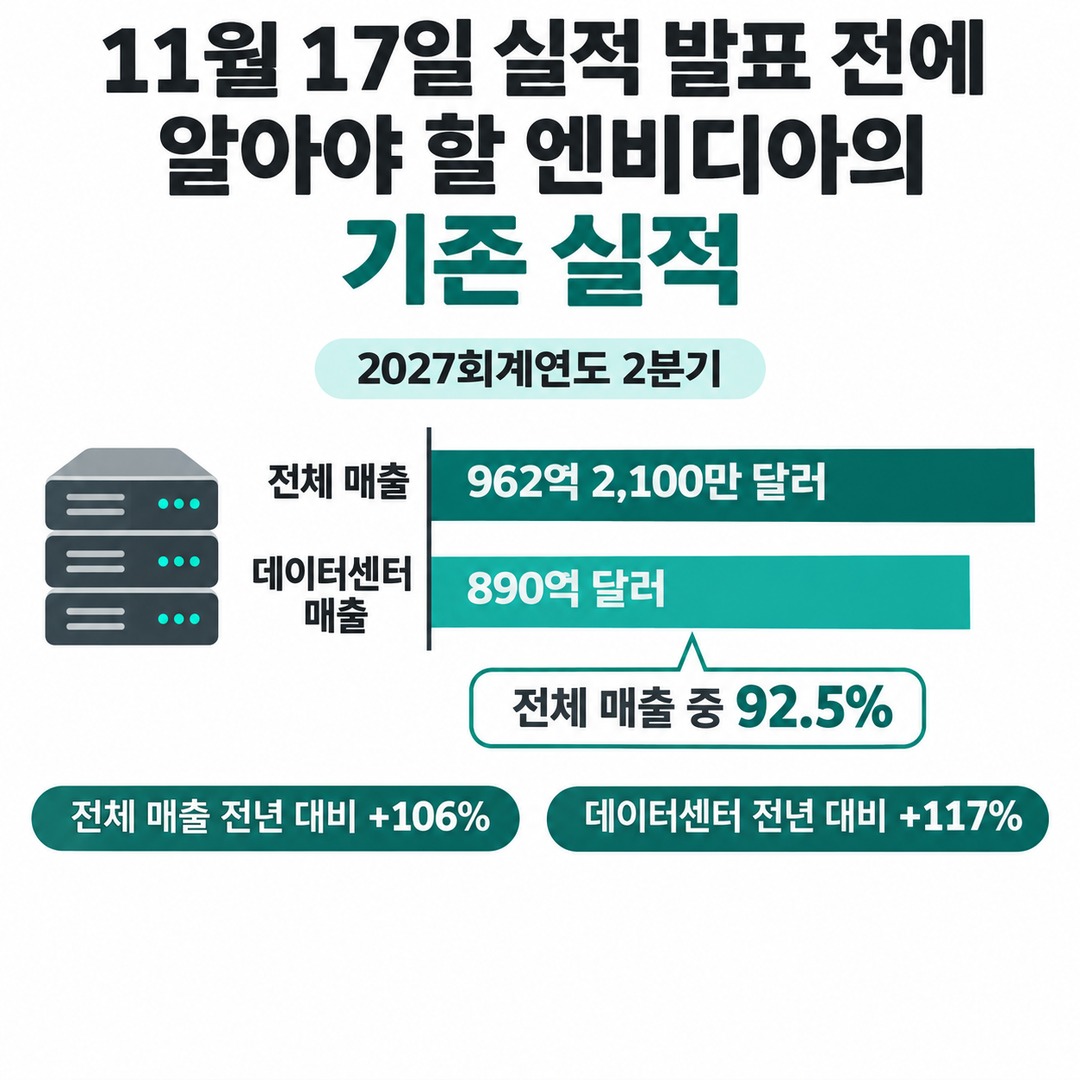
Both figures increased substantially year over year.
| Item | 2027 fiscal-year 2 quarter |
|---|---|
| Total revenue | USD 96,221,000,000 |
| Data center revenue | USD 89,000,000,000 |
| Year-over-year growth in total revenue | 106% |
| Year-over-year growth in data center revenue | 117% |
| GAAP gross margin | 75.0% |
| Non-GAAP gross margin | 75.0% |
The figure investors may want to focus on here is data center revenue.
Dividing data center revenue, USD 89,000,000,000, by total revenue, USD 96,221,000,000, gives approximately 92.5%.
Author’s calculation:
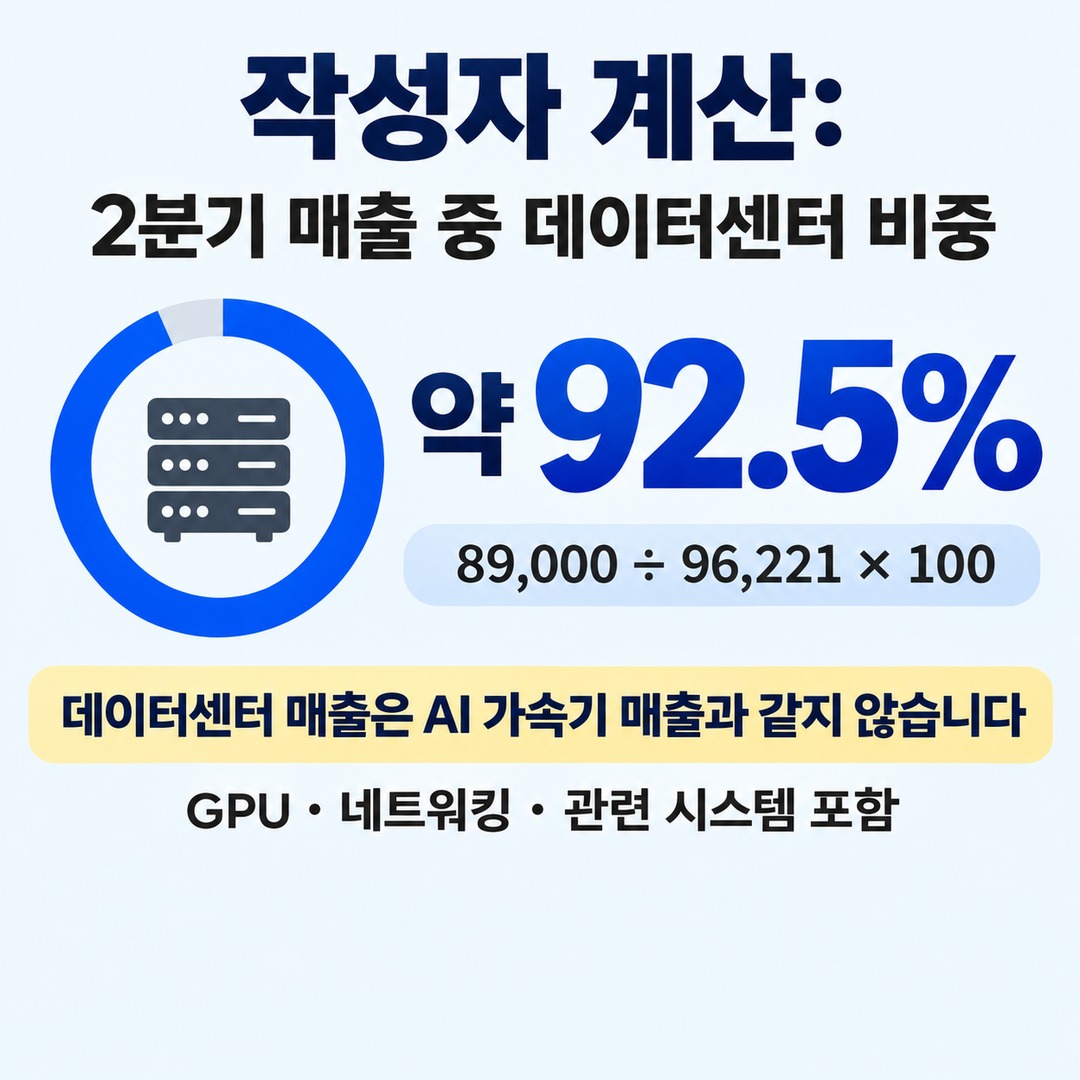
89,000 ÷ 96,221 × 100 = approximately 92.5%
In other words, data center accounted for approximately 92.5% of NVIDIA’s revenue in the 2 quarter.
This calculation shows the share of NVIDIA’s results represented by its AI infrastructure business. However, total data center revenue should not be interpreted as equivalent to AI accelerator revenue. Data center includes a range of businesses, such as networking and related systems, as well as GPUs.
The original results are available in NVIDIA’s 2027 fiscal-year 2 quarter earnings release.
The first figure to check in the next earnings report is revenue: USD 108,000,000,000
In its previous earnings release, NVIDIA forecast revenue of USD 108,000,000,000 for the 2027 fiscal-year 3 quarter, with a margin of error of ±2%.
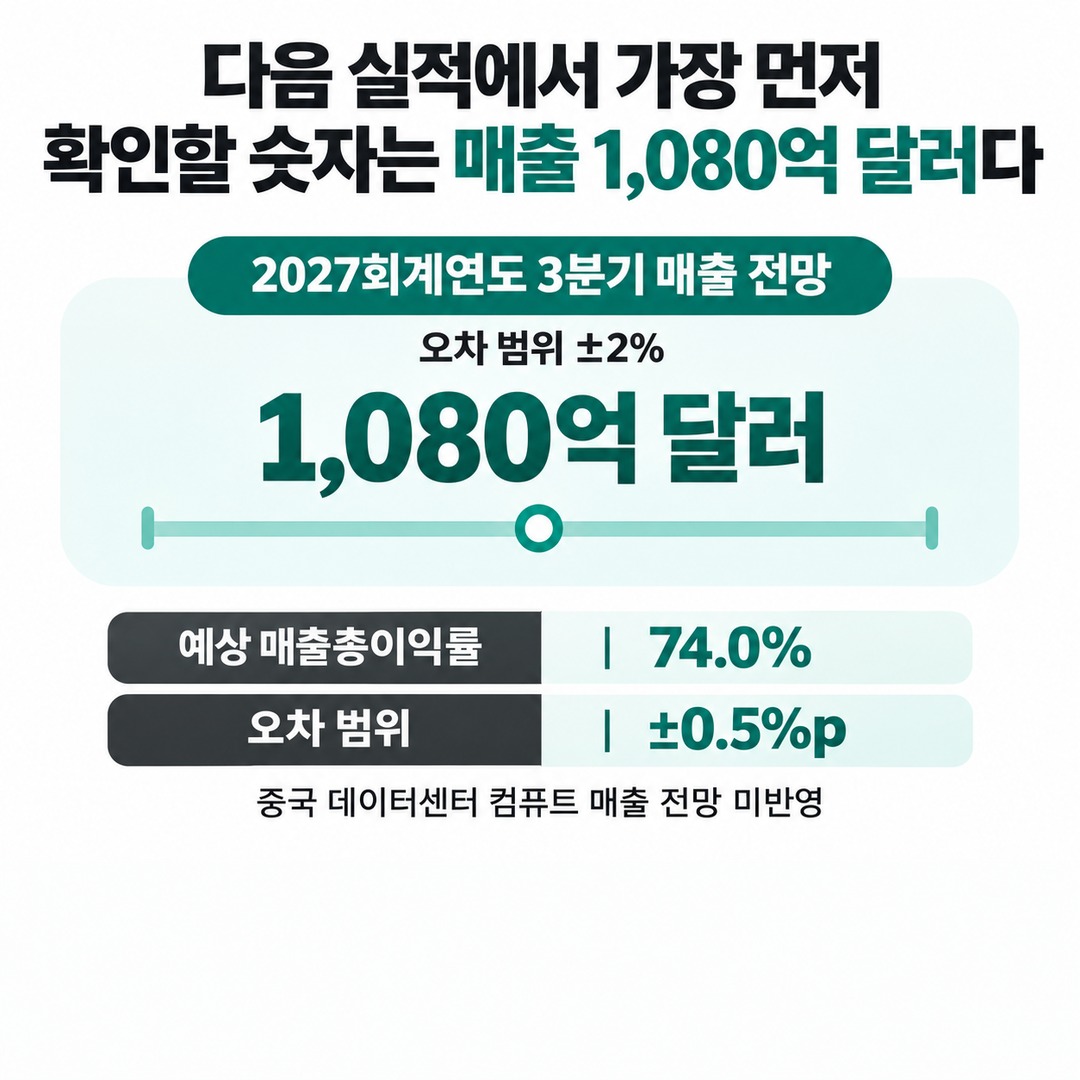
This is the company’s existing guidance, which can serve as a benchmark before the results are announced.
| Item | Existing company guidance |
|---|---|
| Total revenue | USD 108,000,000,000 |
| Forecast margin of error | ±2% |
| Expected gross margin | 74.0% |
| Gross margin margin of error | ±0.5%p |
| China data center compute revenue | Not included in the forecast |
The revenue forecast range can be calculated as follows.
Author’s calculation
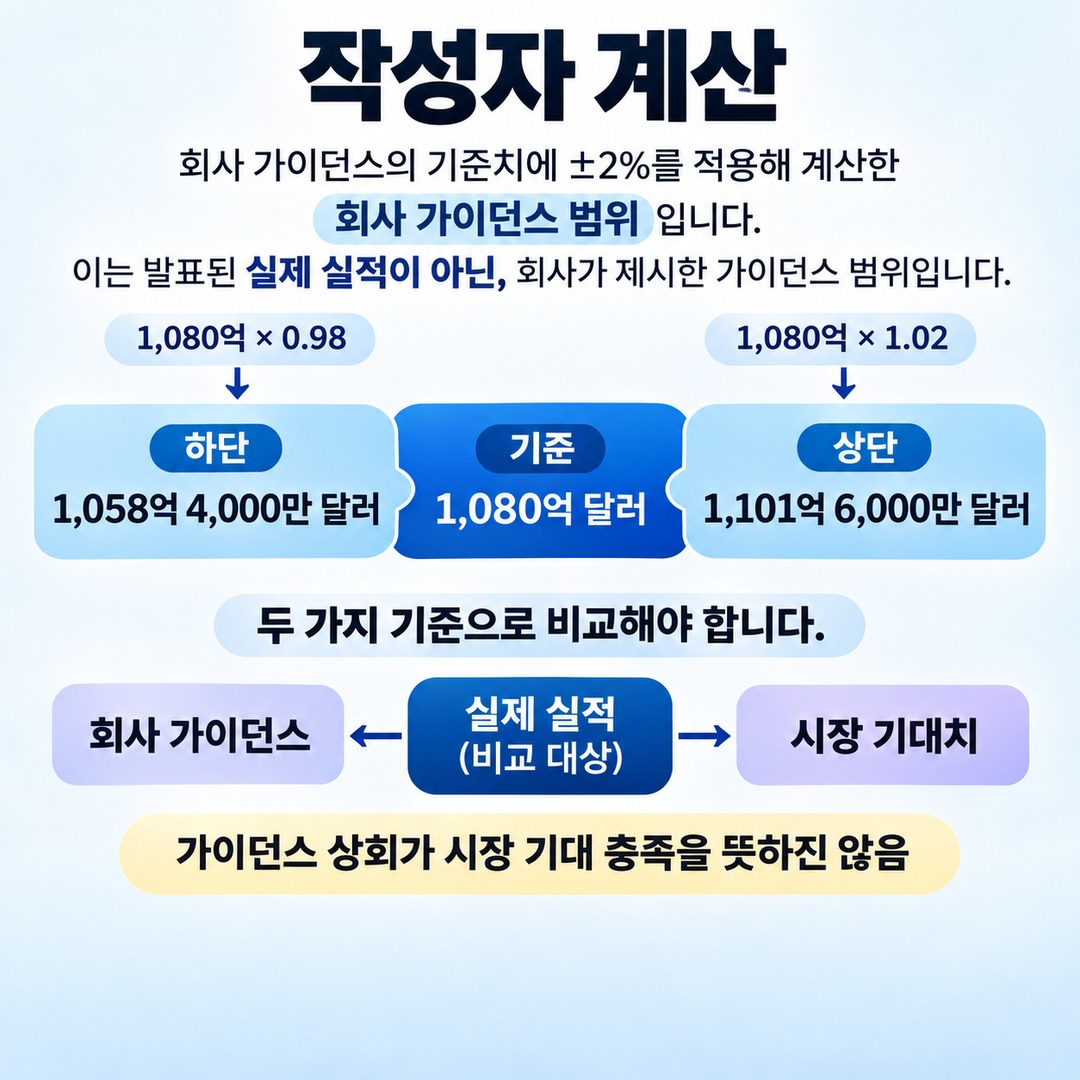
Low end: 1,080 billion × 0.98 = USD 105,840,000,000
Baseline: USD 108,000,000,000
High end: 1,080 billion × 1.02 = USD 110,160,000,000
Therefore, in the earnings report, investors should look beyond whether revenue exceeded USD 108,000,000,000 and examine the gap between actual revenue and the existing forecast range.
The key point is that revenue exceeding the forecast does not necessarily mean it met investor expectations.
Market expectations and the company’s guidance are different benchmarks. If market estimates were higher, results that beat the company’s forecast could still disappoint investors and weigh on the stock.
Which metrics can confirm AI chip demand?
Revenue growth alone is not enough to assess demand for AI chips. Investors should also look at data center revenue, growth by customer group, supply constraints, and product transitions.

In particular, remarks by NVIDIA CFO Colette Kress during the previous earnings release offered clues for assessing demand beyond the next quarter.
1. Is data center revenue continuing to grow?
Data center revenue in the 2 quarter was USD 89,000,000,000, an increase of 18% from the previous quarter.
In subsequent results, investors should check whether data center revenue continues to grow and whether its growth rate slows.
However, a slowdown in the growth rate alone does not prove that demand has declined. Because revenue has already reached a large scale, investors should consider both the growth rate and the actual increase in revenue.
2. Is the customer base becoming more diverse?
In its previous earnings release, NVIDIA mentioned the following customer groups:
Hyperscale cloud providers
AI research labs
AI-focused companies
Enterprise customers
National AI infrastructure operators
Customer diversity can help investors assess the company’s reliance on investment plans from any single large customer.
In the earnings report, investors should examine how demand has changed across customer groups and whether increased investment by large cloud providers is translating into actual NVIDIA revenue.
3. Is a supply shortage limiting revenue growth?
At the time of the 2026-08-26 earnings release, NVIDIA said it expected FY2028 revenue to grow by approximately 70%.
At the same time, the CFO said the forecast assumed ongoing supply constraints.
This shows that having sufficient demand and being able to ship products are separate issues.
Therefore, in the 3 quarter, investors should distinguish among the following:
Are customer orders increasing?
Are product shipments increasing?
Is the supply chain expanding?
Are production and customer deliveries proceeding as planned?
If orders or demand forecasts are strong but shipments fail to keep pace, the timing of revenue realization may change.

Conversely, if supply improves and shipments increase, that could support revenue growth.
Why gross margin matters alongside revenue
In the AI chip market, the amount of revenue matters, but so does how profitably products are actually sold.
NVIDIA’s GAAP and non-GAAP gross margins for the 2 quarter were both 75.0%.
For the 3 quarter, the company forecast 74.0% under both measures, with a margin of error of ±0.5% percentage points.
In other words, investors should check whether gross margin meets the existing forecast, separately from revenue growth.
Gross margin is the share of revenue represented by profit after the cost of revenue from selling products and services is deducted.
For example, gross margin can decline even as revenue increases if costs rise more quickly.
Investors should check the following:
1. Did actual gross margin meet the existing 74.0% forecast?
2. Can the company maintain similar profitability in the next quarter?
3. How will costs change during the transition to next-generation products?
4. Will expanded supply translate into both higher revenue and improved profitability?
This metric helps distinguish between strong demand for AI chips and how much of that demand translates into company profits.
Three signals to watch in the CEO succession after Jensen Huang’s resignation
It is important that this earnings release will come under an interim CEO, rather than being the first report after a new CEO has been appointed.
In its November 12 announcement, NVIDIA said it had begun the process of finding a permanent CEO and would consider both internal and external candidates.
Investors should distinguish among the following three points.
First, Colette Kress’s management message.
Explaining the financial outlook as the existing CFO is different from setting the direction of the entire company as interim CEO.
In this earnings release, investors should look beyond the revenue forecast and see what she says about product development, customer engagement, the supply chain, and long-term strategy.
Second, the process for appointing a permanent CEO.
What has been publicly confirmed so far is the appointment of an interim CEO and the start of the search for a successor.
No formal announcement has confirmed the final candidates or when a permanent CEO will be appointed.
It is therefore not appropriate to assume in advance that any particular executive will become the next CEO.
Third, how responsibilities are divided between the board and management.
Harvey C. Jones was appointed as the new chairman of the board.
Investors should watch what role the board plays in selecting a CEO and how the interim CEO and existing management team continue running the business.
However, the current announcements alone do not make it possible to judge how the new governance structure will perform over the long term.
November 17 earnings announcement: 7 questions to check
The following items can be checked in order during the earnings announcement.
| Item to check | What investors should examine |
|---|---|
| Total revenue | Difference between the USD 108,000,000,000 forecast and actual results |
| Data center | Whether revenue continues to grow |
| Customer demand | Growth among customer groups beyond hyperscalers |
| Supply conditions | Changes in production and shipment constraints |
| Gross margin | Difference between the 74.0% forecast and actual results |
| Next-quarter outlook | New revenue guidance |
| CEO succession | Kress’s management message and the process for appointing a successor |
This time, in particular, it is important to keep the earnings figures separate from management’s commentary.
Even if results are strong, the next-quarter outlook could be lowered. Conversely, long-term demand expectations could remain intact even if supply constraints persist for now.
The two should not be confused.
When can you check the earnings in Korea time?
In its official announcement, 2026-10-28 NVIDIA announced the date and schedule for releasing its 2027 fiscal-year 3 quarter results.
The company plans to release its results at approximately November 17, 1:20 p.m. U.S. local time and hold a conference call at 2 p.m.
Converted to Korea time, the schedule is as follows.
| Category | U.S. Pacific Time | Korea time |
|---|---|---|
| Earnings release | November 17 13:20 approximately | November 18 06:20 approximately |
| Conference call | November 17 14:00 | November 18 07:00 |
In the United States, November 17 falls during the period when daylight saving time has ended and standard time (PST) is in effect, so the time difference with Korea is 17 hours.
For this conference call, Colette Kress’s written CFO commentary is expected to be available immediately after the earnings release.
The earnings release and conference call details are available on NVIDIA’s official investor relations website.
What NVIDIA investors should distinguish now: earnings and leadership succession
Jensen Huang’s resignation is an actual change in NVIDIA’s leadership. By contrast, how long AI chip demand will hold up and how the new CEO’s leadership will perform over the long term remain unknown.
Therefore, when interpreting the 3 quarter results, investors should consider three things separately.
Business performance: Are data center revenue and total revenue meeting the existing forecasts?
Profitability: Is gross margin holding up alongside revenue growth?
Leadership succession: Will the product roadmap and customer engagement continue under the interim CEO, and will the process for appointing a permanent successor become more concrete?
Above all, the results announced on November 17 will be the first major source of information for assessing NVIDIA’s business performance after Jensen Huang’s resignation.
However, a single day’s results cannot establish the long-term competitiveness of the new leadership. For an investment decision, investors should also review any changes to guidance after the earnings release and official announcements about the appointment of a permanent CEO.
※ This article is for informational purposes to help readers understand market trends and is not a recommendation to invest in any particular stock or asset. You are responsible for your own decisions and investments.