

Samsung Electronics Union Demands Withdrawal of Bonus-Related Labor Dispute Guidelines: How Far Does Collective Bargaining Extend?
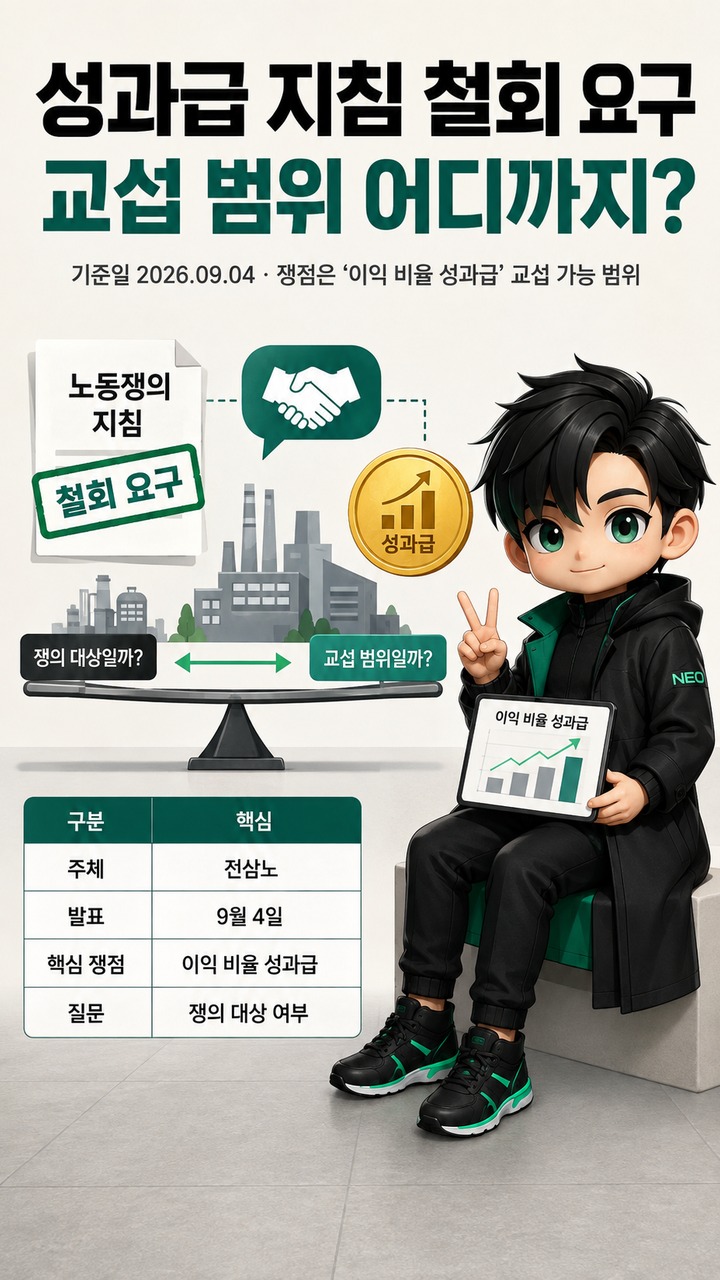
The National Samsung Electronics Union (NSEU) demanded the withdrawal of the Ministry of Employment and Labor's 'Implementation Guidelines on Matters Subject to Labor Disputes, Including Management Performance Bonuses,' issued on 2026-09-04. The central issue is not whether bonuses themselves can be negotiated, but whether demands to allocate a fixed percentage of corporate profits, such as operating profit, to bonuses can also be subject to mandatory collective bargaining and industrial action.
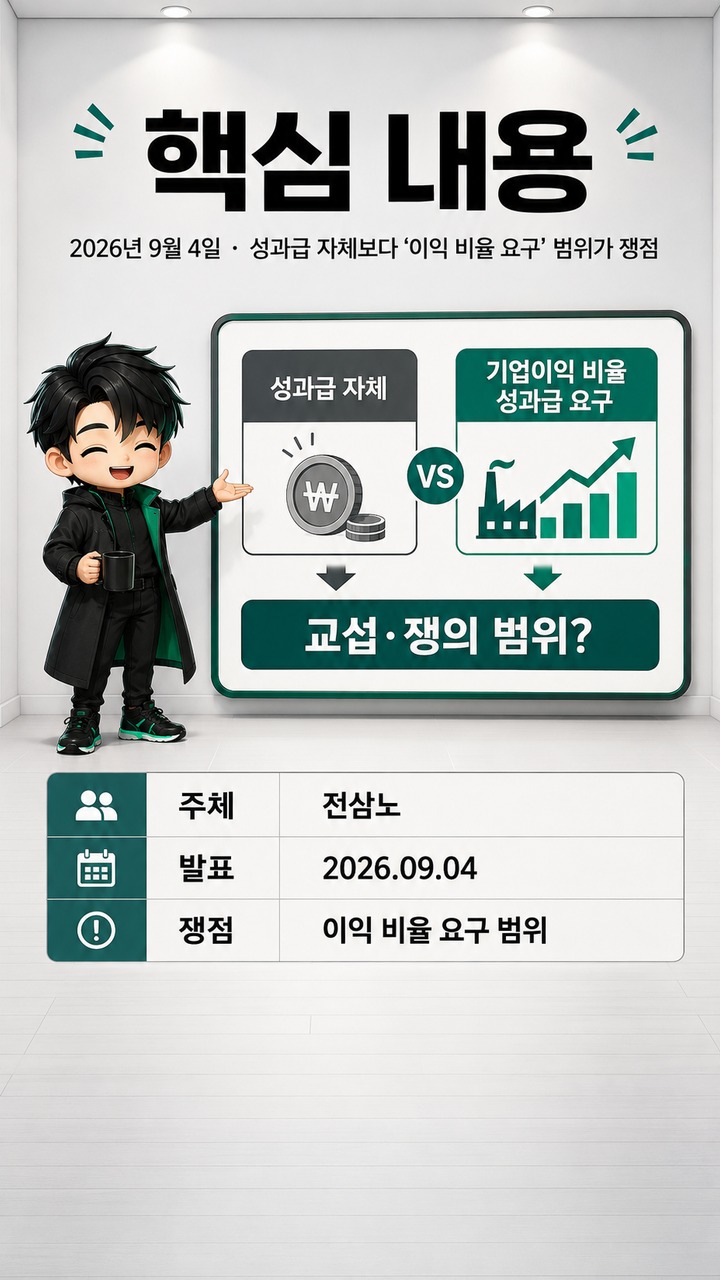
This is precisely where the Ministry of Employment and Labor and the National Samsung Electronics Union differ. The ministry stated that demands for bonuses tied to a fixed percentage of corporate profits are difficult to classify as matters subject to mandatory bargaining, labor dispute mediation, or industrial action. The NSEU, however, opposes this distinction, arguing that not only the amount of bonuses but also the criteria used to distribute company performance affect wages and working conditions.
The information was verified as of 2026-09-04 at 17:1 Korea Standard Time.
The Guidelines Do Not Prohibit Unions From Negotiating Bonuses
Interpreting the new implementation guidelines as meaning that unions will no longer be allowed to negotiate bonuses would be an overly broad reading.

The Ministry of Employment and Labor explained that management performance bonuses related to determining employees' wages, welfare benefits, and other terms of employment may be subject to mandatory collective bargaining. Employers and unions may also voluntarily negotiate management performance bonuses.
What the government has specifically distinguished is a demand to predetermine a fixed percentage of corporate profits, such as revenue, operating profit, or net income, as the funding source for bonuses.
For example, under the new guidelines, the ministry considers a union demand to distribute a fixed percentage of a company's operating profit as bonuses difficult to classify as a matter subject to mandatory collective bargaining, labor dispute mediation, or industrial action.
Conversely, the guidelines do not categorically exclude proposals for bonuses calculated as a percentage of base salary or annual salary, or as a fixed amount, without linking them to a fixed percentage of corporate profits. Nor do they categorically exclude negotiations over payment criteria, timing, or eligibility.
Therefore, when examining bonus disputes in the future, it will be necessary to determine the calculation method and structure of the demand, rather than simply asking whether the issue concerns bonuses.
Why Is the National Samsung Electronics Union Demanding Withdrawal?

The National Samsung Electronics Union published a statement on its official website on the afternoon of September 4, demanding withdrawal of the implementation guidelines.
The NSEU objects to the fact that the scope of bargaining and industrial action available to a union would differ depending on how the same type of bonus is calculated.
The union argued that excluding bonuses from mandatory bargaining and labor dispute procedures solely because they are linked to corporate profits would restrict workers' rights based on the form of a demand rather than the substantive nature of the bonuses.
The union emphasized that the issue is not simply how much employees ultimately receive in bonuses. It maintains that the criteria used to distribute the results of a company's performance among workers are also directly connected to wages and working conditions.
It further argued that workers' rights to organize, bargain collectively, and take collective action must be considered alongside companies' freedom to conduct business and the rights and interests of shareholders and other stakeholders.
An important distinction is necessary here. This is the union's position, as expressed by the National Samsung Electronics Union on September 4. In the same guidelines, the Ministry of Employment and Labor sets out a standard that seeks to protect workers' three fundamental labor rights while also considering companies' freedom to conduct business and the rights and interests of 3 parties. The two sides therefore differ in their assessments.
Why the Government Separately Classifies Bonuses Linked to Corporate Profits
The Ministry of Employment and Labor does not regard revenue, operating profit, and net income as a single pool of surplus funds that companies can freely distribute as bonuses.
Revenue includes income before expenses are deducted, while operating profit represents earnings before items such as interest, corporate income taxes, and dividends are deducted. Net income may also include non-operating income that is not directly connected to employees' work.
Corporate profits are also used for various business decisions, including research and development, capital investment, and dividends.
Considering these factors, the ministry concluded that demands to allocate a fixed percentage of corporate profits to bonuses in advance could affect management decisions and the rights and interests of other stakeholders, including shareholders, creditors, and the government.
For this reason, the ministry distinguishes between the negotiability of bonuses themselves and demands to allocate N% of corporate profits to bonuses in advance.
The NSEU challenges precisely this distinction. It argues that it is inappropriate to apply different standards for mandatory bargaining and industrial action to the same category of management performance bonuses depending on whether they are linked to corporate profits.
Factory Relocations and AI Adoption Are Not Automatically Excluded From Labor Disputes
The guidelines also address business management decisions beyond bonuses, including the construction or relocation of factories, corporate acquisitions and sales, and the introduction of AI and automated equipment.
Under the government's standards, management decisions themselves, such as where to build a factory, which region to relocate to, whether to sell a company, or whether to introduce AI or automated equipment, are generally not considered matters subject to mandatory collective bargaining.
However, the government takes a different approach when those decisions lead to specific changes in employees' actual working conditions.
If a factory relocation results in concrete restructuring or reassignment plans, or changes employees' workplaces and requires decisions on support arrangements, the related working conditions may become subjects of collective bargaining.
Similarly, in a corporate sale, a demand to cancel the transaction itself is not treated in the same way as demands concerning the transfer of employment, job security, or preservation of existing working conditions.
The guidelines also distinguish between opposition to the introduction of AI and automation technologies themselves and issues arising when their introduction changes actual job duties, working hours, work processes, or employment plans. If such changes can be objectively anticipated, the ministry's guidelines indicate that reassignment, job security measures, working-hour adjustments, and occupational health and safety measures may fall within the scope of collective bargaining.
Ultimately, rather than simplifying the rules to mean that all management decisions are excluded from bargaining, it is necessary to distinguish the decisions themselves from the specific changes in working conditions that result from them.
What Could Change During Actual Labor Disputes?
The guidelines are intended to serve as more than explanatory material. They are expected to be used as standards for interpreting labor union law and handling government proceedings, including labor dispute mediation.
The ministry explained that when a union submits bargaining demands concerning management decisions themselves or bonuses linked to a fixed percentage of corporate profits, a Labor Relations Commission may recommend that the union revise those demands.
The guidelines also state that if the union refuses to accept such a recommendation, the relevant demands may become subject to administrative guidance on the grounds that they do not qualify as matters subject to labor disputes under labor union law.
According to the government's explanation, if a union actually undertakes industrial action primarily over matters that are not legitimate subjects of industrial action, the legitimacy of that action will be assessed under existing Supreme Court precedents and other applicable standards.
The government also established a standard under which an employer's refusal to bargain over management decisions themselves or demands for management performance bonuses linked to a fixed percentage of corporate profits would be difficult to classify immediately as an unfair labor practice.
However, this does not mean that employers have no reason to engage in any discussions about bonuses. The government separately and explicitly states that employers and unions may voluntarily negotiate management performance bonuses.
When interpreting the guidelines, it is important not to conflate the scope of voluntary consultation, the scope of legally mandatory collective bargaining, and the matters that may be subject to labor disputes and industrial action.
What to Watch in Samsung Electronics' Bonus Negotiations
The National Samsung Electronics Union's latest statement does not announce or establish a new bonus amount within Samsung Electronics, nor does it change any specific existing bonus amount.
As of September 4, the confirmed issue is that the NSEU rejects the government's standards for determining matters subject to labor disputes and is demanding their withdrawal.
Samsung Electronics employees and others following the issue should therefore avoid immediately interpreting it as a question of whether bonuses can still be paid or whether future bonus negotiations have been prohibited. Instead, they should examine the calculation methods used in actual bargaining proposals from management and labor.
In particular, the following three types of demands may be treated differently in the future.
Demanding bonuses of a specified amount or a fixed percentage of base salary or annual salary
Negotiating bonus payment criteria, timing, and eligibility
Demanding that a fixed percentage of corporate profits, such as operating profit, be allocated in advance to fund bonuses
The government's guidelines consider the third category difficult to classify as a matter subject to mandatory bargaining, mediation, or industrial action. There is no confirmed indication that the guidelines impose the same prohibition on the first and second categories.
What Developments Should Be Monitored Next?
As of 2026-09-04, the officially confirmed action taken by the National Samsung Electronics Union is the publication of a statement demanding withdrawal of the implementation guidelines.
The statement itself does not mean that the guidelines have been withdrawn or amended. At the same point in time, the Ministry of Employment and Labor continues to make the guidelines publicly available as official material.
Future developments should therefore be assessed separately, including any additional action by the NSEU, revisions or supplements to the ministry's guidelines, how the standards are applied in actual Labor Relations Commission mediation proceedings, and how courts rule in related cases.
The most important point is that interpreting the guidelines as excluding all bonuses from collective bargaining, or as excluding every employment condition connected to management decisions, goes beyond the scope of the currently published guidelines.
The current standard can be summarized in one sentence: The government takes a restrictive approach to mandatory bargaining and industrial action concerning demands to allocate a fixed percentage of corporate profits to bonuses in advance and management decisions themselves, but it does not categorically exclude other bonus calculation methods or matters involving objectively anticipated changes in working conditions resulting from management decisions.
The National Samsung Electronics Union opposes the part of this standard that separately excludes bonuses linked to corporate profits and is demanding its withdrawal.
Related Articles
August 21 KOSPI Outlook: The Previous Day's 5.89% Surge Is Key After the Nasdaq's -1% Decline
US Stocks Open Lower: 10-Year Yield at 4.698% and Walmart Plunges 8.6%