

What Is NVIDIA Circular Financing? How GPU Investment Flows Back Into Revenue and the Meaning of USD 105,000,000,000 in Guarantees

A new factor investors should watch in NVIDIA’s AI business is not just GPU sales volume but also how its customers obtain financing. This is because a structure is expanding in which NVIDIA invests in AI companies, customers use that funding and external financing to secure GPUs and data centers, and NVIDIA then provides cloud usage commitments or payment guarantees. This is called AI circular financing (Circular Financing).
According to 2026-11-15, distinguishing whether this structure is simply industry collaboration or a financial risk that could inflate actual AI demand has become a key consideration for investors.
1. How does NVIDIA circular financing work?
Circular financing is a structure in which investments, product purchases, service agreements, and financial support are interconnected among companies.
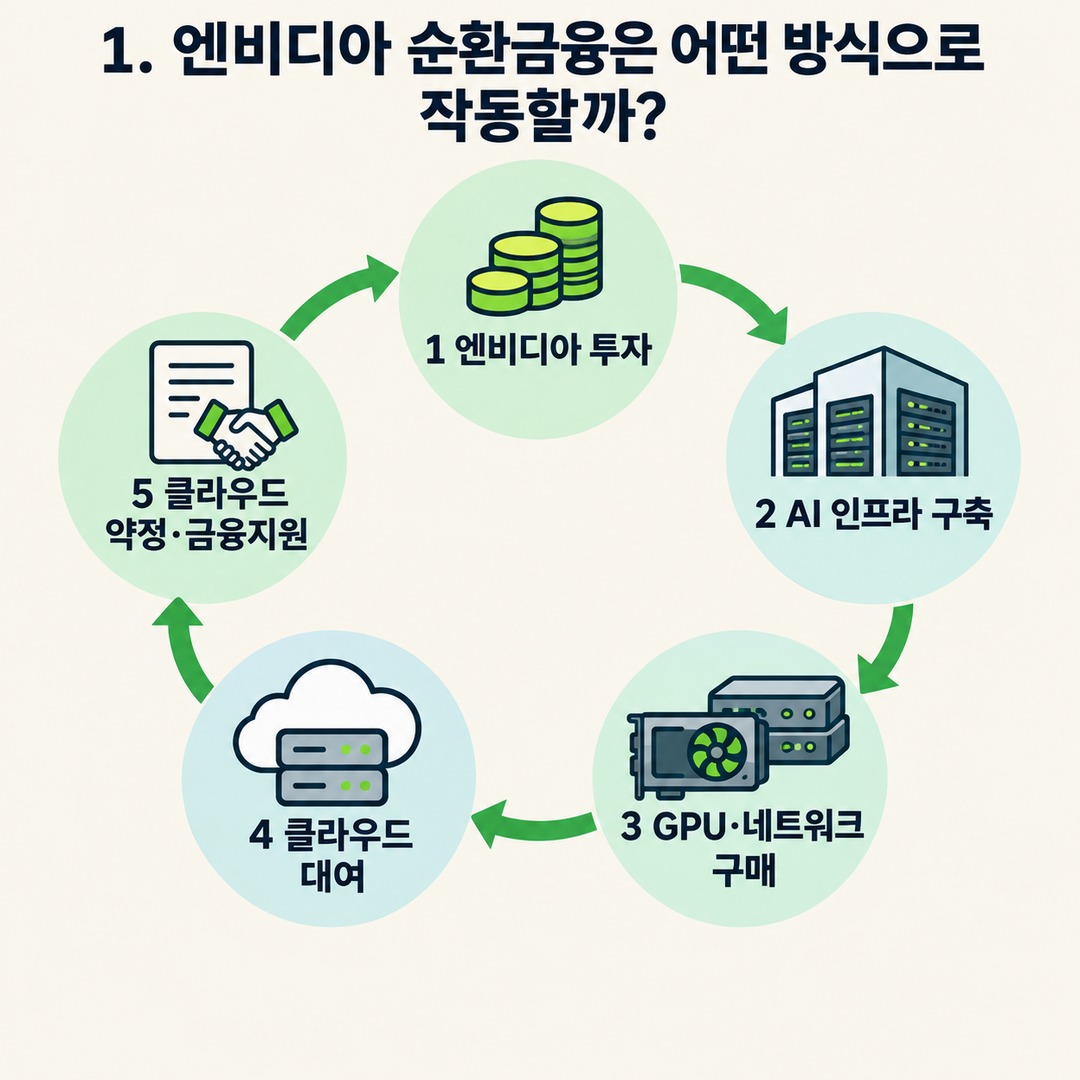
In a conventional semiconductor transaction, a customer buys GPUs with its own funds, and the supplier records revenue by selling the products.
In the AI industry, however, business relationships can become more complex.
For example, the flow could look like this:
1. NVIDIA invests in an AI model developer or data center operator.
2. The company receiving the investment uses external and internal funds to build AI infrastructure.
3. As it builds that infrastructure, it purchases NVIDIA GPUs and networking equipment.
4. The cloud provider rents the GPUs it has secured to AI companies and general customers.
5. NVIDIA participates in some cloud usage commitments or financial support for data centers.
In this process, NVIDIA’s investments and financial support can help expand AI infrastructure and increase GPU demand.
There is, however, an important distinction.
The fact that investment funds were used to buy GPUs does not by itself show that actual demand from end users of AI is sufficient.
It must be assessed separately whether external customers are paying to use the services and whether infrastructure operators could run their businesses independently without the investments and guarantees.

2. How much has NVIDIA disclosed in investments, commitments, and guarantees?

NVIDIA’s 10-Q for the quarter ended 2026-07-26 discloses several amounts related to investments, supply chains, cloud contracts, and data center guarantees.
The key point is that these amounts do not all represent debt or committed spending of the same kind.
| Category | Disclosed amount | Meaning |
|---|---|---|
| Existing equity investments | USD 99,000,000,000 | Investments in the AI ecosystem and other areas |
| Equity investment commitments | USD 25,000,000,000 | Conditional investment commitments |
| Supply and production capacity commitments | USD 279,000,000,000 | Securing supply chain and production capacity |
| AI cloud contracts | USD 36,000,000,000 | Commitments related to cloud services |
| SB Energy-related guarantee | Up to USD 105,000,000,000 | Credit support for lease and power obligations at specific data centers |
The information is as of 2026-07-26, and each item has a different accounting and contractual nature. They should not simply be added together and interpreted as NVIDIA’s total debt or cash outflow.
The USD 105,000,000,000 guarantee is particularly noteworthy.
NVIDIA disclosed that it entered into guarantees of up to USD 105,000,000,000 to support lease agreements for OpenAI-affiliated customers at data center projects related to August 2026 SB Energy.
The project is designed for approximately 4.25GW of IT load, with the guarantees taking effect in stages across 9 data center phases.
There are important limitations.
Payment obligations arise only under specified conditions, such as a tenant default.
The guarantees do not cover the full cost of building the data centers or all of the tenants’ obligations.
The guarantees take effect as facilities in each phase become operational.
NVIDIA’s guarantee exposure may decrease as lease payments are made.
The contract includes termination conditions, such as meeting certain credit rating requirements.
In other words, USD 105,000,000,000 is not cash that must be paid immediately; it is the maximum guarantee amount that could become payable under specific conditions.
Overlooking this distinction could lead investors to overstate or, conversely, significantly understate NVIDIA’s actual financial risk.
3. Does circular financing inflate actual demand?
Circular financing by itself does not mean that demand is fake.
Building an AI data center requires power, land, cooling facilities, server space, networking, and substantial upfront capital, in addition to GPUs.
In this environment, investment by a supplier can be a sensible business strategy that accelerates a customer’s infrastructure buildout.
The problem arises when a company relies too heavily on investment and financial support from its supplier compared with its own ability to generate cash.
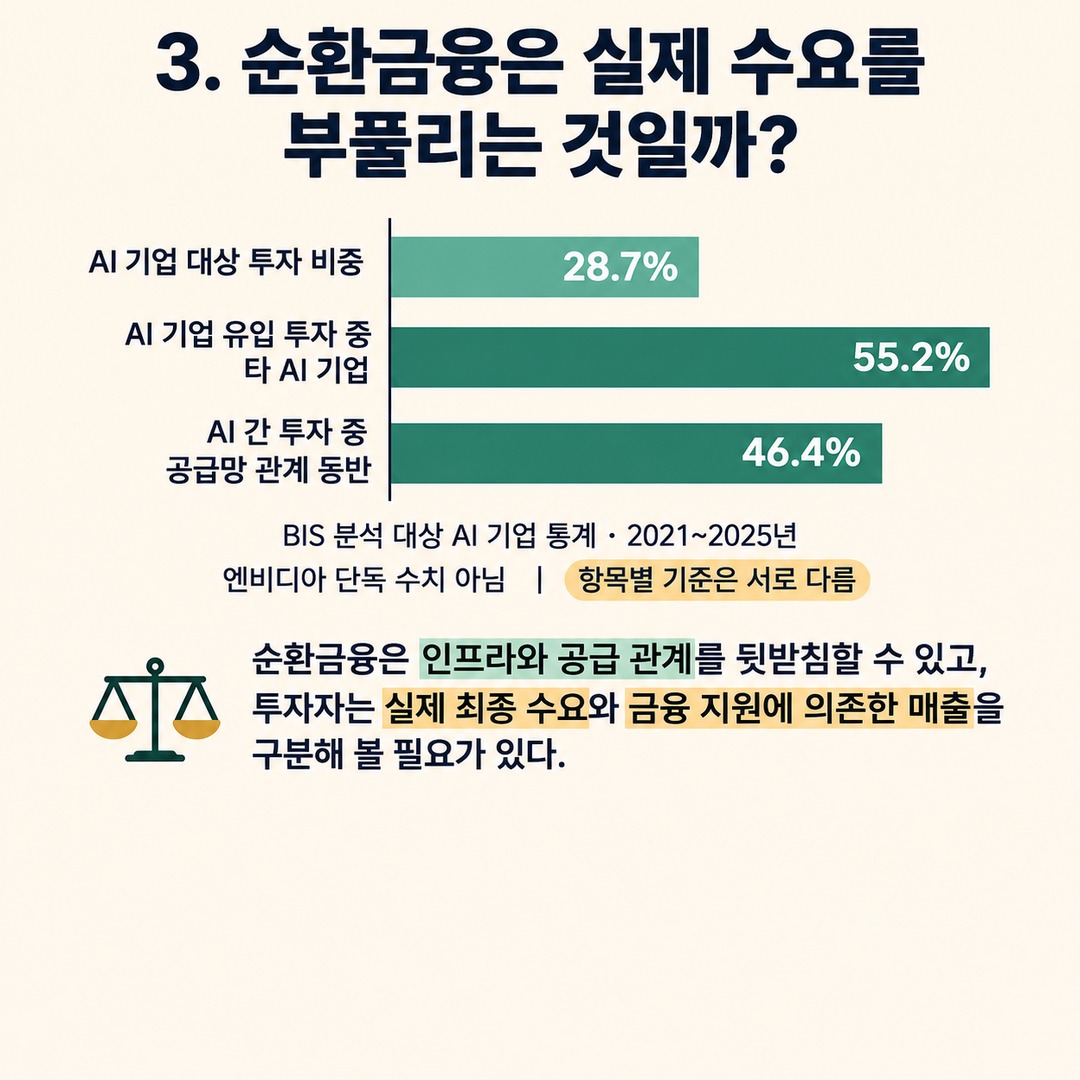
A report released by the Bank for International Settlements (BIS), 2026-10-01, provides useful context for understanding this issue.
BIS Bulletin 137 analyzed investment relationships among AI companies from 2021 to 2025.
| Survey item | BIS analysis |
|---|---|
| Share of investment going to AI companies | 28.7% of total investment transaction value |
| Investment received from other AI companies | 55.2% of investment received by AI companies |
| AI-to-AI investments involving commercial supply chain relationships | 46.4% of total AI-to-AI investment |
These figures describe investment relationships across all the AI companies included in the analysis, not NVIDIA alone.
The BIS explains that these relationships may serve an economic purpose by securing critical supply chains and addressing information asymmetry, but they could also make financial connections more complex and reduce the transparency of risks.
Circular financing does not need to be viewed as inherently negative, but actual end-user demand must be distinguished from revenue that depends on financial support.

4. What should investors look at beyond GPU sales?
Investors assessing NVIDIA’s AI business should consider the following four factors together.
First, revenue actually paid for by external customers.
A company having secured GPUs is not the same as having sold access to those GPUs to external customers and collected the cash.
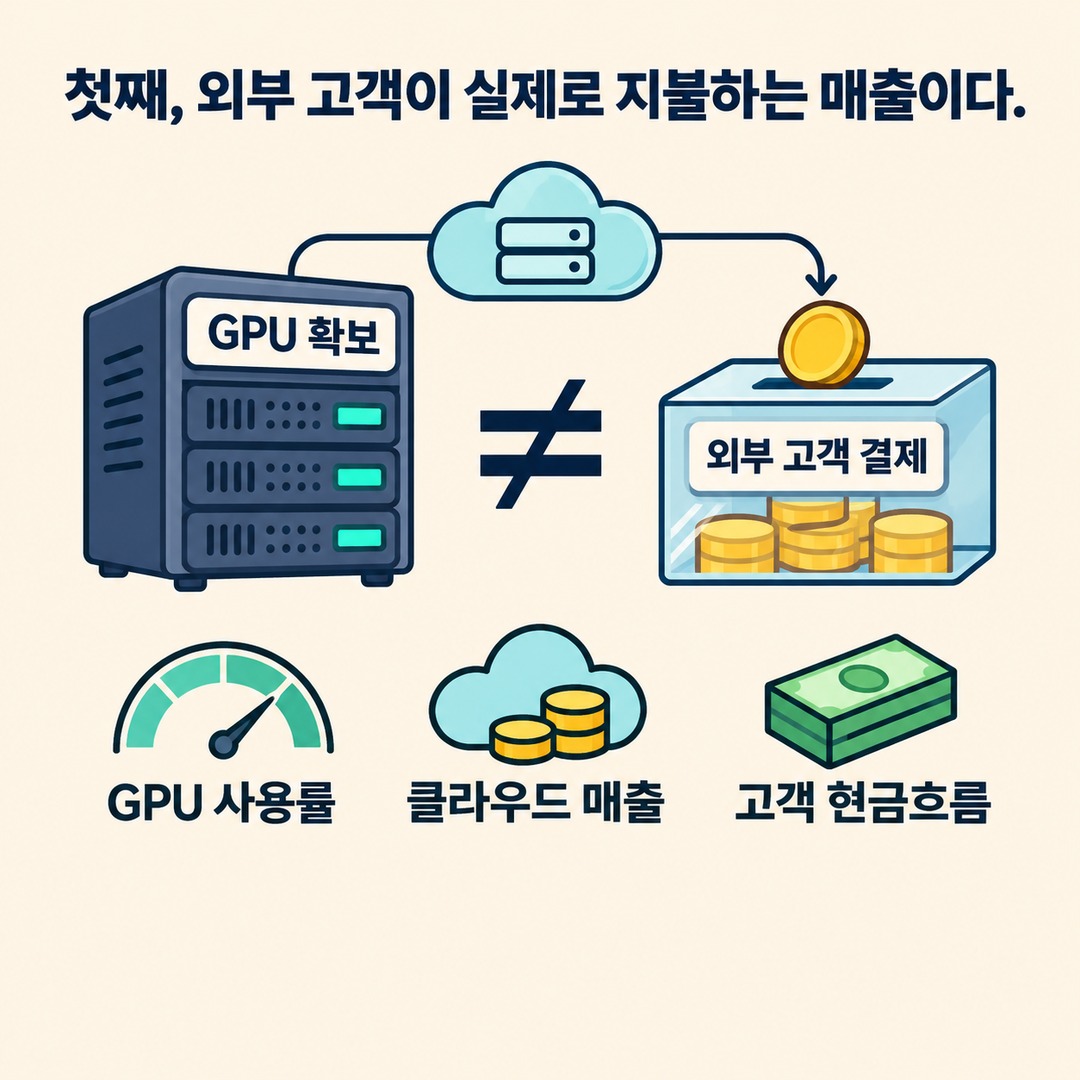
Investors should look at GPU utilization, cloud service revenue, and customers’ cash flows together.
Second, customers’ ability to raise funds independently.
Investors should check whether customers can obtain financing from banks, bond markets, or outside investors even without NVIDIA’s investments or guarantees.
It also matters how external financial institutions assess each company’s business prospects and creditworthiness.
Third, whether long-term contracts are actually fulfilled.
AI infrastructure projects often involve long-term contracts.
Even when the contract value is large, delays in data center construction or power supply can change when GPUs are installed and revenue is recognized.
Fourth, the likelihood that a guarantee will be called.
The guarantee limit alone is not enough to assess the risk.
Investors should also check when the guarantee takes effect, its payment conditions, contract termination conditions, the counterparty’s financial condition, and the assets covered by the guarantee.
If all four factors improve together, financial support can help underpin growth in the AI industry.
Conversely, if demand from external customers slows and customers also struggle to raise funds, the investment, purchase, and guarantee relationships could all become a burden at the same time.
5. Circular financing factors to watch in NVIDIA’s November 17 earnings
NVIDIA is scheduled to hold its 2027 fiscal-year 3 earnings conference call at 5 p.m. Eastern Time on 2026-11-17.
Alongside revenue and data center growth, investors should also examine NVIDIA’s contractual relationships with AI cloud providers.
In particular, it is useful to check the following:
Is demand from AI cloud partners’ external customers translating into actual revenue?
How have existing investments and new equity investment commitments changed?
How are the activation conditions and risk exposure for data center-related payment guarantees being managed?
Are long-term supply commitments translating into actual product shipments and customer revenue?
Are financing conditions improving for AI infrastructure operators?
In its earnings schedule announcement released on 2026-10-28, NVIDIA said it would provide the CFO’s commentary materials for this quarter’s results immediately after releasing the earnings.
Therefore, in November 17, it is important to look beyond the figures themselves and review the financial commentary and Q&A from interim CEO and CFO Colette Kress for information about financial support and the fulfillment of contracts.
However, investors should not assume that unconfirmed contract changes or reductions in guarantees are facts before the earnings announcement.
6. Is NVIDIA circular financing evidence of an AI bubble?
In short, the existence of circular financing alone does not prove that the AI industry is a bubble.
AI infrastructure requires substantial upfront investment and has a long payback period, so investment and financial support between companies may occur.
But if the number of people using AI services does not grow or customers’ profitability does not improve, long-term contracts and financial support could become a burden.
Investors should distinguish between the following two situations in particular.
| Category | Positive scenario | Scenario that warrants caution |
|---|---|---|
| GPU demand | More purchases by external customers | More purchases dependent on financial support |
| Cloud business | Improved utilization and cash flow | More contracts, but delayed cash collection |
| Investment structure | Greater inflows of outside capital | Support concentrated in a particular company |
| Data centers | Power and facilities secured and operational | Construction delays and rental costs become a burden |
| Guarantees | Conditions are met and exposure declines | Risk of default increases |
Ultimately, investors need to look beyond how many GPUs NVIDIA has sold and ask whether the companies that bought them can sell services to actual customers and generate cash consistently.
NVIDIA’s investments and guarantees can help accelerate growth in the AI industry, but they can also become a channel that links the financial risks of customers and suppliers.
In November 17 earnings, investors should look not only at revenue growth but also at independent demand across the AI ecosystem and its reliance on financial support.
※ This article is for informational purposes to help readers understand market trends and is not a recommendation to invest in any particular stock or asset. You are responsible for your own final decisions and investments.