

Why 6 Months of Work May Not Add Up to 180 Days for Unemployment Benefits: How to Calculate It on a 5-Day Workweek
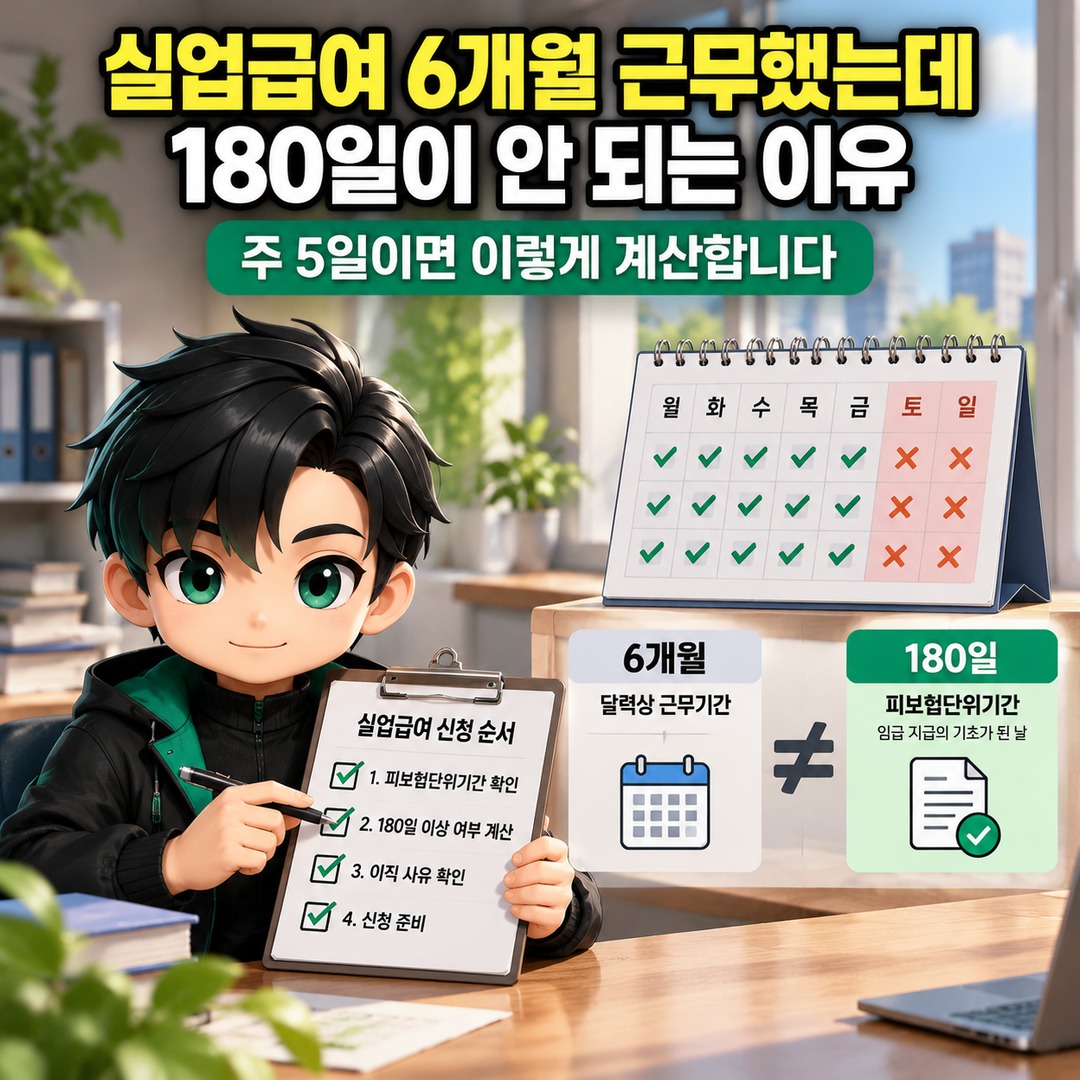
The ‘180 days’ required for unemployment benefits does not mean 180 calendar days of employment or simply 6 months of work. Because the insured qualifying period—the days used as the basis for wage payments—must total at least 180 days, employees working 5 days per week may fall short of 180 days even after completing 6 months of employment.

As of 2026-09-30, when checking unemployment benefit eligibility, it is important to examine how these 180 days are calculated, just as you would check your salary or expected benefit amount.
Why Are the 180 Days Required for Unemployment Benefits Different From 6 Months of Employment?
According to the Ministry of Employment and Labor, the insured qualifying period is not the entire period during which a person was enrolled in employment insurance, but the total number of days used as the basis for remuneration payments.

At a workplace operating on a 5-day workweek, where employees work Monday through Friday, Sunday is a paid weekly rest day, and Saturday is an unpaid day off, the insured qualifying period generally amounts to 6 days per week.
| Category | Typical Example of a 5-Day Workweek |
|---|---|
| Actual working days | 5 days per week |
| Paid weekly rest day | 1 day |
| Unpaid day off | Excluded |
| Insured qualifying period | 6 days per week |
Therefore, assuming that ‘6 months of employment = 180 insured qualifying days’ can produce a different result from the number of days recorded on the official employment separation confirmation document. The Ministry of Employment and Labor also explains that employees working 5 days per week may accumulate approximately 25–26 insured qualifying days per month, meaning 6 months of employment may not be enough to meet the 180-day requirement.
Approximately How Many Months Must Employees Working 5 Days per Week Work to Reach 180 Days?

If the insured qualifying period is calculated simply as 6 days per week, 30 weeks are needed to reach 180 days.
The author's calculation is as follows.
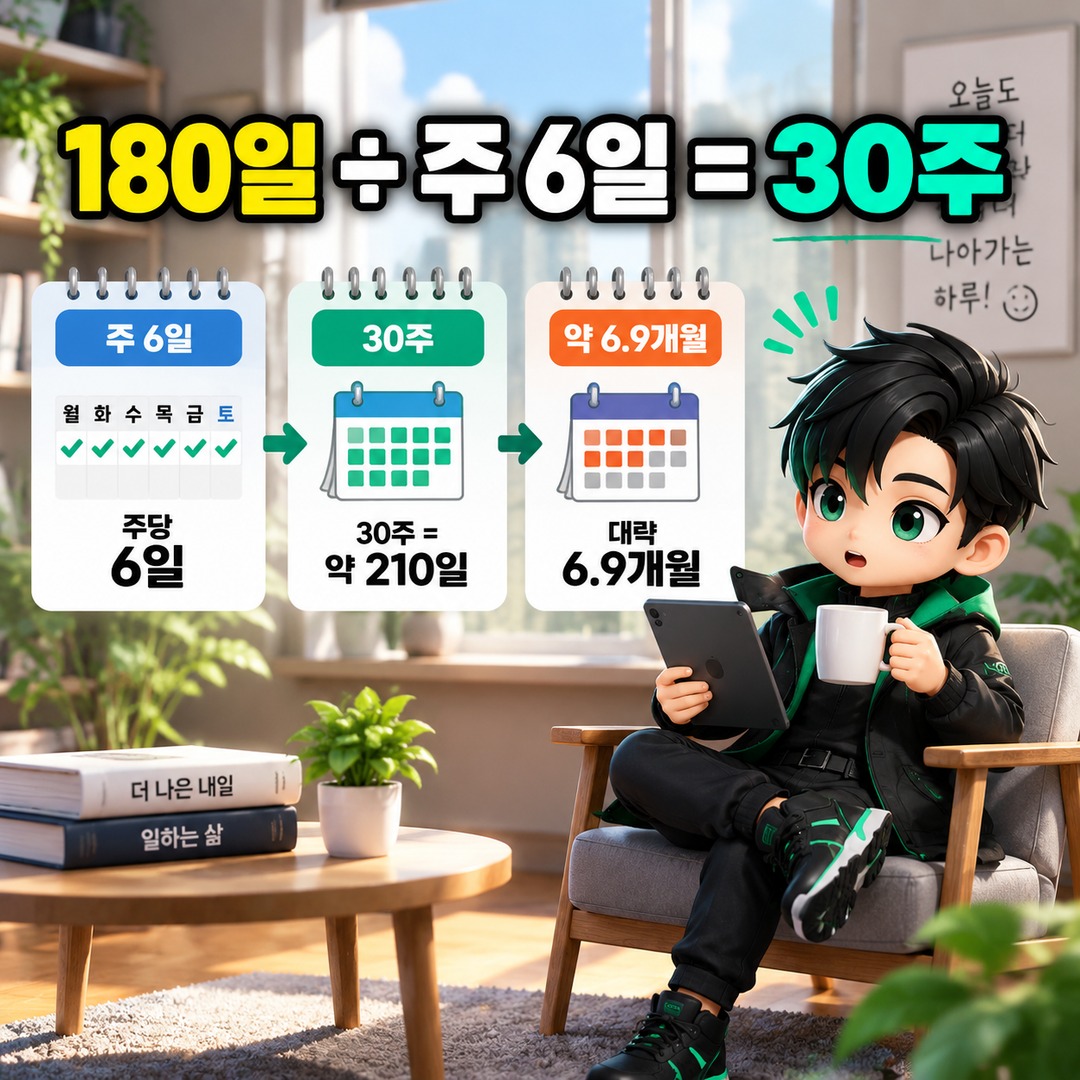
180 Days ÷ 6 Days per Week = 30 Weeks
30 weeks corresponds to approximately 210 calendar days, or roughly 6.9 months. This is why explanations of unemployment benefit eligibility for employees working 5 days per week often note that they may need to work longer than 6 months.
However, you should not assume that working 7 months automatically satisfies the requirement. The actual insured qualifying period can vary depending on the arrangement of paid and unpaid holidays, employment start and end dates, absences, leaves of absence, and how the workplace handles paid holidays.
In its consultation cases, the Ministry of Employment and Labor also explains that, at workplaces operating on a 5-day workweek, actual working days and paid weekly rest days are added together with other days used as the basis for remuneration payments, while unpaid holidays are excluded.
Are Saturdays, Sundays, and Public Holidays All Included?
Not every holiday is excluded, and not every holiday is included. The key question is whether that day was used as the basis for remuneration payments.
For example, if Saturday is an unpaid day off, it is generally excluded from the insured qualifying period. On the other hand, if Sunday is a paid weekly rest day, it may be included even if the employee did not actually report to work.
Days on which employees receive wages from their employer despite not actually working, such as paid leave days, may also count toward the insured qualifying period. Conversely, unpaid holidays are generally excluded because they are not days used as the basis for remuneration payments.
Therefore, simply counting the calendar days between your employment start date and departure date is not an accurate way to calculate your 180 days.
Can Employment Periods From Previous Jobs Be Combined to Meet the 180-Day Requirement?
In some cases, yes. As a general rule, eligibility for job-seeking benefits for ordinary employees is determined by checking whether the combined insured qualifying periods within the 18 months preceding the final employment separation date total at least 180 days.
In other words, even if you did not accumulate 180 days at your most recent workplace, qualifying insured periods from previous workplaces may be combined if they fall within the applicable reference period. The Ministry of Employment and Labor also confirms in its consultations that insured qualifying periods from different workplaces can be combined if they fall within 18 months before the final employment separation date.
For example, if the recognized qualifying period at your most recent workplace is 150 days and the eligible period from your previous job is 40 days, the simple combined total is 190 days.
However, this alone does not automatically establish eligibility for unemployment benefits. Other eligibility conditions, including the reason for leaving the most recent workplace, must also be reviewed.
Exceeding 180 Days Does Not Automatically Qualify You for Unemployment Benefits
An insured qualifying period of 180 days is an important requirement, but it is not the only condition.
As of September 2026, ordinary employees must generally have accumulated at least 180 insured qualifying days within the 18 months preceding their final employment separation date. They must also be unemployed despite having the willingness and ability to work, have left employment for a reason that does not disqualify them from receiving benefits, and make efforts to find new employment.
In particular, it would be incorrect to assume that ‘once I exceed 180 days, I can voluntarily resign and automatically receive unemployment benefits.’ Actual eligibility is determined after reviewing the reason for leaving the most recent job and the individual's specific circumstances.
Where Can You Accurately Check Your Insured Qualifying Period?
The most important document is the employment separation confirmation document submitted by the employer.
This document records not only the insured qualifying period but also information needed to determine eligibility for job-seeking benefits, including the reason for leaving employment, wages before separation, and the prescribed working hours for 1 day. If periods from previous jobs must be combined, additional employment separation confirmation documents from those workplaces may be required.
Therefore, rather than assuming before resigning that ‘I have worked for more than 6 months, so I must have exceeded 180 days,’ it is safer to verify the insured qualifying period actually reported.
Because the result may vary depending on your individual work schedule and how paid and unpaid holidays are handled, final eligibility should be confirmed with the relevant Employment Center.
What to Remember to Avoid Confusing 6 Months With 180 Days
The 180-Day Requirement for Unemployment Benefits Means ‘180 Days Used as the Basis for Remuneration Payments,’ Not 180 Calendar Days of Employment.
Under a typical 5-day workweek, where Saturday is unpaid and Sunday is a paid weekly rest day, 6 days may count toward the insured qualifying period each week. Applying this arrangement as a simple calculation means 30 weeks are needed to reach 180 days, so 6 months of employment may not be sufficient.
Conversely, the result may differ if qualifying periods from previous jobs can be combined or if paid holiday arrangements are different.
Ultimately, the figure you should check before applying for unemployment benefits is not simply ‘how many months have I worked?’ but ‘how many insured qualifying days are recognized on my employment separation confirmation document?’
※ This article is provided for reference to help readers understand market trends and does not constitute an investment recommendation for any particular stock or asset. Final investment decisions and responsibility rest with the individual.
Related Articles
5 Indicators Worth Checking Alongside RSI: Why Start With Moving Averages and Trading Volume?