

Dividing Unlisted Shares in Divorce: Must the Settlement Be Paid Entirely in Cash? Supreme Court Leaves Room for a Mix of Cash and Shares
이 포스팅은 쿠팡 파트너스 활동의 일환으로, 이에 따른 일정액의 수수료를 제공받습니다.
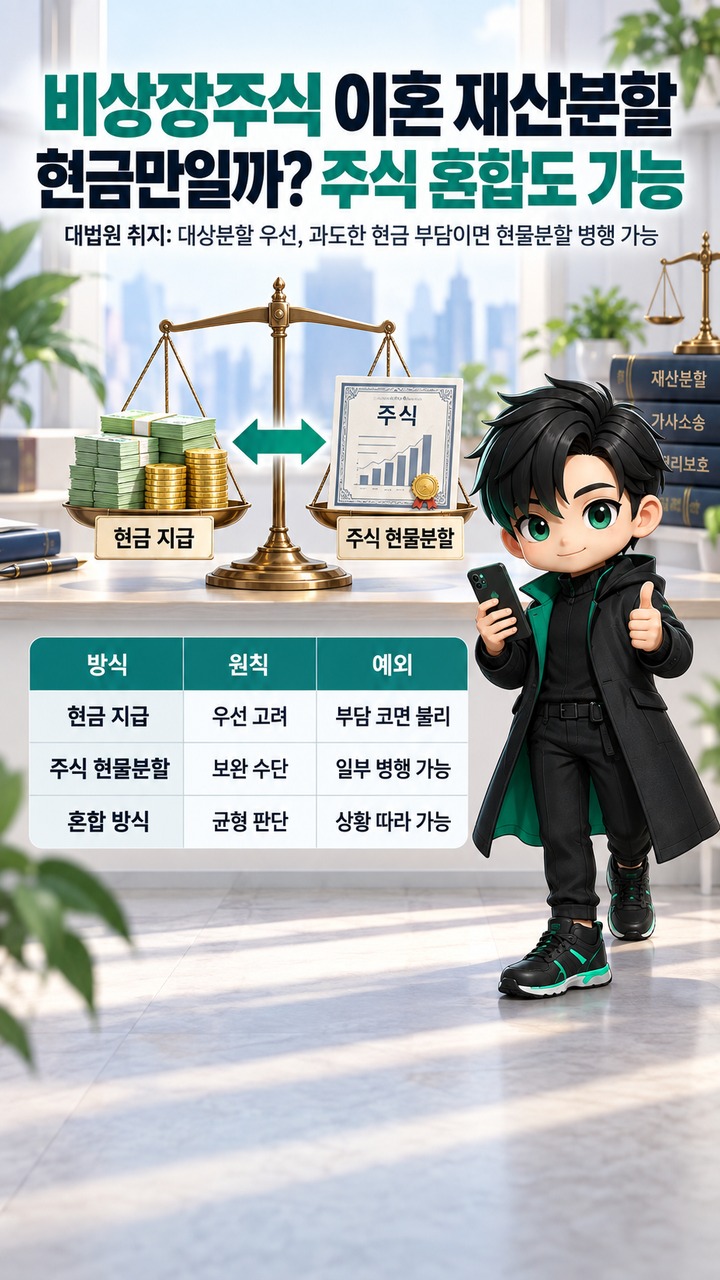
Just because unlisted shares are subject to property division in a divorce does not mean that half the shares must be transferred or, conversely, that the entire settlement must be paid in cash. The Supreme Court has held that courts should generally first consider allowing the original shareholder to retain the shares while paying the other spouse an equivalent amount in cash. However, if a substantial cash payment would place an excessive burden on one party, a combination of methods, including an in-kind division of shares, may be appropriate.

As the corporate valuation of KRW 8,016,000,000,000 attracts attention in the divorce proceedings involving Smilegate founder Kwon Hyuk-bin, another question has emerged: If property division is ordered, will the couple actually have to split ownership of Smilegate shares?
Understanding this issue requires distinguishing between how much property is divided and how that division is carried out.
Dividing Unlisted Shares: The Amount and the Method Are Separate Questions
The court must first determine which assets are subject to division and how much each spouse contributed to their acquisition or preservation. It must then decide how to transfer the resulting entitlement in practice.
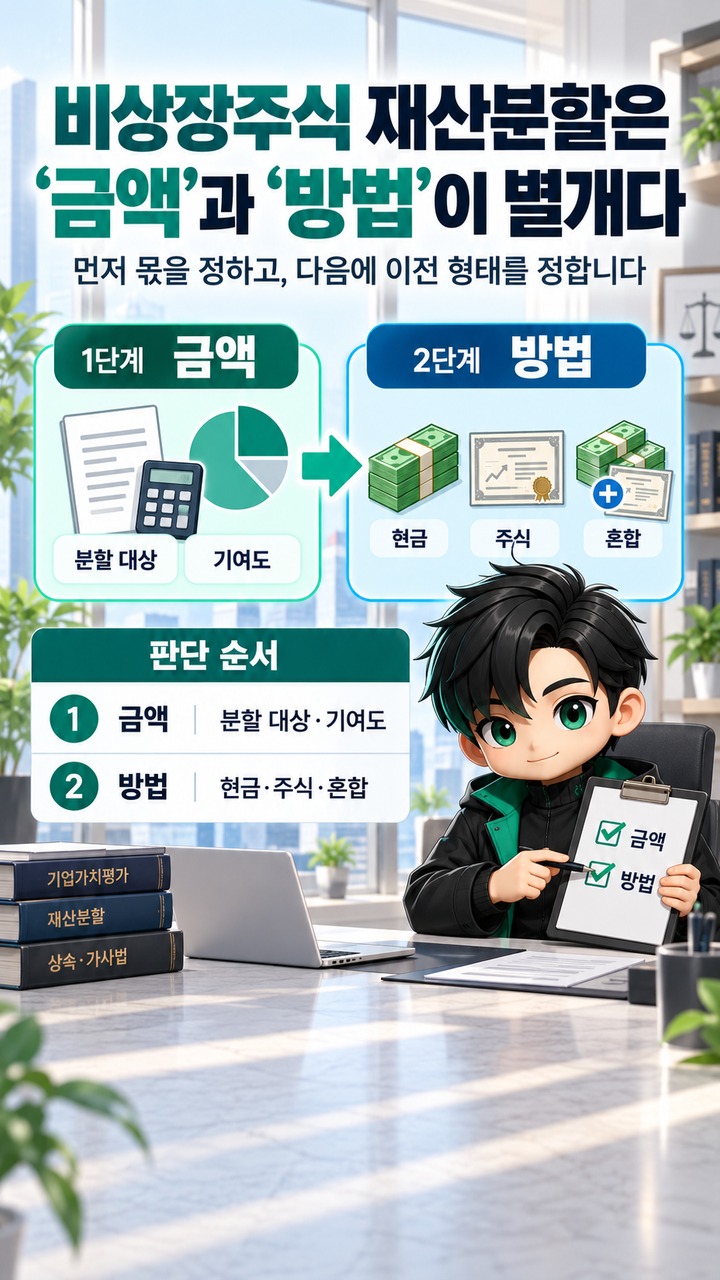
For example, if one spouse owns shares in an unlisted company, that does not automatically mean the same proportion of shares must be transferred to the other spouse.
The main methods of property division include:
Cash equalization: The original shareholder retains the shares and pays the other spouse in cash.
In-kind division: The shares themselves are divided and transferred in specified proportions.
Division following an auction or sale: The property is sold and the proceeds are divided.
Mixed division: Part of the settlement is paid in cash and part through shares or other assets.
Courts may choose the appropriate method after considering the composition of the marital assets and the financial circumstances of the parties.
Why the Supreme Court Says Cash Payments Should Generally Be Considered First for Unlisted Shares
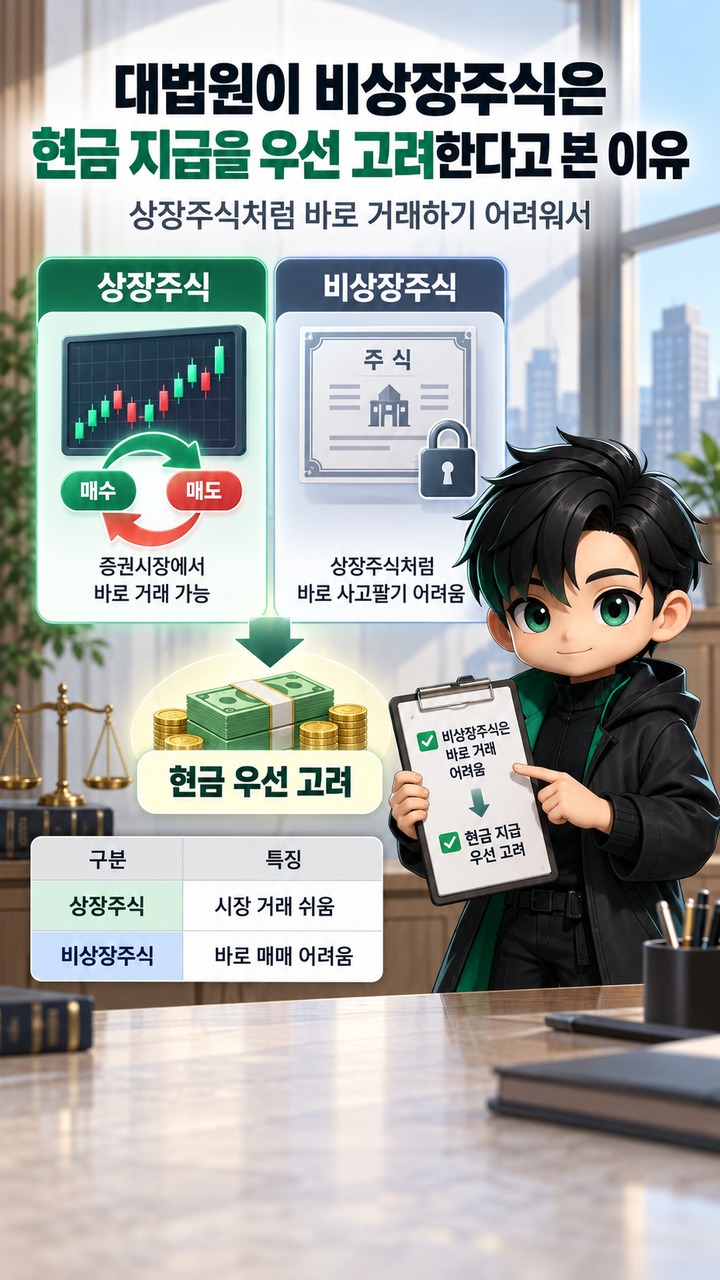
Unlisted shares differ fundamentally from publicly traded shares, such as Samsung Electronics stock, which can be bought and sold directly on a securities exchange.
A spouse who receives a minority stake may struggle to find a suitable buyer, and there is no continuously observable market price. Becoming a minority shareholder without involvement in the company's operations does not necessarily make meaningful participation in management any easier.
For these reasons, in its 2026-05-29 ruling, the Supreme Court stated that, unless special circumstances exist, it is preferable to first consider a cash equalization arrangement under which the spouse who originally owned the unlisted shares retains them and pays the other spouse the monetary equivalent of their entitlement.
In other words, including company shares among the assets subject to property division does not necessarily mean the other spouse will become a shareholder in the company.
Why, Then, Did the Supreme Court Overturn a Ruling Requiring an Entirely Cash-Based Settlement?
Even if cash payment is generally preferred, the situation changes when the amount involved becomes excessively large.
In a case decided by the Supreme Court in 2026, the couple's net assets subject to division totaled approximately KRW 89,100,000,000, with unlisted shares accounting for most of that amount at approximately KRW 75,300,000,000. The 2-instance court ordered that the husband retain the shares and pay the other spouse approximately KRW 14,300,000,000 in cash as a property division settlement.
However, the Supreme Court held that the court also needed to examine whether raising the necessary cash would likely require selling a substantial portion of the unlisted shares and whether that process could undermine control of the company.
The essential principle is straightforward.
Even if a cash settlement is generally convenient, courts should not insist exclusively on cash when obtaining the necessary funds would require an unreasonable sale of core assets.
The Supreme Court ruled that, in such circumstances, courts should actively consider combining multiple methods, including in-kind division.
Why a Company Valued at KRW 8,000,000,000,000 Would Not Automatically Have to Transfer Half Its Shares
Suppose a company is valued at KRW 8,000,000,000,000. A simple calculation using a spouse's contribution rate of 50% produces KRW 4,000,000,000,000.
However, that calculation alone does not establish that the spouse will receive 50% of the company's shares or that the founder must pay KRW 4,000,000,000,000 in cash.
Actual property division requires at least three separate determinations.
First, are the shares subject to property division?
The central questions include whether the assets were acquired or maintained during the marriage and how each spouse contributed.
Second, how should the shares be valued?
Unlisted companies, in particular, have no publicly quoted market price, so their valuations can vary significantly depending on the methodology used.
Third, how should the recognized entitlement be paid?
The court must separately consider whether a cash payment is feasible, whether transferring some shares would be fairer, and whether the settlement should be adjusted using other assets.
Therefore, a single calculation such as `Company valuation × Contribution rate = Cash settlement amount` is not enough to predict the actual outcome of a court ruling.
Does Receiving Shares Instead of Cash Automatically Confer Management Control?
Receiving shares does not automatically give someone control over a company.
Management control is not determined simply by share ownership. It depends on several factors, including the actual ownership percentage, voting rights structure, the holdings of other shareholders, the company's articles of incorporation, and shareholder agreements.
The Supreme Court has also identified the difficulty of selling minority stakes in unlisted companies and the limitations on management participation as characteristics that must be considered when dividing such shares in divorce proceedings.
Therefore, assuming that the appearance of a major corporate shareholding in a divorce case will automatically lead to a transfer of half the shares and joint management is an oversimplification.
In Kwon Hyuk-bin's Divorce Case, the Question Goes Beyond the Settlement Amount
As of 1 p.m. on 2026-09-09, the 1-instance ruling in Smilegate founder Kwon Hyuk-bin's divorce case was scheduled for 2 p.m. that day, and the outcome had not yet been announced.
According to published reports, the spouse's side is seeking division of half of the Smilegate shares, while Kwon's side reportedly maintains that the shares should not be subject to property division.
Once the ruling is issued, several questions will need to be examined beyond the monetary amount.
Did the court recognize Smilegate shares as assets subject to division? What contribution rate did it assign to the spouse? What valuation standard did it apply to the company? And did it ultimately order division through cash, shares, or a combination of the two?
Even if the property division amount is the same KRW 1,000,000,000,000, an entirely cash-based settlement and one involving unlisted shares could have very different implications for the founder's ownership percentage and the company's governance structure.
Because the method and proportion of property division in individual divorce cases depend on the specific facts, the final outcome of any particular case should be verified against the court's written judgment.
※ This article is provided for informational purposes to help readers understand market developments and does not constitute an investment recommendation concerning any particular security or asset. Readers are responsible for their own final decisions and investment risks.
Related Articles
이 포스팅은 쿠팡 파트너스 활동의 일환으로, 이에 따른 일정액의 수수료를 제공받습니다.