

U.S. S&P500 ETF Up 10%, Exchange Rate Down 10%: Why Is the Return in Korean Won -1%?
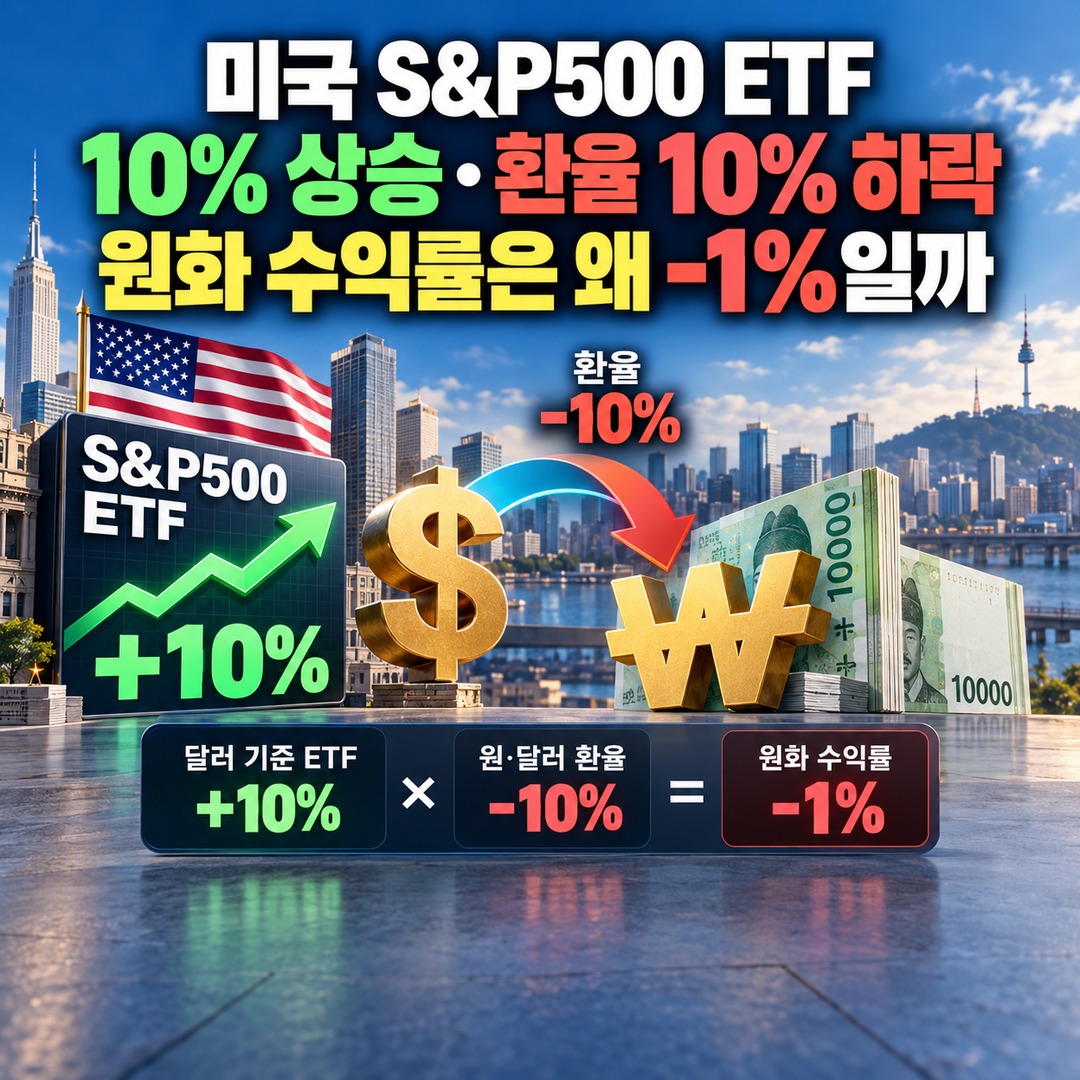
Even if a U.S. S&P500 ETF gains 10% in U.S. dollar terms, a 10% decline in the USD/KRW exchange rate over the same period means the return in Korean won is -1%, not 0%. This assumes an investment in an unhedged ETF and excludes taxes, fees, distributions, and other costs. The reason is that the two rates of return must be multiplied rather than simply added.
The key point to examine as of 2026-10-27 is not simply how much U.S. stocks have risen, but how much an investor can ultimately recover when converting the investment back into Korean won.
How an 10% Gain in the S&P500 Turns an KRW 1,000,000 Investment into KRW 990,000
Suppose you invest KRW 1,000,000 in a U.S. S&P500 ETF.
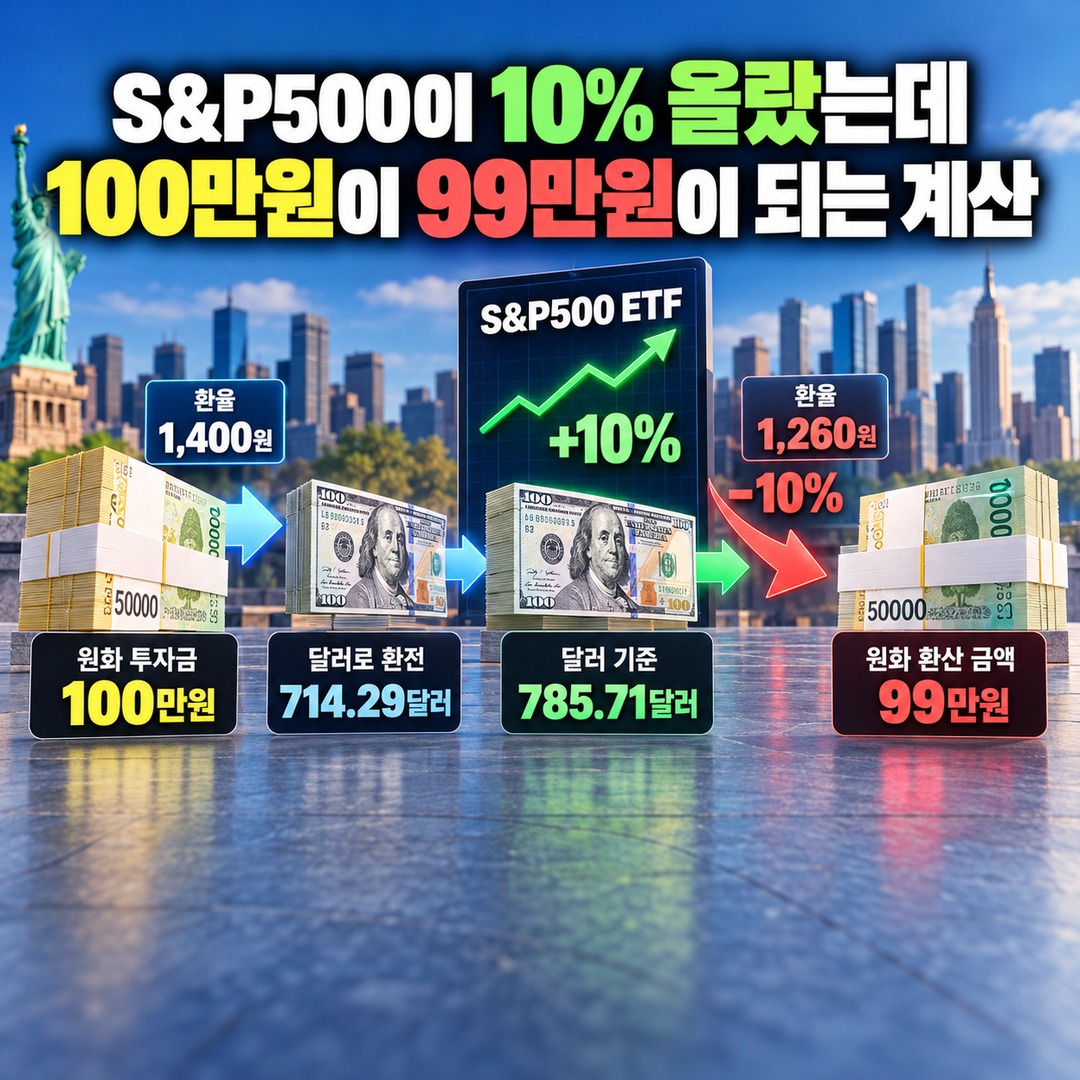
Assume the initial USD/KRW exchange rate is KRW 1,400 per USD 1. The ETF then rises 10% while the exchange rate falls 10% to KRW 1,260.
This is a hypothetical calculation, not an actual investment result from any specific historical period.
ETF Return in U.S. Dollars
+10%
USD/KRW Exchange Rate
-10%
Return in Korean Won
-1%
Author's calculation. Assumes unhedged currency exposure, the same measurement period, and excludes costs, taxes, and distributions. The calculation proceeds as follows.
| Category | At Investment | At Valuation |
|---|---|---|
| USD/KRW exchange rate | KRW 1,400 | KRW 1,260 |
| Investment value in U.S. dollars | USD 714.29 | USD 785.71 |
| Value converted into Korean won | KRW 1,000,000 | KRW 990,000 |
Converting KRW 1,000,000 at an exchange rate of KRW 1,400 gives approximately USD 714.29.
If the ETF rises 10%, its value in U.S. dollars increases to approximately USD 785.71.
However, when that value is converted back into Korean won after the exchange rate has fallen to KRW 1,260, the investment is worth KRW 990,000.
Author's calculation
KRW 1,000,000×1.10×0.90=KRW 990,000KRW 1,000,000\times1.10\times0.90=KRW 990,000Return in Korean won=KRW 990,000−KRW 1,000,000KRW 1,000,000×100=−1%Return in Korean won=\frac{KRW 990,000-KRW 1,000,000}{KRW 1,000,000}\times100=-1\%Although the investment gained value in U.S. dollars, its value after conversion into Korean won actually decreased by KRW 10,000.
Why Is It Wrong to Simply Add the Stock Price Gain and the Exchange Rate Decline?
To calculate the return in Korean won, the stock price return and the exchange rate change must be combined multiplicatively.
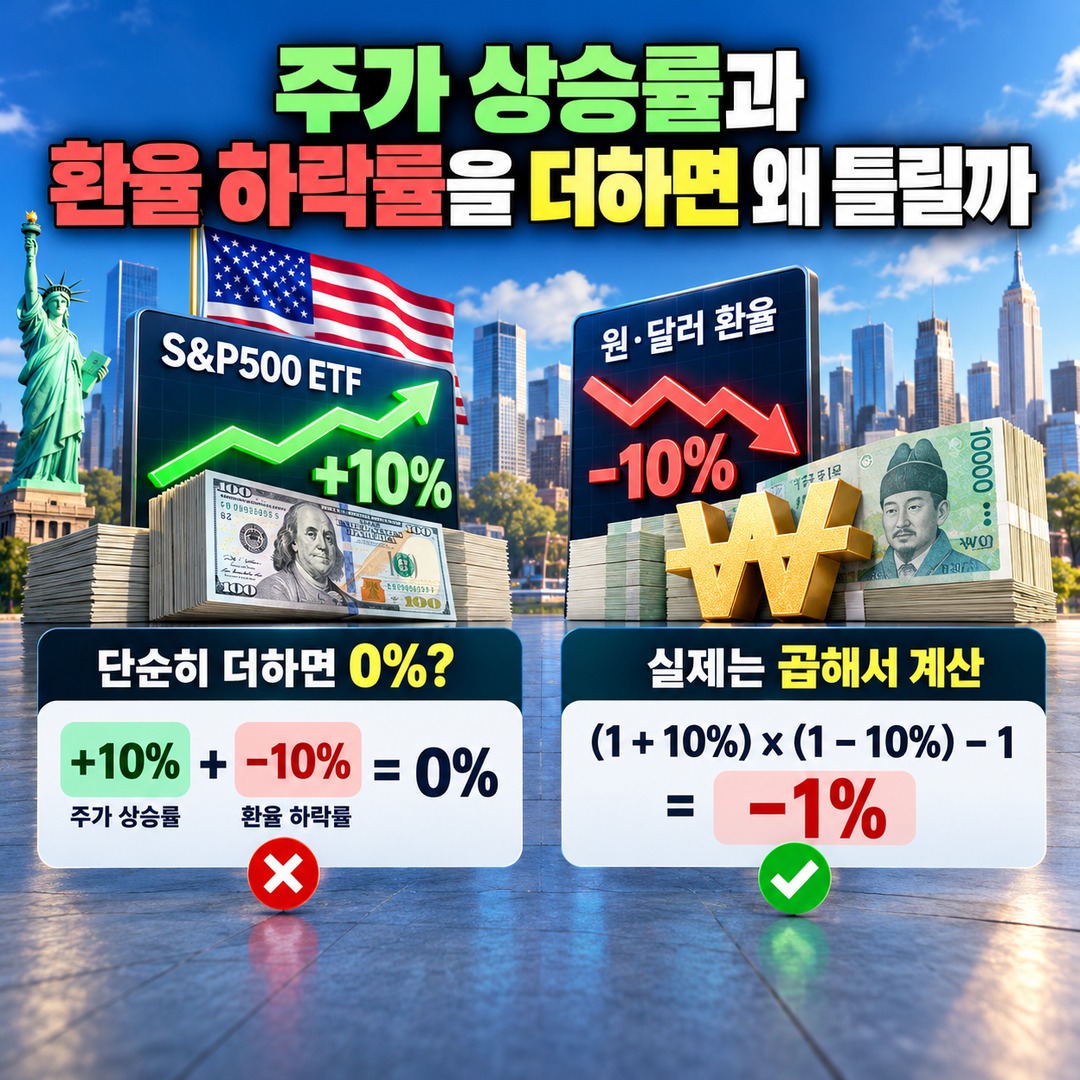
If the stock price rises 10% and the exchange rate subsequently falls 10%, the exchange rate decline applies to the entire appreciated value of the dollar-denominated assets, not just the original principal.
Therefore, the correct basic formula is as follows.
RKRW=(1+RUSD)(1+RFX)−1R_{\text{KRW}}=(1+R_{\text{USD}})(1+R_{\text{FX}})-1Here is what each term represents.
RKRWR_{\text{KRW}}: Return measured in Korean won
RUSDR_{\text{USD}}: ETF return measured in U.S. dollars
RFXR_{\text{FX}}: Percentage change in the USD/KRW exchange rate
Expanding the expression for the two returns gives the following equation.
RKRW=RUSD+RFX+(RUSD×RFX)R_{\text{KRW}}=R_{\text{USD}}+R_{\text{FX}}+
(R_{\text{USD}}\times R_{\text{FX}})Simply adding an 10% increase and an 10% decrease gives 0%, but the actual calculation also includes a cross-product term of -1% percentage points.
Investor.gov, the investor education website of the U.S. Securities and Exchange Commission (SEC), also explains in its guidance on international investing that exchange rate movements can increase or reduce investment returns on foreign-currency-denominated assets.
An important condition in this calculation is that the ETF's U.S. dollar return and the change in the USD/KRW exchange rate must be measured over the same period.
If the Exchange Rate Falls 10%, How Much Must the ETF Rise to Break Even?
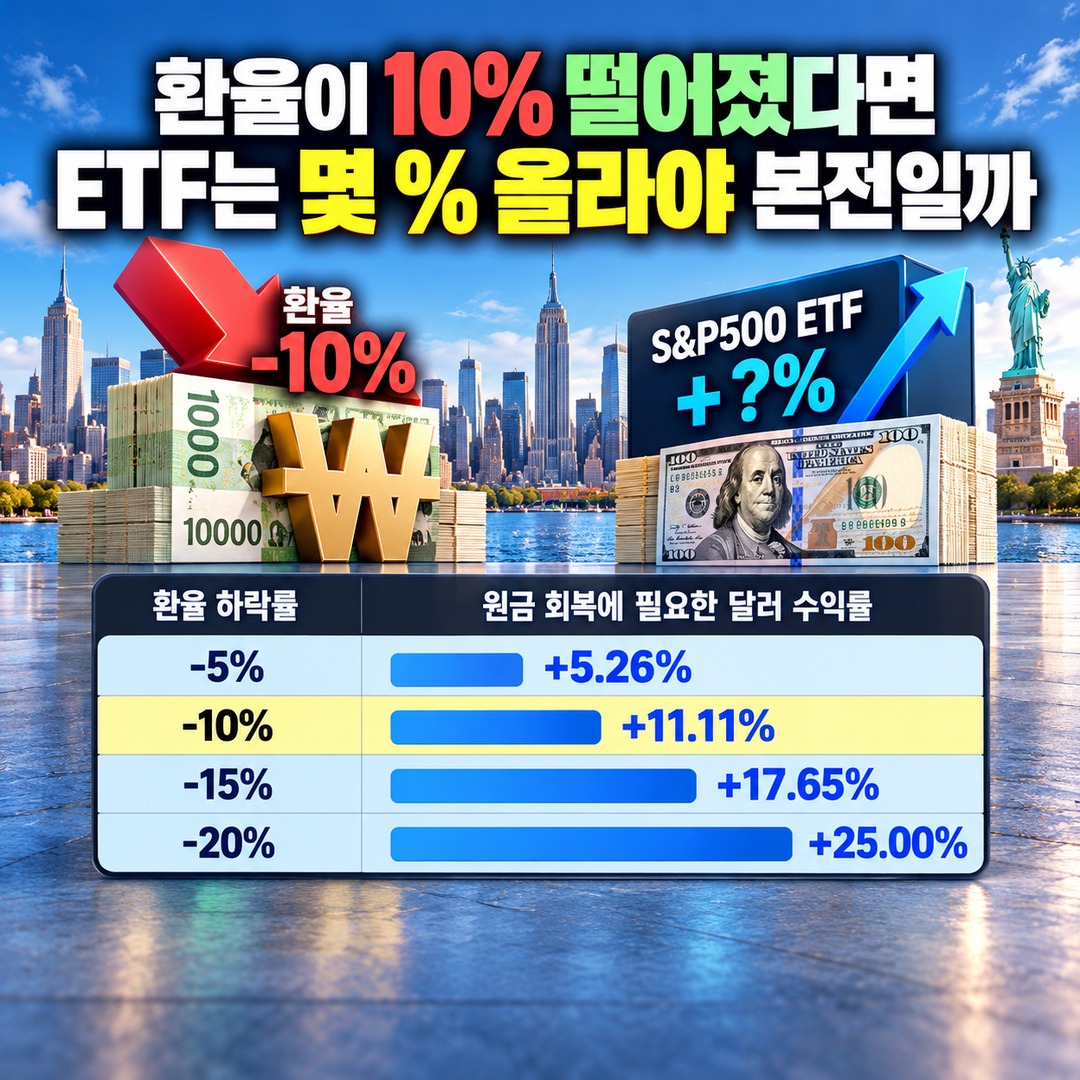
If the exchange rate falls by exactly 10%, the ETF must gain approximately 11.11% in U.S. dollar terms for the investor to recover the original principal in Korean won.
A gain of 10% is not enough; the ETF would need to rise by approximately 1.11% additional percentage points.
Setting the return in Korean won to 0 gives the following calculation.
(1+RUSD)×0.90=1(1+R_{\text{USD}})\times0.90=1RUSD=10.90−1R_{\text{USD}}=\frac{1}{0.90}-1RUSD≈11.11%R_{\text{USD}}\approx11.11\%The larger or smaller the exchange rate decline, the more the ETF must rise to recover the original investment.
| Exchange Rate Decline | USD-Denominated Return Required to Break Even |
|---|---|
| -5% | +5.26% |
| -10% | +11.11% |
| -15% | +17.65% |
| -20% | +25.00% |
Author's calculations. These figures represent the break-even point in Korean won for an unhedged investment, excluding costs. If the exchange rate falls 20%, an ETF gain of 20% alone will not be enough to recover the original investment.
The ETF must rise 25% in U.S. dollar terms to reach the break-even point in Korean won.
This calculation is not a recommendation to invest based on an expectation that the exchange rate will decline. Rather, it is a way to determine how much an exchange rate movement that has already occurred affects investment performance measured in Korean won.
The Calculation Changes If You Hold a Currency-Hedged ETF
A currency-hedged ETF is designed to reduce the impact of fluctuations in the USD/KRW exchange rate on investment performance.
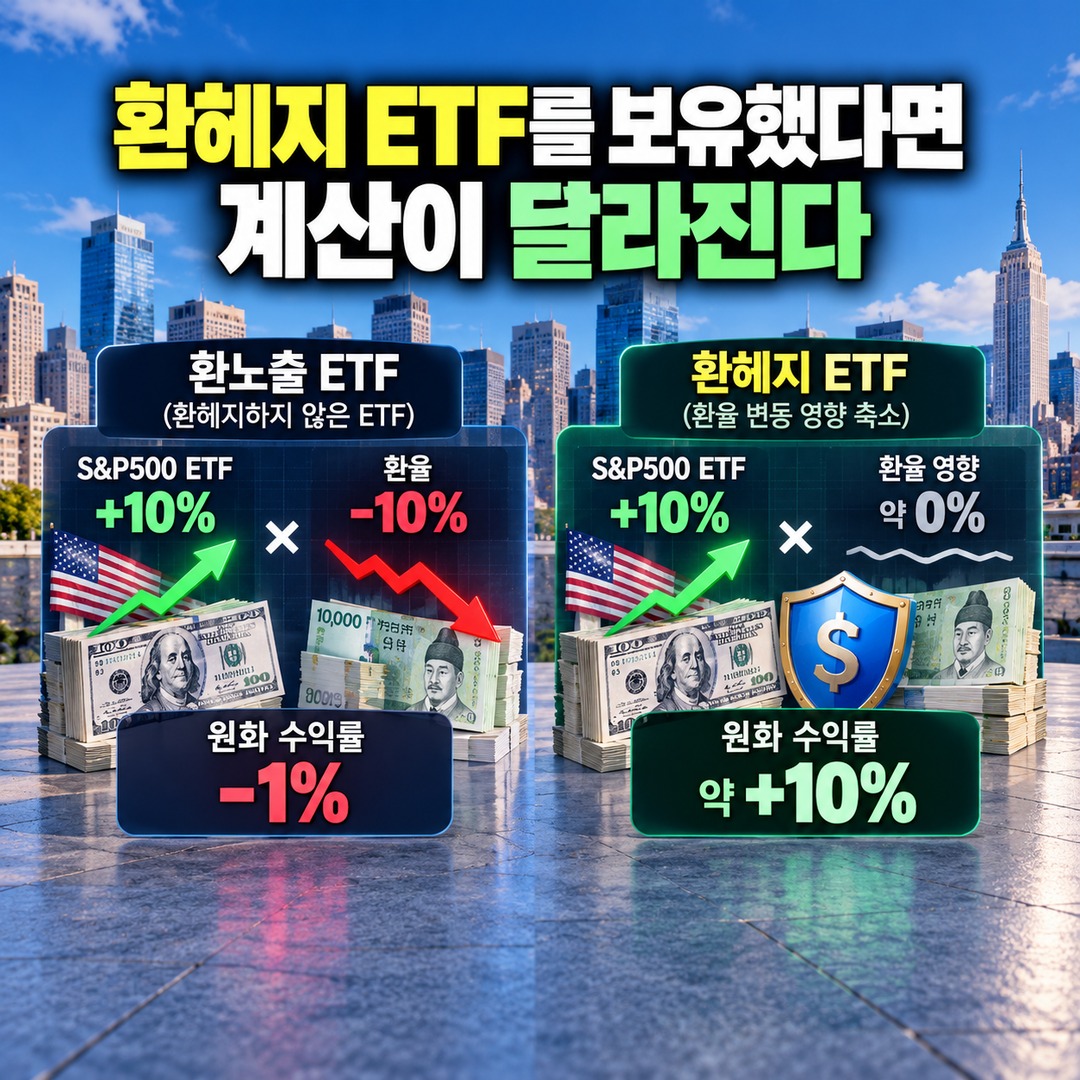
Therefore, even if the exchange rate falls 10%, you should not apply the earlier -1% formula directly to calculate the Korean won return of a currency-hedged ETF.
For example, assuming the underlying asset returns 10% and the currency hedge works perfectly, the direct impact of the exchange rate decline can be reduced. However, this does not mean the ETF's actual return will be exactly 10%.
Actual returns may reflect hedging costs, management fees, tracking error, distributions, and differences between the ETF's market price and its net asset value.
Furthermore, not every ETF traded in Korean won on a South Korean exchange is currency-hedged. The currency used for trading and the method used to manage exchange rate risk are two separate matters.
Look for an '(H)' designation in the fund's name, but ultimately check the currency-hedging policy disclosed in the ETF's prospectus.
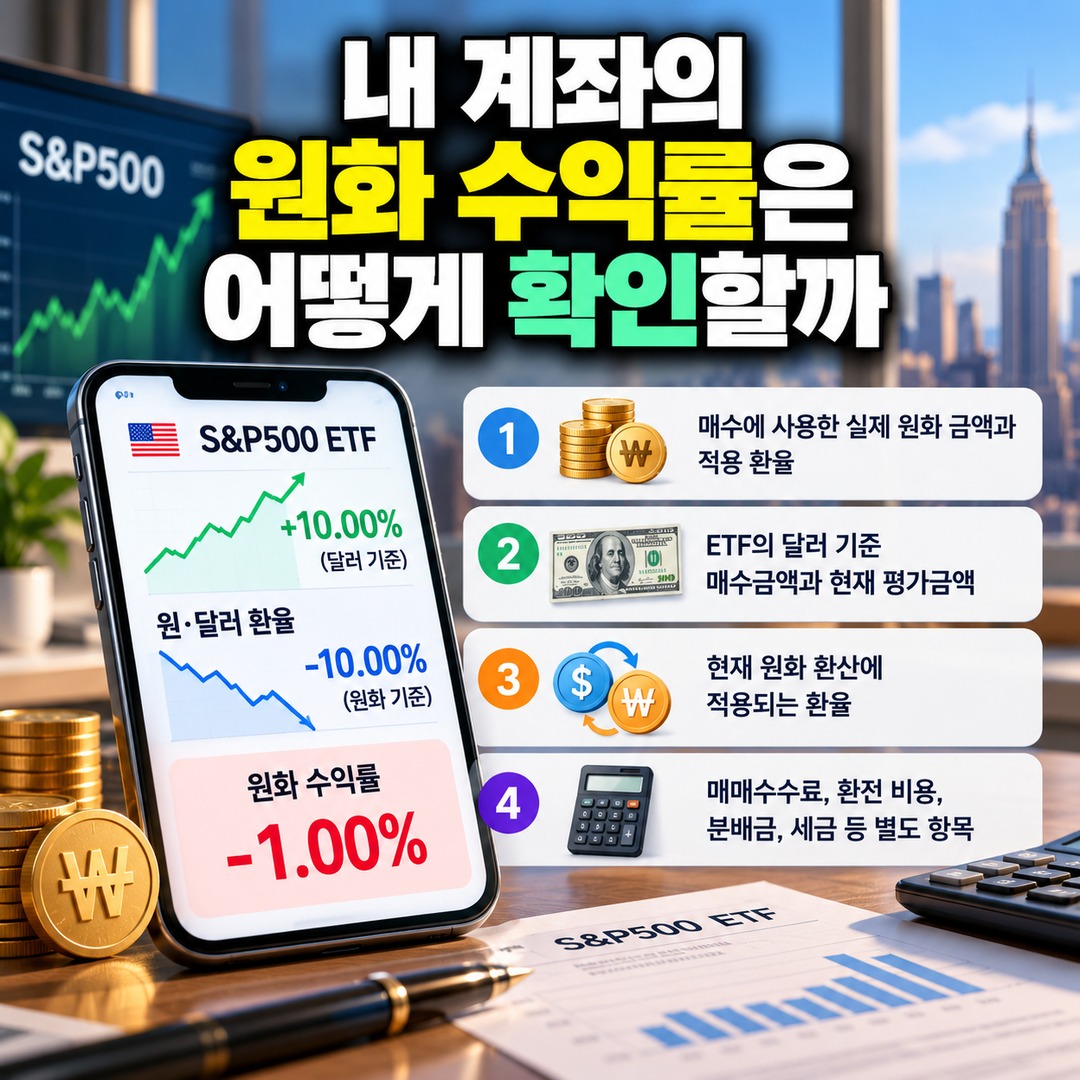
How Can You Check the KRW Return in Your Own Account?
In an actual investment account, you need to compare the investment amount at the time of purchase with its value at the time of evaluation, using the same currency for both.
If you purchased a U.S.-listed ETF directly, check the following:
1. The actual amount in Korean won used for the purchase and the exchange rate applied
2. The ETF's purchase amount in U.S. dollars and its current valuation
3. The exchange rate used to convert the current value into Korean won
4. Separate items such as trading commissions, currency conversion costs, distributions, and taxes
If you have bought and sold the ETF multiple times, it is difficult to calculate your total return accurately using only the initial and final exchange rates. You need to account for the cash flows and exchange rates associated with each transaction.
For a U.S. S&P500 ETF listed in South Korea, it is more appropriate to first check whether the fund is currency-hedged and then calculate your unrealized gain or loss using your actual purchase price and the current market price in Korean won. The underlying index's U.S. dollar return alone cannot establish the actual return of a domestically listed ETF.
A rise in the U.S. S&P500 index does not mean that every investor holding an S&P500 ETF will earn the same return in Korean won.
This is because investment timing, exchange rates, currency-hedging methods, actual transaction prices, and costs can all differ.
Ultimately, evaluating the Korean won return of a U.S. S&P500 ETF requires considering both the value of the U.S. dollar-denominated assets and the USD/KRW exchange rate, rather than looking at the ETF's price increase alone.
When the exchange rate falls 10%, the required increase in the ETF's price is approximately 11.11%. For an ETF you actually hold, you must also account for costs, distributions, taxes, and other account-specific factors to determine your final investment performance.
※ This article is provided for informational purposes to help readers understand market movements. It is not a recommendation to invest in any particular security or asset. You are responsible for your own investment decisions and their outcomes.