

Basic Old-Age Pension Eligibility in 2026: Check the Monthly KRW 349,700 Amount and Recognized Income First
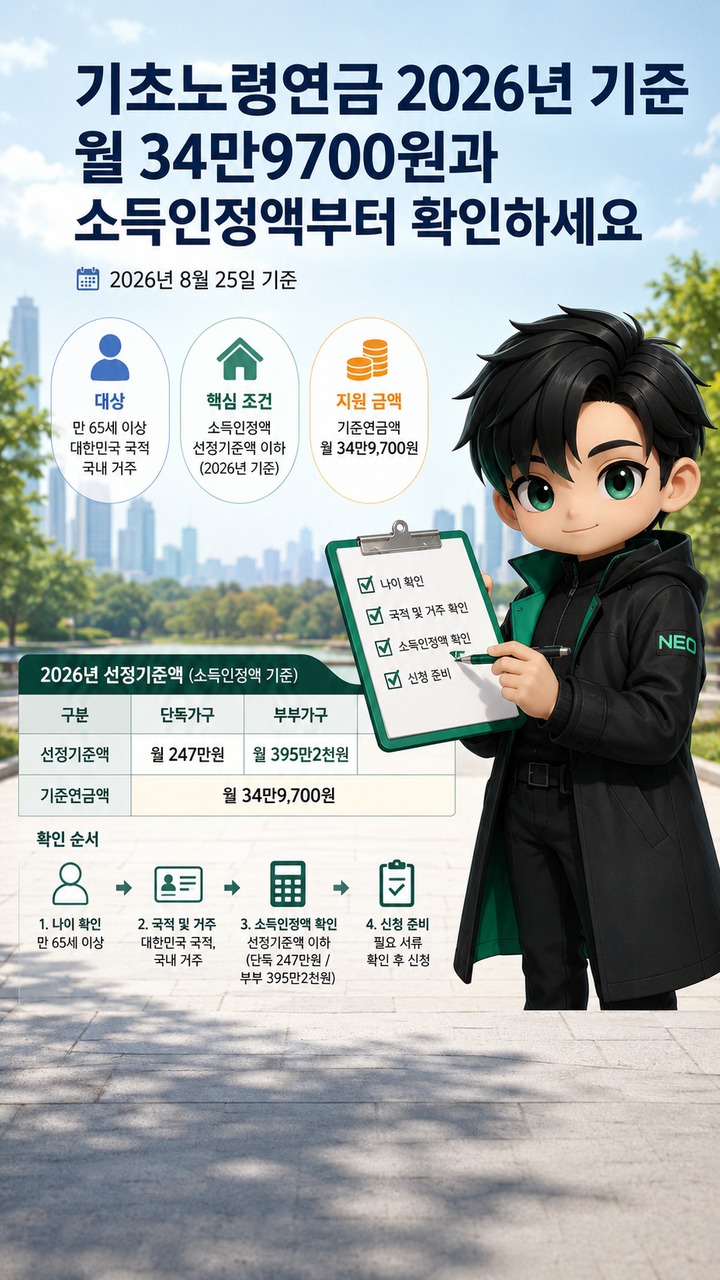
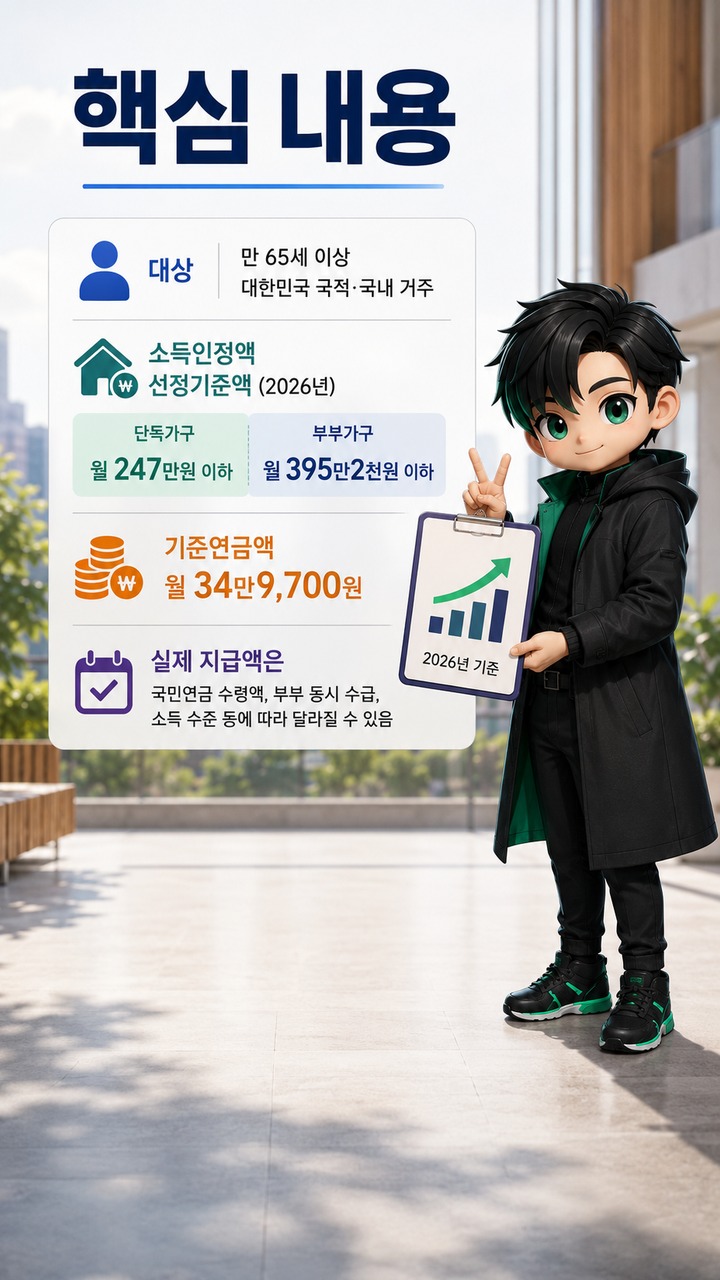
As of 2026-08-25, the official name of the program commonly known as the basic old-age pension is the Basic Pension. People aged 65 or older who are South Korean citizens residing in South Korea may qualify if their household's recognized monthly income is KRW 2,470,000 or less for a single-person household or KRW 3,952,000 or less for a married-couple household, the eligibility thresholds for 2026. The standard pension amount is KRW 349,700 per month, but the actual payment may vary depending on National Pension benefits, whether both spouses receive the Basic Pension, income levels, and other factors.
Are the Basic Old-Age Pension and the Basic Pension Different Programs?
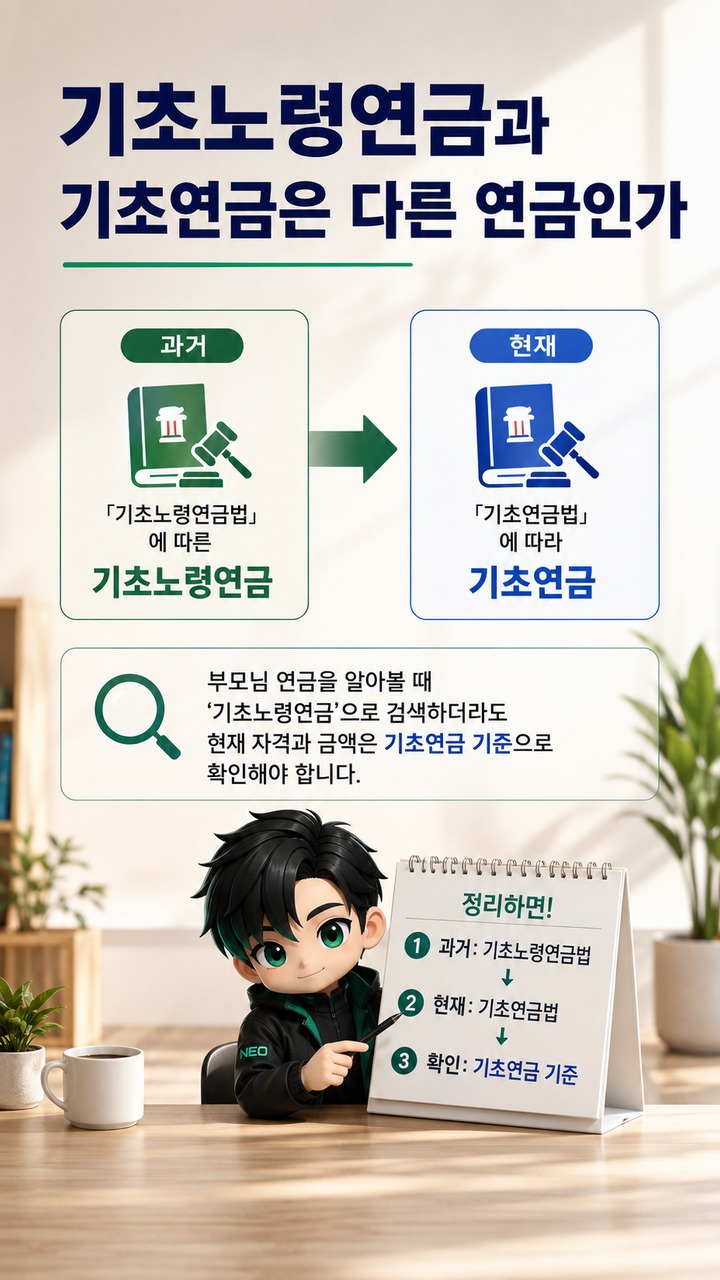
The official name of the program currently accepting new applications is the Basic Pension. In the past, the Basic Old-Age Pension was provided under the Basic Old-Age Pension Act. Today, payments are made under the Basic Pension Act. Therefore, even if you search for the basic old-age pension when researching benefits for your parents, you should check current eligibility requirements and payment amounts under the Basic Pension program.
One of the most common sources of confusion is the Old-Age Pension under the National Pension system. Although the names are similar, they are not the same program.
For the Basic Pension, the key requirement is whether a person aged 65 or older has recognized income, calculated by assessing income and assets, that falls below the eligibility threshold. In contrast, the National Pension Old-Age Pension is paid according to the period of National Pension contributions and the applicable benefit eligibility requirements.
Therefore, receiving the National Pension Old-Age Pension does not automatically disqualify someone from receiving the Basic Pension. People aged 65 or older who meet the Basic Pension's income and asset requirements may receive both pensions. However, the calculated Basic Pension amount may vary depending on National Pension benefits and the income-redistributive component of those benefits.
What Is the Maximum Income Allowed to Receive the Basic Pension in 2026?
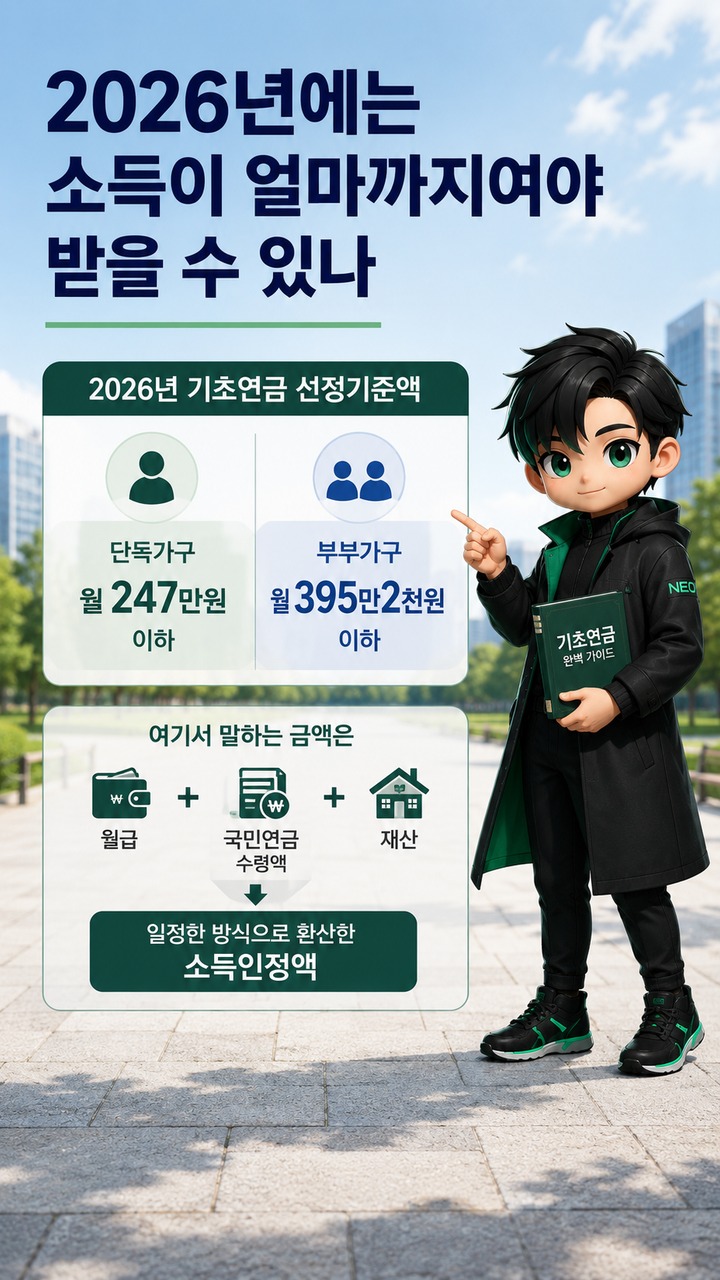
The Basic Pension eligibility thresholds for 2026 are KRW 2,470,000 per month for single-person households and KRW 3,952,000 per month for married-couple households. These amounts do not simply represent the sum of monthly wages and National Pension payments deposited into a bank account. Instead, they refer to recognized income, which is calculated by converting income and assets into an assessed amount using prescribed methods.
Even if only one spouse is aged 65 or older, or only one spouse applies for the Basic Pension, the married-couple household threshold applies when the applicant has a spouse. Importantly, the spouse's income and assets may be included in the assessment even if that spouse has not yet reached the eligible age for the Basic Pension.
Recognized income is calculated by combining two main components.
Recognized income = Assessed income + Monthly income-converted value of assets
In 2026, employment income is not counted in full. First, KRW 1,160,000 is deducted from monthly employment income, and an additional 30% of the remaining amount is deducted. Expressed as an official formula, the employment-income component is `0.7 × (Employment income - KRW 1,160,000)`. Other applicable income, including business income, property income, public transfer income, and imputed income from rent-free housing, is then added.
For example, in the official single-person household illustration, a person with monthly employment income of KRW 2,000,000 and National Pension benefits of KRW 300,000 has an assessed income of KRW 888,000. This means that monthly receipts totaling KRW 2,300,000 are not automatically treated as recognized income because employment-income deductions are applied.
Assets are not counted directly as monthly income either. For general assets, a basic asset allowance is deducted according to the region. For financial assets, 2 ten-thousand won is deducted, after which liabilities and other relevant factors are taken into account when converting the remaining assets into monthly income.
The basic asset deductions are KRW 135,000,000 for large cities, KRW 85,000,000 for small and medium-sized cities, and KRW 72,500,000 for rural and fishing communities. Therefore, even households with the same home value and bank deposits may have different recognized income amounts depending on their region of residence, debts, and the composition of their other assets.
How Much Is the Monthly Basic Pension in 2026?
From January 2026 through December, the standard pension amount is KRW 349,700 per month. However, it would be inaccurate to assume that everyone automatically receives KRW 349,700 upon reaching age 65.
Typical groups whose benefits are calculated using the standard pension amount include people who do not receive the National Pension, people whose monthly National Pension benefits are KRW 524,550 or less, recipients of National Pension survivor or disability benefits, beneficiaries of the National Basic Livelihood Security system, and recipients of the Disability Pension.
However, meeting one of these conditions does not necessarily mean that the full KRW 349,700 will always be deposited into the recipient's account. A reduction designed to prevent income reversal may apply when recognized income approaches the eligibility threshold. A reduction for married couples may also apply when both spouses receive the Basic Pension.
In particular, when both spouses receive the Basic Pension, 20% is deducted from each spouse's Basic Pension amount. As a result, the actual combined payment may differ from a simple calculation in which both spouses receive the full standard amount of KRW 349,700. Married couples should therefore check the estimated payment for each spouse separately.
People receiving relatively large National Pension benefits should also distinguish between eligibility for the Basic Pension and the actual amount payable. In 2026, if the National Pension benefits of an Old-Age Pension or Divided Pension recipient exceed KRW 524,550, and the A-benefit amount, representing the income-redistributive component, also exceeds KRW 262,270, the Basic Pension calculation linked to National Pension benefits may apply.
In other words, receiving more than KRW 524,550 per month from the National Pension does not, by itself, result in immediate disqualification from the Basic Pension. First, determine whether total recognized income falls below the eligibility threshold, and then check the actual calculated Basic Pension amount.
Does Owning a Home or Having Savings Disqualify You From the Basic Pension?
Owning a home or having savings does not automatically disqualify someone from the Basic Pension. Separate deductions apply to general and financial assets. The remaining assets are converted into monthly income and combined with other income to determine whether the total exceeds the eligibility threshold.
For financial assets such as bank deposits, installment savings, and stocks, the amount remaining after deducting 2 ten-thousand won is reflected in the asset-to-income conversion process. General assets are subject to the regional basic asset deductions described earlier.
However, passenger cars, vans, or motorcycles valued at 4 ten-thousand won or more may be assessed differently from ordinary assets. In principle, they are excluded from the basic asset deduction and subject to a monthly income conversion rate of 100%. However, vehicles that are at least 10 years old, vehicles that cannot be operated, or vehicles recognized as necessary for earning a livelihood may qualify for the standard annual conversion rate of 4% applied to general assets.
People living rent-free in a home owned by their children should also check an additional condition. If the applicant's or spouse's registered residential address is a home owned by their child and the property's officially assessed value is KRW 600,000,000 or more, imputed income from rent-free housing may be included in the assessment.
For these reasons, eligibility cannot be determined from a single condition, such as "I have no salary, so I must qualify" or "I own a home, so I cannot qualify." The actual assessment is based on monthly recognized income calculated from both income and assets.
Can You Receive the National Pension and Basic Pension at the Same Time?
Yes, both pensions can be received simultaneously. Even if someone already receives the National Pension, they may qualify for the Basic Pension if they are aged 65 or older and their income and assets fall within the Basic Pension eligibility threshold.
However, the calculation method for the Basic Pension may vary depending on the amount of National Pension benefits received. Under the 2026 rules, people whose National Pension benefits are KRW 524,550 or less are included among those whose benefits are calculated using the standard pension amount. For amounts exceeding that threshold, formulas considering the National Pension A-benefit amount or the National Pension benefit amount may apply.
The A-benefit amount is not the same as the monthly National Pension payment. It is a separately calculated portion of National Pension benefits that serves an income-redistribution function. Therefore, receiving KRW 600,000 from the National Pension does not, by itself, provide enough information to estimate the A-benefit amount.
The National Pension Service allows individuals to check the National Pension benefit amount and A-benefit amount used in Basic Pension calculations. If you already receive the National Pension, checking these figures before applying for the Basic Pension can help determine whether a reduction may apply.
The Government Employees Pension, Private School Teachers Pension, Military Personnel Pension, and Special Post Office Pension must be treated differently from the National Pension. Recipients entitled to these occupational pensions and their spouses are generally excluded from Basic Pension eligibility. However, exceptions may apply depending on the type of benefit received, such as certain lump-sum retirement payments. It is therefore important to confirm the exact name of the benefit received.
When Should You Apply After Turning 65?
The Basic Pension is not deposited automatically. An application is required. Applications are accepted throughout the year and may be submitted starting 1 months before the month in which the applicant turns 65.
For example, someone who turns 65 in October may apply starting in September. Applications can be submitted at community service centers or administrative welfare centers in any eup, myeon, or dong nationwide, regardless of the applicant's registered address. Applications are also accepted at National Pension Service branches and online through the Bokjiro welfare portal.
For an in-person application, applicants should generally prepare identification and a copy of a bankbook for an account in their own name to receive Basic Pension payments. If the applicant has a spouse, consent to the provision of financial information and related data from the spouse may be required for the income and asset assessment, even if the spouse is younger than 65 or is not personally applying for the Basic Pension. Applicants living in rental housing under a jeonse deposit arrangement or monthly rental agreement should also prepare the relevant lease contract when applicable.
Applications may also be submitted through an authorized representative if the applicant cannot visit in person. A spouse, child, sibling, certain other relatives, or the head of a social welfare facility may serve as a representative. In such cases, identification for both the applicant and representative, along with a letter of authorization, is required.
If an applicant previously applied but was found ineligible because of income or asset requirements, it is worth checking the Basic Pension eligibility follow-up management service. Those who enroll can have their income and assets reviewed annually for 5 years after an ineligibility decision and may receive guidance on applying again if they are expected to become eligible.
When checking Basic Pension eligibility, the most accurate approach is to first confirm the applicant's age according to resident registration records and whether they have a spouse. Next, assess recognized income, including not only wages and National Pension benefits but also real estate, financial assets, and liabilities. In 2026, the first eligibility thresholds are KRW 2,470,000 for single-person households and KRW 3,952,000 for married-couple households. Once eligibility has been established, the actual payment should be checked separately after accounting for National Pension-linked calculations, reductions for married couples, and other applicable adjustments.
※ This article is provided for reference purposes to help readers understand market trends and does not constitute an investment recommendation for any particular stock or asset. Final investment decisions and responsibility rest with the individual.
Related Articles
Household Debt Approaches 2 Trillion Won: Key Figures to Check in the Official August 19 Statistics