

Abolition of the Family Support Obligation Criterion for Livelihood Benefits: Income and Asset Restrictions on Family Members to Be Lifted Starting with People with Severe Disabili
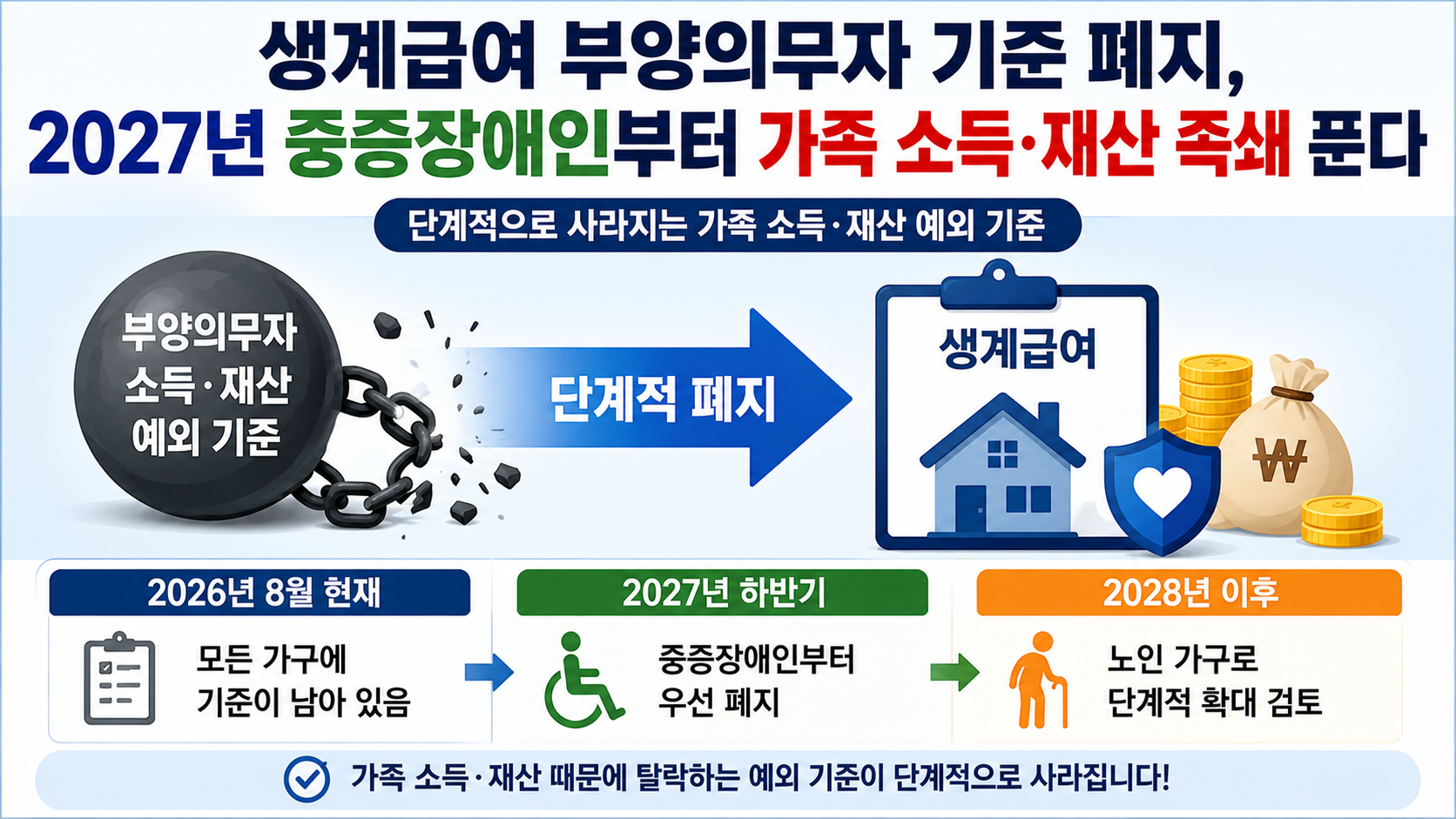
The exceptional rule that can disqualify applicants for livelihood benefits because of their parents' or children's high income or assets will be phased out. However, it has not been abolished for all households as of August 2026. The government is pursuing its abolition first for people with severe disabilities in the second half of 2027, while an expansion to elderly households from 2028 is under consideration.
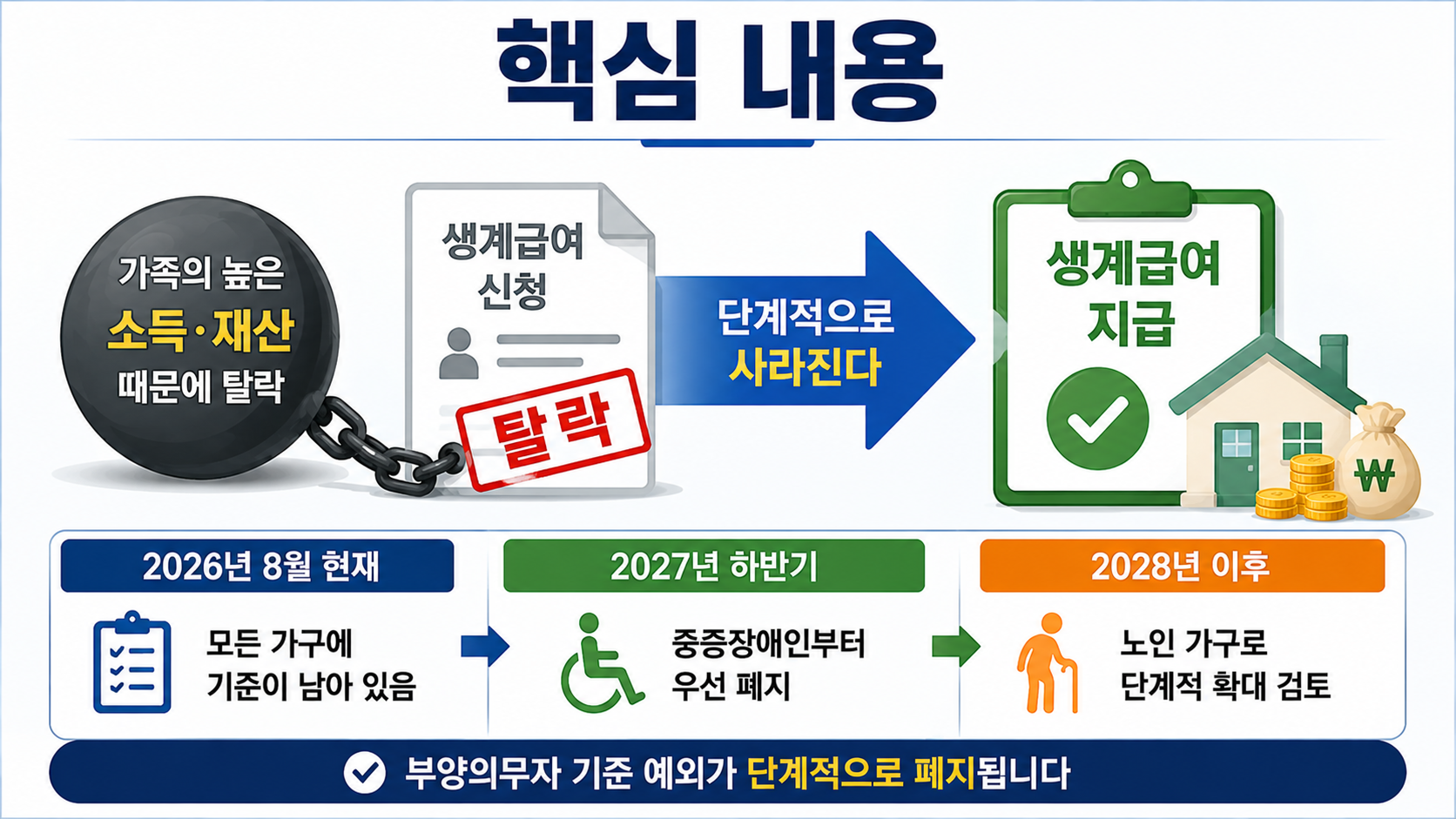
The most important distinction is between the general assumption that 'having family members means you cannot receive livelihood benefits' and the exceptional rule that 'having family members with exceptionally high income or assets can make you ineligible.'
Even in 2026, Parents' and Children's Income and Assets Are Not Entirely Excluded from Consideration
Following October 2021, the general family support obligation criterion for livelihood benefits was abolished. The system has already changed significantly from one in which applicants could be disqualified simply because they had parents or adult children.
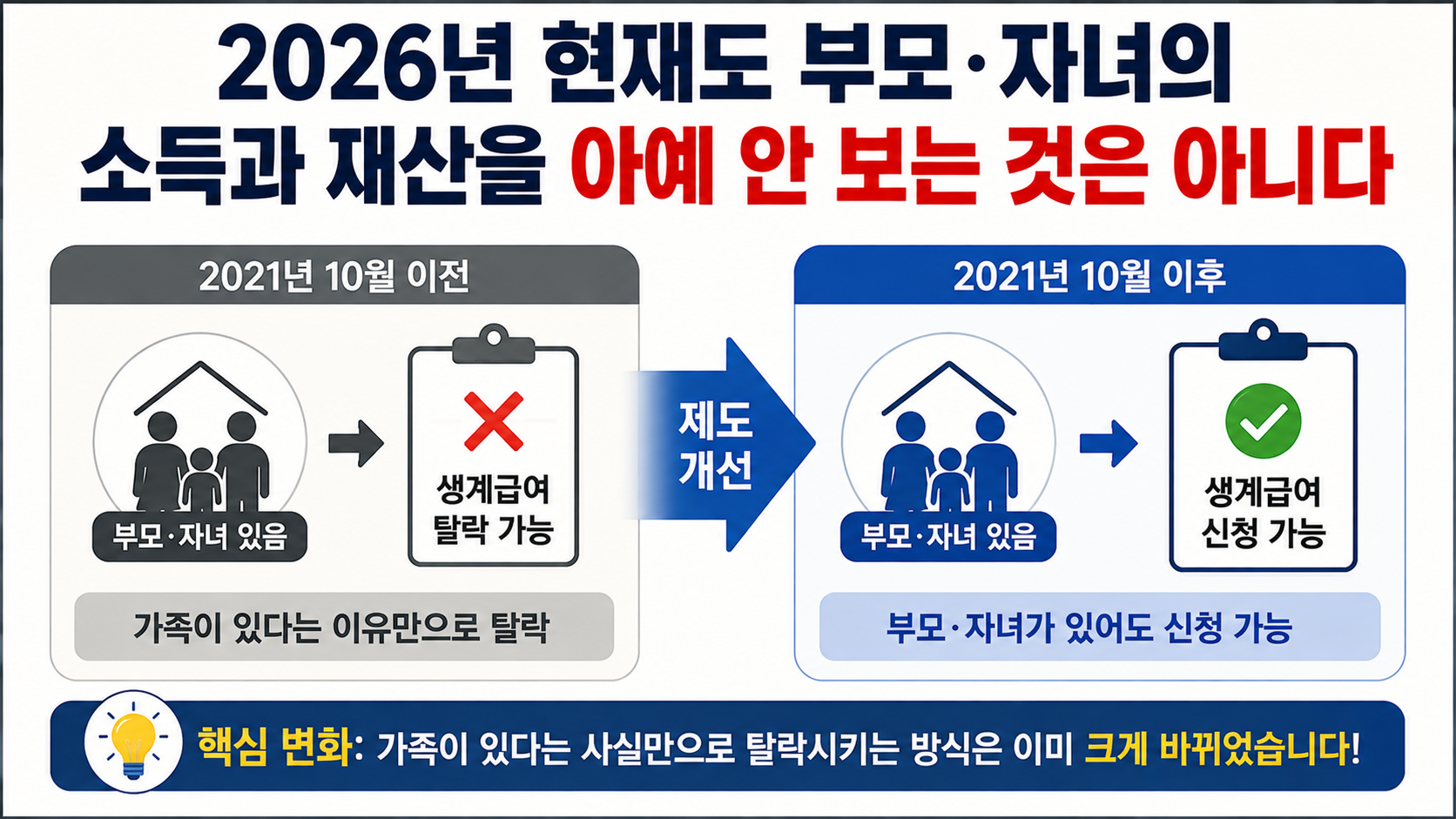
However, an exception remains for family members with high income or substantial assets who are legally considered responsible for providing support. As of 2026, applicants may be excluded from livelihood benefits if such a family member has annual income exceeding KRW 130,000,000 or general assets exceeding KRW 1,200,000,000.
Here, a person legally responsible for providing support generally refers to the applicant's parents and children, who are direct blood relatives within 1 degree of kinship, as well as their spouses.
The thresholds have been relaxed compared with previous rules. Until 2024, the exclusion thresholds were annual income exceeding KRW 100,000,000 or general assets exceeding KRW 900,000,000. They were subsequently raised to KRW 130,000,000 for annual income and KRW 1,200,000,000 for general assets.
According to the author's calculations, the income threshold increased from KRW 100,000,000 to KRW 130,000,000, an increase of KRW 30,000,000, or 30%, while the general asset threshold increased from KRW 900,000,000 to KRW 1,200,000,000, an increase of KRW 300,000,000, or approximately 33.3%.
In other words, previous reforms relaxed the system by raising the exclusion thresholds and reducing the number of people affected. The proposed changes differ because they aim to eliminate the exceptional rule itself, beginning with specific groups.
Abolition of the Criterion Is Being Pursued First for People with Severe Disabilities in the Second Half of 2027
If implemented according to the government's plan, the family support obligation criterion for livelihood benefits will first be abolished for people with severe disabilities beginning in the second half of 2027.
Under the current system, an applicant's household may meet the eligibility requirements for livelihood benefits but still be excluded if a parent or child exceeds the high-income or high-asset thresholds. Once the abolition takes effect for people with severe disabilities, the system is expected to remove this barrier based on their family members' financial circumstances.
For example, consider a household that includes a person with a severe disability applying for livelihood benefits. The applicant's household meets the income and asset requirements, but a parent or child living separately exceeds the current high-income or high-asset thresholds. Unlike under the current rules, the revised system is intended to prevent the applicant from being excluded solely because of that family member's substantial financial resources.
However, the planned implementation in the second half of 2027 must not be confused with the rules currently applicable as of August 2026. The precise scope of eligible applicants and the practical implementation procedures will need to be checked again as the policy is finalized and introduced.
The Criterion Will Not Disappear for Everyone at Once Starting in 2028
From 2028 onward, the government is considering expanding the abolition to older adults and other groups with limited capacity to work. Under the currently reported plan, the family support obligation criterion would be abolished gradually for elderly households, with implementation proceeding by age group.
Therefore, it would be inaccurate at this stage to state definitively that 'the family support obligation criterion for livelihood benefits will be completely abolished from 2028.'
The current situation can be summarized as follows.
As of 2026: The exception for family members with high income or substantial assets remains in place.
Second half of 2027: The government is pursuing abolition first for people with severe disabilities.
From 2028 onward: A phased expansion to elderly households and other groups with limited capacity to work is under consideration.
In particular, the eligible age groups and detailed implementation schedule from 2028 onward must be checked against the final rules once they are announced.
Applicants Must Still Meet Their Own Household Income and Asset Requirements Even If the Family Criterion Is Abolished
Abolishing the family support obligation criterion does not mean eliminating all asset assessments for livelihood benefits. The applicant's household must still meet the recognized-income eligibility threshold.
Recognized income is calculated not simply from actual earnings but by adding an assessed income amount to an amount derived by converting assets into income according to prescribed rules.
In 2026, the livelihood benefit eligibility threshold is 32% of the standard median income.
The monthly eligibility thresholds are KRW 820,556 for a 1-person household, KRW 1,343,773 for a 2-person household, KRW 1,714,892 for a 3-person household, and KRW 2,078,316 for a 4-person household.
For a 5-person household, the threshold is KRW 2,418,150, while for a 6-person household, it is KRW 2,737,905.
Therefore, even if the income and asset restrictions relating to parents or children no longer apply, a household may still be ineligible for livelihood benefits if its recognized income exceeds the applicable eligibility threshold.
Conversely, having a salary does not automatically disqualify an applicant. Eligibility is determined using 'recognized income,' calculated from employment income, business income, and various assets according to the National Basic Livelihood Security system's assessment rules.
Livelihood Benefits Do Not Pay Every Household the Full Eligibility Threshold Amount
The KRW 820,556 threshold for a 1-person household in 2026 is not a fixed payment provided equally to every 1-person beneficiary household.
The basic calculation is as follows.
Livelihood benefit amount = Household-specific livelihood benefit eligibility threshold - The household's recognized income
For example, suppose a 1-person household in 2026 meets all other requirements and has monthly recognized income of KRW 300,000. Under a simplified calculation, its livelihood benefit would be KRW 520,556, calculated by subtracting KRW 300,000 from KRW 820,556.
This example is intended to explain the calculation method. Actual recognized income may vary depending on employment income deductions, the types of assets held, asset-to-income conversion methods, and household characteristics.
For this reason, looking only at the figure indicating that 'livelihood benefits for a 1-person household exceed KRW 820,000' may lead to an inaccurate expectation of the amount actually deposited.
If You Were Previously Rejected Because of Family Assets, There Are Reasons to Check Your Eligibility Again
If you previously applied for livelihood benefits but were rejected because of your parents' or children's income or assets, you should not assume that the earlier decision means you will remain ineligible indefinitely.
First, the high-income and high-asset thresholds for family members legally responsible for support have already been relaxed. Until 2024, the thresholds were annual income of KRW 100,000,000 and general assets of KRW 900,000,000. They have since been raised to KRW 130,000,000 and KRW 1,200,000,000, respectively.
Second, the government is pursuing a policy to phase out these restrictions, beginning with people with severe disabilities in the second half of 2027.
Third, the livelihood benefit eligibility thresholds change each year in line with adjustments to the standard median income. It cannot be assumed that the income and asset conditions applicable when someone previously applied are identical to those in effect today.
Therefore, if the reason for a previous rejection was 'high income or substantial assets held by a family member legally responsible for support,' it is important to reassess eligibility under the current rules.
Should People Who Want to Apply Now Wait Until 2027?
If you are currently struggling to meet basic living expenses, waiting solely for the policy changes planned for 2027 is not advisable. You may already qualify under the rules in effect as of 2026, so you should check the current system first.
Applications and consultations for livelihood benefits are available at the local eup, myeon, or dong Administrative Welfare Center responsible for your registered address. During the application process, officials assess the household's income, assets, household composition, and other information necessary to determine eligibility.
In particular, applicants who have little or no contact with their parents or children, receive no financial support from them, were previously rejected because of the family support obligation criterion, or have household circumstances involving disability or advanced age should explain their individual situation in detail and confirm which rules currently apply.
Consultations about the National Basic Livelihood Security system are also available through the Ministry of Health and Welfare Counseling Center at 129.
Because additional details may be introduced between a policy announcement and its actual implementation, people expected to become eligible under the changes planned for the second half of 2027 should also check the finalized application requirements immediately before the new rules take effect.
The Most Important Distinction Is Between 'Family Members' and 'Your Own Household'
The central purpose of abolishing the family support obligation criterion for livelihood benefits is to gradually remove barriers that exclude applicants from assistance because of their parents' or children's financial circumstances.
However, this does not mean livelihood benefits will become available regardless of income or assets. The applicant's own household must still meet the program's eligibility requirements, including recognized income, household size, and assets.
As of August 2026, the exception for family members legally responsible for support who have annual income exceeding KRW 130,000,000 or general assets exceeding KRW 1,200,000,000 remains in place. The government is pursuing abolition of this barrier first for people with severe disabilities in the second half of 2027, while a phased expansion to older adults and other groups with limited capacity to work from 2028 onward is under consideration.
Therefore, the most reliable approach is for current applicants to check their eligibility under today's rules and for those who may benefit from future changes to verify the finalized requirements when the relevant provisions actually take effect.
The current livelihood benefit criteria for 2026, verified through online sources, set the eligibility threshold at 32% of the standard median income: KRW 820,556 for a 1-person household, KRW 1,343,773 for a 2-person household, KRW 1,714,892 for a 3-person household, and KRW 2,078,316 for a 4-person household. The existing exception for high-income and high-asset family members, the proposed initial abolition for people with severe disabilities in the second half of 2027, and the potential phased expansion to elderly households from 2028 onward were also cross-checked.
※ This article is provided for reference to help readers understand market trends and does not constitute investment advice regarding any particular stock or asset. Final investment decisions and responsibility rest with the individual.