

National Pension Retroactive Contributions in 60 Installments: How Much Interest Will You Pay? 3 Things to Check Before Applying

In 2026, National Pension retroactive contributions can be paid in up to 60 installments, but choosing installment payments adds interest on top of the principal. Therefore, even if your total retroactive contribution is KRW 10,000,000, it does not mean you will pay only KRW 166,667 each month for 60 months.
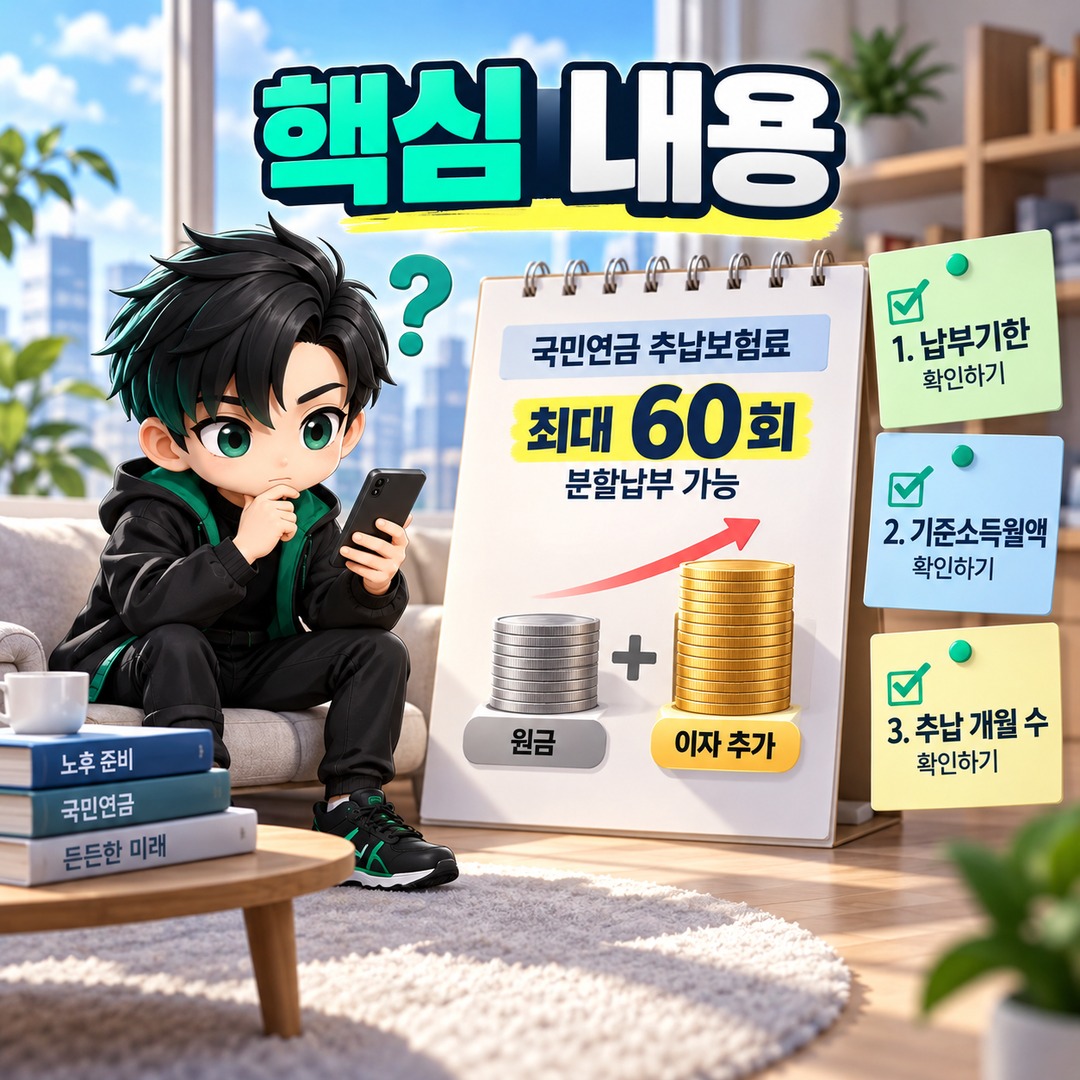
In particular, if you have already applied for retroactive contributions or are considering installments because paying a lump sum would be difficult, you should check not only your monthly payment amount but also how interest is calculated and any additional charges for missed payments.
*Reference date: 2026-10-12 | Based on official guidance from the National Pension Service*
1. National Pension Retroactive Contributions Can Be Paid in Up to 60 Installments, with Interest Charged Separately
The National Pension retroactive contribution system allows eligible individuals to pay contributions later for certain past periods when they did not pay premiums, thereby increasing their pension contribution period.
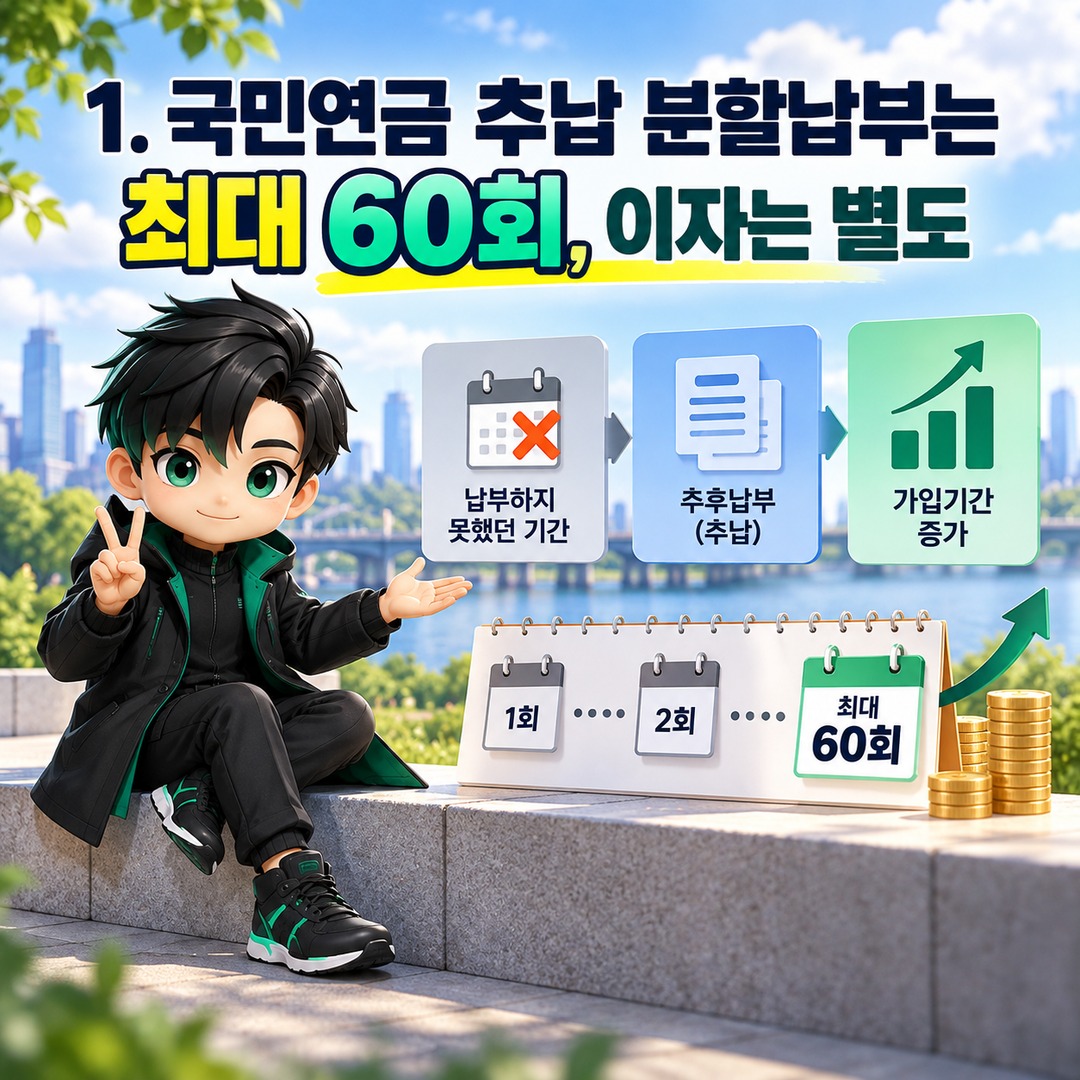
There are two main ways to pay retroactive contributions.
| Category | Lump-Sum Payment | Installment Payment |
|---|---|---|
| Payment method | Pay the full amount at once | Pay in monthly installments |
| Number of payments | 1 payment | Up to 60 installments |
| Installment interest | None | Charged |
| Main feature | Requires a large upfront payment | Spreads the financial burden across months |
The National Pension Service explains that installment payments are subject to additional interest calculated using the interest rate on a 1-year fixed-term deposit.
The important point is that paying in 60 installments is not an interest-free payment plan.
The eligible retroactive contribution period and the number of permitted installments are also different.
For applications submitted after 2020-12-29, the maximum eligible retroactive contribution period is 119 months, but the contributions for that period can be divided into no more than 60 installments.
In other words, paying retroactive contributions for 119 months does not mean you can spread the payments over 119 installments.
2. If You Divide KRW 10,000,000 in Retroactive Contributions into 60 Installments, How Much Will You Pay Each Month?

Suppose your total retroactive contribution is KRW 10,000,000.
If you simply divide the principal without including installment interest, the amounts are as follows.
| Number of Installments | Principal per Installment (Simple Calculation) |
|---|---|
| 12 installments | Approximately KRW 833,333 |
| 24 installments | Approximately KRW 416,667 |
| 36 installments | Approximately KRW 277,778 |
| 60 installments | Approximately KRW 166,667 |
*Author's calculation: KRW 10,000,000 ÷ number of installments. Actual billed amounts may vary depending on rounding to the nearest won and the application of interest.*
If you choose 60 installments, you should prepare approximately KRW 167,000 per month for the principal alone.
However, installment interest will be added to the actual amount due.
You therefore need to distinguish between these two amounts.
Principal installment amount: The total retroactive contribution divided by the number of payments
Actual billed amount: The principal installment amount plus the applicable installment interest and any other charges for that payment
The exact total interest depends on factors such as the applicable interest rate and payment schedule, so it cannot be determined simply by multiplying the principal by a single annual interest rate.
To Determine the Actual Total Cost of 60 Installments, the Most Accurate Approach Is to Check the Scheduled Payment Amount and Interest for Each Installment with the National Pension Service.

3. Will You Pay Additional Interest If You Make an Installment Payment Late?
Interest charged when you initially choose installment payments should be distinguished from additional interest resulting from late payments.
This issue was also addressed in a National Pension Service response to a customer suggestion published on 2026-07-16.
Regarding a case in which an individual applied on December 2020 to pay retroactive contributions in 60 installments, the agency explained that additional interest charges could arise from unpaid installment amounts.
Therefore, if you applied for retroactive contributions but postponed payment, checking only the principal amount originally provided is not sufficient.
There are three amounts you should verify.
1. The outstanding principal of your retroactive contributions
2. Interest charged for installment payments
3. Additional interest charges resulting from the period of nonpayment
In particular, people who applied for retroactive contributions a long time ago and subsequently stopped making payments may find that the amount currently due differs from the amount stated in their original application.
Can Unpaid Retroactive Contributions Lead to Asset Seizure?
The National Pension Service's guidance on retroactive contributions states that if contributions are not paid by the deadline, the agency will issue one notification of the outstanding amount. It also explicitly states that delinquency enforcement measures are not taken against unpaid retroactive contributions.
However, the absence of delinquency enforcement does not mean that the amount due will remain unchanged when payment is delayed.
If you have left installment payments unpaid for an extended period after applying, it is advisable to ask the National Pension Service whether you should maintain your existing application or whether cancellation and reapplication are possible.
If you reapply, your contribution amount may change depending on the contribution rate and calculation conditions applicable at that time.
4. When Will the Bill Arrive After Applying, and What Is the Payment Deadline?
National Pension retroactive contribution bills are generally sent around the 11–15 of the month following the application month, with payment due by the end of that month.
For example, if you apply in October 2026, the usual billing schedule would be as follows.
| Item | Expected Schedule |
|---|---|
| Retroactive contribution application | October 2026 |
| First bill issued | Around November 2026 11–15 |
| First payment deadline | 2026-11-30 |
If you apply for installment payments, you will continue making monthly payments according to the established installment schedule.
However, you should confirm the actual billing dates and amounts based on the processing results of your application.
In particular, if your payments extend across 2026 and 2027, or if you miss a payment deadline, you should separately check issues involving the applicable contribution rate and additional interest.
5. How to Check the Actual Interest and Total Payment Amount Before Applying
Before applying for retroactive contributions, the first things to check are how much you can afford to pay each month and the total cost.
Follow these steps.
1. Visit the National Pension Service website.
2. Find the service related to retroactive contribution payment applications under the electronic civil services section.
3. Check your eligible retroactive contribution period and estimated contribution amount.
4. Choose your preferred number of installments.
5. Contact the National Pension Service at 1355 or your local branch to ask about the interest charged for each installment and the total scheduled payment amount.
When consulting the agency, it is better not to ask only how much you will need to pay each month.
Checking the Following Three Points Together Makes It Easier to Compare Payment Options.
What is the total amount if you pay everything in a lump sum?
What are the respective total amounts, including interest, if you pay in 12, 24, or 60 installments?
Can you pay the remaining balance in a lump sum during the installment period, and if so, how will the interest be settled?
The final question depends on your application status and the agency's processing rules, so it is best not to make assumptions without confirmation.
6. Lump-Sum Payment vs. 60 Installments: Which Is the Better Choice?
A lump-sum payment has the advantage of avoiding installment interest. Installment payments, on the other hand, allow you to avoid paying a large amount all at once, even though you will incur interest.
For example, if your retroactive contribution totals KRW 10,000,000, dividing the principal into 60 installments reduces the monthly principal burden to approximately KRW 167,000.
However, your total payment amount will increase by the installment interest charged.
Therefore, choosing a larger number of installments is not necessarily more advantageous.
If you have sufficient funds for living expenses and emergencies, you may consider paying in a lump sum. If a large upfront payment would be burdensome, it is reasonable to compare the total cost of installment payments, including interest.
In addition, the estimated increase in your pension benefits resulting from retroactive contributions depends on factors such as your existing contribution period and income history. You cannot determine whether retroactive contributions are financially worthwhile based solely on the payment method.
In Conclusion, Before Choosing to Pay National Pension Retroactive Contributions in 60 Installments, You Should Separately Check the Principal, Installment Interest, and Any Additional Interest Charges for Missed Payments.
If you have already applied for retroactive contributions, it is important to check your current outstanding balance and applicable interest rather than relying on the amount stated in your original application.