

Why Can’t You Withdraw the Money Until D+2 After Selling Korean Stocks? How Friday Sales and Market Holidays Change the Deposit Date
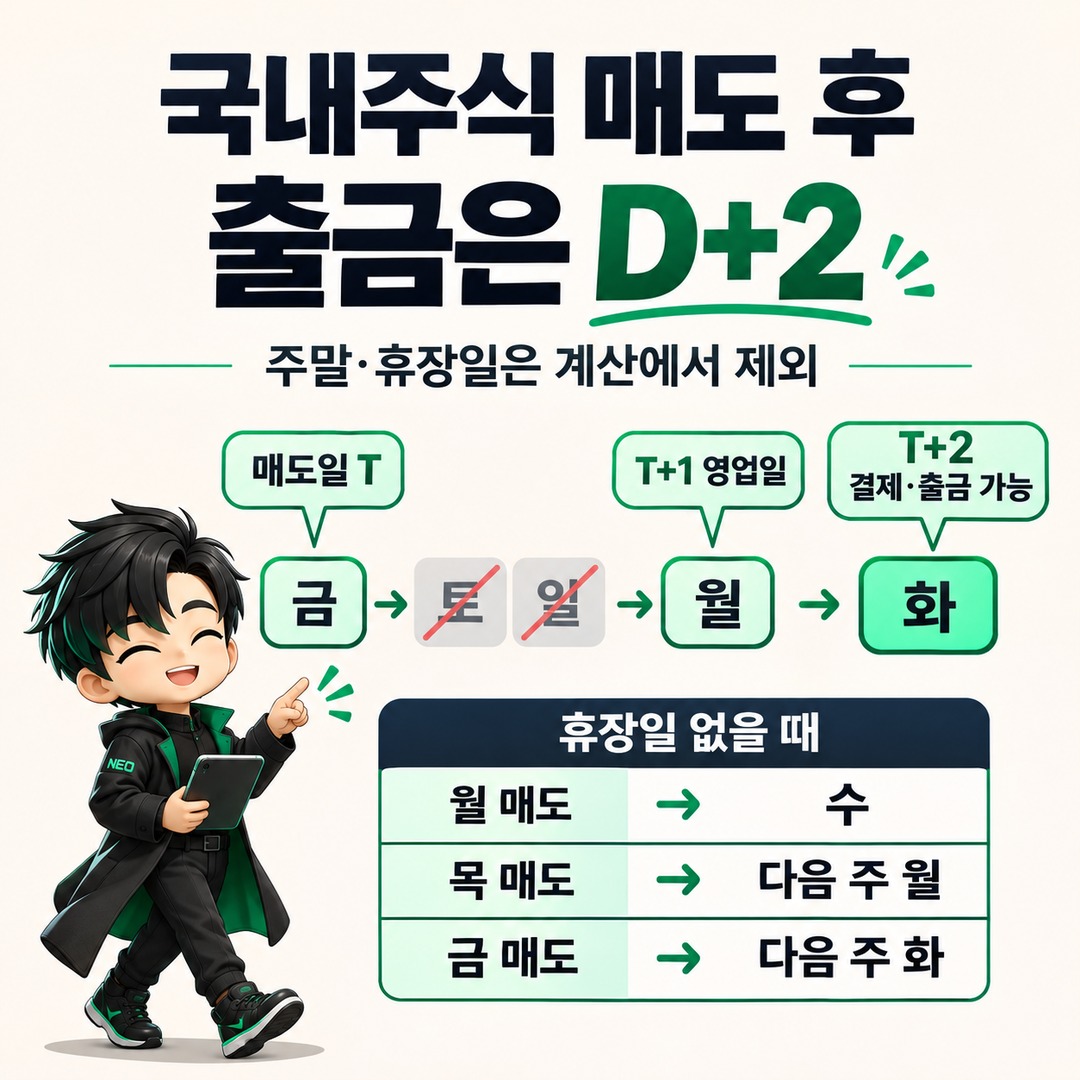
You cannot withdraw the proceeds from a Korean stock sale to your bank account as soon as the sell order is executed. In ordinary trading of Korean-listed stocks, settlement is completed on T+2, 2 business days after the trade date; weekends and stock market holidays are excluded from the count. You should therefore plan your funds around the date the money is actually available for withdrawal, rather than the date you sold the shares.
If you plan to use the proceeds for living expenses or other investments, distinguish among three dates: the trade execution date, the scheduled settlement date, and the date the funds are actually available for withdrawal.
Why Can’t You Withdraw the Proceeds from a Korean Stock Sale Immediately?
That is because clearing and settlement take place between the execution of the stock sale and the actual settlement. Trade execution means the transaction has been agreed; settlement means the exchange of the shares and cash has been completed.
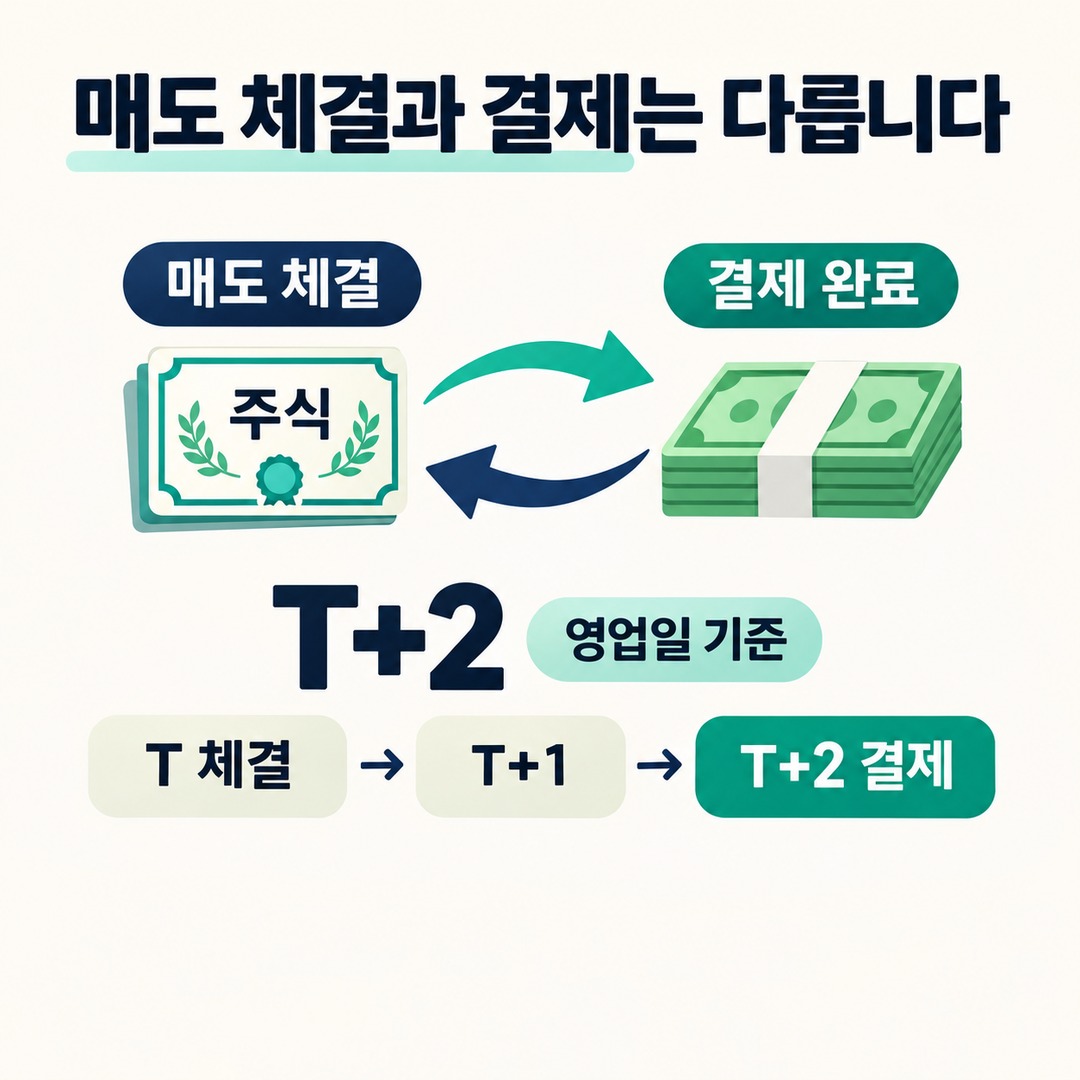
The Financial Services Commission describes the standard settlement method for Korean exchange-traded stocks as T+2. Settlement of the shares and proceeds is completed 2 trading days after the trade date.
The important point is that T+2 does not mean two calendar days later.
T: Trade execution date
T+1: First business day
T+2: Second business day and settlement date
So, if you sell on Monday, settlement is generally completed on Wednesday. If you sell on Friday, it is generally completed the following Tuesday.
Korean Stock Sale Proceeds: Withdrawal Dates by Day of the Week
The usual settlement date depends on the trade execution day, assuming there is no weekend or separate market holiday.
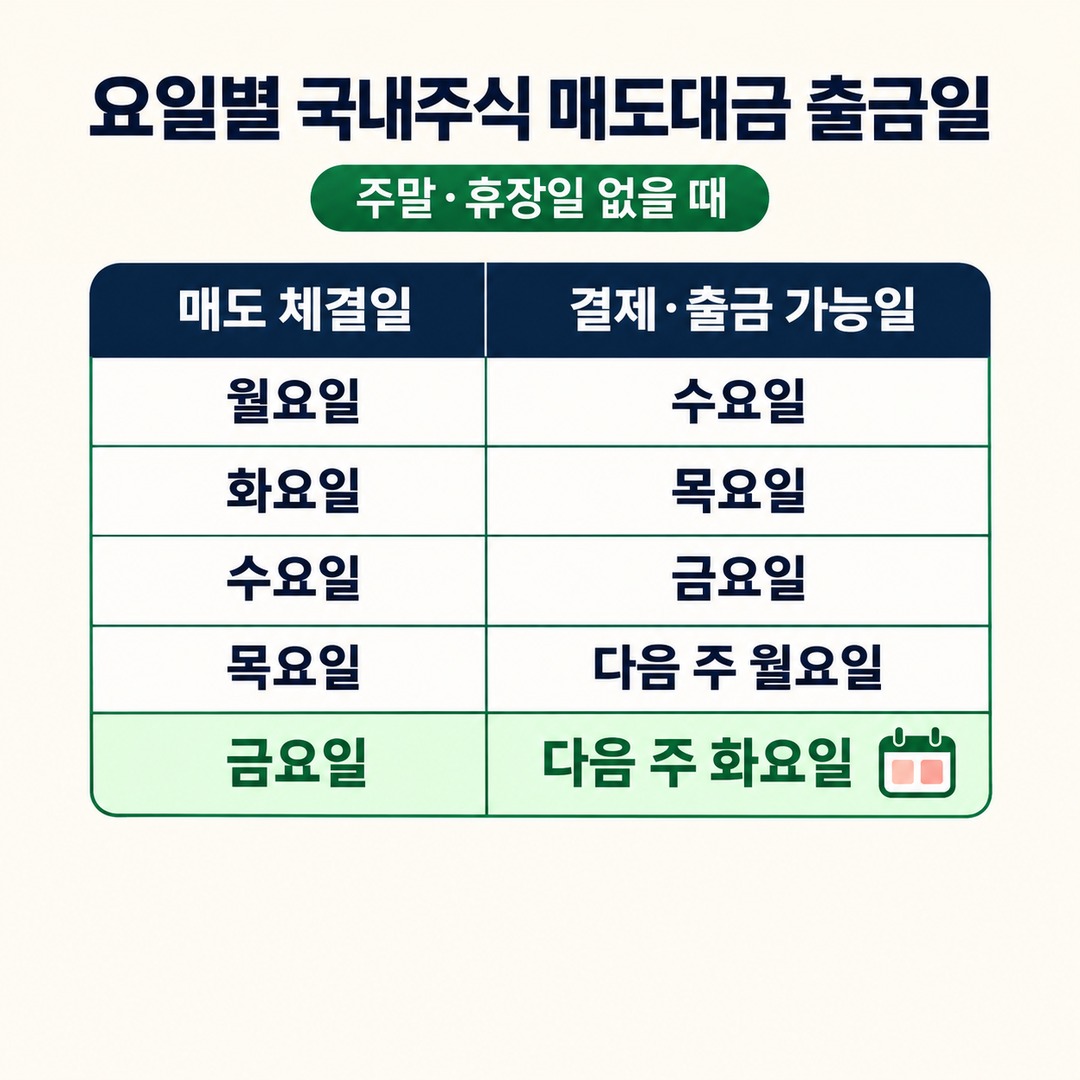
| Trade execution day | Settlement date when funds are available for withdrawal |
|---|---|
| Monday | Wednesday |
| Tuesday | Thursday |
| Wednesday | Friday |
| Thursday | The following Monday |
| Friday | The following Tuesday |
This schedule is calculated based on trading days and settlement business days on the Korea Exchange.
v.daum.netThe Friday sale example makes this easier to understand.
Friday: Trade execution date (T)
Monday: First business day (T+1)
Tuesday: Second business day (T+2)
Tuesday: Check the amount available for withdrawal after settlement is complete
Saturday and Sunday are not counted as settlement business days.
What happens when there is a public holiday in between?
A public holiday or stock market closure pushes the settlement date back.
For example, suppose you sell shares on a Thursday and the following Monday is a public holiday.
| Date | Settlement calculation |
|---|---|
| Thursday | Trade execution (T) |
| Friday | T+1 |
| Saturday–Sunday | Excluded from the count |
| Monday | Public holiday; excluded from the count |
| Tuesday | T+2 settlement date |
Even if two calendar days have passed, you cannot withdraw the funds unless two settlement business days have elapsed.
For accuracy, check both the exchange’s actual market holiday schedule and your brokerage’s settlement guidance.
How Are D+2 Cash Balances Different from the Amount Available for Withdrawal?
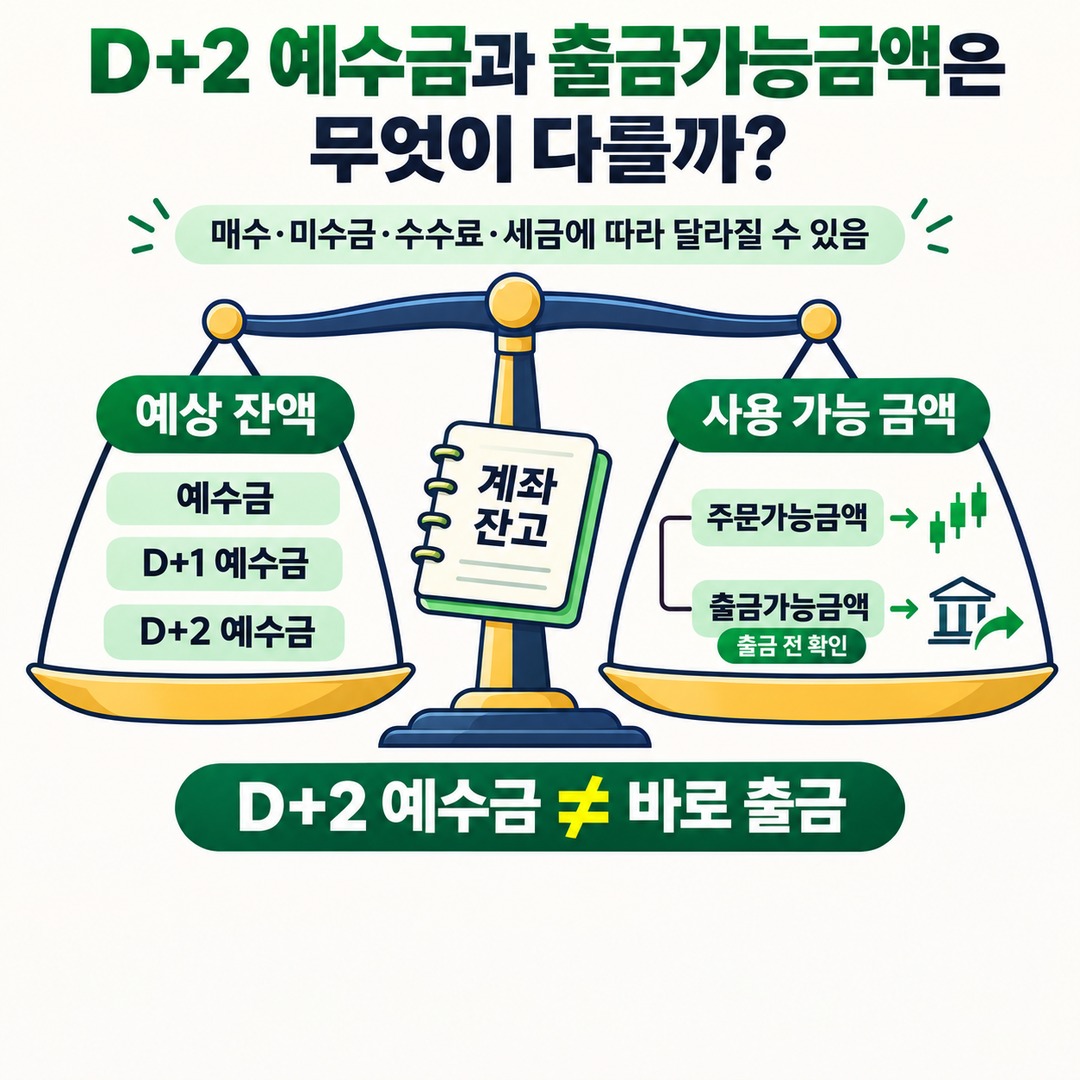
This is one of the easiest things to confuse in a brokerage app. Seeing a D+2 cash balance does not mean you can transfer that amount to your bank right now.
Each item serves a different purpose.
| Account display | Meaning |
|---|---|
| Cash balance | Cash held in the brokerage account |
| D+1 cash balance | Projected balance as of the next business day |
| D+2 cash balance | Projected balance as of the settlement date |
| Buying power | Funds available for placing stock buy orders |
| Amount available for withdrawal | Amount that can currently be transferred to an external account |
For example, suppose you sell stocks worth KRW 5,000,000.
Even if the sale proceeds of KRW 5,000,000 are reflected in the D+2 cash balance, the amount actually available for withdrawal may vary depending on settlements for other stock purchases, existing unsettled debt, fees, taxes, and other items.
So when you need the sale proceeds, check the amount available for withdrawal first, rather than the D+2 cash balance.
Samsung Securities’ guide to domestic stock trading also explains that settlement reflects fees, taxes, and other charges deducted from the sale proceeds. Samsung Securities+1
Can You Use the Proceeds to Buy Other Stocks Right Away?
In some cases, yes. Before cash settlement of the sale proceeds is complete, a brokerage may include them in the buying power available for placing another stock order.
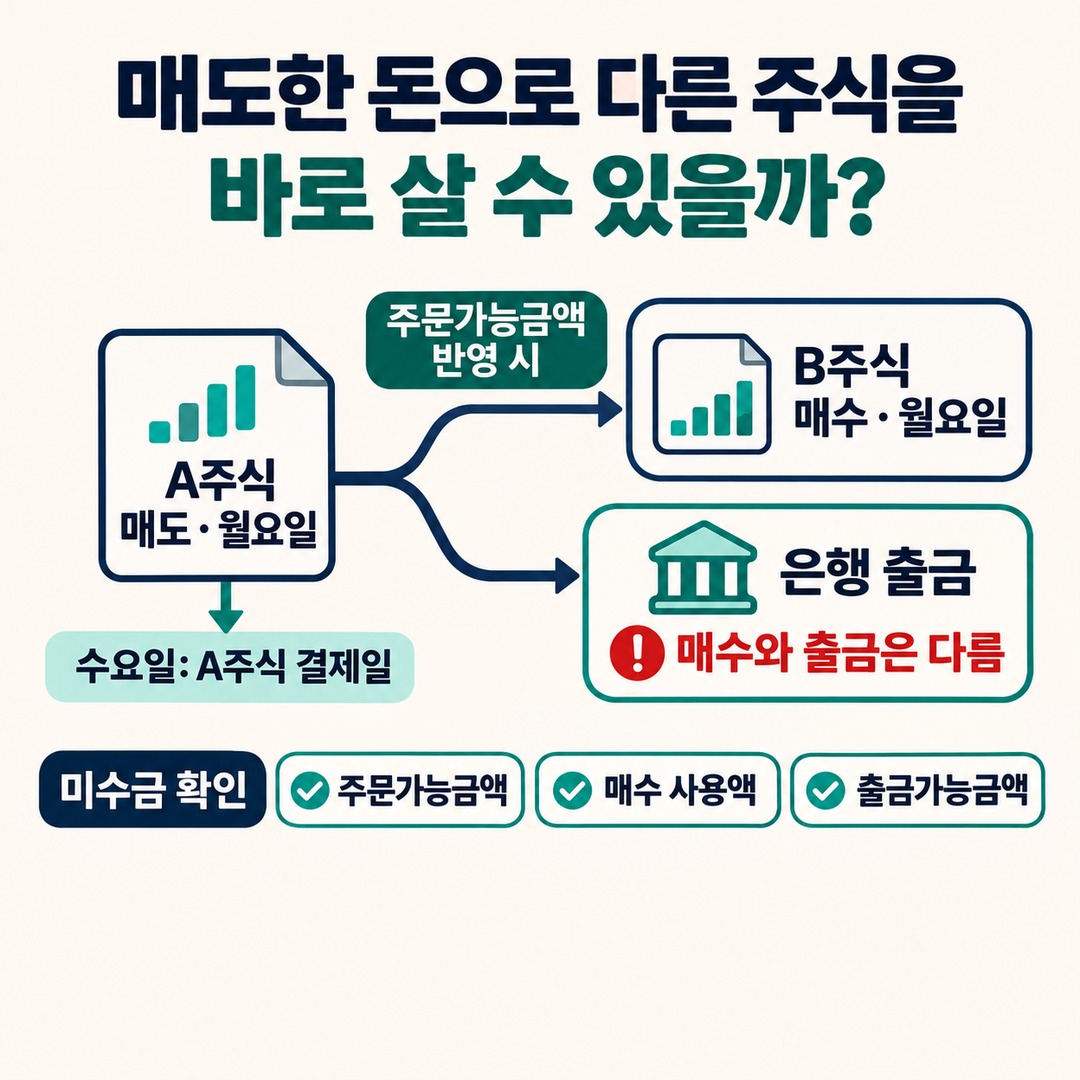
However, buying stocks again and withdrawing cash are two different things.
Consider a situation like this:
Monday: Sell Stock A
Monday: Buy Stock B using the sale proceeds
Wednesday: Settlement date for the sale of Stock A
Being able to buy Stock B on Monday does not mean you can withdraw the proceeds from selling Stock A to your bank on Monday.
Also, using the funds to buy Stock B can affect the cash balance and amount available for withdrawal when settlement takes place.
Check these three things separately:
1. Have the sale proceeds been included in your buying power?
2. How much was used for the buy order?
3. How much can ultimately be transferred to your bank?
In particular, if you bought another stock before the settlement date, check whether that could result in an unsettled debit.
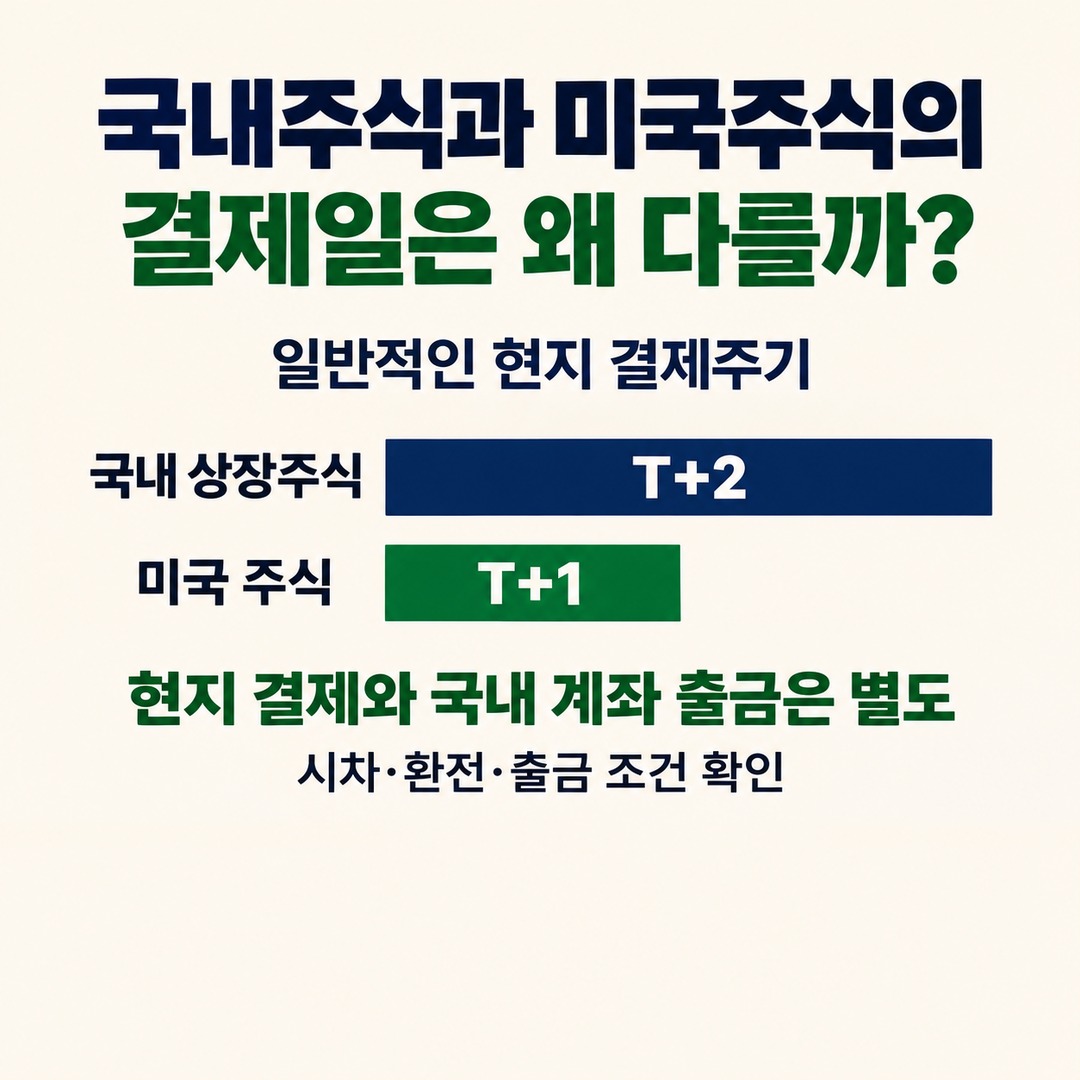
Why Do Korean and U.S. Stocks Have Different Settlement Dates?
If you also invest in overseas stocks, distinguish between the Korean and U.S. settlement systems.
Following a rule change by the U.S. Securities and Exchange Commission (SEC), the U.S. securities markets have applied a T+1 settlement cycle to most securities transactions since 2024-05-28. Securities and Exchange Commission+1
| Market | Typical local settlement cycle |
|---|---|
| Korean-listed stocks | T+2 |
| U.S. stocks | T+1 |
For U.S. stocks, however, distinguish local settlement from when currency conversion and withdrawals are available through your Korean brokerage account.
When you use a Korean brokerage, the time difference, when funds are credited to your domestic account, and withdrawal rules for each currency can also matter in addition to local settlement.
Toss Securities, for example, explains in its official FAQ when proceeds from domestic and overseas stock sales become available for withdrawal, and advises investors to account for market holidays in the relevant market. Toss Securities Official Website
So do not apply the Korean-stock T+2 schedule as is just because you sold U.S. stocks.
5 Things to Check When You Can’t Withdraw Money After Selling Stocks
If the settlement date has passed but you still cannot withdraw the funds, check the following in order.
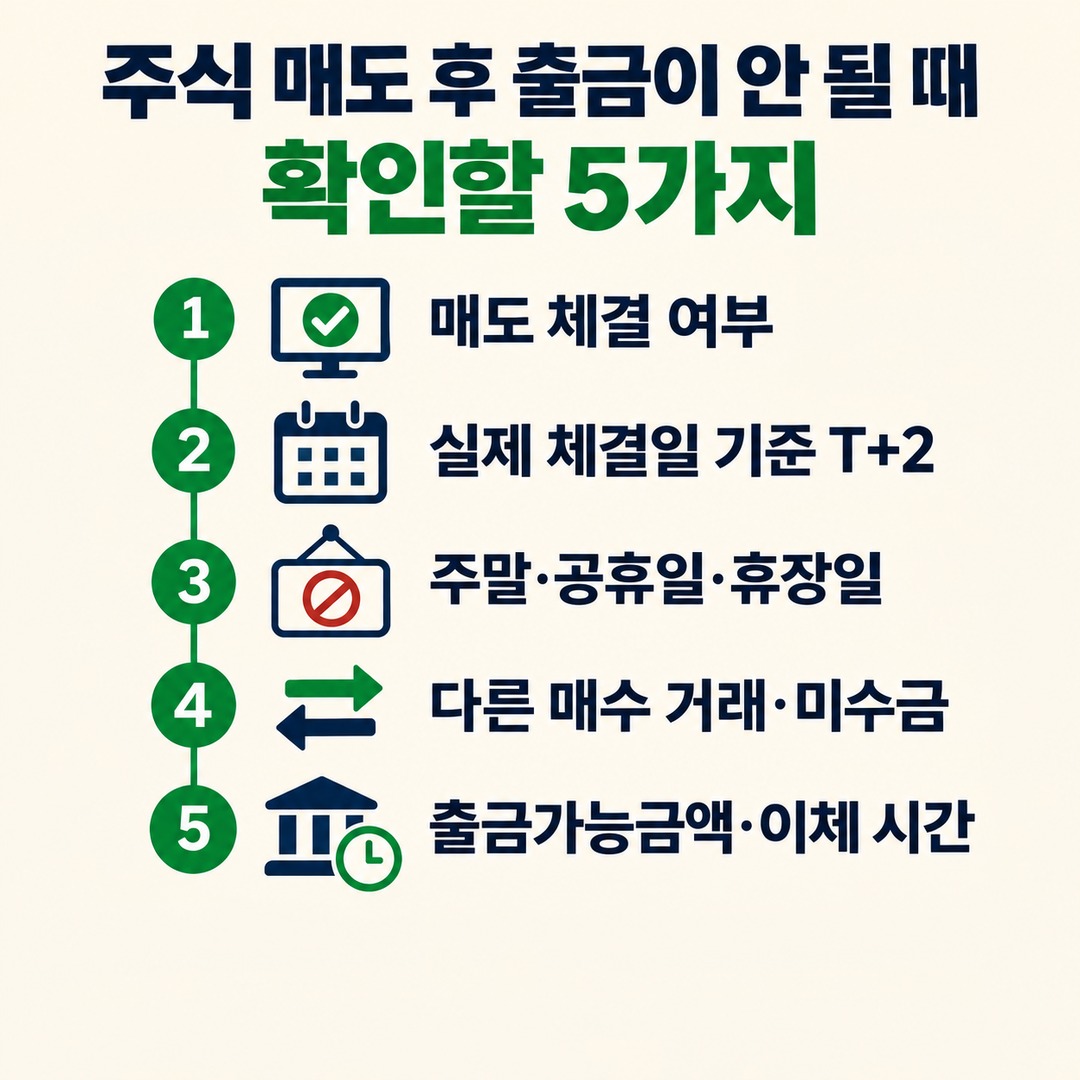
First, check whether the order was actually executed.
Submitting a sell order is not the same as having a trade executed. If some shares remain unfilled, the sale proceeds will differ from what you expected.
Second, calculate T+2 from the trade execution date.
Use the date the trade was actually executed, not the date you placed the order.
Third, check for Korean stock market holidays.
Public holidays and other market closures, as well as weekends, can affect the settlement schedule.
Fourth, check for other buy transactions and unsettled debits.
If the sale proceeds have been used to pay for other stock purchases or settle an unsettled debit, the amount available for withdrawal may be lower.
Fifth, check the amount available for withdrawal and transfer hours in your brokerage app.
Even after settlement is complete, the actual time the money reaches your bank may vary depending on your brokerage’s account processing and transfer hours.
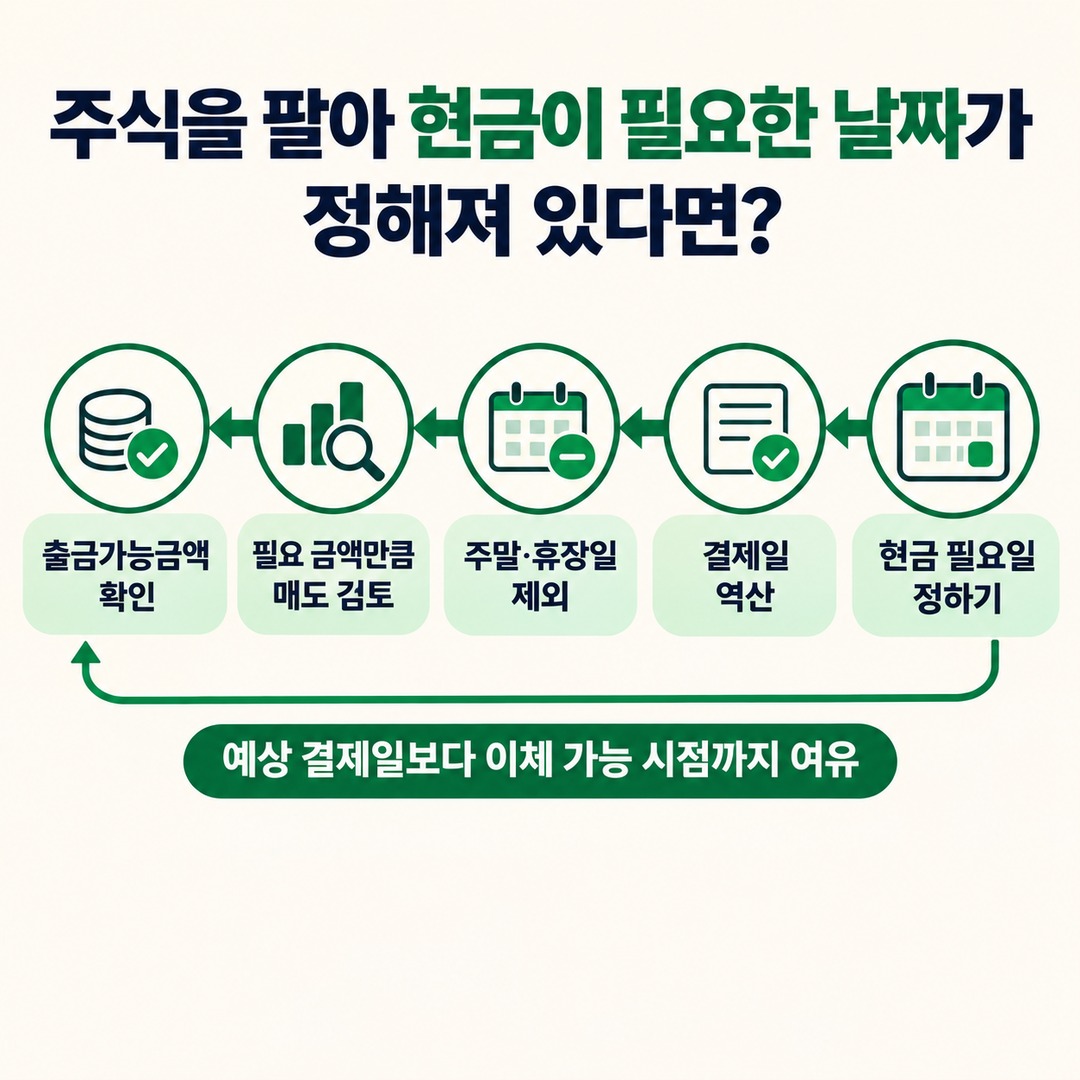
What If You Need the Cash by a Specific Date?
When deciding how much cash to hold as part of your asset allocation, consider not only the amount invested but also when you will actually need the money.
For example, if you sell stocks on Friday and need the money for living expenses the following Monday, the standard T+2 settlement schedule may not meet your timing needs.
In that case, it is best to plan in this order:
1. First, set the date when you will need the cash.
2. Then count backward from that date using settlement business days.
3. Exclude weekends and stock market holidays.
4. Consider selling only the amount you need.
5. Check the amount available for withdrawal on the settlement date.
If you need cash urgently, it is safer to leave some extra time until a bank transfer is actually available rather than relying only on the estimated settlement date.
Frequently Asked Questions
Q. If I sell stocks on Monday, can I withdraw the money on Wednesday?
For ordinary Korean stock trades, Wednesday is the T+2 settlement date. If there is no separate market holiday or account restriction, you can withdraw the funds after settlement is complete.
Q. If I sell on Friday, can I withdraw the money on Monday?
Generally, no. Saturday and Sunday are not settlement business days, so the following Tuesday is the T+2 settlement date.
Q. Can I reinvest stock sale proceeds before settlement?
You can, within the buying power your brokerage allows. However, check separately whether reinvestment is allowed and whether cash is available for withdrawal.
Q. If settlement for Korean stocks changes to T+1, will withdrawals also be available a day earlier?
If the T+1 system takes effect, the standard settlement schedule may become shorter. However, check both the effective date of the rule change and your brokerage’s actual conditions for processing withdrawals.
When selling stocks, calculate the date the proceeds will actually be available for withdrawal instead of checking only the sale amount.
For Korean stocks, the key point is T+2; for U.S. stocks, distinguish the local T+1 settlement cycle from when your Korean brokerage processes withdrawals.
To keep investment funds separate from living expenses, it is important to check when the money can actually be converted to cash, rather than relying on the account’s displayed valuation.
※ This article is for reference to help readers understand market trends and is not investment advice regarding any specific stock or asset. You are responsible for your own investment decisions.